Genre
Of the four Gospels, Mark is most overtly a “docudrama,” consisting of noteworthy “clips” as well as typical or representative events; snatches of speeches or dialogues; and commentary by the narrator. Mark’s approach to the biographical data is that of a careful recorder. Mark’s Gospel, however, is not a biography in the modern sense, as there is no attempt to describe Jesus physically, treat his family origins, or portray Jesus’ inner life. Rather, like other ancient biographies (which were called a bios or “life”), Mark’s purpose is to speak about the actions and teachings of Jesus that present his ministry and mission. Of course, the book is at the same time an implied proclamation and apologetic work that hints at the redemptive meaning of the events recorded. All of the Gospels are hero stories. Additionally, Mark’s Gospel is made up of the usual array of subgenres found in the NT Gospels, including calling stories, recognition stories, witness/testimony stories, encounter stories, conflict or controversy stories, pronouncement stories, miracle stories, parables, discourses and sermons, proverbs or sayings, passion stories, and resurrection stories.
Even though the overall format of Mark’s Gospel is narrative, it does not possess a continuous story line but is a collection of discrete units. There are crowd scenes, small-group scenes, public scenes, and private scenes. The resulting book is a collage or mosaic of the life of Jesus. The best way to negotiate this format is to regard oneself as Mark’s traveling companion as he assembles his documentary on the life of Christ. The main unifying element in the mosaic is the protagonist, Christ himself.
Mark’s Gospel (the shortest of the four) is a fast-paced narrative. Mark tends to include vivid descriptive details, and he prefers Greek verbs that portray an action in process. He often records people’s responses to what Jesus did and said. Like all storytellers, Mark selected his material by two criteria: he chose events that were typical or representative in the life of Jesus (such as miracles of healing and the telling of parables), and unique, once-only events (esp. those connected with the crucifixion and resurrection of Jesus).
Setting
Though Mark wrote from Rome, the Gospel of Mark was composed for the wider church as the record of the apostolic testimony of Peter. Even during the early Patristic period, Gentile Christians were frequently mentioned as the recipients of this Gospel. Mark addresses an audience that is largely unfamiliar with Jewish customs. He intends to familiarize them with those customs, because only then will they understand the coming of Jesus as the culmination of God’s work with Israel and the entire world.
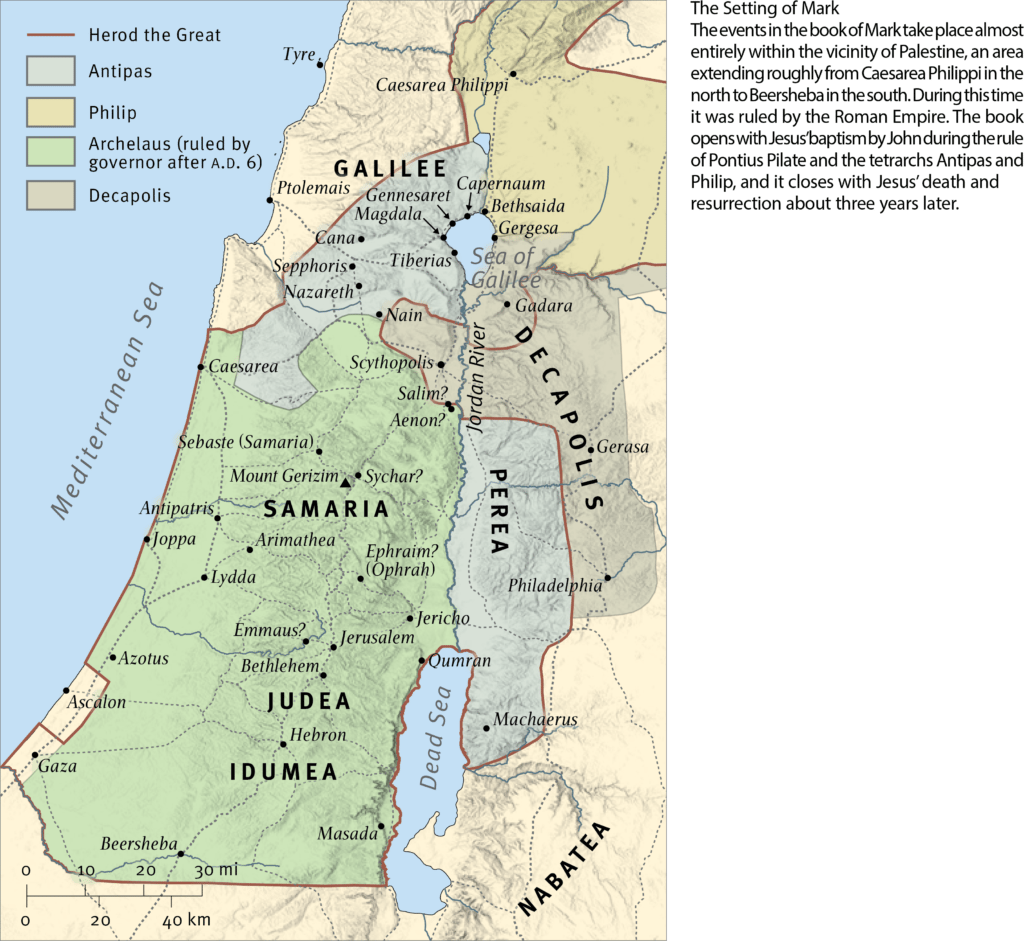
Taken from the ESV® Study Bible (The Holy Bible, English Standard Version®), copyright ©2008 by Crossway, a publishing ministry of Good News Publishers. Used by permission. All rights reserved. For more information on how to cite this material, see permissions information here.




