Genre
The main genre is gospel, which combines three ingredients—what Jesus did, what Jesus said (discourse and dialogue), and people’s responses to Jesus. Within this format the usual gospel subgenres are found: calling stories, recognition stories, witness stories, conflict stories, encounter stories, miracle stories, discourses, proverbs or sayings, passion stories, resurrection stories, and post-resurrection appearances.
Balancing the narrative richness are expanded discourses by Jesus. The Gospel of John also frequently employs symbolism, especially with reference to Christ, who is portrayed by images such as light, bread, water, and a shepherd. As an extension of this, the first half of the book is built around seven great “signs” that Jesus performed as proof of his messianic identity (see John 2:1–11; 4:46–54; 5:1–15; 6:5–13; 6:16–21; 9:1–7; 11:1–44). Then, in a further intricacy, John often links a “sign” or other great symbol with a corresponding statement made by Jesus in the form of either a conversation or full-fledged discourse. For example, Jesus feeds 5,000 (John 6:1–13), which is followed a few verses later by Jesus’ discourse on being the bread of life (John 6:25–40).
Literary motifs include:
- Statements that are misunderstood—in which Jesus makes a pronouncement, a bystander expresses an unduly literal understanding of Jesus’ words, and Jesus explains the true, spiritual meaning of his original statement (nine instances: John 3:3–8; 4:10–15; 4:31–38; 6:47–58; 7:33–36; 8:21–30; 8:31–47; 8:56–58; 11:11–15),
- Events or statements that occur in threes (e.g., three denials of Jesus; three utterances from the cross) and statements that occur in sevens (including seven great signs and seven “I am” statements by Jesus; see ESV Study Bible notes on John 2:11; 6:35), and
- Heightened contrasts scattered throughout the book (e.g., light vs. darkness; life vs. death; the fleeting vs. the eternal; disease vs. health; love vs. hate).
Setting of John
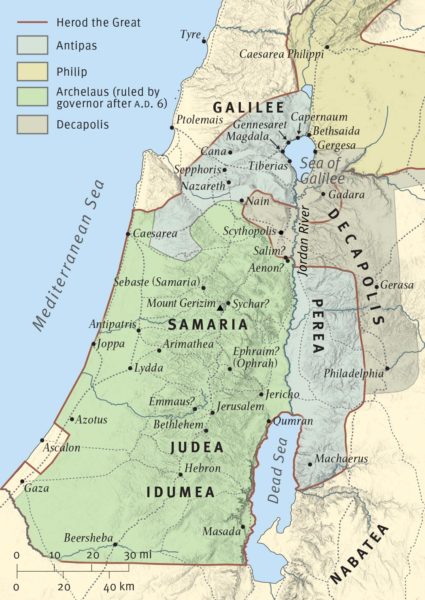
The events of the Gospel of John take place in Palestine, incorporated into the Roman Empire in 63 B.C. Appointed by the Romans as king over the Jews in 37 B.C., Herod the Great ruled until his death in 4 B.C. The Romans divided his kingdom among his descendants. The predominantly Gentile region of the Decapolis, or “Ten Cities,” was a loose confederation of semiautonomous cities administered by the Roman legate of Syria.
Taken from the ESV® Study Bible (The Holy Bible, English Standard Version®), copyright ©2008 by Crossway, a publishing ministry of Good News Publishers. Used by permission. All rights reserved. For more information on how to cite this material, see permissions information here.