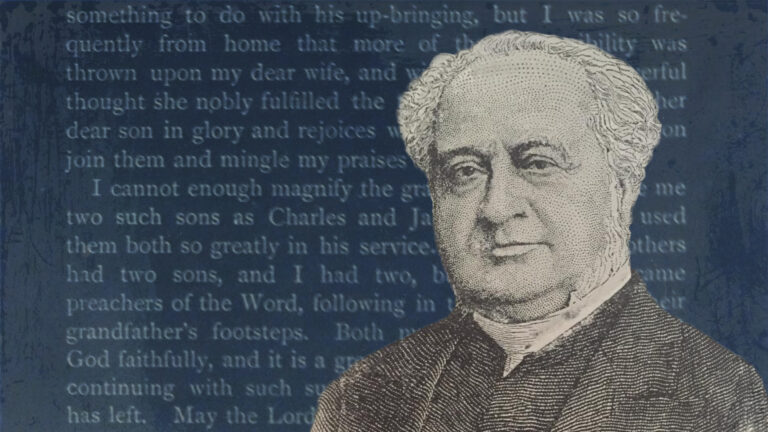





How can you believe what the Bible says about sexuality when Christians have acted so hatefully? How can you be a Christian given the church’s record on race? Questions like these have caused many to doubt—and even deconstruct—their faith. Where can we find help when we feel racked by doubt or are walking alongside someone who is?
In this talk from TGCW24, Collin Hansen and Rebecca McLaughlin explore these questions and offer hope and help by pointing to Jesus, the One who has the words of eternal life.
In This Episode
00:00 – Deconstruction and its effects on faith
03:41 – Disenculturation vs. deconstruction
06:42 – Personal and cultural reflections on faith
10:41 – Historical and theological context of slavery
20:41 – Rebecca McLaughlin’s perspective on deconstruction
27:33 – Biblical foundations of marriage and sexuality
36:38 – Challenges and misconceptions in Christian sexual ethics
41:01 – The role of Christian ethics in society
Resources Mentioned:
- Before You Lose Your Faith edited by Ivan Mesa
- The Secular Creed by Rebecca McLaughlin
- Sapiens: A Brief History of Humankind by Yuval Noah Harari
SIGN UP for one of our newsletters to stay informed about TGC’s latest resources.
Help The Gospel Coalition renew and unify the contemporary church in the ancient gospel: Give today.
Don’t miss an episode of The Gospel Coalition Podcast:
Transcript
The following is an uncorrected transcript generated by a transcription service. Before quoting in print, please check the corresponding audio for accuracy.
Collin Hansen
It’s joy for us to be able to share talking about what is, I’m sure, for many of you in this room, an extremely personal topic. Whether it’s applying to somebody that you know, somebody that you love, and or perhaps yourself, it’s a it’s a popular term in recent years: deconstruction. And the odds are that if you’ve chosen this breakout among the many, many wonderful options available to you, you know someone who has gone through this process, saying, “I’m deconstructing my faith, or someone who has apostatized effectively and left the faith altogether. It could be could be your spouse back home, a dear friend, where you may have shared close spiritual communion in the past, maybe even attended a Gospel Coalition Women’s Conference together, or maybe most personally, in many cases, a child that you reared in the nurture and admonition of the Lord. When I talk to Christians around the world, this is one of the most painful and common experiences that I hear about. And when I first started learning about this process that people were labeling deconstruction, we published a book at the Gospel Coalition, 2021, called “Before You Lose Your Faith: Deconstructing doubt in the church. You can pick it up in the bookstore or online. I think it would be a helpful resource for you or someone that you know who might be in this process or vulnerable to that process of deconstruction. And we cover a number of of topics in this book, ranging from politics to social justice to science and hell, and one topic in particular that I will focus on at the end of my time, which will be race, one that we find that comes up very often in these conversations. But it could be the case that you have chosen to come because you yourself Are doubting, you yourself have questions, and need help thinking those through. Well, if if that’s if that’s the case, I just want to say thank you, thank you for coming, thank you for having the courage to attend the conference, whether by yourself or with friends. Thank you for coming to this session. You’re in the right place because you are not alone. You’re not alone. There’s a philosopher named Charles Taylor who years ago changed my life, and he described our secular age as cross pressured. As cross pressured because what we experience is that in Western society, all different factors in our lives seem to push against belief. They don’t reinforce our Christian faith at any turn, or for that matter, belief in any other religion outside of the self. And here’s how one of his chief interpreters, the scholar James K. A. Smith, put the question and describe Taylor’s insights. He said, “Faith is fraught. Confession is haunted by an inescapable sense of its contestability. We don’t believe instead of doubting. We believe while doubting. We’re all Thomas Now, so like I said, you are not alone in this room. We all have doubts, and where better to place, to voice, to share, to talk about those doubts than when you’re surrounded by other Christians, or when you get a chance to be able to ask Rebecca your hardest questions? That works too. I want to open this discussion by talking about the difference between this process of deconstruction and something that I want to commend to all of you, whether you’re doubting or not, wherever you are in your Christian journey. Something called disenculturation, and then, as I said, we’ll close talking about one example in racism where it’s especially difficult for Americans, in particular, to often separate our biblical faith handed down from the generations from our cultural inheritance. And I wonder if anybody out there, just to describe and to depict, I think the easiest way to talk about what disenculturation is all about is to think about a recent movie. Anybody out there seen the recent movie Jesus Revolution? All right, good number of people. That’s pretty good. It’s a great movie. Came out last year. It tells the story of revival in Southern California in the 1970s, and it illustrates this point of disenculturation really well. The basic problem was that if you were a California hippie in the 1970s and you came to a dramatic saving faith in Jesus Christ, what did you have to change about yourself? Did you have to change your clothes?
Collin Hansen
Did you have to change the style of your hair or the kind of in? Instruments that you worshiped with. Well, we kind of take for granted some of the answers to those questions, but it’s precisely because of a process of disenculturation that happened in that era, or related to that. Well, then on the other hand, what about about drug use? What about sexual promiscuity? Do I have to leave those things behind as well as I become a Christian? And so, what you see happen in that movie, but more broadly when you understand the context of what was going on at the time, is is almost like Acts 15 and that Jerusalem council where they’re working through and seeking the Lord’s guidance on what to do about Gentiles coming into the faith, what do they need to observe of Jewish of Jewish law and Jewish practice? It’s a process of disenculturation of being able to say what is essential to our faith and what is a cultural accretion or even threat to that faith. Is what these Californians were doing 50 years ago, and what they concluded was that no, when you come to faith, you don’t necessarily need to cut your hair, you don’t have to wear a suit every time to church or enjoy organ music, but you do definitely have to stop doing drugs and you definitely have to stop sleeping around. That was a process of disenculturating their faith. For the rest of us who might not have that dramatic example, I still commend that you begin to see yourself as if your home native culture that you’re going to go back to tomorrow or later this weekend, almost looking at that like a missionary would have to look at that culture if they traveled overseas. It’s the same thing. Even look at even if you’ve never you’ve been in the same church and you’ve loved it your whole life, never moved different churches to begin to look at that almost like an outsider. Here’s what I mean. I I teach a course on cultural apologetics at Beeson Divinity School in Birmingham, Alabama, and I ask each one of my students-they’re typically young-to write a personal statement of disinculturation, and I’m trying to help address this very problem that we’ve gathered here today to discuss about doubt and deconstruction. Because many Christians I find have never learned to see themselves as situated in a particular culture. It’s like the fish that doesn’t know what water is. They’ve just been swimming in it their whole lives. They don’t know anything else. So I ask these students to answer three questions. This is the process of disenculturation of helping you separate what is essential to my faith to what is something that is an add-on that might contribute in some ways, or might even undermine authentic faith. The first thing I ask them to consider is, what do I bring from my home culture that must be adopted if I were to move into a new culture? So, for these Southern Californians, that question was: It doesn’t matter what culture you’re in. The Bible’s teaching about sexuality doesn’t change. The Bible’s teaching about about caring for the poor, providing for the poor. That doesn’t change no matter how affluent or poor your own culture is. That is a universal to the Christian faith. Wherever you are, that is essential. The second question I have them answer is: What what must I bring from my home culture, or what? What could I bring from my home culture that I could either leave behind or import? It’s kind of a neutral. The first is a negative, necessary positive. The second is a neutral. This is, I think, where, for example, your preference for musical style might come into play. It might translate across cultures, or it might not. But the only way you could go wrong is if you said this is the only kind of music Christians could listen to, and be faithful, or use for worship music. That’s the only place you’d go wrong. But it’s not a matter where Scripture tells us exactly what to think about that. There is a variety there. Then the third question becomes: What must I leave at home as this thinking as a missionary, so as not to confuse the gospel with any cultural demands. Again, these are the negatives.
Collin Hansen
These are the things where you say, “No, I’ve learned that I cannot bring that attitude where I am because that is antithetical to the gospel. That is a threat to belief in Scripture’s authority. This I’m focusing on this as important because when you don’t learn to separate between cultural expressions of faith and biblical essentials, when you don’t learn to disenculturate, you’re more prone to deconstruct your entire faith when something goes wrong, because at some point, no matter where you live, no matter what you have done, you realize that at some point, your home culture, your family, your home church, your youth group. Has gotten something wrong, and it can feel as though when that one thing goes wrong, everything else collapses. I hear this often related to purity culture, and for those of us who grew up in the ’90s and ‘2000s in the church, you can understand what I’m talking about here. There’s a difference between what’s often known as purity culture versus the Bible’s teaching about sexuality, and a lot of people have never learned how to separate those two. And so, while rejecting purity culture, they end up rejecting the Christian faith altogether, even though those two are not the same thing. This is what I mean when I talk about the need to disenculturate, so that we don’t deconstruct in our faith. So the last time that we have together here, I want to then talk about racism and slavery and segregation as one topic in particular that has led many Christians over the years, while failing to disenculture, it has led them to deconstruct and ultimately to apostatize to leave the faith. You may or may not be aware that questions related to slavery, segregation, and slavery, racism, and segregation are often used against Christians. This is odd, as Rebecca and others can point out to you, because Christianity has been the only source of alleviating and ending slavery around the world over time, belatedly in many cases, and not as well as it should have. But this is still often used against Christianity by a number of groups, not just your standard liberal or atheist critics, but also groups such as the Nation of Islam or Black Hebrew Israelites, where Christianity is equated with a slaveholder’s religion. One of the problems here is that it can be a very disenchanting experience as a Christian to look back on what has actually been taught and practiced in the church. One of my heroes, Jonathan Edwards, while preaching amazing messages about God’s word, was also owned at least one slave. Or more famously, the incredible evangelist George Whitfield actually circumvented Georgia law, colonial law, in order to introduce slavery as a way, get this, to make his orphanage viable, to provide for an orphanage enslaving Africans. It’s very convoluted and evil. And so, when people learn this, and they don’t necessarily know how to interpret this biblically, or understand how this could have happened, they’ll often just deconstruct their faith altogether. They’ll leave it behind, and so what I do is as I try to walk young people, especially, but it works for anybody in any church context to learn how to do biblical interpretation through the question of slavery. And so what we do is we we use a whiteboard and we try to put every argument we could think of, biblically and otherwise. And we have on one end question: Does the Bible condone slavery? And then the other side we say: Does the Bible condemn slavery? I’ve done this in my seminary classes. I’ve done it in churches. Strongly recommend it. It again is very helpful. Just learning how to interpret Scripture and help you in that process of disenculturation. I’ll give you a shortcut. We’re not. We don’t have time to be able to go through the entire exercise, but I’ll tell you what we find when we do this together. You find that first there is no command in Scripture to enslave anyone else. There is no command; you will not find it anywhere. It may seem at first glance, when you’re looking through Scripture, to see that it might be condoned, but this is a very important principle in biblical interpretation and hermeneutics that lots of behavior in Scripture is described without ever being condoned.
Collin Hansen
A good example here would be polygamy, described with any number of biblical figures, but it is certainly not condoned. The narratives are very clear. This is the undoing of many godly leaders. Now, slavery may not appear to be explicitly condemned. However, I think you can get pretty close with the Apostle Paul in the Book of Philemon. I think you can get pretty close there. But make no mistake: slavery is never commended, never commended in Scripture. Just think about Romans 622, where the Apostle Paul exhorts us as slaves to God. Notice that in God’s Word in Christian history, you will never see any recommendation that we seek out becoming slaves, property owned by someone else, as a means of becoming more. Jesus, that never happens. That is not is not out there. And so again, this is how we understand it’s not commanded. May seem to be condoned, might not be explicitly condemned, but it is never commended, never commended. And most importantly, you will never find any parallel in Scripture to American-style chattel slavery, you might think, why in the world am I dwelling on this right now? Because there are teachers in the church today who say that we need to get back to slavery because that’s what the Bible teaches. I’m not making this up. This is an actual problem that we see today. But what we see going back is that slavery in the Roman world described and Hebrew world described in Scripture was neither exclusively racial nor permanent. Race-based slavery never made sense. It didn’t make sense then. It doesn’t make any sense now. If you can just enslave anyone else because they have darker skin, then it means that somebody from Norway should be able to enslave someone from Italy. It just doesn’t make sense. It’s an arbitrary divide supporting an evil system. And note again that this is one of the things that blows the mind of my students. I say many of us evangelicals in the United States have a theological inheritance that argued that slavery was a biblical necessity and even a good. Some of our greatest theologians of all things were saying these, which I think would conclude they’re probably not our greatest theologians. If that’s the case, but here’s what happened: you will find almost no arguments about any of this being a good thing for people until the early 1800s. What happened in the early 1800s when the cotton gin was invented? All of a sudden, slavery became profitable, and sure enough, the theological justifications came behind to support. So you might have somebody say, “How could you follow that slaveholder religion? or, or “How could you be so blind? Christians have of health or say the Bible teaches that slavery is good. No, bad theologians teach that the Bible says that slavery is good. That’s not what the Bible teaches. Make no mistake. The eminent historian Mark Noll has described the American Civil War as a theological crisis, one that I would say exists in to that we continue to deal with today. And Rebecca does an amazing job of talking about this problem in her best-selling book, *The Secular Creed. If you haven’t read it, go ahead, pick up a copy in the store. But we dwell on this because in deconstructing, apostatizing, leaving the faith, many were responding to Christians arguing that slavery was biblical. But here’s the encouragement I want to leave you with. Mark Knowles says something else. This historian talking about the theological crisis. He says outside the United States, one rarely encountered the conviction that to trust the Bible meant to approve, however reluctantly, the slave system in its American form. One of the most outspoken critics of American slavery was Charles Haddon Spurgeon. He was so well known as a critic of slavery in Great Britain that a group of Christians in Montgomery, Alabama, got together and warned that if he ever visited the United States, they would murder him. This is how severe this was. And so, what was the difference? It’s what I was telling in the beginning. He could see from the outside. He could see the blind spots. We couldn’t see them. Our ancestors-they couldn’t see them. He could see them from the outside, and that’s what I want to commend to you. This process of disenculturation, so that you don’t deconstruct.
Collin Hansen
The first thing you need to do is avoid novelty. If your argument has not been seen, or you’re hearing a preacher teach you something that has not been seen in Christian history, it’s almost certainly wrong. That’s what was happening. These these arguments appeared all of a sudden, slavery is a biblical good. No, no, those were novel arguments. So first, avoid novelty in your biblical interpretation. Second, seek catholicity, meaning we have the church universal across time and across geography. If only your small group of Christians are the ones who are reading it this way, but not in other countries and not across time. Again, you’re probably wrong on that. This helps us to not over enculturate our faith, and then finally, never disobey one part of Scripture so that you can supposedly obey another part. Of Scripture, do not pit Scripture against itself. Here’s what I mean: Some people were so intent on arguing that supposedly the Bible upheld slavery that they seemed to have forgotten the basic commandment of Jesus to love your neighbor as yourself. If they were not going to inflict themselves that way, why would they do that to others? Don’t turn Scripture against itself. Scripture is a unity brought about by the Holy Spirit. Look, and I want you to recognize that everyone in our secular age doubts. We’re all exposed to these arguments. We’re all exposed to challenges to our faith. The one way you can help inoculate yourself against this deconstruction process is to learn to look at your culture as an outsider from the vantage, especially of Scripture, above all else, and also use the global church and use Christian history as well. When you can disenculturate your faith, then you’re less likely to deconstruct. And one person I think God has raised up to do an especially good job of helping us to see that aspect of our faith from an outside perspective is Rebecca McLaughlin. Please join me in welcoming Rebecca.
Rebecca McLaughlin
Thanks, brothers. I have an anti-podium policy. I’m very biased against podiums, so I’m afraid you get. I’m a pacer, is why I need to be able to to walk around and talk to you guys. In fact, I like walking so much that every Thursday night, a dear friend of mine and I walk down the river near our house and pray together. Well, first we tell each other everything that’s going on in life. You know, the good, the bad, and the ugly. We have committed to tell one another the embarrassing things that you don’t really want to tell anybody, or those those sinful practices that are creeping into your life that you’re trying to justify. You’re trying to justify, but you honestly know if you were somebody else talking to yourself, you’d say, “Uh-uh, that’s not it. So a few years ago, my friend Carol and I, walking down the the river and on the way back she says to me oh I want to take a stop at at our house now she lives right around the corner from me and at the moment their house is under construction or should I say under deconstruction just that day they had had the demolition guys come through, and in one day it was extraordinary how much of the house was no longer there. We went in through the door that just about was still a door. We walked up the stairs where I was like slightly afraid for my life going up these stairs onto the top level of our house, and we looked out over the city of the Cambridge through the walls that were no longer there at all, and it struck me as extraordinary how much damage can be done by a few guys with sledgehammers in the course of one day. And the fact that my friend had paid these guys to come and ruin her house-it was sort of extraordinary. Why was she doing that? Why was she paying 1000s of dollars for people to come and basically demolish her house? Clearly, because she was hoping to build something better on the same foundation. I think many of us today, or many of those who we love, who are going through a process of deconstruction are hoping to build something better. It’s typically not that we just go straight in with a sledgehammer, wanting to live in nothingness, wanting to stand with no roof over our heads. But we we get the sledgehammer out and we we start hitting at things because we know that parts of the house that we may have lived in for some time are actually rotten. But we’re we’re seeing some structural problems. We’re seeing some mold that’s crept in, and we know that something quite drastic needs to happen if we’re going to build a better house. As we come back together to the scriptures, we’re going to find that the Lord has given us Firm foundations and load-bearing walls for the house of faith in which we need to live. The guys who my friend had hired to knock down her house were somewhat careful. It didn’t look like it, but they were somewhat careful because they they weren’t knocking down the load-bearing walls. They were knocking down the things that that were keeping the the wind and the rain out, but not the the walls that were actually keeping the structure of the house up in the first place. And so, as we go through this process, we need to know what are the load bearing walls in the Christian faith. What what is the mole? Where is the the rot that we might have grown up with? That as Collins mentioned. May not have actually come to us from the scriptures at all. Where are the load-bearing walls, and and what is our foundation? And in our short time today, I especially want to look at the whole question of sexuality, because I think this is one of the areas that is often at the heart of many people in our churches today sort of desire to deconstruct. It’s often in people’s minds connected to questions of race, and that’s actually for good reason.
Rebecca McLaughlin
I think one of one of the most emotionally compelling arguments that we will sometimes hear is, just like you speaking to somebody like me, just like you white Christians back in the 60s used your Bibles to justify your opposition to the desegregation of schools, or to a black person and a white person getting married. So now you’re using your Bibles to justify your opposition to same-sex marriage, or maybe to transgender identities. And it’s only when we fully recognize the first part of that statement is true. That back in the 60s there were far too many people who were using their Bibles to try and justify segregation. It’s only when we recognize that that’s true that we’re going to have the moral legs to stand on when it comes to questions of sexuality. But if we open our Bibles, we will find that just as firmly and clearly as the Bible calls us toward love and equality across racial difference, so clearly and firmly it calls us away from same-sex sexual relationships. So actually, the problem with the 60s segregationists was not that they were too Christian. It was that they weren’t half Christian enough. It wasn’t they were reading their Bibles too carefully. It was they were doing utter violence to the scriptures in order to reach the conclusions that they were they were trying to reach. And actually, if we open our Bibles and try to find a way to justify same-sex marriage for Christians, we will find ourselves, perhaps with a better heart-I don’t know-but we will find ourselves doing a similarly contorted level of gymnastics to reach those conclusions. Now, some of you may may know my story; others others won’t. I’m not someone who first came to the Bible hoping that it would say no to same-sex sexual relationships for Christians. As long as I can remember, I’ve been a Christian. As long as I can remember, I’ve been attracted to other women. I would have been more than happy at one point in my life to open the Bible and found that it did affirm same-sex marriage for believers. But the more I’ve studied the scriptures on this question; the more convinced I become that it doesn’t, and the more I’ve realized that actually Jesus and His love for us is right at the center of that story. So often we have conversations about sexuality that that seem to leave Jesus to the side, quite honestly, and many who are advocating for same-sex marriage for believers are wanting to say, “Do you know what? I want. I want to be a Jesus kind of Christian. You know, maybe not a Paul kind of Christian. I want to be. I want to be a Jesus sort of Christian. He doesn’t. He doesn’t really talk about this issue. So, how can we think this is a a big issue, something that we Christians should be concerned about? But actually, if you read through the full sweep of the scriptures and what they have to say about sexuality, you’ll find that from the very beginning, human beings are made male and female in God’s image, and one man and one woman are brought together. And this is a curious comment in Genesis two. Therefore, a man will leave his father and his mother and be united to his wife, and the two shall become one flesh. It’s a curious comment that gets picked up, actually, in the New Testament when Jesus defines marriage, and points us right back to not only that passage in Genesis two, but also to Genesis one when God creates human beings, male and female, in His image. So you have this sort of picture at the beginning of male and female in a one-flesh union as marriage, and then as the Old Testament unfolds, you’ll find all sorts of sexual relationships that fall short of that. But you’ll also find a persistent metaphor, coming back time and again through the prophets, that compares God to a loving, faithful husband, and Israel too is ought to have an unfaithful wife. And as you read through the Old Testament, you’ll find this marriage is in crisis because God’s people keep cheating on Him with other gods, so-called gods, fakes, idols. And then Jesus comes. Jesus steps onto the stage of human history, and he declares that he is the bridegroom.
Rebecca McLaughlin
It’s a very odd comment to make if you think about it for a man who never married in his life on this earth. So, what is Jesus saying? It’s one of the ways in which he’s stepping into the shoe. Of the Creator God revealed in the Old Testament, and as we read on in the New Testament, as we read Paul’s letter to the Ephesians in chapter five, he gives us this beautiful description of Christian marriage as like a little scale model of Jesus’s love for his people. And at the end of the Bible, in the Book of Revelation, we hear this great shout going out: “The wedding of the Lamb has come, and Jesus’s marriage to His Church bringing heaven and earth back together. This is why marriage is male, female, and why husbands and wives are called to different roles. Like Christ and the Church, it’s a love across difference. Like Christ and the Church, it’s a love built on sacrifice. Like Christ and the Church, it’s a life-creating, flesh-uniting, never-ending, exclusive love. So marriage is meant to point us to Christ, but it’s also meant to disappoint us, because even the best human marriage could only ever be a tiny echo of Jesus’s love for us. So often, my friends, I think we have had conversations about sexuality from a Christian perspective, and we have completely missed this big picture. It’s like imagine having a conversation about what it means to be a Christian father, without noticing that in the Bible, God is described as our father, and so the absolute best Christian father is giving us a tiny little echo of God’s fatherly love for us. Actually, when when Paul reflects back on even that first marriage in Genesis, he quotes from Genesis two. Therefore, a man will leave his father and his mother and be united to his wife, and the two shall become one flesh. And he says this is a profound mystery, and I am saying that it refers to Christ and the Church. That was always what it was about, from the beginning, when God made humans male and female, when He gave us the capacity to have sex and to get to get married, to have children together. All of that-it’s baked into our biology. This picture of Jesus’s love for His people, and when we realize that Jesus’s love for his people is actually at the front and center. Other things start to fall into place. It’s a very common belief in our culture today that sexual romantic fulfillment is the thing. And so, to say to somebody, “You need to deprive yourself of sexual or romantic fulfillment. You know, maybe to say to somebody who, like me, is primarily attracted to their same sex, to say to that person, actually, you shouldn’t be pursuing your romantic desires. In our culture today, that sounds like a death sentence. That’s right, and so often, if we’re honest, if we’re brutally honest in our churches, we have acted like that’s true. We recognize that that marriage is the the right context for sex, but we bought into the idea that actually, if you don’t have sexual romantic fulfillment, if if you don’t end up getting married, for example, then you’ve missed out on the thing. My friends, that the Bible calls that idolatry. There is one relationship that you and I cannot live without, and that is relationship with Jesus Christ. And actually, our deepest romantic or sexual longings are cuing us in to something much, much greater. The the longings of our heart are ultimately for the one person who can satisfy for the one marriage that all of us are invited into, which is the marriage of Jesus to His people, that will be consummated at the end of time. But if we if we bought into this idea that actually yeah marriage is the thing you can’t live without, if we told our children and especially our our little girls, and maybe maybe there are folks in this room who’ve been who were brought up that way themselves. That actually, your greatest aspiration is to be a wife and a mother, and if you don’t get married, then you know. Oh, I’m sorry. Like it’s that’s unfortunate. Like there’s maybe we can fix that somehow. We’re actually reinforcing this idea that marriage is the thing.
Rebecca McLaughlin
You know, Paul, who said that Christian marriage was so beautiful that it was meant to picture Jesus’ love for his people, he said singleness is even better. But so often in our Christian cultures, we’ve left single people out, and so when somebody says to me, “How can you expect a Christian who is maybe exclusively attractive to their same sex to be lonely for the rest of their lives? What I want to say to them is, if our Christian culture is such that single people are lonely, we are massively failing. To live up to Christian ethics, we need to open our Bibles and we need to notice the family language that slaps us in the face from the very beginning. You know, think about when Jesus is teaching one day and it’s full crowd, and somebody comes and taps on the shoulder and says, “Jesus, your mother and your brothers are here to see you. Does Jesus say, “Oh, sorry guys, family first, got to go” No, he says words that are honestly outrageous to our modern Western Christian culture. He says, “Who is my mother, and who are my brothers? And then he looks around at the people in that room and he says, “Whoever does the will of God as my brother and sister and mother, Jesus actually redefined the family to be the inclusive family of God, and my friends, I don’t think we live like that’s true, and because of that, we’ve actually we’ve lost our vision for love between believers of the same sex, because actually, if we look at the Bible, we won’t find that there is only a no to love between believers of the same sex. The no to sexual and romantic love, the no to to same-sex marriage. That no is very clear. But we also find a a strong yes to brother and sister love. If you think about what Jesus said on the night that he was betrayed, he said to his disciples, “This is my commandment that you love one another as I have loved you. Greater love has known than this, that he laid down his life for his friends. If we start to live like that is true, our conversations around sexuality are going to change. And friends, let’s be real: we we live in a world which has collapsed all intimacy, all real, meaningful intimacy, down into sexual and romantic relationships. We live in a world which has bought the lie that having multiple sexual partners is going to be good for your health and happiness. If you look at, for example, the sexual revolution of the 1960s, sold to us as the liberation of women. In actual fact, the self-reported happiness of women has decreased since the ’60s, and it’s been discovered by, like, you know, studies done not by Christians but like secular university studies that actually increasing your numbers of sexual partners, especially for women, is correlated with lower levels of happiness, higher levels of depression, sadness, suicide ideation, drug abuse, alcoholism-all the things we would not want-and actually, in in today’s cultural moment, we have something even worse happening. We have a not only the sort of normalization of sex without commitment, we actually also have a normalization of sexual violence toward women under the thin veneer of consent. I think for years we’ve been used to thinking that Christian sexual ethics is kind of an embarrassment. If we’re honest, we’ve been thinking that it’s it’s probably unfair on people who are attracted to folks of their same sex, and it’s probably limiting to women in particular.
Rebecca McLaughlin
Actually, if you look at the data, Christian sexual ethics is one of the best things we have to offer, with Jesus at the center and a family of love that brings people together, regardless of whether you’re married or single, whether you’re older or young, whatever your your background is, the the inclusive family of God that we are called to is one that is very restrictive when it comes to sex, and does say sex only belongs in marriage between one man and one woman, but is actually the opposite of restrictive when it comes to love, because the first-century Jewish man we worship told us to love our neighbor, told us to love our enemy, and taught us to relate to one another as brothers and sisters, to welcome one another, as Paul puts it, as Christ has welcomed us. When we think about deconstruction, we need to think about what what new house are we going to build. And it was sort of fascinating to me. Fascinating is probably an unkind way to put it, but about a week after my friend gave me the tour of her no longer house, she texted me and she said, “Bad news: the foundation has started to fall in. It turned out that the guys with the sledgehammers had just gone a bit too sledgehammer happy, and the foundations of a house were collapsing. And a question I would have for you, if you are somebody who is in the midst right now of deconstructing, or if you are walking in love with somebody in your life who is deconstructing, I would want I want to want to ask the question that Peter asked actually, when Jesus noticed that a lot of people, a lot of his followers were leaving, and he said to his disciples, “Well, what about you guys? Peter said, “Where else have we to go? You have the words of eternal life. I believe that that is true, and I also believe that in meaningful ways it is demonstrably true even today, because those of us who are questioning Christianity because of a history of racial injustice, or those of us who are questioning Christianity because of what we’ve seen of abuse and sexual abuse, or those of us who are questioning Christianity because of the hateful ways in which people have have sometimes been treated outside the church, we’re questioning on the basis actually of Christian ethics. The Declaration of Independence famously says we hold these truths to be self-evident that all men are created equal. I’m sorry, that’s not a self-evident truth. It’s actually a biblical belief, and if we take Christianity out of the foundation, we don’t have any foundation to build on anymore. If you listen to some of the top secular thinkers today, so for example, you all know Harari, who wrote this book called *Sapiens: A Brief History of Humankind* global best-selling book. He’s very honest about the fact that atheism doesn’t give you a foundation for the deepest beliefs that you and I probably share. Actually, regardless of our religious affiliations, he says things like human beings have no natural rights, just as chimpanzees, hyenas, and spiders have no natural rights. He says human rights are figments of our fertile imagination. Quoting the Declaration of Independence, he says the Americans got the idea of human equality from Christianity, but if there is no God and we who made made human beings and gave us souls, etc. etc. then what does it even mean for human beings to be equal? He says the scientific study of Homo sapiens has embarrassingly little to do with human rights and equality. So, friends, if we evaluate Christianity on the basis of whether it’s delivering on love across racial difference, on justice for the poor and the weak and the marginalized, on on care for the oppressed, on opposing violence, we’re actually judging it by Christian standards. If we’re believing in the equality of men and women, if we’re believing that that babies are actually precious and valuable. If we’re believing that the strong and the rich and the powerful don’t have the the right to trample on the weak and the poor and the marginalized, those are actually Christian beliefs. And if we throw Jesus out, we have nowhere to go. Our foundation will crumble because he has the words of eternal life.
Collin Hansen serves as vice president for content and editor in chief of The Gospel Coalition, as well as executive director of The Keller Center for Cultural Apologetics. He hosts the Gospelbound podcast, writes the weekly Unseen Things newsletter, and has written and contributed to many books, including Timothy Keller: His Spiritual and Intellectual Formation and Rediscover Church: Why the Body of Christ Is Essential. He has published with the New York Times and the Washington Post and offered commentary for CNN, Fox News, NPR, BBC, ABC News, and PBS NewsHour. He edited The Gospel After Christendom, The AI Apocalypse, and The New City Catechism Devotional, among other books. He is an adjunct professor at Beeson Divinity School, where he also co-chairs the advisory board.
Rebecca McLaughlin holds a PhD from Cambridge University and a theology degree from Oak Hill Seminary in London. She is the author of several books, including Confronting Christianity, The Secular Creed, Jesus Through the Eyes of Women, and Does the Bible Affirm Same-Sex Relationships? You can follow her on X, Instagram, or her website.