When an editor at The Gospel Coalition e-mailed to see if I’d be willing to review a book by Creed frontman Scott Stapp, I replied, deadpan, “You’d better offer this to Don Carson first. This kind of thing might be right up his alley.” He didn’t respond . . . not even a perfunctory “Ha ha.” Anyway.
The fact that TGC readers normally wouldn’t touch anything as potentially cheesy as a 1990s rock star’s autobiography, of course, made me really want to do it. Most Famous Person autobiographies are either (a) so self-congratulatory, (b) so shallow, or (c) so obviously not at all written by the famous person himself as to be pretty much useless. This book, refreshingly, is none of these things. I think Stapp is humble, engages in real theological thinking, and was actually pretty involved in the writing of his own book. Sinner’s Creed is essentially the story of the Holy Spirit’s conviction of sin, a man’s confession, and his walking a long, courageous road of repentance. This man just happens to be famous.
Admission: I make part of my living ghostwriting Famous Person books and it remains, to me, one of the most seductive (Famous People are interesting), practical (making a living is important), and infinitely frustrating things a writer can do. While an author approaches writing as a mostly artistic endeavor, Famous People usually approach it with different motives. Also, most Famous People, since they’re wealthy and have been fawned over much of their lives, operate under the mistaken premise that they can do everything well (especially write). All that to say, Stapp’s ghost did a really nice job with this one. And it helped that Stapp was actually willing to say interesting things.
It’s easy to go through life as a Famous Person—especially a Christian Famous Person—assuming your motives are only pure. This is the reason many Christian Famous People are semi-insufferable to be around. They can sometimes lack the kind of humility that lives out the basic premise of the gospel: we’re all sinners who fall short of the glory of God. There’s rarely enough of the attitude expressed by Paul at the end of Romans 7, who writes, “I’m a wretched sinner . . . who will save me from this body of death?”
Stapp’s book, refreshingly, embraces this attitude.
Sure, there are the usual Famous Person indulgences. The section about what a tremendous athlete Stapp was as a kid was a little too long, and there many be a few too many stunning pictures of Stapp soaking wet onstage or on the beach with his beautiful family (there are 16 pages of photos). But this is really a story about the tension between legalism and license, and the story starts with Stapp’s personal rock bottom: falling off a South Beach balcony in a drug-induced paranoid haze a few years ago, and almost dying. Amazingly, the rapper T.I., who was in the suite below, found Stapp and saved his life. You couldn’t make this stuff up.
All Things, All People
Stapp, who was an exceptionally talented kid in and out of the classroom, grew up “wanting to be a superhero” and “wanting to be bigger than Elvis” so that he could be all things to all people. He wanted to make his divorced mom happy. He wanted to take care of everyone all the time. For me, as a man, this was an imminently understandable feeling. Stapp, however, got used to being everyone’s idol until he needed to be everyone’s idol, to the point where he’d replaced God on the throne. Again, I can relate to this as a man because it’s the insidiousness of sin, couched in the kind of ambition society loves.
Stapp also grew up in what can only be described as a legalistic, semi-crazy abusive home environment where he was physically punished for everything from getting a “B” in school to not brushing his teeth right to listening to a song with the electric guitar in it. It was your garden-variety kooky legalistic upbringing, and Stapp does a great job of bringing out the hopelessness in this mindset—the idea that if you can’t be perfect (and nobody can), you might as well fail big. For him, there was no middle ground between extreme legalism and extreme license.
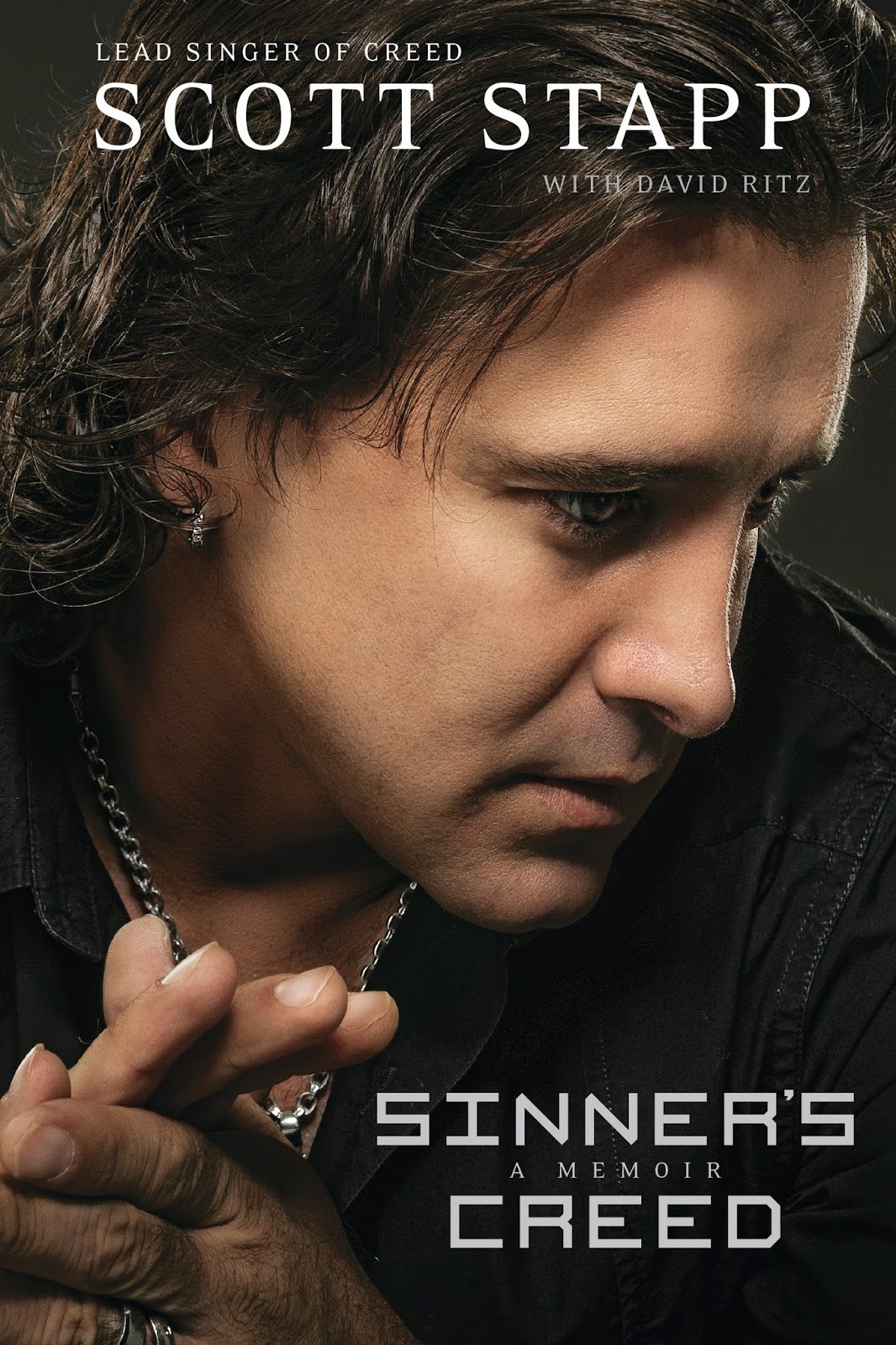
Sinner’s Creed
Scott Stapp
Sinner’s Creed is the uncensored memoir of Scott Stapp, Grammy Award–winning leader of the multiplatinum rock band CREED. During CREED’s decade of dominance and in the years following the band’s breakup, Scott struggled with drugs and alcohol, which led not only to a divorce, but also to a much-publicized suicide attempt in 2006. Now clean, sober, and in the midst of a highly successful solo career, Scott has finally come full circle—a turnaround he credits to his renewed faith in God.
For those of us who grew up evangelical and were educated in small evangelical colleges (Stapp got kicked out of Lee University), there is an eerie relatability to all of it—the hypocrisy (both real and perceived) and the reality that parents and authority figures didn’t necessarily have it more put together than anyone else.
Note About Writing Memoir
It’s hard to write memoir, primarily because you’re writing about real people who exist in real life and have real feelings—in this case, Stapp’s biological father and stepfather, an unscrupulous manager, bandmates, ex-bandmates, ex-girlfriends, an ex-wife, and a current wife. That said, it’s a courageous thing to do, especially as a people-pleaser, knowing you’re probably going to make a lot of those people mad. Kudos to Stapp for coming real and refusing to sugarcoat.
Stapp makes perhaps his most profound point in the middle of his narrative on Creed’s ascension. He reflects, “I didn’t have the wisdom to see how an already big ego, made massive by the joyride of rock and roll, could do me in. And it wasn’t even the partying—yet. It was the false sense that I couldn’t fail.”
He later writes, “I was bathing in my glory. You work hard, you put up with rejection, you live with frustration, and then when you finally reach the top you want to take a couple of victory laps. You want to strut. That’s only natural. But what happens when you confuse yourself—your talent, your your charisma, your creativity—with God?”
Stapp writes deftly about his depression without absolving himself of, as he puts it, “my willing participation in all the toxicity.” He says, “I’d disgraced myself and the God I claimed to serve,” then recounts the time he took two machine guns and shot up his mansion in Orlando (see: not able to make this stuff up).
Pehaps the most interesting thing about Sinner’s Creed is the stark portrayal of fame. Stapp makes it look awful, which, I think, is the point. His bandmates were jealous of his fame. I know what this feels like; I’ve been jealous of my friends’ fame too, and have needed to confess it. His parents wanted his money. Again, I know what it feels like to want and need money. It’s easy to think nobody can relate to a book about a rockstar, but I think it’s impossible not to. We live in a society where everybody wants to feel like a rock star, which is why we need books like this.
At one point, strung out on drugs, bled dry by his manager, and abandoned by his bandmates, Stapp says he was left with “only [his son] Jagger and God.”
So What’s in This for Pastors?
I was talking with a kid recently who said, “I’m thinking about going to seminary, but it’s not like I want to be one of those famous pastors.” I was taken aback. First, he made it sound like getting famous was like falling off a log. As someone who has scratched and clawed for even a taste of minor, basement-level literary fame, and then been almost completely negatively consumed by even the tiny hit I got of it, I was offended that this kid thought he could just walk into fame. But then I was saddened that fame is even a part of everyday conversations for kids considering ministry. Perhaps what Stapp does best is relate the dangers of chasing fame, having fame, and losing fame—the fruit of self-idolatry resulting in compromised relationships. Don’t think this doesn’t happen on even the smallest levels. It does.
If you’re reading this website, more than likely you’re a pastor, you’re in seminary, or you’re the kind of layperson who has the time and inclination to seek out stuff like this. You probably think, I’ll never be famous. But I bet you’ve thought about it. Be honest: I bet you’ve at least thought about how fresh it would be to write a TGC article, to see your name on the front page and get lots of comments, or to be asked to speak on the sub-sub-substage at the next big conference. I know I have, and I’m not even a pastor.
I started this review with a joke, but the book was anything but. Fact of the matter is, I really loved it. It’s hopeful. It shows me sin and led me to the cross. Stapp could have done a whole lot worse.
Sinner’s Creed ends with Stapp revisiting rock-bottom. He writes, “I’ve come to see sin as separation from God. In that respect, I’ve been a lifelong sinner. . . . At the same time, sin is not the end of my story. I believe with all my heart that the living Christ, whom I love deeply, stays steady. He is there whenever we call him.”