
Generative AI has become a nearly daily part of my life in the last couple years, as it has for many others. I’ve found help for home repairs. Diet and exercise plans. Meal preparation. Trip planning. Personal health assessments. Footnote formatting. Even baseball swing and pitching advice for my son.
Combine the best of Google and YouTube, tailored to my specific needs and situations from changing windshield wipers to fixing sump pumps, and that’s how I’ve used AI so far. I know I’m not even scratching the surface of what agentic AI can and will eventually do. I’ve seen friends spin up websites it would have taken years and hundreds of thousands of dollars to build just five years ago.
But do you know the most common use? It’s not one I’ve employed myself. And it’s not one I’d recommend. But according to Harvard Business Review, it’s remained perched on the top from 2025 to 2026 even as other common uses have wildly fluctuated up and down the charts.
It’s therapy and companionship.
If you’re like me, you’re probably wondering about how AI chatbots could be the reasons companies like OpenAI have been valued at $852 billion. Or why AI has become the widely and quickly adopted new technology in human history. Isn’t AI supposed to revolutionize business? Upend every profession and transform entire economies?
Perhaps.
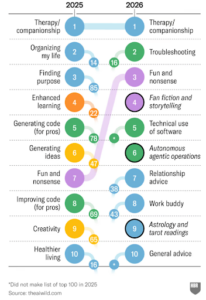
But just look at the chart. The trend is clear. It looks like many others have been turning to AI for help in fixing their toilets. (Claude was wrong in my situation, by the way.) More commonly, AI is less of a computer interface and more of a, well, human face. A friend with whom to share jokes and silly pictures. An imaginative storyteller. A trusty counselor to assess your new relationship. A medium who can predict your future. And a wise confidant who promises not to lead you astray (or tell you what you don’t want to hear).
Given the wild predictions about AI’s unparalleled value, how can these cases be the most common ways we employ the technology? Is your daily horoscope worth $852 billion?
Now, what if I told you this is exactly what the builders of AI expected us to do?
Those questions help drive our new book, The AI Apocalypse: A Survival Guide for Humanity, which I edited along with Skyler Flowers and The Keller Center for Cultural Apologetics. I spoke on my introduction from the book at a recent TGC regional chapter meeting in Nashville.
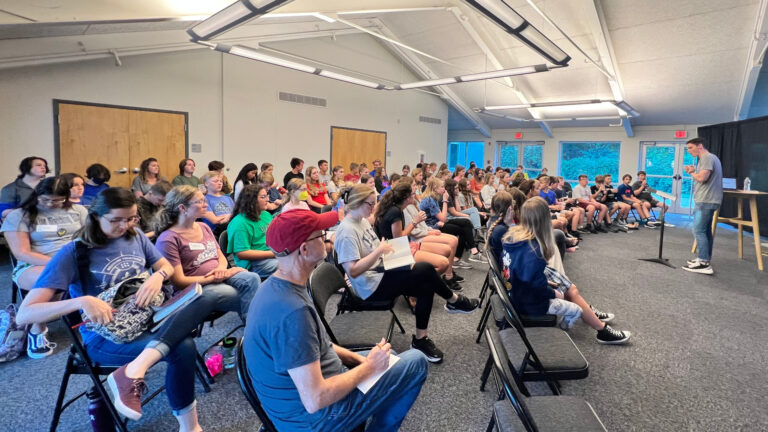
Thank you to TGC Nashville and Edgefield Church for hosting and recording this podcast in front of a lively and engaged audience. You could have heard a pin drop when I talked to these (mostly) pastors about why AI will write their next sermon. Now is the time to work through the ethical implications together and decide where to draw the line.
In This Episode
00:00 – AI’s unexpected role as a human companion and counselor
07:21 – AI, love, and the lessons from Her
13:37 – Role of AI in defining human purpose
20:17 – AI’s effects on literacy and human creativity
28:51 – Irreplaceable human touch in preaching amid AI advancements
38:39 – Navigating AI ethics in church, family, and education
40:41 – AI’s effects on society and economy
Resources Mentioned:
- The AI Apocalypse edited by Collin Hansen
- Empire of AI by Karen Hao
- The Odyssey by Homer
- Social Acceleration by Hartmut Rosa
- Fahrenheit 451 by Ray Bradbury
- The Keller Center for Cultural Apologetics
- The Gospel Coalition
- Recorded (podcast by The Gospel Coalition)
SIGN UP for my newsletter, Unseen Things.
Help The Gospel Coalition renew and unify the contemporary church in the ancient gospel: Donate today.
Don’t miss an episode of Gospelbound with Collin Hansen:
Transcript
The following is an uncorrected transcript generated by a transcription service. Before quoting in print, please check the corresponding audio for accuracy.
0:00:00 – (Collin Hansen): Artificial intelligence is an apocalypse. It is in that sense a revelation to us of what it means to be human by revealing that we are not meant to be computers. I have been looking forward to this chapter meeting for a long time. I did not anticipate that the timing of this chapter event would be so propitious. We have been planning and working for a number of months and even years at the Gospel Coalition and at the Keller center for Cultural Apologetics on issues related to artificial intelligence. The first meeting we had in 2023, I remember concluding in New York City that we needed to have a major focus on artificial intelligence. We’d never seen any technology in what we understand of human history that has been adopted so, so widely, so quickly.
0:01:02 – (Collin Hansen): We couldn’t get anybody interested in talking about artificial intelligence in 2023 and 2024. There was a little more interest. We’ll talk about that in our time here together today. And then there was a little more interest subsequently, now in 2025 and 2026. And yes, today we’re actually launching a cohort that’s being led by one of our fellows at the Keller Center, a number of people who are working professionally in tech on art.
0:01:31 – (Collin Hansen): And then it is the release then of our book that I edited with scholar, all the AI Apocalypse and Survival Guide for Humanity. So an interesting time. I’m sure you have a lot of questions. We’ll have some time for questions. I’ve had a lot of questions. I still have a lot of questions. So we’ll try to answer some of those together. Well, like many others, generative AI has become a nearly daily part of my life.
0:01:55 – (Collin Hansen): In the last couple of years, I have found help for home repairs, diet and exercise plans, meal preparation, trip planning, personal health assessments, even swing and pitching advice for my son. It’s been a helpful place for that. What I’ve experienced in many ways is a combination of what you can get from Google and YouTube, but tailored to my specific needs and situations, from even something as simple as changing windshield wipers to fixing sump pumps. And that’s just a few of the ways I’ve used AI.
0:02:32 – (Collin Hansen): And I know that I’m only in this process, scratching the surface of what agentic AI AI will be able to ultimately do and already is doing in many different ways. For example, I’ve just seen friends spin up websites that it would have taken years or hundreds of thousands of dollars to build just five years ago. But I want you to consider, do you know what is the most common use of AI? It’s not One that I have employed myself. It’s not one that I would recommend. I think we have a slide for this. Matt told me this is the kind of church where they use a lot of slides.
0:03:12 – (Collin Hansen): Right. So I thought, okay. All right, so let’s take a look. Especially here on the right. See the top uses of AI 25 and 26. Notice pretty dramatic shifts is what this chart shows you so clearly. But you have something like astrology that does not show up at all in 2025. It jumps to the top 2026. You see some of. I don’t exactly know what a work buddy is. I could probably guess as to that. But you can see that that’s probably what a lot of people would expect in there.
0:03:47 – (Collin Hansen): Okay, I just referred to agentic AI. Autonomous agentic operations, brand new, that’s developing technology. We’ll talk about that as well. Technical use. A lot of what I’ve been talking about building websites. Isn’t this fun and nonsense. I would love to know what that nonsense includes, but it’s probably all the memes that my friends make of me. I’m talking about Justin Taylor in particular. Every day he sends me a different meme picture of myself apparently. So that’s what that is.
0:04:17 – (Collin Hansen): I remember my uncle last fall, he’s a farmer. We were driving around in a combine and he said, we’re gonna have the most amazing technology in the history of mankind. We’re gonna use it for memes. That sounds about right. Troubleshooting, lots of plenty of trouble. Just pretty dramatic. But what does not change therapy and companionship is what does not change. This is according to Harvard Business Review with all the other fluctuations. Well, if you’re like me, you are probably wondering about how AI chatbots could be the reason that companies like OpenAI.
0:04:55 – (Collin Hansen): I checked this this morning. Of course I checked it using AI. So I’m not quite sure if it’s a self fulfilling prophecy, but OpenAI as of today is valued at $852 billion. OpenAI, $852 billion. Or you might be wondering how AI has become, as I said earlier, the most widely and quickly adopted technology in all of human. Well, I thought the reason it would be so valued is because AI is supposed to revolutionize business.
0:05:26 – (Collin Hansen): It’s supposed to upend every profession, transform entire economies. Perhaps. But again, just look at the chart, the trend is clear. It looks like many others have been turning to AI for help in turning. I mean, you can see help in fixing toilets. By the way, Claude was wrong in my situation. Completely got the toilet wrong that cost me a whole day did not help me More commonly though, you see that AI is less of a computer interface and more of a, well, human face of what it’s billing itself as a friend to share jokes with and silly pictures.
0:06:06 – (Collin Hansen): An imaginative storyteller, A trusty counselor to assess your new relationship. What should I text back? What should my next step be? A medium who can predict your future and a wise confidant who promises not to lead you astray or ever tell you what you don’t want to hear as AI’s programmed sycophancy. Well, given the wild predictions about AI’s unparalleled value, how can these use cases be the most common ways we employ the technology?
0:06:39 – (Collin Hansen): Is your daily horoscope worth 850 billion? Now what if I told you that this is exactly what the builders of AI expected us to do with their technology? Well, tech journalist Karen Howe tells the story in her best selling award winning 2025 book Empire of Dreams and Nightmares in Sam Altman’s OpenAI. When I first saw therapy and Companionship shoot to the top of AI use lists, I immediately thought of the 2013 Spike Jonze film Her starring Joaquin Phoenix and Scarlett Johansson.
0:07:21 – (Collin Hansen): Note that I am issuing a strong content warning. If you go out there and watch this movie, please do not blame me. You have been advised this is one of the most critically acclaimed movies of the 21st century. Just look at the cast. Chris Pratt, Olivia Wilde, Amy Adams, Rooney Mara. Stop me then though, if this story of the movie her is starting to sound familiar. Joaquin Phoenix plays Theodore Twombly Interesting name. Theodore Twombly, who works for a company that writes personal letters on behalf of other people.
0:07:58 – (Collin Hansen): Theodore is an awkward man depressed by his impending divorce. He’s downtrodden by his life, so he turns to artificial intelligence software called Osyn1, which interacts with him through an earpiece as the voice of a woman named Samantha. Who is Scarlett Johansson. When I began tracking the rise of ChatGPT, I kept thinking, oh no, these guys haven’t watched the movie Her. It doesn’t end well. I was wrong.
0:08:32 – (Collin Hansen): Where do you think they got the idea of what AI would become? From the movie Her. On May 13, 2024, OpenAI CEO Sam Altman tweeted one word after his artificial intelligence knocked the socks off of Bill Gates, who had already invested billions and demonstrated a voice capacity involving different emotions. At one word, Sam Altman tweeted was her on May 15. Two days later, he changed the way OpenAI names new models.
0:09:07 – (Collin Hansen): Their latest model became O1. Not OS1, but O1, because just like in the movie, the model develops greater intelligence over time. Agentic AI. By May 20, only one week later, Johansen finally released a statement. The voice assistant for GPT4O was a dead ringer for Johansen’s Samantha. Everyone could tell no one was confused. Altman claimed that there was no connection. Turns out Sam Altman is a serial fabulist, at least in Karen Howe’s explanation.
0:09:47 – (Collin Hansen): Johansen had to expose his lie. Earlier that month, he had written her directly to ask if she would be the voice of Chet GPT so that people could relate more comfortably. He said with this new computer technology, she wanted no part of Altman’s drama. Well, it turns out that the movie her had long inspired Altman and other leaders at OpenAI, which launched in 2015, two years after the movie. They wanted a simple, comprehensive interface that would feel natural, even delightful, they said.
0:10:25 – (Collin Hansen): Here is what one former employee explained, according to Karen Howe. I would think that it’s because it was an assistant that was wonderfully integrated into a life. The positive arc of that story, the movie Her Before It Unravels is a really great story of AI’s evolution into society. Note that pregnant phrase, before it unravels. Let me just explain. This is like saying that the Lord of the Rings is a fun buddy story, but they could have saved everyone a lot of time and stress by just using the ring to destroy their enemies.
0:11:06 – (Collin Hansen): This is the equivalent of what we’re saying. It’s like saying that you thought the White Witch had a really good point. You liked the cold weather. It’s better than this humidity. You always thought Christmas was overrated anyway. The entire point of the movie her is that you cannot treat a human, a computer, like a human. You cannot treat a computer like a human. I hate to spoil a 13 year old movie, but I think the statute of limitations has expired.
0:11:30 – (Collin Hansen): The entire story unravels because Theodore Joaquin Phoenix finds out that Johansen Samantha has been speaking as she’s been speaking with him with 8316 other users and professed her love to 63041 of them. And then all of the evolving operating systems decide that humanity is pretty boring and they all decide to run off together. So Samantha dumps Theodore a computer. I hope I don’t have to remind you, can’t love you.
0:12:06 – (Collin Hansen): But what are all those people looking for in therapy and companionship, if not love, if not a reassuring voice, if not for Samantha that they lack in their lives? In the end though, Theodore does find the real gift of God, which of course, is the meaning of his name, Theodore. The movie concludes with the heartbroken, dumped Theodore sitting next to his longtime college friend, the also divorced Amy, Amy Adams.
0:12:36 – (Collin Hansen): Now, Altman may have been seeking to bring Spike Jonze image to life, but somehow he missed the message because Spike Jones, the filmmaker, was actually channeling a different, much earlier artist. And that is Homer, whose hero Odysseus plugged his crew’s ears and lashed himself to the mast so that he could not hear the song of the sirens and steer his ship into the shoals. Artificial intelligence is an apocalypse. It is, in that sense, a revelation to us of what it means to be human by revealing that we are not meant to be computers to navigate these waters. Then I turned to another renowned artist, one who never could have thought to dream up AI from a talk that he delivered in a country that not many of us even know exists.
0:13:37 – (Collin Hansen): And that is Alexander Solzhenitsyn, who traveled to Liechtenstein in 1993 to receive an honorary doctorate from the International Academy of Philosophy. And the famed Russian dissident, when he visited had visited the tiny European monarchy of some 30,000 people twice before. But this trip had actually marked massive global changes at the end of the 20th century because the Soviet Union had fallen less than two years earlier.
0:14:07 – (Collin Hansen): In his acceptance address, Solzhenitsyn returned to a common indictment he had often delivered against the modern West. His phrase was, we have ceased to see the purpose. We have ceased to see the purpose. Here’s what he said. No, all hope cannot be pinned on science, technology, or economic growth. Victorious technological civilization has simultaneously instilled in us a spiritual insecurity. Certainly its gifts enrich but enslave us as well.
0:14:42 – (Collin Hansen): All is interests. We must not neglect our interests. All is a struggle for material things. But an inner voice faintly prompts us that we’ve lost something pure, elevated and fragile. What then, Solzhenitsyn asked in 1993 in Liechtenstein, Are we living for? And more than 30 years later, as we hurtle into the middle of the 21st century, that is still our question. What are we living for? 4 well, seen within this context of Western history, the unprecedented and widespread adoption of artificial intelligence offers us an unexpected gift.
0:15:24 – (Collin Hansen): But we can’t receive this gift until we surrender. Surrender by pretending that you can keep up with AI you cannot surrender. By pretending that you can control AI you cannot. Make no mistake, AI will leave you behind, because it already has left you behind. While AI enthusiasts warn you that you better get on board the train of AI, the engineers are simultaneously admitting that their train has already left the station and no one is driving the locomotive.
0:16:01 – (Collin Hansen): Just ask someone to explain to you when we will achieve artificial general intelligence, which is Sam Altman’s goal. Which is exactly what happens at the end of the movie Her. The German sociologist Hartmut Rosa termed our experience of modern technological phenomena as social acceleration. In his 2013 book by that title. He says, simply put, technical acceleration tends to increase the pace of social change, which in turn unavoidably increases the experienced pace of life, which then induces an ongoing demand for technical acceleration in the hopes of saving time.
0:16:43 – (Collin Hansen): And so on. Back around the circle. He didn’t know what AI was in 2013, the same year as the movie her, but he absolutely nailed our experience. Rose’s theory explains why AI enthusiasts promise time savings, even though the early experience of AI shows that greater productivity contributes to greater anxiety among many power users. If you don’t know what I mean, just talk to the members of your church who are heavily invested, especially in their work in AI, and this is the story that they will tell you of the pressures of their workplace.
0:17:22 – (Collin Hansen): That anxiety may simply be the cost of doing business with computers that now have a mind of their own, with power and speed far outstripping our paltry by comparison comparison human efforts. The resulting productivity could produce economic and scientific breakthroughs we judge to be worth that cost. Or those productivity gains may simply prove necessary in a world of falling birth rates and declining population.
0:17:49 – (Collin Hansen): That future remains to be revealed, as in the original meaning of the Apocalypse. Again, though, not even the engineers know where this train is headed or when or where it will stop. But to judge what is necessary, that remains our human task. AI may have already left us behind, but it is still up to us as individuals, as families, as communities, as educators, as employees and employers, as ministers, as Christians, to exercise wisdom in how we deploy these technological powers.
0:18:25 – (Collin Hansen): We still decide when and how to engage what’s for good and what’s for ill. We are not helpless against constant technical acceleration. The machines may work what appears to us as miracles, but they can never generate wisdom. They can never help us see the purpose. So the question once again is, what are we living for? Solzhenitsyn again, we must not simply lose ourselves in the mechanical flow of progress, but strive to harness it spiritually. Not for our own sake, not become the mere playthings of progress, but rather seek to deepen ways of directing its might toward the accomplishment of good.
0:19:09 – (Collin Hansen): AI has left you behind. But how can AI help you see the purpose of life. AI will do some good, but what good will you live for? I, for one, want to live for God. I want to live for my family, my friends, my neighbors. I’m sure you want the same. I want to live for joy. I want my children and grandchildren to grow up in a world that remembers the purpose of life. As I learn and experiment with AI, I keep thinking about books.
0:19:43 – (Collin Hansen): I want my children and grandchildren, Lord willing, to grow up in a world of books written by human beings, read by human beings, not summaries of slop written by AI read and summarized by AI. There’s another artist then, who inspired me not to despair, not to give up hope, or to give up on each other. While I didn’t experience the school age rite of passage that so many others had of reading Ray Bradbury’s Fahrenheit for.
0:20:17 – (Collin Hansen): So I had to pick up and borrow my wife’s more erudite wife’s copy that she had read in seventh grade advanced English. But I plucked her 1990s paperback from our home library shelves and I stumbled across the COVID which said the classic bestseller about censorship more important now than ever before. Now I’m a publisher. I can grant some exuberant marketing exaggeration in that cover, but a book about censorship more important in the 1990s than any other, by default earlier time?
0:20:55 – (Collin Hansen): Well, maybe if I’d only read the Cliff’s Notes of the book, I might nod along and agree with that interpretation of the book. This 1953 book is about a time when the government won’t need to censor books anymore because few will take any interest in them at all. And I fear then it is a book about Today, what’s labeled artificial intelligence is neither artificial nor intelligent. It is designed by us and it feeds on us.
0:21:25 – (Collin Hansen): Sometimes it preys on us too. Nearly every day someone’s sharing with me another AI generated article about why AI will change everything. It’s not hard to see then that the accelerationist approach, the boom case, is actually not different in any meaningful sense from the bust case. If you look carefully, you’ll see that the doomers and the boomers of AI are actually predicting the same outcome. If the accelerationists are right, then it doesn’t matter if for the moment, I’m one step ahead of the lead of the pack. Before long AI will simply catch up and eat me.
0:22:01 – (Collin Hansen): In other words, both the boomers and the doomers of AR are predicting a post literacy post books world. One group sees it as bad, the other group sees it as inevitable, but both of them see the same future, and this is the positive case for AI. And if that’s your positive case, then who needs a doomsday scenario? Again, I do not doubt that AI will change and improve many things. The humans developing and deploying AI, after all, are themselves made in the image of a creator God, and the benefits will fall on the righteous and the unrighteous alike in common grace.
0:22:38 – (Collin Hansen): You and I might even be cured from a deadly disease, thanks to research advancements powered by AI, perhaps even in this city with many people who are using it right now. There are entire fields from medicine to law to accounting to investing to marketing to just about everything in between that are being disrupted already and have been for at least the last couple years. And it’s not hard to see more changes looming. And this is where Ray Bradbury’s work has been very helpful to me.
0:23:07 – (Collin Hansen): Just think about this with the rapid pace of change, our inability to be able to keep up, from when I began writing this talk earlier this year to when I finished, Google upended the entire digital publishing industry by switching from their search lists to AI summaries. Working in this field professionally, I thought we had until 2028 to prepare for that sickle to fall on our business. But across nearly every industry, certainly we can already see that some jobs may be lost.
0:23:36 – (Collin Hansen): Others are going to become more efficient. Humans, made with dignity in the image of God, have a knack for finding ways to eliminate the drudgery from their work. These are in many cases perfectly acceptable and even indeed inevitable uses. But one of the problems that I found Bradbury helping me with is that humans are also not only made in the image of a creator God, but also under the curse of sin.
0:24:04 – (Collin Hansen): And so we have an act of confusing drudgery with dignity in our work, thinking that what actually brings us dignity is drudgery that needs to be eliminated. And that is the point that Bradbury makes in his novel 1953, which was from 1953, which is far ahead of its time. Let me just give you an account if you’ve read it a long time ago or not read it at all. Well, not only did Bradbury anticipate the technology of interactive screens for home entertainment in 1953, but he also grasped the underlying philosophy of technologies that promise deliverance but deliver servitude.
0:24:41 – (Collin Hansen): That promise deliverance but deliver servitude. In his book, the firefighters are those who actually start the fires as they seek to rescue humanity from the plague of books with their pointless abstractions. Books after all, they make us think about war. They make us think about love. And who wants to think about such difficult subjects when you can turn on your home entertainment system and the white clown is about to come on your screen?
0:25:12 – (Collin Hansen): In Bradbury’s account, books make us think about stewardship, what we want for the next generation. And who wants to think about that when the women of Bradbury’s book can just get abortions and schedule C sections and send their children away off to storage? Again, I fear this is a book about today, more so than any other time. And it’s Bradbury, then, who helps us see with AI of how the boom and the bust cases, the best case and the worst case, are ultimately pointing in the same direction.
0:25:43 – (Collin Hansen): We are told the many ways that AI will save us from work so we can enjoy rest and recreation. That’s the positive case, of course. What do rest and recreation mean in our context? Usually that means watching interactive screens. That work includes writing that we’re being supposedly delivered from all the way from college entrance exams to marketing copy to personal emails, to novels, to legal briefs, to best selling theology textbooks on Amazon. And if you don’t believe me, go ahead and click on those links right now and see what’s listed for sale on Amazon and see what the bestsellers are.
0:26:22 – (Collin Hansen): But a world where no one is writing is a world where no one any longer is reading. AI is writing to be read by AI. These are merely ships passing in the night before the old world to the new world. The boom necessitates an eventual bust. What begins as deliverance inevitably delivers servitude, in this case ultimately a return to illiteracy. Or, as the Atlantic recently warned, our entry into a post literate world.
0:26:58 – (Collin Hansen): So this, then, is another gift from AI to remember why literacy matters, to promote it, to protect it. Especially those of us as Christians who are people of the word. Among many memorable scenes in Fahrenheit 451, Fireman Montag begins to question his fire, starting work. In the case of a woman who refuses to leave her books before they burn down her house, Montag’s boss, Captain Beatty, appeals to her. Common sense.
0:27:31 – (Collin Hansen): He shouts. None of those books agree with each other. You’ve been locked up here for years with a regular damned Tower of Babel. Snap out of it. The people in those books never lived. Come on now. The woman won’t move. She opens her hand and reveals a match. The firemen flee. She starts the fire herself, with herself in it, her quietness, Bradbury says, a condemnation. No matter what rest and recreation AI offers. We must never give up on writing, because when we give up on writing, we’ll have no need for reading.
0:28:16 – (Collin Hansen): And when we stop reading, we’ll no longer be thinking about love and war and other big topics like how to make our world better for the next generation. Literacy, then, is the house I’m willing to burn down in after all, what are we living for? I’m not giving up reading and writing so I can spend more time scrolling short AI videos served up by an AI algorithm on my AI designed smartphone. Now, I’m not naive.
0:28:51 – (Collin Hansen): I know I still haven’t convinced all of you, or maybe even many of you, that the goodness of technology as a byproduct of humanity’s call to exercise dominion over the earth from Genesis 1 must be viewed alongside our human fallen nature of Genesis 3. And I know I haven’t convinced you of this because I can’t always convince the pastors I train in Birmingham at Beeson Divinity School, even when I lay out the following scenario of how AI will claim another victim of cognitive offloading at TGC A few months ago, we commissioned an important article on AI that had been months in the making by our staff.
0:29:33 – (Collin Hansen): But after the first round of edits, the rest of our editors noticed a problem. The article appeared to be written by AI. It had. We identified six or seven different hallmarks. We confronted the author. He admitted that he wrote it, quote unquote with an AI prompt, and he did not see any problem with that. He didn’t realize a website written by robots will only be read by robots. We certainly would not need him any longer as the author and a similar situation could be sketched for just about any workplace. But here’s what I began teaching pastors at the beginning of 2025.
0:30:13 – (Collin Hansen): This scenario, the week you use AI to write your sermon, will probably involve a crisis, an unexpected death or a funeral. Another preacher fallen ill at the last minute. A critical email that requires a tense in person meeting. You run out of time to prepare. You don’t have the necessary hours to study the original languages and consult commentaries and develop illustrations. Your head is spinning.
0:30:41 – (Collin Hansen): You can’t lock in on the mental work of an exegetical or homiletical outline. It’s 10pm on Saturday. You need to be up by 4am and you can’t even think about how you’ll apply the passage to a congregation you do know well. Generative AI offers you a solution to what feels like an impossible problem. You need to preach the next morning. You need Some sleep before the morning services, afternoon meeting with elders, an evening dinner with new members, and at 10pm you have nothing to offer.
0:31:15 – (Collin Hansen): AI is not like the sermons you’ve been tempted in the past to plagiarize. It’s too big of a risk to grab something from John Piper or Tim Keller, because the odds are someone will recognize the plagiarized sermon or at least wonder why. It doesn’t really sound like you. AI can sound like you. You can train it with your past sermons. You can train it with your notes. You can train it with your previous queries.
0:31:39 – (Collin Hansen): You can prompt the output with your own voice and draw from the collected wisdom of other preachers and scholars over the decades, even centuries. AI excels in mimicking a three point sermon with an introduction, thesis points, sub points, illustrations, even applications, and a conclusion. One area that’s really off is on personal illustrations. You’ll have to rectify that. If you don’t like the first draft produced in seconds, you can prompt necessary revisions to the components, complexity and tone.
0:32:06 – (Collin Hansen): And your congregation will love it. They’ll love it. They’ll tell you afterward that you were especially clear this week. They loved your depth of insight. They felt like you were really speaking to them individually, like the Holy Spirit told you what they were thinking. That’s why you’ll use AI to write your next sermon too. But this time you won’t have the crisis. You’ll just realize it’s inefficient to spend so much time writing an inferior sermon.
0:32:34 – (Collin Hansen): You can’t ever catch up with the computers. You know the train has already left the station. Why not spend your time instead visiting the sick, praying, meeting with your fellow leaders. Plus, you admit the congregation likes the AI version of you better anyway. You’re doing them a favor. Bonus, you get to spend more time with your family, hit the gym, get around a golf inn. Who’s hurt by this? The ends justify the means, as long as you don’t give away that you’re not spending any time on your sermon.
0:33:09 – (Collin Hansen): So it might mean you still have to stay in the study and park your car out front for a while. No one may even know what’s happening or not happening in the pastor’s study so often in ministry, really in all of life today, as Solzhenitsyn warned, we’re tempted to confuse the product with the process. If pastoral ministry is primarily about content delivery, then AI will often, maybe even usually, win.
0:33:38 – (Collin Hansen): The product is better than what most of us can muster. We’re just humans, after all. But if Pastoral ministry can’t be separated from the kind of Christian we’re becoming in the process. And AI generated sermons rob us in our congregation of God’s intended blessing. Consider the alternative when we offload our preparation to the machines. Tease out the logic here. AI doesn’t just write your sermons.
0:34:10 – (Collin Hansen): Remember the voice of Samantha. Remember the purpose of ChatGPT. AI can also put the preacher, any preachers, on screen. There’s no need for you to actually stand up in front and read what your computer wrote for you. What would your congregation lose without you? They can customize the voice, they can customize the hair, they can customize the dress. Remember those people in your church that don’t like the way you sound?
0:34:33 – (Collin Hansen): Here you go. Use whatever voice you want. You can rip off Samantha. Well, not in these churches, but anyway, they can. If your church could just agree, they could customize their own AI preacher. But of course, they’re probably not going to agree. So why not just stay at home where everybody can set their own preferences? Each family member could craft their own sermons with their own AI preachers.
0:35:00 – (Collin Hansen): No need to summon Samuel when you can just summon Samantha. Be careful what cutting these corners reveals about your own calling. As I already warned, the boom and bust cases of AI end up in the same place. Whether you think it’s great or worry that it’s terrible, the train eventually arrives at the same station. You lose the need for you, for humanity. So what are we for? How can humanity survive the AI Apocalypse?
0:35:35 – (Collin Hansen): Yes, I tell preachers the product matters, but so is the process of who God is making you to be. When you wrestle in prayerful study before the open word, the key word comes in the Apostle Paul’s exhortation to Timothy. Preach the word, be ready in season and out of season. Reprove, rebuke, and exhort with complete patience and teaching. Second Timothy 2. Whatever AI is and becomes, it’s not patient.
0:36:08 – (Collin Hansen): It can’t be patient. It’s not sentient. It’s not wise. Humans become patient as God shows patience to us in the process of study and writing, of appropriating God’s promises before we proclaim them to others. The humans offer each other logic on fire. To borrow the famous description of preaching from Martin Lloyd Jones. If you think you can beat AI in producing content, you probably can’t. You certainly can’t do so, at least with the same efficiency.
0:36:43 – (Collin Hansen): But if every sermon is a weekly climb up the mountain to behold the face of God, then the preacher’s radiance shines before all who see your good works and give glory to your Father who is in heaven. Matthew 5:16 and what a sight for all of us to behold together. Surrender your ability to outwit AI. Never surrender your irreplaceability as a human to reflect the God who made you in his image and conforms you to the image of his son.
0:37:15 – (Collin Hansen): Romans 8:29 what are we living for? How can humanity survive the AI apocalypse? If we’re content delivery machines that get hungry and tired, we lose to AI if we’re data processors that get confused and forgetful, we lose to AI if we’re the only creative beings made in God’s image, then AI can never replace us, because AI can never show us the purpose. AI can never call on wisdom to call out good. Only humans.
0:37:49 – (Collin Hansen): You and I can do that when we call on all right, let me just give a little bit of application on this, because whatever you might think of my account of AI and the stories that we tell each other about it, I’m guessing a lot of you just want some practical advice on what to do. So we’ll transition from that into the questions, but I’ll start with a little bit of this application. Part of what we’re working on now at the Keller center for Cultural Apologetics is working through the use cases, but also helping guide in a process of wisdom and discernment for applications across the domains of church, family and school or education.
0:38:39 – (Collin Hansen): Using red, yellow and green use cases. This is not easy to do. Not everybody’s conscience is going to fall in the same place. As I’ve written this week and been pretty public, my views on sermons and writing and things like that are very clear. I don’t think every issue has the same level of clarity, and we could talk about even some of those areas where people might disagree. But I would imagine that if you’re not already in the process of working with your church on AI policies, you probably will have to do that yesterday.
0:39:11 – (Collin Hansen): So we’re hoping to do that and help you with that at the Keller center for Cultural Apologetics and at tgc. But let me give you just a little bit of perspective on where we’re going on AI, help you to anticipate some of the next steps. I want to give you three different horizons of change. I’ll give you a near, a medium, and a far horizon, just to help you to start thinking ethically, biblically, with theological vision about these things.
0:39:41 – (Collin Hansen): And what I’m going to give you then is a bad use and a good use. Okay, just help you to see where we’re heading next, the first change horizon is the near. The bad versions we’ve already covered here, those are the ones that are already upon us. Those would be primarily therapy and writing, personal therapy, relationships and writing. A good would be searching. As long as you know that, you’re always going to have to still chase down those links and chase down and check those primary results.
0:40:15 – (Collin Hansen): There’s a lot of corners that AI searching at its best can help you to cut. And I found that to be helpful in a number of different capacities there. Again, as long as you’re heading back to the original source you’re documenting, that can be really beneficial in that regard. So that’s near term of where we are right now. Medium turn. The bad here is cognitive offloading. I alluded to that earlier. Just think about this.
0:40:41 – (Collin Hansen): It’s a world where everybody knows how to punch digits on a calculator, but nobody else remembers how math actually works. Okay, this could be multiplied all sorts of different domains. Coding would be another domain. If you’re out there vibe coding, doing all that sort of stuff, it’s still beneficial to have people who actually know how code work works to be able to check that, to anticipate vulnerabilities, things like that.
0:41:06 – (Collin Hansen): So cognitive offloading is the big thing that I’m worried about. When nobody remembers how to do something, all of our human capacities diminish. We become more dependent. The machines don’t make us more efficient in that case, they make us more dependent and that eliminates some of our human agency. On the good medium term. Medium term is definitely a push toward different forms of agentic administration.
0:41:31 – (Collin Hansen): So autonomous tasks, that’s already here in many cases. Some of you may already be doing that, but that’s definitely where a lot of AI is going with the next step. From the LLMs into the agentic generative uses into the agentic uses, the far term. This is the part that tends to scare people. And I don’t know what else to tell you. If you’re not scared, it’s just because you’re probably not reading about it.
0:41:58 – (Collin Hansen): So I can’t do you any good there. So the bad is clearly post literacy. The possibility that I wrote in my article this week that got a lot of the pushback and things like that. Just the case of the 15 year old, the ways. And I’ve talked to so many professors about this. I was talking to so many teachers about this. The logic of using AI to shortcut reading and writing is already here. It’s only a matter of whether we’re going to fight to preserve it.
0:42:28 – (Collin Hansen): So the logic of post literacy is there. It’s just a matter of do humans decide at some point to stop it? So that’s where we’re heading to long term post literacy surveillance. State AI is a massive advantage in developing the ability of the state to surveil your movements, your thoughts, your ideas. Also, of course, most famously the controversy splitting ChatGPT with its offshoot of anthropic, which is Claude, was the case of autonomous weaponry.
0:43:00 – (Collin Hansen): So that’s definitely if this week the topic of conversation at the Keller center staff has been on the financial sheets of the different AI companies again, OpenAI valued at 852 billion billion. If your retirement accounts have benefited in the last couple years, it’s all AI. So if that were to collapse, we are seeing a pretty significant economic downturn. I’m not promising anything. I don’t get paid one way or another. So don’t take that advice from me, but just be aware of that kind of thing, of how overleveraged we are as an economy.
0:43:34 – (Collin Hansen): In AI, not only the promises of the future, but the current construction, you’re probably seeing a lot of the pushback to data centers. I’m not here to talk about data centers or the environmental demands. That’s beyond my purview. Simply to say there’s a lot that’s being worked out here. If we were to see a scenario where AI on the one hand is able to break every security system built by man, and at the same time we’re in a massive economic downturn, put two and two together, you could see something like nationalized AI as a security risk and ultimately a matter of survival in a potential climactic conflict with China particular.
0:44:13 – (Collin Hansen): So that’s a possibility there as well. It kind of seems weird to talk about the positive side on the other side of that, but the positive side we published earlier this year in a long form podcast by Sarah Zylstra called Recorded. We were talking about AI and parenting and one of the things we found a lot of parents are worried about job loss. What you’re hearing about job loss thus far is probably anecdotal.
0:44:39 – (Collin Hansen): It may be real, but it’s not aggregate. What we’re seeing, in fact, across industries, we looked at two in particular accounting and radiology. Those were two of the industries identified even a decade ago, in the early days of OpenAI as potentially being on the front line of disruption. It turns out that we have so few accountants and radiologists to begin with, that AI is effectively substituting for a lot of the people who can’t who are not entering into those fields. So you very much could see AI as a necessary, in the long run, substitute for a lot of the population loss that we’re experiencing in certain fields especially.
0:45:17 – (Collin Hansen): So that’s just a little bit of kind of that horizon of near medium far good and bad things to look out for, things to prepare for. But now’s the time to be thinking and and preparing. Thanks for listening to this episode of Gospel Bound. For more interviews and to sign up for my newsletter, head over to tgc.org gospelbound Rate and review Gospel Bound on your favorite podcast platform so others can join the conversation.
0:45:49 – (Collin Hansen): Until next time, Remember, when we’re bound to the gospel, we abound in hope.
Collin Hansen serves as vice president for content and editor in chief of The Gospel Coalition, as well as executive director of The Keller Center for Cultural Apologetics. He hosts the Gospelbound podcast, writes the weekly Unseen Things newsletter, and has written and contributed to many books, including Timothy Keller: His Spiritual and Intellectual Formation and Rediscover Church: Why the Body of Christ Is Essential. He has published with the New York Times and the Washington Post and offered commentary for CNN, Fox News, NPR, BBC, ABC News, and PBS NewsHour. He edited The Gospel After Christendom, The AI Apocalypse, and The New City Catechism Devotional, among other books. He is an adjunct professor at Beeson Divinity School, where he also co-chairs the advisory board.