



The identity of the 144,000 is hotly debated within the church. Even outside evangelicalism, this group’s identity takes on great significance. Jehovah’s Witnesses, for example, argue that the 144,000 is a literal number and that “144,000 people will be resurrected to heavenly life” and will “rule with [Jesus] in the heavens.” I even recall taking a systematic theology class in college where the professor, on the first day, made it a point to say that the 144,000 in Revelation 7 is literal.
A dispensational or futurist reading of this number in Revelation 7 often interprets the group as a literal 144,000 Jews. According to John MacArthur, these Jews will embrace Christ and function as a “firstfruits of Israel,” set apart “to proclaim the gospel” to restore the nation of Israel and convert many Gentiles during the seven-year tribulation before the millennial kingdom.
This dispensational approach to Revelation is largely built on a literal hermeneutic that interprets John’s visions “literally” or physically. But not all are convinced that John intends the 144,000 to be read in a strictly literal fashion.
In contrast to a dispensational approach, many theologians interpret the book of Revelation in a largely symbolic manner. This approach is sometimes labeled “redemptive-historical idealism.” It generally interprets Revelation as a series of overlapping visions that recapitulate the same event.
Though we could say a great deal about how the 144,000 relate to other portions of Revelation, let’s just consider 7:4–8 and see how the group figuratively refers to the church between the two comings of Christ.
Numbers in Revelation
We begin our investigation with the nature of numbers in the book. Numbers in Revelation are highly symbolic, as they are in any Jewish apocalypse (e.g., see portions of Daniel, 1 Enoch, 4 Ezra, 2 Baruch). Consider the following examples:
- Fractions: a tenth (Rev. 11:13), a fourth (6:8), a third (8:7–12)
- Single digits: two (11:3–4), three (8:13), four (4:6), five (9:5), six (4:8), and seven (1:4)
- Double digits: 10 (2:10), 12 (12:1), 24 (4:4), and 42 (11:2)
- Hundreds: 144 (21:17) and 666 (13:18)
- Thousands: 1,000 (20:2–4), 1,260 (11:3), 1,600 (14:20), 7,000 (11:13), 12,000 (7:5–8), and 144,000 (7:4)
- Millions: 200,000,000 or “twice ten thousands of ten thousands” (9:16)
A futurist often takes these numbers as literal descriptions. The problem, though, is that some are clearly symbolic. Take, for example, the “seven spirits” before the heavenly throne (1:4). That’s a reference to the Holy Spirit. Not even futurists claim there are seven literal Holy Spirits before the throne. We could say the same about John’s massive number in 9:16 (200,000,000 or “twice ten thousands of ten thousands”). The futurist Buist Fanning concedes that “a literal count . . . is not intended.”
Instead of oscillating between literal and symbolic, the redemptive-historical idealist interprets the numbers in Revelation as symbolic. Yes, there are seven literal churches in Asia Minor (1:4), but even these seven churches symbolize the church at large. So we need to discern the symbolic significance of the number 144,000.
Symbolism of Twelve Tribes
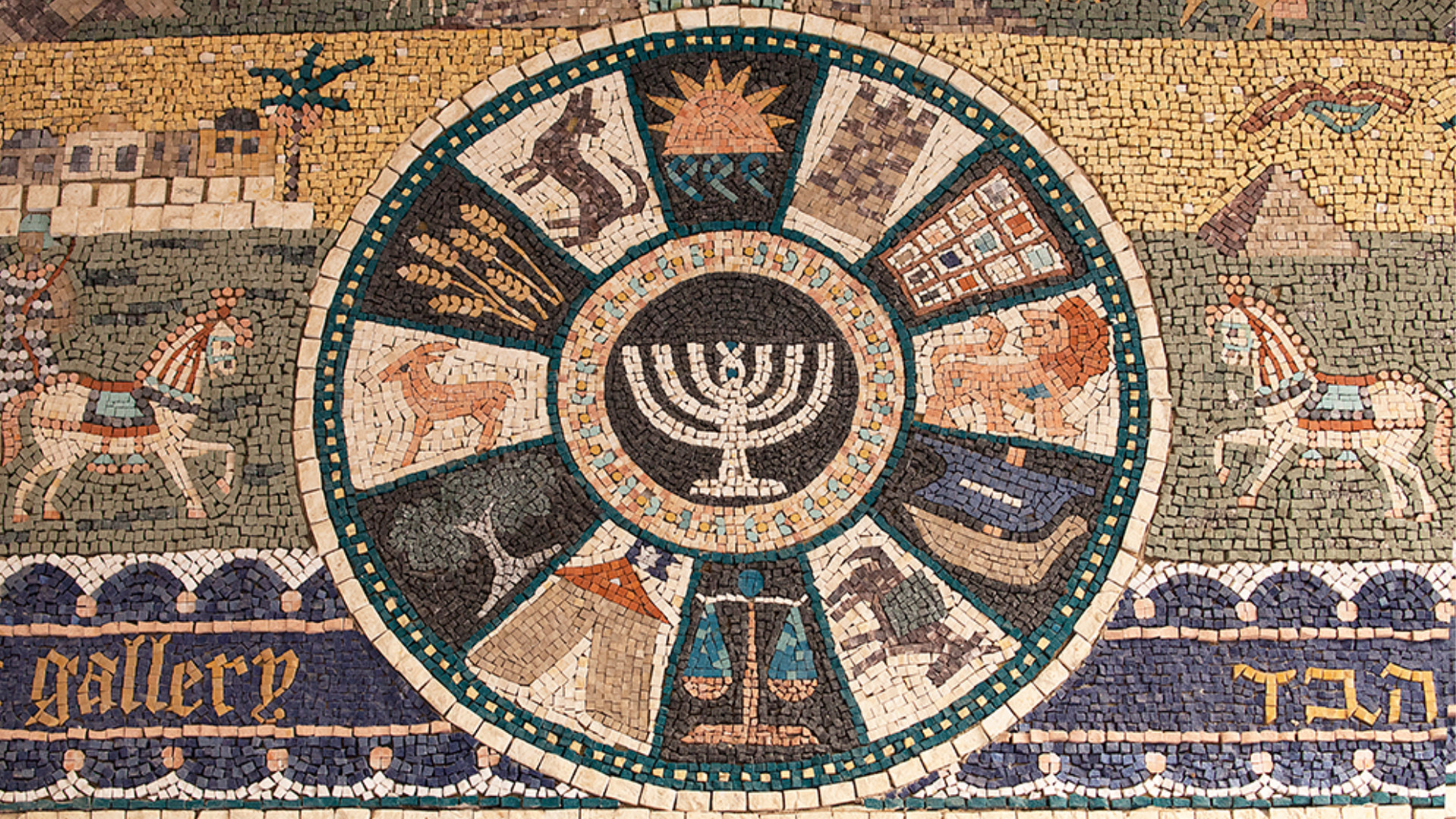
This number in 7:4 is derived from the list in verses 5–8, where John lists 12 tribes, each numbering 12,000. But when we look carefully at this list, we notice a few oddities. If we compare it to the 12 tribes outlined in Genesis 35:23–26, we discover this is no ordinary list of Israel’s tribes.
This is no ordinary list of Israel’s 12 tribes.
Judah appears at the top of the list in Relevation (he should be fourth). Manasseh replaces Dan, and Naphtali is elevated to the fifth position (he should be tenth). Gad and Asher are bumped up to the third and fourth positions (they should be eleventh and twelfth). Keep in mind, too, that the four tribes Dan, Naphtali, Gad, and Asher are the offspring of Bilhah and Zilpah—Jacob’s concubines.
Taken together, these modifications demonstrate that “the order of the tribes in Revelation 7 symbolizes the reign of Jesus, from the tribe of Judah; the incorporation of outcasts; and the exclusion of idolaters from the covenant community.”
Symbolism of the Number 144,000
Not only does the arrangement of John’s list carry symbolic weight, but so too the tribes’ numbering in 7:5–8 is freighted with symbolism. The number 144,000 could derive from 12 x 12 x 1,000, representing the fullness of the church, the true Israel of God (cf. 21:16). John has elsewhere taken up expressions that refer to Israel in the Old Testament and applied them to the church (e.g., 1:6; 5:10), so it makes sense for him to do so here.
The numbers in 7:5–8 also appear to be a census. This census in Revelation 7 corresponds to Israel’s census in the wilderness, where each tribe takes inventory of Israelite men 20 years or older, who are eligible to serve in the army to conquer the Canaanites (Num. 1:20–43; cf. 26:4–50; 1 Chron. 27:1–15). At the end of the census, we learn there is a total of 603,550 men (Num. 1:46; cf. 26:51).
When we read Revelation 7 in light of the book of Numbers, we discover that “each tribe supplies twelve battalions of a thousand men each.” God, in other words, has assembled a messianic army. Revelation 14:4 confirms this line of interpretation when it states that the 144,000 are men who “have not defiled themselves with women, for they are virgins.” Such language is found in the context of men ready for battle (1 Sam. 21:4–5).
Symbolism Applied
But God doesn’t assemble this army to wage a physical battle against his enemies. This is a battle bound up with Christ’s initial battle at the cross.
God has assembled a messianic army.
G. K. Beale contends, “The church is thus depicted in military terms as a remnant called out of the world to do battle for God. . . . They conquer their enemy ironically in the same way in which the kingly Lamb from Judah ironically conquered at the cross: by maintaining their faith and witness through suffering, they overcome their foe, the devil and his hosts.”
John deploys the symbol 144,000 to signify that God has assembled his church to imitate Christ and his victory. We must recognize that our spiritual and physical sufferings are the means by which we conquer sin, the Devil, and his minions.
Join The Carson Center mailing list
The Carson Center for Theological Renewal seeks to bring about spiritual renewal around the world by providing excellent theological resources for the whole church—for anyone called to teach and anyone who wants to study the Bible. The Center helps Bible study leaders and small-group facilitators teach God’s Word, so they can answer tough questions on the spot with a quick search on their smartphone.
Click the button below to sign up for updates and announcements from The Carson Center.
Join the mailing list »