




In the years since he was involuntarily committed to a mental health institution for bipolar disorder, Frederik deBoer has wrestled with both profound gratitude for a system that saved his life and also palpable frustration that his experience of healing has become so rare.
All in Your Head: Illness as Identity, Trauma as Fashion, and the Desire to Be Disordered is the latest broadside from one of the internet’s most heterodox thinkers and writers. As an “old school” Marxist best known for writing The Cult of Smart, deBoer takes aim at how the cultural drift within his own tribe is responsible for making mental health care so elusive for those who need it most: “The tendency to treat mental illness as an exciting adventure, the endless romanticization of lunacy in popular culture, is one of many aggravations I have nursed for years” (8).
The root of his aggravation—the treatment of mental illness and disability as an identity to be celebrated rather than a disability that needs treatment—isn’t all in his head. The use of talk therapy rose 47 percent between 2019 and 2024. A 2025 LifeStance survey found around 29 percent of U.S. adults have self-diagnosed their mental health condition after consuming online content, rising to 50 percent among Gen Z (versus 9 percent of boomers). Of the people who self-diagnose symptoms, almost a quarter (24 percent) “rarely” or “never” feel the need to take the next step to discuss them with a qualified clinician.
DeBoer argues that rather than reducing the stigma surrounding mental illness, the inordinate attention given to the mildly and dubiously afflicted is a dangerous distraction crowding out help for the severely ill. Accelerated by social media, this “gentrification of disability” has become a full-blown social contagion, compromising even the experts and institutions responsible for mental health care (153–54).
DeBoer is largely right, and the cultural shift he identifies has real-world implications both inside and outside the church. But the same ideological priors that so sharpen deBoer’s critique also suffer from two significant blind spots that, were they addressed, would make All in Your Head the more courageous, more constructive, and, therefore, more widely read manifesto we need.
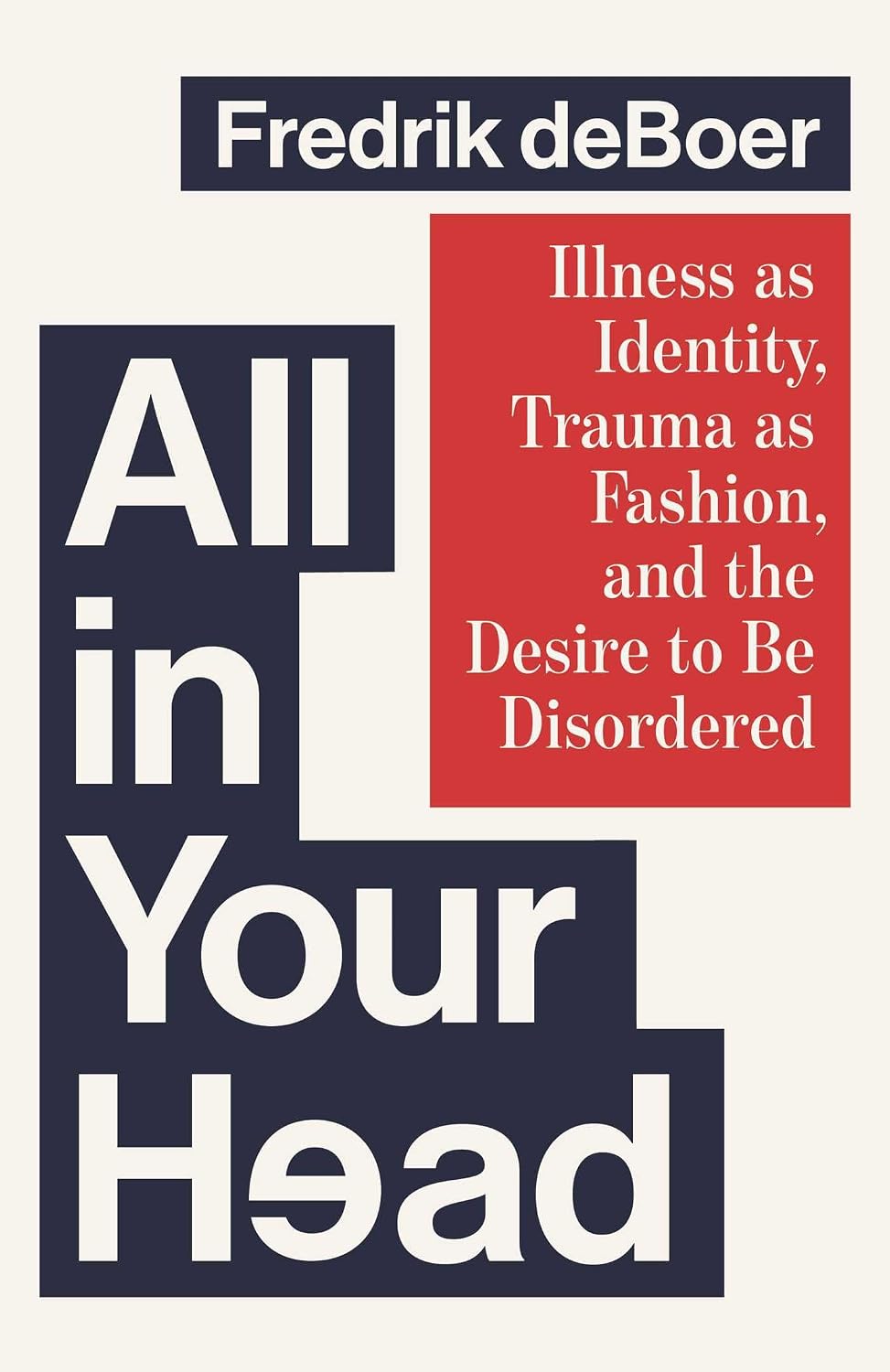
All in Your Head: Illness as Identity, Trauma as Fashion, and the Desire to be Disordered
Frederik deBoer
All in Your Head: Illness as Identity, Trauma as Fashion, and the Desire to be Disordered
Frederik deBoer
With All in Your Head, Fredrik deBoer offers a powerful and long-overdue critique of modern mental health culture. He shows how deinstitutionalization, a well-intended but ultimately doomed corrective to psychiatry’s early abuses, collapsed into a humanitarian disaster, leaving the severely mentally ill to cycle through homelessness, incarceration, and neglect. More recently, the “gentrification of disability” has turned mental illness into social currency, even as those with the most disabling conditions deteriorate on the streets. The digital age has only intensified this crisis, spreading implausible self-diagnoses through social media and turning rare disorders into identity theater, while the truly ill are left out of the conversation.
General Bipartisan Ire
If you picked up All in Your Head to understand how modern therapy culture spread like wildfire across social media over the last several years, it’s not immediately obvious why deBoer starts his argument with an in-depth analysis of the anti-psychiatry movement’s influence in late 20th century politics and academia. But, if you can forgive me the pun, there’s a method to his madness.
After a blistering critique of “rightwing libertarian” policies that neglected mental illness, he cashes in on the subsequent trust he earns with left-leaning readers to launch a series of absolute haymakers toward “a species of thought that sometimes amounts to a kind of leftist pseudo-radicalism or a libertarian fantasy” (198) that drives the “destabilizing . . . move from mental illness as reality to mental illness as symbol” (8).
American individualism and anti-institutional bias aren’t new, but the painstakingly specific way deBoer traces their spread through the culture surrounding mental health and therapy is refreshing and instructive.
Our “apolitical romanticism of resistance to modern society” fuels two opposite errors: On the right, mental illness is sometimes seen as either imagined or a symptom of weak character. But on the left, the same romanticism often describes mental disability as more enabling than disabling, as if neurodivergent minorities don’t need society’s help—society needs theirs.
Gentrification of Disability
DeBoer’s emphatic rejection of this predominantly progressive error— of “making a medical disorder an identity”—is the “overarching principle of [his] book” (165). This is never more clear in what he labels “the gentrification of disability,” where “diagnoses become fads” because the “intellectual and discursive space once dedicated to the interests of the most afflicted have become fixated instead on a class of patients whose disorders range from mild to dubious” (154).
Said spaces and institutions have become so compromised due to “the diseased incentives of social media” and “liberal conventional wisdom that says it’s offensive to question any claim any individual makes about a disability.” Combined, “we’ve created ‘disorder communities’” not unlike fan clubs “rooting for a particular sports team” (154).
The disproportionate attention given to those wealthy enough or high-functioning enough to perform their disability online is a dangerous distraction with real consequences: The more that influential elites use their status to “define the disorder in the public mind,” the more those who are impoverished or severely disabled go unseen and neglected.
The disproportionate attention given to those wealthy enough or high-functioning enough to perform their disability online is a dangerous distraction with real consequences.
Clear to anyone not living under a rock for the last decade is how familiar these patterns are. As I argued in The Reason for Church, counterfeit institutions (e.g., social media) have bypassed gatekeepers and hijacked the incentives of vital social and spiritual institutions undergirding American life.
All in Your Head won’t add many new tools for recognizing these patterns. DeBoer’s contribution is in tracing them throughout an often convoluted bureaucratic ecosystem from the perspective of a “crabby old Marxist” frustrated by the privileged hypocrisy of pop-critical theory and progressive politics. However useful, the same ideological priors also handicap his analysis with two glaring omissions.
Incomplete Diagnosis and Insufficient Prescription
His most obvious omission is the rapid rise of gender dysphoria diagnoses and sex-reassignment surgery for minors. For more than a decade, gender-affirming physicians have been telling parents they must choose between having “a trans kid or a dead kid,” but, as Rebecca McLaughlin points out, the evidence says otherwise: “Puberty blockers can make the mental health of some young people worse, not better.”
Considering deBoer’s impressive track record of taking unpopular, heterodox positions within his own tribe, his failure to address what is arguably the most volatile and life-altering consequence of toxic therapy culture is bewildering.
DeBoer’s second omission is more understandable. While he concludes with well-reasoned (if regrettably materialist and socialist) policy prescriptions, he doesn’t offer any remedy for the broader therapeutic culture (i.e., the “ideological commitment to radical individual autonomy” [77]) that he spends most of the book arguing is the root of resistance to reform. That neglect robs his policy prescriptions of much persuasive power.
Christians can affirm deBoer’s diagnosis of the problem of individual autonomy, but the church has the social and spiritual resources missing from all legislative and policy prescriptions. We know humans were never meant to construct our identities but to receive them in Christ and through belonging to our families, to our churches, and ultimately to God.
Church has the social and spiritual resources missing from all legislative and policy prescriptions.
Despite any omissions, All in Your Head is a clear-eyed and validating read, especially for those in (or disappointed by) mental health care. It would be a fine complement to Matthew Loftus’s Resisting Therapy Culture and describes many of the downstream problems Philip Rieff anticipated in The Triumph of the Therapeutic.
All in Your Head is “not a memoir” (8) but a pragmatic antimemoir seething with a holy discontent that challenges both performative mental illness and the also voyeurism that incentivizes it. The result is a concrete and compelling remapping of mental health culture with impressive explanatory power.