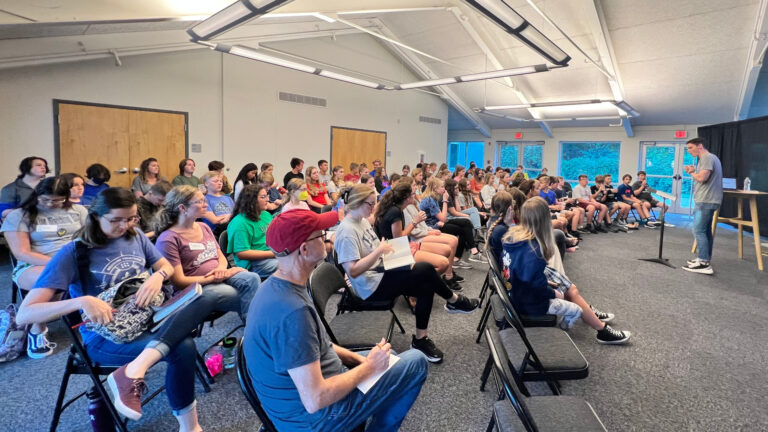



Does the gospel have the power to bridge the chasms within our polarized society? In the second of this two-part episode, recorded at TGC25, Bill Riedel gives pastoral reflections on how we can seek to be faithful in proclaiming the good news in our polarized contexts.
He talks about understanding disordered affections, cultivating an exile mindset among a congregation, and addressing political divisions within a local church body.
In This Episode
00:00 – Subversive gospel in a polarized world: introduction and context
03:08 – Personal background and church context
05:48 – Challenges and successes in church leadership
08:39 – Theology of Christ’s kingdom and kingdom citizenship
29:45 – Embracing life in exile and confronting disordered affections
42:29 – Subversive influence and commissioning the church
Resources Mentioned:
- The Spirit of Our Politics by Michael Wear
- Faithful Presence by Bill Haslam
SIGN UP for one of our newsletters to stay informed about TGC’s latest resources.
Help The Gospel Coalition renew and unify the contemporary church in the ancient gospel: Give today.
Don’t miss an episode of The Gospel Coalition Podcast:
Transcript
The following is an uncorrected transcript generated by a transcription service. Before quoting in print, please check the corresponding audio for accuracy.
Bill Reidel:
All right. Well, good evening. I understand that. Yeah, I’m about the same after drinking from the fire hose that Dr. Powell just gave us. It is a lot to take in. My task tonight is to try to make this and bring this to a practical level and have some examples of how this idea of the subversive gospel in polarized times has impacted our church and our approach to our church, and some things within the EFCA that have been important markers in leadership. In as we’ve tried to bring clarity in that venue as well, we’re in a time that it’s difficult to know exactly how to lead, how to teach, how to bring Scripture to bear in a way that isn’t going to fall into creating greater divides, and so we’re going to solve that tonight. So the and I hope to give you a realistic look too. I mean, you’re going to hear about a lot of the the good things and successes along the way, but that that has come with great cost too, and plenty of of pain as in error as we learn. So great reminders from Dr. Powell today. I’m it is an honor to be at all associated with David, let alone to be asked to speak alongside him today, and to follow up after him, and so I’m going to pray, and we will continue on. Well, Father, we are thankful for the chance to have space and time to hear Your Word preached from Ephesians throughout this conference, to be able to worship together, to be able to hear breakouts on theological issues and ethical issues, and and on practical concerns, and so tonight, as we take this time and have heard from your word to see the ways that Christ Himself was subversive and made a way for us, and showed us what it looks like to follow Him. And so, would you move in our hearts? Would you speak through Your Word as we read it tonight? Would you help us as we try to navigate the place that we live, the world that we live in? Would you help us to trust and to have confidence that you have entrusted this time to us? It’s not an accident that we are here as your people for this time. Would you give us the courage to proclaim the one true King, the one true benefactor, Christ? We pray in His name, Amen, Amen. Well, John mentioned that I am founding and lead pastor of Redemption Hill Church. We meet on Capitol Hill. I get asked often, so where are you in the Are you in the D.C. area? I’m like, well, we’re four blocks from the Capitol, so very much in the area, right in the middle of it. On january 6, a couple of years ago, a few years ago, our church building that we meet in was inside the security perimeter that was established, so we could not hold services that weekend because we weren’t sure that people would be able to get to the building because they’re ID checked. So as far as proximity, that’s where I live. We live in the neighborhood and have for 15 years now, which is kind of freaking me out. It doesn’t feel like that long that we’ve been there, but we moved in the summer of 2010, planted out from Cornerstone Church in Anadale, Virginia, and so we are kind of in the heart of things. And there is much more to DC than politics. It is a metro area of over 6 million people, and. And there’s lots of other jobs and other interests around the area. I tell try to tell people who aren’t from D.C. that ask me regularly, like, “Oh, you have like lots of politicians in your church. We don’t. They usually go home on weekends. And there’s a lot of us that live in D.C. that aren’t the 535 or 7 that you’re mad at. You can have them back, and we’ll be just fine. And so, but our church-it is in the air. It’s it’s unavoidable, and it’s become unavoidable across the country and across the world. Last night, I met a couple of guys in the hotel lobby, and as I was talking with I think it was Kurt and Mike. They asked what I do, and they and they had no.
This happens to me at home too when people are saying, “So what do you do? and I’m a pastor, and they’re like, “I don’t, I don’t know what to do with that. But as we started talking, Kurt at one point said, “You know, I think the problem that our world has and our country has right now is that people have given up on faith and religion, and they’ve made their religion politics. And I was like, you could teach my session tomorrow night. And so it’s not something that’s just being noticed by Christians and by those of us who are faithful to Christ and in faithful and cling to the gospel is our hope. This is something that’s being seen across the board, and so it’s certainly not a time for us to shrink back. And our church, just for a little bit of background, it’s incredibly diverse politically. We have a very even spread across the aisle, but our people are very ideologically driven. That has not come easy. It’s been an emphasis point from the very beginning. I didn’t realize when we moved there how rare that was and how much rarer it was about to become. But we-it’s something that we talk about a lot as a church that we emphasize in membership classes. Now, along the way, there have been plenty of mistakes and missteps and plenty of cost and conflict, but we’re still standing, and it’s been worth it to establish a culture within the church that actually shows the beauty and the grace of the gospel, where people are able to come alongside each other in complete disagreement on policy issues in the same community groups, so that we have you know instances where we’ll have one community group meeting in people’s homes through the week that has staff members from Mitch McConnell’s office and Ilhan Omar’s, and if the gospel isn’t able to break down those dividing walls of hostility, then I don’t know that there’s any hope for them to come down. So that’s a little bit of background. I think that that Dr. Powell’s take and what he just led us through in First Timothy is beautiful and shows us the approach of the New Testament authors. That there’s there’s very little information that you can find in the New Testament of the apostles raising their fists against the empire and decrying the sins of Rome, but you do see a gospel proclaimed that is subversive. You do see intentionality in undercutting the assumptions of people throughout the empire and in the cultural context that they are in. And so, I’m going to work to try to make that practical tonight. I’m in the time that I have, and I want to you know asking questions like, “How do we lead God’s people through and in polarized times? What can ministry look like? How do we handle it as pastors and leaders in churches? Don’t need to be a pastor to be a key leader. How do we lead people to a Christ-like posture and life? And how do we encourage our people to embrace a subversiveness of the gospel in this time. One of my favorite passages, so I’m just going to make this our root text for the night, since I am a preacher at heart. Is out of Joshua five in verse 13. Joshua was by Jericho, and he lifted his eyes, and behold, a man was standing before him with his sword drawn, with a drawn sword in his hand. And Joshua went to him and said, “Are you for us or for our adversaries? And he said, “No. So it’s not just in the New Testament either. If there’s any point that you would expect a different answer, it would be when they’re at Jericho, after 40 years of wandering around, and so leading and living this subversive gospel or polarized times, there are-I just don’t know how this fell together-but I end up with 5c’s for us that we’ll walk through, and we’ll see them as we go. So first, we need to cultivate a theology of Christ’s kingdom. This is the starting point. If this isn’t embedded into our perspective and our understanding theologically of what it means to be a follower of Christ and what it means to be a Christian, then we’re not going to be able to have the the deeper, more practical.
Discussions about issues and of our time, and so there. If if you are in church leadership or trying to even with friends and other people that you know, if you’re looking for where to start, you have to have a foundation of kingdom theology, and you can’t just jump to you know making outright statements against or for things, if that foundation doesn’t exist. The truth is that we can look at our times, and we always like to talk about the uniqueness of our times and how it’s unprecedented. Which I would love to live in some more precedented times for just a little stretch. It’s been a lot over the last several years in D.C. but Jesus’ time was pretty polarized. I mean, he had Simon the Zealot and Matthew the tax collector together. That doesn’t make sense. So when I get asked by people and challenged by people, like, “How can you have a Democrat in your church? or “How can you embrace Republicans in your church? I’m like, “Well, Jesus could do it. He had one guy that was big government, wanted the state, and was working for the state. One guy that was ready to get military and angry to overthrow it. It’s not that different. But he preached a greater kingdom. We see that in Matthew, especially Matthew’s emphasis on Jesus as the true King, that that he preached the kingdom of God. That the whole Sermon on the Mount, I’m sorry, I just started it on Sunday, so it’s very fresh in my mind. The entire Sermon on the Mount is the the inbreaking of the subversive kingdom of Jesus. It shows us the upside down nature of his kingdom when compared with every other kingdom on this earth, he refused to let people make him their king on his terms or on their terms, and so, like John six, after he had fed a whole crowd of people, fed 5000 people, and a group of men were ready to 1000s of men were ready to take him and make him the king, and he just slipped away into the mountains. We see. I think it’s amazing that even when you get to Acts chapter one, that the disciples who have been told everything the whole way along, you get to Acts chapter one, and still their question to Jesus is, “Is this the moment? Are you going to overthrow Rome now? And that’s enough for Jesus to say, “I’m out of here. I’m done. And he goes to the sky. But it’s because he’s assuming his actual throne. He didn’t come to overthrow Rome. If what we needed was a king to overthrow the government, God would have sent that. But it wasn’t a politician and a political leader. It was the King of all kings, the Savior of all things, the one who is making all things new, and so, and and he refused violent confrontation with lesser powers. Dr. Powell just showed us how he, you know, the good confession in First Timothy that he made before Pontius Pilate, and don’t forget though that in Gethsemane that his disciples Peter tried to make it a fight. I mean, there’s no other way to look at it. That he you know he has the moment where he washes the disciples’ feet. He he they have the Last Supper. Judas slips out after Jesus says like somebody who’s dipping bread with me is going to about to betray me, and they’re all looking around and confused. And then it’s it’s amazing that that he says, “All right, now is a time when you can take a sword, and that’s like all the disciples hear. He’s like, “But this is the moment when all of redemptive history is about to come to its to its climax, and they say, “Well, we have a sword, and I think it’s still true that God has given the government the sword, and the church the keys, and whenever the church picks up the sword, people get hurt, and it is not the way of Christ. And he had to stop it and heal Malchus’s ear, which I’m convinced the reason we know Malchus’s name is because he had to have been a Christian after that. In First Peter, we see this that Jesus entrusted himself to the Father.
Right after Peter says to us, he says, “You know, you need to submit yourself to governing authorities. He never tells us to fear them. He says, “Fear God, love the brothers, and submit to the emperor. But then he goes on, “For to this you have been called. Oh, I forgot I’m running my own. To this you have been called because Christ also suffered for you, leaving you an example so that you might follow in His steps. He committed no sin; neither was deceit found in His mouth. When He was reviled, He did not revile in return. When He suffered, He did not threaten, but continued entrusting Himself to Him who judges justly. He Himself bore our sins in His body on the tree, that we might die to sin and live to righteousness. By His wounds you have been healed, for you were straying like sheep, but now have returned to the Shepherd and Overseer of your souls. So, if we want to know how to live in polarized times. We have the answer right here. Christ has shown us, and He’s made the way for us. The apostles lived in polarized times. The division was a constant threat in the early church. That’s why we have most of the letters to churches. It’s because stuff was messy, and they were dividing among God’s people, and so we see this all the way through, right through Acts in chapter six. You have you have ethnic and racial divides with Jewish or Hebrew Jewish people, widows and Hellenistic Jewish widows, and they’re not getting served equally. And so there’s conflict in the church right at the start that has to be addressed. Acts chapter 10 and 11, where Peter goes to Cornelius’s house, and but before that, he’s at Simon the Tanner’s in Joppa. Which imagine this, like over. This is one of my favorite parts of Scripture because it’s in overlooking the the harbor there in Joppa that the sheet vision of the sheet comes down, and that is why we can eat shrimp cocktails and bacon, and it’s it is just that moment in scripture. If I could be there, it would be one of the moments. But then he gets back, and if you read chapter 11, he got back, and the his the people back in Jerusalem were angry that he ate with Gentiles. And he has to go through the whole thing and explain to them, yeah, they actually received the Holy Spirit too. We see it in Acts 15, a Jerusalem council called on where to draw lines, as Paul and James had different approaches to things. In Ephesians chapter two, where we’re called fellow citizens and saints, which we heard preached here at this conference, in Christ’s kingdom. Colossians three, when Paul is saying, you know, listen, barbarian, Scythian, slave, free, we are all one in Christ, and of course in Galatians three, all one in the promise to Abraham that we are brought into the family of God. We see it in religious observance that whether to be circumcised or not be circumcised, and what it means and doesn’t mean. We see it in people wrestling with food laws, and so there were all kinds of divisions within the church, but the apostles didn’t hesitate in addressing them and calling people back to the gospel, and so we in June 2003, so two years ago, we in the EFCA. So this is on the EFCA side of things, had some things that were coming up, like most movements right now, and some some challenges that were being raised. And so we produced a statement that was called a statement of denials and affirmations, and that it was. I learned after after this document was produced, that it was the first time that the EFCA’s board of directors and board of ministerial standings had ever released a joint statement, and it was read by Kevin Complin, who was president of the EFCA at the time and before he was moved over to Trinity, and and it felt risky because we took on some things that people didn’t want to take on, and but needed clarity on, and so it felt like a massive risk because we took on eight issues, which those issues were that QR code. By the way, will take you to the EFCA’s website if you want to see the whole document.
The issues we took on were these eight? So if you could pick more controversial ones, I’d love to hear them. But we decided we should address social justice, wokeness, critical race theory, Christian nationalism, Christians in politics, gender dysphoria, men and women in ministry, and eternal conscious punishment for good measure. And in that, though, if you go to that QR code and pull up the statement and read it after this session, obviously, the the what you’ll find. I hope you’ll take time to read the introduction and the summary and the and the appendix because the information around the eight bullet points is more important, I think, than the bullet points themselves. The bullet points are addressing particular issues, but we’ve had the questions like, “Are we going to codify this more fully? And the answer is no, because we don’t know how many how long these terms are even going to be used. But the posture of it and saying there are times when it is necessary to defend our ministries, like Paul does in his letters in times when we need to give leadership and clarity in the midst of confusion. So the explanation, the summary you’ll see after the eight bullet points, essentially says we will not allow ourselves to be defined by any social movement over and above God’s word. And so, how do we approach things so that we’re able to address what is good and bad, what we can take or in leave in these controversial issues, and that is the appendix of saying we need to have a sick at non mindset, meaning yes and no, that we need to help people learn how to process and take in information because. Most of the discipleship that Christians get through the week is not Christian. As a pastor, I’m very aware that I get, you know, depending on the Sunday, 40 to 60 minutes to be able to invest into preaching ministry, but that doesn’t have anything close to the podcasts people are consuming daily, to articles and news sources, especially as people get more myopic in the sources they have, and we have greater echo chambers created by algorithms. And so this mindset isn’t just the third way middle road for middle road’s sake, like it’s a mushy thing, but instead it’s saying no. There, that’s not helpful to just be middle for middle’s sake. But there does have to be a third way, and and when we see things, we need to be careful not to just say all yes or all no because either they use language that we’re not used to, or the people that we look to for information hate or love it, and so there’s way too much too often I think that we can hear something and it’s like, well, this podcaster said it’s awful, so therefore it is awful. Instead of engaging it, and so instead saying in these issues, let’s learn to say yes to what truth we can find, and then have the courage to say no to what we must. And so there’s an example of that. Oh, here’s by the way. Sorry to put more of these up, but the second one, the bottom one, is a biblical commentary. We produced biblical commentaries to all eight points that expands them. And so the ones on because this I think is most pertinent to tonight, on the bullet points on Christian nationalism and politics, I’ll read for you. The first one says, “We are not Christian nationalists who believe the federal government should declare the United States a Christian nation, or believe that Americans are God’s chosen people, but we do believe that a patriotic love of one’s nation is appropriate, and that Christians should be good citizens who may freely advocate for God honoring public policies. We do not believe that political means can establish the kingdom of God, but we do believe that God has appointed governing authorities to do good, and that for citizens in Christ’s kingdom, King Jesus’s rule and reign transcends all other citizenships. Here’s those two, and so sorry, King Jesus’ rule and reign transcends all of their citizenships and partisan ideologies, and transforms how we live in the world. So this is an example of two of the eight bullets. So you got a quarter of them. You’ll have to go to the site for the rest.
But this was a way for us as leaders that we felt a burden to say, okay, these are things that need to be addressed. Like we don’t want to see this movement splinter and divide, and and not have at least taken a shot at bringing clarity and understanding and unity and trying to give definitions to words that are completely definitionless, and just used however someone intends them, but nobody intends them the same way. And so this was an attempt that we had, and again, it felt risky at the time, but it was received with a standing ovation, and it has been widely used by people in pastoral searches in churches. We’ve heard of pastors that have preached series through these things, and so it’s an example of where we got one right: that leadership and clarity were needed for a particular moment, and the boards of the EFCA didn’t shrink back from taking that risk. We didn’t want to just show what to think, but we wanted to help people learn how to think better. And so that’s one of five. Now number two, we need to cultivate a theology of Christ’s kingdom, and second, call people to greater kingdom citizenship. And so that’s the two statements that I just read. But this also comes from Ephesians chapter two. So then, you are no longer strangers and aliens, but you are fellow citizens with the saints and members of the household of God, built on the foundation of the apostles and prophets, Christ Jesus Himself being the cornerstone, in whom the whole structure, being joined together, grows into a holy temple in the Lord. In Him, you are also being built together into a dwelling place for God by the Spirit. So, the idea of kingdom citizenship isn’t isn’t foreign to the New Testament. It’s baked into an understanding of what it means to be a Christian, and and we see that in Ephesians and and it we and so that’s the things we want wanted to be able to emphasize through the denials and affirmations. Another way that we’ve addressed this more recently in our church, we’re in Capitol Hill, and so the I think. Many places right now have been touched by job uncertainty for federal employees and contractors and educators that are connected with federal grants, and it’s been a really tense time in D.C. It’s we have a lot of people whose jobs have been taken and then given back and then maybe taken again or just laid off, or we’ve had we have people that have been escorted out of their offices and then called the next morning and said we made a horrible mistake. Come back. Somebody has a PhD in Chinese war strategy. We probably want them at work. And so it’s been really hard. And it’s these are the moments for our church that get most tense. It’s not usually election season. That’s what people assume, but this is when it’s hitting home and livelihood. And so there were some things beginning to percolate in our church, and and the guy was feeling that. And so I went to our elders and said, “Hey, guys, we can either wait for something to pop and then have to clean up a mess, or try to get out in front of this. And it’s hard, right? This is wisdom in in ministry and in leadership. Is is there’s no like clear manual in the New Testament for when to speak up and when to not and what to speak up into. And this it takes wisdom and the guidance of the Holy Spirit and some you know some fires you want to let burn themselves out and others if you don’t take care of it it’s going to burn the city down and and so we decided that the elders would write a letter and try to speak into the building tensions in our church and the content of the letter is going to be posted on TED’s Center for Transformational Churches, and so if you want to see it in fullness, it’s at transformationalchurches.org. And here’s a shameless plug: the TED’s communications team sends out TED’s bulletin regularly. It is a it is an incredible resource that will hit your inbox, your email inbox. It is not just trying to get money.
The TEDs could use that too, but it is it is it is giving resources and articles and insight and videos and on key cultural and theological topics that we have an incredible resource in TEDs that we want to be able to have speak into things this way, and so you can sign up for the TEDs bulletin also on the Trinity’s website. So, but in this letter we could feel that simmering tensions, and we wanted to get ahead of it and give the church guidance, and and so we we sent it out to the church again, kind of one of those moments where you’re like, okay, we’re going to see how this goes, but it it helped our people gain clarity and understand how we can walk through this together. Just a couple of quick excerpts from that. It said, “Redemption Hill, things are tense right now in our city. It’s not the first time that we’ve faced partisan friction and deep divides in the political arena, but our current moment has challenges that are only made clearer and sharper because it is deeply personal for many in our church. We can have good faith discussions and even robust debates about government spending and fiscal responsibility and which programs are valuable or what responsibilities the government ought ought to entail. Different people in our country will come to sharp disagreement on a variety of difficult issues and how they might be addressed, the tensions people in our church are facing are not merely partisan; they are personal. Sweeping changes and the potential for more at both federal and local levels in D.C. are having a real impact in people’s lives. Christians of all people ought to be the strongest and clearest critics of their own side in politics, we need to rise above what James Davison Hunter calls the crudest simplification of public life, and see that the common good is always more than its political expression. Our citizenship in Christ’s kingdom, in His reign, in our hearts and our lives, and all things can free us from finding hope in policy, so that we can engage in our work and see people through the lens of the gospel. And so we ought to be able to say that government spending ought to be reined in, and the chaotic approach right now is doing real harm. That immigrants are human beings made in the image and likeness of God, and governments are responsible for maintaining borders, that truth matters, and efforts to obscure the truth are wrong, whatever the party; that the ends don’t justify the means, whatever the party. So then it goes on and closes by saying, “Please join me in praying for our city, our nation, our governing authorities, our church, and our world. Let’s commit ourselves to immersing in, let’s commit to immersing ourselves in God’s word and finding our hope in Christ, pleading that the Spirit will move in power in our own hearts and through our church into our city. Remember that God gave us not a spirit of fear, but of power and love and self-control, that we can bring all our cares and worries to God, and trusting that our good Father cares. For us and will care for us. So this is just a little bit of excerpts, but I wanted to give really practical examples when I say like we want to bring leadership and be and speak into things as leaders in a church and not shrink back from them. I think that can all sound nice, and then it’s like okay, what does that mean? And so that’s one example that that I thought might be helpful. The third point that I that I think we ought to call toward is first, cultivate a theology of Christ’s kingdom. Second, call people to a great to greater kingdom citizenship, and third, convince people to embrace life in exile. This is language that Peter uses in First Peter two. But you are a chosen race, a royal priesthood, a holy nation, a people for His own possessions. Possession. So this is language straight out of Exodus 19 at Sinai, as and as Peter is talking and applying those titles for God’s people to the church and to Christians. He says, “Why? Why are we those things?
Well, it’s so that it’s for the sake of worship, so that we might proclaim the excellencies of Him who called you out of darkness into His marvelous light. Once you were not a people, but now you are God’s people. Once you had not received mercy, but now you have received mercy. And so, beloved, I urge you as sojourners and exiles to abstain from the passions of the flesh. So Peter uses all this Old Testament language from Sinai at the first paragraph, and then he uses this language of sojourners and exiles, which is calling on Jeremiah chapter 29, where Jeremiah 29, when God says to Isaiah, this is incredible passage, right? That that chapter 28 has Hananiah the false prophet coming out with a yoke of wood and breaking it, saying, “Hey, everything’s going to be great. God’s bringing you home. And God says, “Jeremiah, here’s the letter you need to write. You’re not going anywhere. It’s going to be at least 70 years, and most of you’ll die there. And God doesn’t even shirk it. He says, “I’m the this. I’m the one who sent you into exile. But the calling he has on them is as which I think familiar to many of you, when he says, “Build houses and live in them, plant gardens and eat their produce, take wives and have sons and daughters. Take wives for your sons, and give your daughters in marriage, that they may bear sons and daughters. Multiply there, and do not decrease. But seek the welfare, the shalom of the city where I have sent you into exile, and pray to the Lord on its behalf. For in its welfare and its shalom, you will find your Welfare. He goes on to say, “Don’t listen to the false prophets. And then the well-known verse that was really popular in the late ’90s, right? “For I know the plans I have for you, declares the Lord. Plans for your welfare, your shalom, and not for evil, to give you a future and a hope. And then he tells us what the future and hope is. If you just read to verse 12, then you will call upon me and come and pray to me, and I will hear you. You will seek me and find me when you seek me with all your heart. I will be found by you, declares the Lord. And so, and then he talks about restoration for the people. And so, this is the background of what it means when we are called sojourners and exiles by Peter. But too many Christians have bought, and it’s too tempting in our own hearts. I mean, my heart, if if we’re going to be honest about these things, it’s too tempting to hear that and go, “That’s nice biblical language, and buy into the false prophecies of Hananiah for our own lives. That we say, “Okay, that’s nice, but wouldn’t it be better to be in a position of power than to be in exile. Well, that’s nice, but wouldn’t it be better if we had the control, and we neglect the reality that this calling of life in exile was used by the apostle Peter for a reason, because we are in Christ’s kingdom, our citizenship is in a greater kingdom, and we are soldiers and exiles here. That’s not going to change, and most of us will die here before the Lord makes all things new. And so, recently, actually, Dr. Pao recently shared a devotional that I have completely adopted. In I’ll call it kingdom collaboration. That’s stealing. But pointed out, I mean, just incredibly brilliantly that that if you read Deuteronomy chapter 20 and its instructions for the people coming into the promised land, that in Deuteronomy chapter 20, God gives instructions for times when people are exempt from holy warfare, and that people are not to go to war when they have built a new house, planted a new garden, a new vineyard, or just gotten married. The exact three calls enter. Jeremiah 29, and so I recently brought this to our church and said, much to their surprise, that means for us DC is the promised land, which nobody thinks the cost of living alone. But what Jeremiah, what God is saying to the exiles in Babylon in Jeremiah is, you are not called to holy warfare in this place.
The exemptions from warfare are to build houses and plant gardens and have children, and get married and have your have sons and daughters and have them get married. So, so that’s what you’re supposed to do here. You’re supposed to live in peace and shalom, and bring welfare and receive it at the same time. And so, we as Christians need to hear that. That embracing life in exile means we are not in warfare over the culture of this world. God has entrusted this time to us, but we are exiles here, and so let’s invest into the good of this place, and lay down the sword. This this to start this year, I preached Esther. That was my plan in July before the election had happened. So it was regardless of whoever might have won. I thought it might be helpful, and it got creepy. We called it sovereignty in the silence, and it led us through January and into February, and it helped us to be able to look at living in exiles under power that does not reflect the values of Christ’s kingdom. How do we do that as Christians? And we go to Daniel often, but we forget that that Esther is showing us the same kind of scenario just later in time. It was a timely look because in that book we see God’s people in no positions of power when the whole city and empire is thrown into chaos. There’s reversal themes showing that Mordecai goes from forgotten and shamed to honored, and to a position of influence. That you have Haman goes from honored to shamed and exposed and eventually dead. You see the nature of justice. That human justice is often limited just to accountability, where God’s justice brings restoration. And what happened after it all? Well, there’s celebrations. A new feast was implemented in Purim, and the people were still in exile. So, as we look at our lives, we need to convince ourselves and our people that we actually embrace life in exile. That if we cultivate a mentality of alignment with earthly power and structure and control, or demand or expect a fullness of Christ’s kingdom to come through earthly power, structures and controls, then we will see people, our people, choose sides and divide, and people are more likely to be comfortable with those who share their politics than their faith. That’s a problem. That’s a discipleship issue, and that when you can be more comfortable with people who share your politics and not your faith than the reverse of people who share your faith but not your politics. But if we cultivated exile mentality seeking the shalom of this place, I think we’ll be able to see people grasp unity in Christ and love for our neighbors. All right, number four, and I’m going to keep going. Number four, confront disordered affections. So we need to cultivate a theology of Christ’s kingdom, and again, the order here is important. Christ is the King; we are citizens of His kingdom under King Jesus, we we are in exile, and we need to be willing to confront when there are disordered affections in our own hearts, in the hearts of our people, in the world around us. I think that’s what we saw so brilliantly laid out from First Timothy chapter six, is looking at an entire system of benefaction and in haughtiness and love of money, where like meekness, the opposite of haughtiness, was actually despised by the Greeks and Romans. Like that was not a good thing. That’s what slaves did, and it was beneath those who had had means. And so it’s for Christ again. Everything gets turned upside down, and we too easily divide the body of Christ along worldly lines. Again, like we need to remind people, there will be Republicans in heaven, and there will be Democrats, and Independents, and Libertarians, and Socialists, and the the we could go on and on. And I can picture people in my church for all those categories I just named, but the standard isn’t their politics; it’s Christ, and so we need to be careful that way. Michael Ware, a good friend in the D.C. area, said in many cases our perspective has been so thoroughly shaped, or even decided. Dipled by worldly ideologies, that we mistake our flawed ideological positions for Christian positions.
And in his latest book, *The Spirit of Our Politics* which basically says, “Hey, if you’re upset about politics and the state of our politics, look at your own heart because it starts with us. Summary of the book, well worth your time, but he says there aversion is the tendency to dislike or and distrust those who we who disagree with us politically, particularly those in a different political party. This aversion is toxic for our politics, but as we’ve seen, it creeps into the communion of believers as well. The very thing that ought to make Christians identifiable to the world, our love for one another is overridden by our politics, thus undermining the testimony of our faith. We don’t have the option, if we’re in Christ, to hate a brother or sister on political grounds. Bill Haslam. So, if you think Michael is a little too left as a Democrat, here’s the right. In his recent book, Faithful Presence, the same kinds of themes as Michael were coming from James Davison Hunter and others, and Bill Haslam said, “It’s my hope that Christians, in being faithful to the role God has called us to, will become people who help heal the political differences that are ripping our country apart. It’s my hope that rather than reacting out of fear of what we might be losing, we will engage as people who are committed to serving in the public square for the common good. While there will always be legitimate areas of disagreement among some among Christians in our political views, I am convinced that there are some things where our call is crystal clear. And so, when we allow and allow earthly things to become our primary focus, that’s called Idolatry, and I think that the guys I met in the hotel lobby last night that are here for a different conference and couldn’t believe there were 7000 people here for a pastor’s convention-that they were right. They saw right through it too. People have given up on worshiping God, and this guy that said he’s not religious at all, but religion, our religion of our nation, has become our politics, and too often it has crept into the church, and so we need to be willing to confront that in house first. I mean, again in Second Peter, right? Judgment be it’s time for judgment to begin where house. of God, and so if we’re not willing to call that out in our own hearts, in the hearts of the people that we’re a part of in our local churches, then we’re actually doing a terrible disservice because we’re allowing them to continue in idolatrous sin and not helping them to cut those ties, so their hearts can have rewired affections to Christ. And so, in this, there’s we need to teach people in the church to identify the weaknesses of their side, and that’s one of the things you may have caught in the letter, the portion of the letter that I read that went to our church that we we call our people to regularly is you should you should be the best critic of where your side falls short. You should be able to lead the way there, and be able to represent others in ways that that they would at least agree are a fair representation of their views, if not a better presentation than they can give. And so, in this, we we we try to teach our teach our people how to identify weaknesses on their own side. One of the things that we have that I think has been helpful is to understand the way that our political idolatry can actually shape our theology and our approach to the narrative of the gospel. So I’m just going to take a couple of minutes here. I don’t want to run too far over, but I want to, but a couple of minutes here. And so that that QR code takes you to TGC article. So I feel even better about that one because we’re a TGC conference. But it’s an article called “Don’t Gut or Truncate the Gospel, and what it what it says is essentially this: that when we think about the gospel narrative as creation, fall, redemption, restoration, right? This is what this is the storyline of Scripture. That the gospel is not just death, resurrection, believe and respond.
Speaker 2
That that Christ is the core of everything, but the story of who God is and what God has done across eternity is is in what we would call the gospel, and as as we theologically think about things, I I hope that we would all agree here that we need to be able to preach this whole thing. Like you can’t just decide, you know what I’m going to emphasize creation, but I’m not really going to talk about the fall. Yeah. I’m going to talk about creation and sin, but let’s just kind of skip the bloody stuff and get to restoration. Like we know implicitly, if you’re a Christian, that you see this and you go, “Yeah, we need to teach the full counsel of God’s word. I think too often our politics can actually impact our theology in ways that are sneaky, that are subversive the wrong direction, and so when I’m trying to help our people to be subversive and understand the subversiveness of the gospel, these are things that I that I mean the slides come right out of a sermon in our church. That’s why it’s so different than in appearance than the other ones. But I want to be able to show people like how do we think, how do we understand what’s happening, and how do we understand and capture and identify the the idols of our own souls? Progressive Christianity has a tendency to emphasize creation and restoration, and so it’s this idea of the result, if taken far enough, is a social gospel. We must bring the entire kingdom, eternal kingdom, now. We must bring the full restoration of all things now. We must see all justice now, all pain and suffering eliminated now. And so, there’s a great emphasis on the world that God has made and has given us on the on the goodness and image and likeness, the imago Dei in human beings, in the need for restoration and what we’re longing for in the coming kingdom, but get really uneasy when you start talking about sin. That you start talking about penal substitutionary atonement-that’s really uncomfortable. It’s messy. People really need to hear in this mindset how to be better citizens and and you know work for justice. And and if you if you gut the gospel this way, so that you’re not talking at all about individual responsibility and sin and redemption, then you’ve gutted it, and you might make disciples, but they won’t be disciples of Jesus. And now conservatives have a tendency to truncate the gospel, fall and redemption, and so a political perspective that emphasizes individual responsibility over systemic and and and broader issues also results, in its extent into easy believeism. You’re a sinner. Repent. Go to heaven, and it ends there. What else do you have to do? You sit back, and there was a there was a Christian punk band in the early ’90s that said that had a song. The world is like an ice cream sundae. It’s all going to melt someday. Cool. Don’t know what you do with Romans eight on that one. That all of creation is groaning, longing for the day of its redemption with the sons of God, and so we need to be careful here because on a conservative side, you can you know you earn your salvation, then you sit back and relax, and what a friend you have in Jesus. And when things go bad, you ask Jesus to help you out, and remember this place isn’t worth the effort, because and you can hunker down in your own bunkers and just wait for the return of Christ. And what you miss is the beauty of creation, the joy of just life day to day that God gives us the beauty of the city. Tim Keller regularly said that in cities we have more image of God per square inch than anywhere else on Earth. If you start hating cities and only only seeing evil sides of them and not seeing the people there, like this, it gets ugly quick because you’ll miss the image and likeness of God and others. You’ll miss restoration and the idea of seeking the shalom of the city that Jeremiah, that God called the exiles to through Jeremiah, and that I think Peter is applying. You miss out on that because what is there to restore?
And so I want to be practical here too, and I’m going to take the risk And I guess here we go. Let’s talk about abortion, poverty, and race injustice. I think that on a conservative side, there can be an overemphasis on abortion. That this is only about sin and repentance. We can’t let promiscuity lead to killing babies, and we need to legislate now to stop the sin. On the progressive side, there can be an overemphasis on societal and systemic issues, saying this is only about the mom. And what have we done as a society to put her in a position to ever seek something as difficult as an abortion is what needs to change so that’s never needed. As a Christian exile, I don’t want to have to choose one of those or the other. We can say there is a reality of sin, and there’s a reality of systemic. Brokenness, because people set up systems, and they are sinful. And so, whatever we can do to care for women, so that abortion is unneeded and unthinkable, while also doing what we can to minimize the carrying out of that procedure, then this is an imago dei issue of the image and likeness of God, and we need to do whatever we can, but let’s not just limit our efforts to either legislation or societal change. Poverty, the conservative side is more likely to say, “Put yourself up. You bear responsibility for yourselves. You got yourself into this mess. Progressives are more likely to say there are systems of injustice that make a drastic impact on individuals, even to the point of saying there’s no responsibility for where you’re at. The gospel says, “Love your neighbor, and have compassion for the poor, and seek justice for the oppressed. It doesn’t neatly fit the kingdoms of this world. Race and justice. On a progressive side, I’m just going to do a little switch so you don’t feel like I’m hammering one side or the other. Progressive side, you might hear something like, “Your identity is unalterably determined by the intersection of your ethnicity and gender and sexuality. On the conservative side, you might hear the statement like, “I don’t see skin color; I only see individuals. The gospel tells us that the imago Dei gives us an ultimate identity that’s shaped by our Creator God, so that we can enjoy the richness of ethnicity and culture and language as brothers and sisters in one family in Christ Jesus, seeking justice for the oppressed in light of the perfect justice in Christ. As we look ahead to the time when people from every tribe and tongue and nation will worship at the throne of Christ. I know that’s a lot longer, but let’s not gut or truncate things again. What did the commander of the Lord’s army say? You with us for us or our adversaries? No. All right, last one. We need to commission people to subversive influence. So, cultivate a theology of Christ’s kingdom, call to greater kingdom citizenship, convince people to embrace life in exile, confront disordered affections, and commission to subversive influence. We see this all over. I think that again, this is what we see Paul doing with Timothy, that Dr. Powell has so beautifully shown tonight, and and shown that he was intentionally using benefactor language and showing how everything that is propped up in the Roman Empire, from the emperor down, is completely overturned in Jesus. And and so we need to be able to do that. We need to be the church ought to be leading the way in some of these discussions. In fact, I think that the primary difference between the movements, the the civil rights movement of 50 years ago, and the modern movements that are seeking are upset about some of the same issues in the modern civil rights movement is 50 years ago. The movement was rooted in theological foundations on the Imago Day. Today, in part because our society has left the church behind, and in part because the church failed to speak up and use their voice, there’s a lack of theological foundation that’s led to a movement that’s reactionary and fueled by anger rather than vision and hope. It’s like a boat with no anchor being tossed around by every wind and wave. Dr. King had his foundation in the Imago Day, saying, “Saying you see the the founding fathers were really influenced by the Bible, the whole concept of the imago Dei, the image of God, is the idea that all men have something within them that God injected-an ability to have fellowship with God-and this gives Him a uniqueness, worth, and dignity. And we must never forget this as a nation. There are no gradations in the image of God. Here we go. Sorry, no gradations in the image of God. Every man from treble white to base black is significant on God’s keyboard, precisely because every man is made in the image of God. Would you love to see a return to that kind of a foundation in rhetoric in the public square? That commitment to the Imago Dei oozed through the early church too. The earliest Christians devoted themselves to human dignity, and it changed the world. Tim Keller said they were champions of women, they were champions of orphans, they were champions of the weak, they were champions of the poor, and they were against abortion. They put the rest of the culture to shame because of their belief in the sanctity of life, and so eventually the whole Western world adopted the idea of the image of God. And so we, the application here is we want to help our people, and in our own hearts we need to do the hard work. And so let me not. Just put this externally to as if it’s just other people who aren’t in the room right now. We need our own hearts to be shaped this way. I need a constant reminder with the news cycle that that my gosh, okay, I’m I’m a herald of Christ’s kingdom. I’m an ambassador of that kingdom. I want to be the kerus. I that I’m called to greater citizenship, that I I want to live and embrace exile here and see how I can serve and love people well for their good, that I want to confront my own disordered affections, and when certain posts hit or I see stuff on my social media feed or I an article hits and buzzes my phone about some chaotic thing that’s happening, and I have something stir in me that is that is an irrational response to it. What is it in my heart that is being touched? I want to ask those questions, and what does it look like for me to live in subversive influence, and as a pastor on Capitol Hill, not to chase the news cycle, but help our people to think through reality and the things that they’re facing, and so not to avoid the news cycle and put my head in the sand as if that’s the gospel answer. And so we need we need to commission people and help people to understand this is what we’re called to. This is one last thing. This will be in the transformational churches article too, and it’s way too small to read. But I thought it would be fun to see because this is something I don’t know that many churches would do. And let me say again: you need to start with kingdom theology. And I’m not. I wouldn’t say that if your church is really mired in political idolatry, there you have to work your way toward patiently shepherding people to hear the voice of the good shepherd. But in 20 June 2020, when the country was erupting and stuff was really heat hot in D.C. with in the wake of George Floyd’s murder, we sent our church guidelines on protests because it was happening in real time. We had some people that were going down for protests, other people that were mad that there were protests, some that were were going to protests wearing masks, some that were upset that people would protest because it was it was it could spread the pandemic. We had people that I mean it was it was all over the map, and so we asked the questions: Should members of Redemption Hill participate in protests? What if I disagree with some aspects or positions of a protest? What are some safety precautions I can take if I want to participate? May I post on CCB? That’s our church software. May I post on CCB asking other members if they want to join me in protest?
If I upload pictures of me at a protest, should I tag Redemption Hill on social media platforms? That one, the first word is no. And number six, what about cleanup efforts or other support work in our city? And so this was a way that we wanted to be able to again lead our people and say, let’s not wait for this to destroy the church. We need to remind our people of our our greater citizenship and that we’re not going to let this divide us. This is this is real and it’s visceral and there are necessary responses, but but we’re not going to let this divide the church of Jesus Christ, the blood bought people of God, and so we wanted to give that kind of guidance. Again, this is all going to be if you go to that article that’ll be on transformationalchurches.org. It’ll be listed in there, so I’m not going to walk through it in fullness right now. So this is where I’ll bring it to conclusion, though. My hope is that the that right now, the best the best hope that I have in in what our current moment, politically and culturally, can do, is that we might reach a point, and I think we have, where true Christians, people who really believe in Christ, who have taken seriously His call of costly discipleship. That you need to lose your life to find it. That you need that what is gain? What if we gain the whole world but lose or forfeit your soul? That that we would take these things seriously and that we would unmoor and and disentangle faith from politics in the public square, but not just to be separatistic, but so that we can engage as free citizens of a different kingdom. That we need people in our political parties who are Christians. I am thrilled to know Christians. On the right and on the left in politics, we’re supposed to be salt and light, right? The preserving influence of salt, and that God has placed us here as a preserving influence in this world. And so, I don’t want to think about major political parties without any Christian influence at all. And so, a lot of my task in D.C. is trying to help people like how how can you stay there, and not just bail on it, but the fact that increasing numbers of Christians are beginning to recognize their own political homelessness, I think is only to great benefit. That we if we’re if we’re towing a party line, if then we are placing our hope in chariots and princes. The Bible addresses that pretty directly. Francis Schaeffer said, I mean, decades ago. The central problem of our age is not liberalism or modernism, nor the old Roman Catholicism or new Roman Catholicism, nor the threat of communism, nor even the threat of rationalism and the monolithic consensus which surrounds us-we could add in there, or postmodernism, or transgenderism, or gender dysphoria, or politics and political division. All these are dangerous, but they’re not the primary threat. The real problem is this: the Church of the Lord Jesus Christ, individually and corporately, tending to do the Lord’s work in the power of the flesh rather than of the Spirit. The central problem is always in the midst of the people of God, not in the circumstances surrounding them. Let’s pray, Lord Jesus. We believe that you are the King over all kings, that you are the Savior, that you are our great benefactor, and that you took on weakness to show power. That the cross is foolishness to shame the wise. That your kingdom is upside down from the values and the ethics and the power grabs of this world, and Lord, we confess that our hearts get trapped and chasing after other things. We get too worked up over things that are way outside of our control.
Would you forgive us for times when we have looked for our hope, and our comfort, and our stability into any place other than Your presence, we trust that You reign and rule over all things now, and we pray, come, Lord Jesus, As long as you delay, would you work in our hearts, in the hearts of your people, to bear witness to a greater kingdom, to live out the subversiveness of the gospel, so that we can see you at work in our weakness. Would you help us to embrace that life? Would you move by the Spirit to give the strength and courage to do so? Amen.
Free eBook by Tim Keller: ‘The Freedom of Self-Forgetfulness’
 Imagine a life where you don’t feel inadequate, easily offended, desperate to prove yourself, or endlessly preoccupied with how you look to others. Imagine relishing, not resenting, the success of others. Living this way isn’t far-fetched. It’s actually guaranteed to believers, as they learn to receive God’s approval, rather than striving to earn it.
In Tim Keller’s short ebook, The Freedom of Self-Forgetfulness: The Path To True Christian Joy, he explains how to overcome the toxic tendencies of our age一not by diluting biblical truth or denying our differences一but by rooting our identity in Christ.
TGC is offering this Keller resource for free, so you can discover the “blessed rest” that only self-forgetfulness brings.
Bill Riedel (MDiv, Trinity Evangelical Divinity School) is the founding and lead pastor of Redemption Hill Church in Washington, DC. He currently serves as the chairman for the board of directors of the Evangelical Free Church of America (EFCA) and on Trinity’s board of regents. Bill and his wife, Alissa, live on Capitol Hill and have three teenage children. You can follow him on X.