

When I first heard that Matthew Kaemingk and Shadi Hamid, cohosts of the ever-fascinating podcast Zealots at the Gate, were writing a book on religion and democracy, I couldn’t have been more thrilled. Kaemingk is a Christian theologian and Hamid is a Muslim political theorist; they’ve been engaged in a five-year-long dialogue on how Christianity and Islam share common resources to serve our democratic public life.
Can Religion Save Democracy? How More Faith—Not Less—Can Heal Our Public Life is a result of that conversation, and it’s a must-read for anyone skeptical of how religion can advance virtues of toleration and humility in a time of polarization and tribalism.
Without watering down the real theological differences between Christianity and Islam, this book succeeds in showing how both traditions “have centuries of experience with deep difference and political conflict” (7). The authors rightly show that while stories of religious extremism “attract the most clicks,” the “democratic insights of Islam and Christianity have remained largely submerged and even unknown, including among believers” (19).
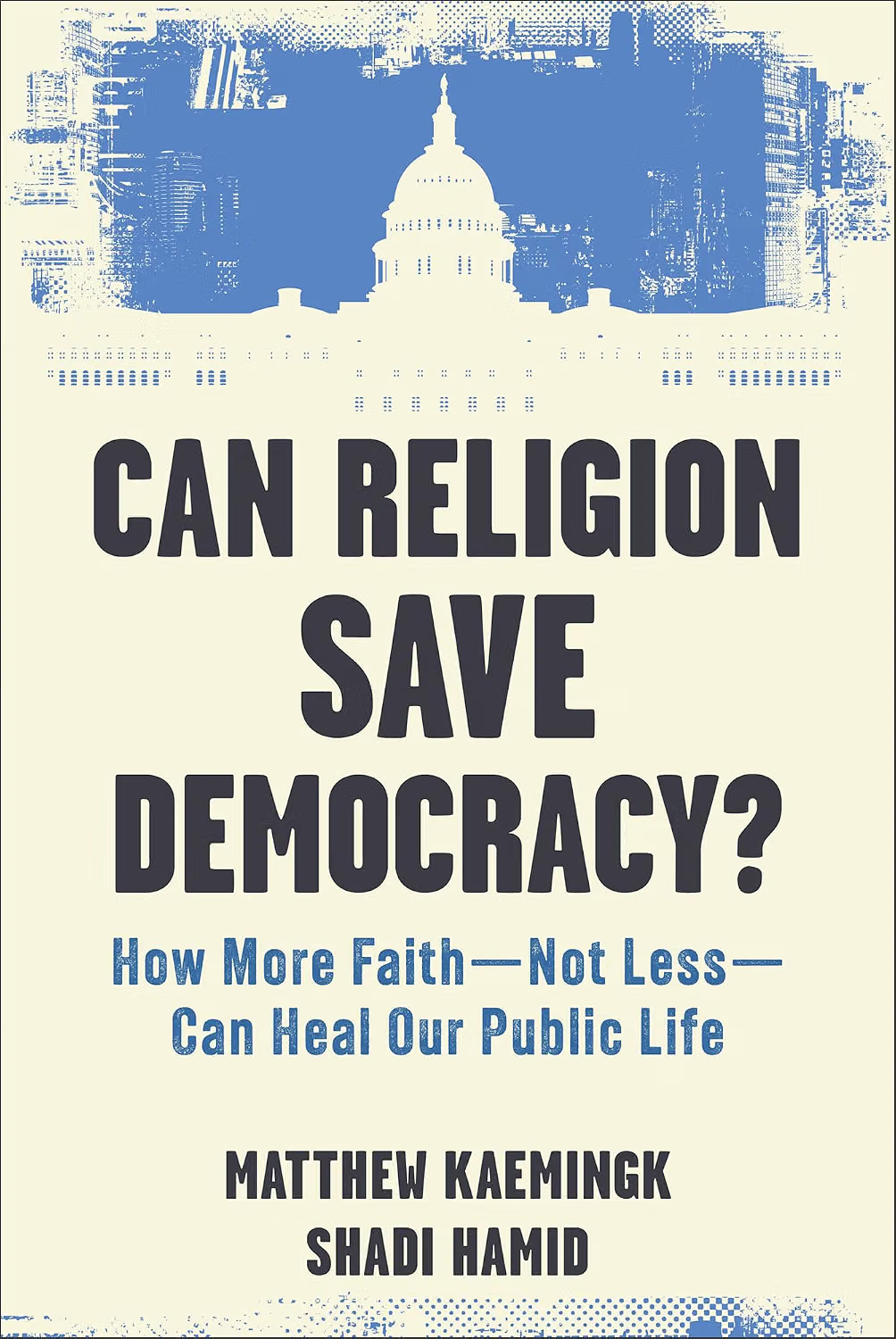
Can Religion Save Democracy?: How More Faith—Not Less—Can Heal Our Public Life
Matthew Kaemingk and Shadi Hamid
Can Religion Save Democracy?: How More Faith—Not Less—Can Heal Our Public Life
Matthew Kaemingk and Shadi Hamid
In Can Religion Save Democracy?, two friends and colleagues—a Christian theologian and a Muslim political scientist—make a bold case: If American democracy is going to survive, it will require more religion, not less. This is not a call for theocracy or religious authoritarianism. It’s a hopeful, clear-eyed vision showing how religious faith offers vital tools to renew the soul of democracy in a divided nation.
Islamic Variants
Evangelical readers may be surprised to hear that Islam has internal resources to foster democratic virtues and pluralism, but the authors present a version of Islam that stands among mainstream Sunni interpretations. The interpretation is familiar to me, as I come from the Muslim-majority but constitutionally pluralistic democratic nation of Indonesia. As The Atlantic reported in 2016, ISIS had more success recruiting from Western nations than from Indonesia.
Sharia (Arabic for “law”) refers to a developing tradition, and as the authors show, sharia isn’t reducible to criminal punishments considered no longer applicable. Today, it also includes political deliberation, toleration of other religions, and antislavery laws.
As Syrian Muslim scholar Muhammad al-Yaqoubi notes in his book Refuting ISIS, “Islamic penalties (hudud) cannot be applied at a time like ours. Obstinate insistence on applying them is a result and an expression of ignorance, excessiveness, injustice, foolishness, puerility, and fanaticism—all of which could not be farther from the spirit of Islam.”
The Islamic tradition isn’t akin to Protestantism in emphasizing sola scriptura, according to which the norming norm is the Qur’an alone. Rather, the majority report holds that the Qur’an must be interpreted by a developing tradition, and the rise of Islamic extremism (which, according to Nabeel Qureshi, represents 0.01 percent to 0.05 percent of the Muslim population) is due to unmediated, naive access to the sources made possible by modern technology.
As Hugh Goddard notes in A History of Christian-Muslim Relations, many of the radicalized young men recruited by violent jihadist groups come from backgrounds with little to no awareness of how to handle ancient texts, and from STEM educational backgrounds:
With regard to their worldview, many of [the radicalized young men] come from contexts in which they had studied scientific subjects, particularly engineering and computing, which did not necessarily impart important skills that are needed for the careful interpretation of texts, both scriptural and contemporary.
Thus, Kaemingk and Hamid are making a welcome contribution, not only displaying how Christians can engage Islam for the purposes of public justice without denying fundamental theological differences between them, but also showing the breadth and diversity within Islam itself.
The authors articulate eight challenges that face democratic societies in the West as they retrieve insights from the traditions of Christianity and Islam that may heal our democratic and common life. I’ll highlight a few of those challenges and ways the authors respond to them.
Search for Unity
The first challenge concerns the migration of religious belief from traditional faiths like Christianity to secularism and liberalism. Instead of recognizing that religiosity is ingrained in what it means to be human, secularism veils its own faith by thinking that one can be religiously neutral. Secular beliefs compose a creed. Faith in the self is still a faith—and a shaky one at best.
Secularized belief becomes authoritarian when it has the absolute confidence of religion without the checks and balances of traditional faiths, which declare that God “might also command that they communicate their beliefs with some level of humility or grace” (28). Take God away, and something else will become divinized in God’s place. The first step in healing our democratic life is to increase the self-awareness that everyone comes to the public square with religious commitments, and that no single position is neutral or represents a “common” sense.
The understandable human longing for unity, “when politically enforced, often leads—ironically—to more conflict” (44). To the contrary, both Christianity and Islam recognize that conflict and religious plurality are God-ordained—something to be expected and managed in this present life. This is a time of divine patience, and so deep difference should be reckoned with rather than politically eradicated. “Unlike traditional religions, secularism posits that human conflict can be resolved not in heaven but in the here and now” (45).
Ironically, secularism, while claiming to be open-minded, is just one more ideology that enforces itself on traditional religions, demanding they be privatized rather than equal participants in the public square.
If God alone can bring about unity, then we should put our hope in neither the state nor the church as ultimate ruler in this life: “Theocracy—the rule of the religious elite—is blasphemous because the throne belongs to Christ, not Christians” (58). Islam, too, doesn’t expect that consensus would take place in this life because conflict is “part of being human” and willed by God for ethical formation (63).
Confident Pluralism
Within the context of religion and politics, distinguishing between absolute certainty and human confidence is key. While Christians and Muslims recognize the Bible or the Qur’an as sacred and absolutely true, we still distinguish between the truth itself and the human discernment of that truth.
The authors point to the example of Ali, the fourth caliph of Islam, who submitted himself to human arbitration because the Qur’an’s meaning is often unclear and doesn’t speak by itself without readers and interpreters. They deftly show that the term “sharia” simply refers to the “way to the watering-hole,” and that “Ali’s pluralistic ethic was baked into sharia itself” (73).
Furthermore, for Christians, we recognize that in this present life we “know in part,” through a mirror dimly, and we long to know God face-to-face (1 Cor. 13:9–10, 12). Or, to present it in classical Reformed categories, we only know God as pilgrims, not yet as the church triumphant—and we know ectypally and analogically, never archetypally or univocally.
The authors make the case for politics to become mundane again. Necessary for this aim is the exercise of recognizing idolatry and retrieving the doctrine of hell. Politics becomes tribalistic when our political parties represent our idols, for which we’re called to sacrifice friendships, families, and even our lives. Politics becomes ultimate when there’s no account of divine vengeance, and so ultimate justice falls to fallible human hands.
Belief in hell actually leads to patience and toleration—for judgment comes later, and the destinies of our political enemies aren’t set in this present life: “The final destination of their souls is not something you can control or predict. This lack of knowledge leaves the door open a crack—for connection, conversation, and freedom” (113). Democracy depends on the hope of persuasion—that no one in this life is yet beyond the pale.
Politics becomes ultimate when there’s no account of divine vengeance, and so ultimate justice falls to fallible human hands.
While rage against evil is necessary, both Christianity and Islam provide resources that nurture the communal bonds a society needs to overcome tribal suspicions. They look to the examples of Jesus’s forgiving grace and of Islam’s condemnation of takfir, that is, of presuming to know the condition of another’s position before God.
More Religion Needed
Religious institutions are schools of democracy. They cultivate characters committed to patience, understanding, and community-building. While Americans are becoming more secular, they haven’t become less spiritual, as citizens are substituting a commitment to religious institutions with the spiritual industry.
A yoga studio or a mindfulness retreat, however, would likely not have taught us to sacrifice “personal ambitions for the good of the neighborhood” or bring together people of differing classes (150). Despite the preconception that religious institutions are bad for democracy, empirical studies show that secular culture still benefits from their “democratic contributions” (152).
Further, it’s through a commitment to these institutions that the digital and abstract temptation toward religious nationalism loses its allure. Simply put, citizens in deep institutional networks “don’t have time for a digital crusade or jihad.” The authors continue, “Chances are they don’t have much time even for a fight on social media either” (157).
The authors observe that socioeconomic status doesn’t predict whether a Muslim would be attracted to extremism. I suggest that the same could be said with respect to some attracted to Christian nationalism. “Those most vulnerable to the temptations of extremism are not the poor but the lonely and disconnected” (159).
While the democratic value of religious institutions is potent, to close the book, the authors warn that these benefits of religion only come as by-products of practicing it for the sake of itself. To put it in Bavinckian parlance, the gospel is a leavening power only if it’s recognized as a pearl.
Three Benefits
This book has three benefits. The first is their deep yet accessible retrieval of the Kuyperian tradition in showing that the Christian faith doesn’t have to choose between a neutral public square and Christendom.
In this sense, this book is a sequel to Kaemingk’s 2018 Christian Hospitality and Muslim Immigration in an Age of Fear, where he argues that Christians can be confident juridical pluralists without endorsing the idea that all religions are basically the same. The public arena is penultimate, and God is calling his people toward toleration and patience because this is an era of God’s common grace, rather than final judgment.
The gospel is a leavening power only if it is recognized as a pearl.
Second, evangelical readers are reminded that Islam is a diverse faith and not to be reduced to the violence of its extremist radicals or the portrait formed by a fear-mongered imagination. As I tell my students when I teach on Islam—we should counter Islamic radicalism by both Christian persuasion and their own sources and tradition. We should be mindful that, for instance, sharia is a developing notion, irreducible to the nonapplicable criminal punishment laws. It includes, for instance, the claim that we should accept religious diversity in the present life.
Finally, the book itself is a demonstration of its conclusions: Here are a Christian and a Muslim, who admit at the outset they disagree deeply on the most important matters about their respective worldviews. Neither would water down the real differences between their doctrines of God, salvation, prayer, or prophecy. Yet they can come together in dialogue for the sake of mutual understanding, and they can come together within the context of deep difference to foster a civic public square.
While the book does a wonderful job anticipating objections from secular liberals, I wish it had done more to anticipate objections from both Christian nationalists and Islamic extremists. The responses may be obvious to readers of both Christian and Islamic traditions, but many remain lured to these minority reports in the contemporary conversation.
How should we respond to the religious violence exercised by Christians (Catholics and Protestants), say, in the age of the Reformation? Or the violence inherent in the age of Islamic conquest right after the death of Muhammad? How should we interpret those passages that Christian nationalists and Islamic extremists would appeal to in justifying a push for a confessionalized constitution or for national religious uniformity?
The authors argue persuasively for a positive vision, and yet I would’ve appreciated an additional chapter just addressing these interpretive debates. But perhaps there’s no higher compliment than to say that I wish the book would have been longer. Can Religion Save Democracy? is one of the first books I’d recommend to anyone who asks for an accessible retrieval of principled pluralism from a Christian and Muslim perspective.