
On rainy Sunday afternoons in my childhood, I’d go over to my grandparents’ house and watch I Love Lucy. In several episodes, Lucy and Ethel head off to bridge club. The card game is an excuse for gossip to move the plot forward. They shuffle the deck and swap secrets. Then they put on their furs and head back out, bumping into the same people they so recently smeared.
I didn’t live through the 1950s, but the proverbial bridge game lives on. Whether through social media or small groups or text threads, gossip sneaks in unannounced. If I participate, whether intentionally or not, at best, I walk away feeling nauseated and remorseful. At worst, a “holier than thou” attitude creeps in—“Well, at least I’m not like her.”
Reading Kristin Kobes Du Mez’s most recent book, Live Laugh Love: The Secret History of White Christian Women and the World They Made, is like sitting at a bridge table. There’s a temptation to lean in and hear Du Mez, history professor at Calvin University, recount the sins of white Christian women.
But at some point, you must put down the book. You must stand up and slip on your shoes and button your coat and return to the real world, the world she critiques. And then you’re forced to wonder, Are you supposed to do something about it? Should the gossip change the way you see your community, or does it simply make living there more interesting?
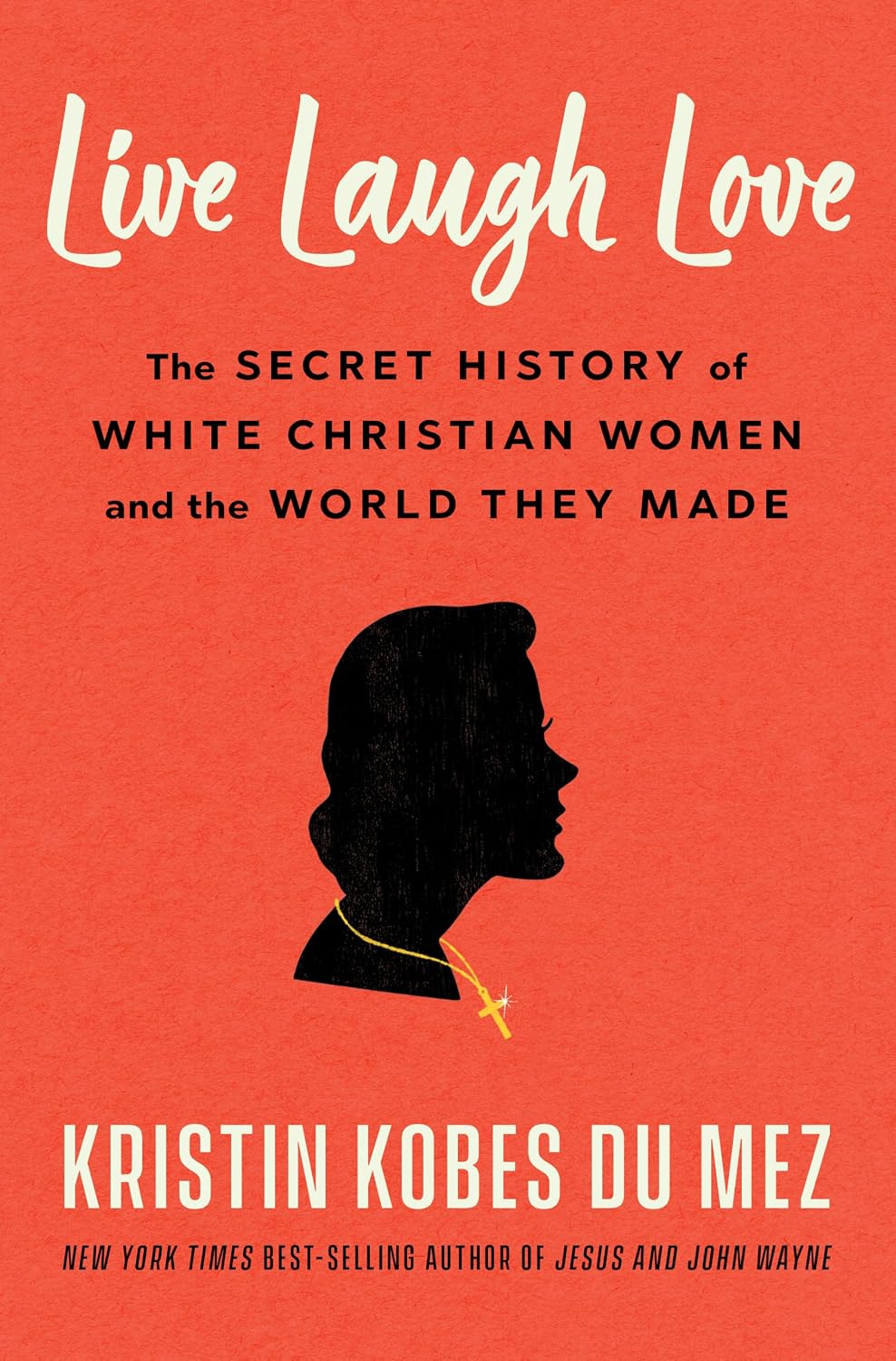
Live Laugh Love: The Secret History of White Christian Women and the World They Made
Kristin Kobes Du Mez
Live Laugh Love: The Secret History of White Christian Women and the World They Made
Kristin Kobes Du Mez
Hidden Secret
In 340 pages (plus back matter), Du Mez traces white evangelicalism’s feminine side from the 1800s to the present. From the Quakers to the Catholics to the Southern Baptist Convention and many Christian subcultures in between, Du Mez reviews the writings and lives of Christian men and women to construct a narrative about how we got to where we are. Her conclusion: White Christian women have crafted a culture at the beck and call of Donald Trump and his unholy trinity of “patriarchy, white supremacy, and violent religious nationalism” (336).
Whatever else it purports to be, this is fundamentally a book about Donald Trump. There’s more to it, but the project’s main thrust is an attempt to explain how evangelical history culminated in the social and political phenomenon that is Trumpism.
Whatever else it purports to be, this is fundamentally a book about Donald Trump.
I have close to zero interest in reading another book about Trump. But as a white Christian American woman, I have a lot of interest in serious books about the good, bad, and ugly of our subculture and how we can never repeat our worst mistakes in the future. Despite the bait and switch in subject matter, a lot of what Du Mez writes is serious.
Du Mez is a career historian, thorough researcher, and clear writer. Live Laugh Love’s predecessor, Jesus and John Wayne, criticizes modern American masculinity and its political implications. And in the last few years, whether it’s a Christian college demeaning women and immigrants to bolster enrollment or denominational leaders ignoring sex scandals to protect reputations, some of Du Mez’s predictions in the earlier book have proved correct.
Much of what Du Mez reports that has gone on in evangelicalism is truly disturbing. Take the example of Elizabeth: a young girl who was abducted and raped. Raised in evangelical purity culture, she struggled not just with the trauma but also with overwhelming shame. After all, she was taught that “no one re-chews a piece of gum, you throw it away” (275–76).
Or hear about the beloved Elisabeth Elliot, whose third husband was controlling and verbally abusive. That’s why, Du Mez claims, the authorized biographer “chose to end the book abruptly” (328). These are just two of many similar stories. Whether it’s the abuse of women, children, or minorities, a lot packed in Live Laugh Love is true and terrible. Turning a blind eye is equally terrible, if not worse.
Banal Elements
As I read this book as a white Christian American woman, names from my upbringing peppered the pages; no one is safe. Elisabeth Elliot. Amy Grant. Ann Voskamp. Books on my shelf from childhood to young adulthood feature in her research: My first Bible—a pink, Precious Moments–branded New Testament—somehow contributed to Trump’s rise and the movement Du Mez calls “Christian nationalism.” So did texts like Elliot’s Through Gates of Splendor and Chuck Colson’s Born Again. Du Mez seems to canvass my personal history, pointing out how everything contributed to the unthinkable.
This book is about me. But also, it’s not about me. Just because certain cultural elements were fixtures of my childhood doesn’t mean that my mother and grandmothers shriveled in fear of their husbands, that my peers find fulfillment in tacky household decor and a “ring by spring” mentality.
The conclusion makes more sense if you read the book from the back to the front. As I made my way through from front to back, I kept wondering when we were going to get to the “secret history” of white Christian American women amid the open facts she was compiling. But it seems the “secret” is her claim that fairly banal elements of the evangelical subculture created a divisive political movement.
And that’s why I wasn’t expecting the ending. It’s a non sequitur. Though many women in my home state very likely voted Republican, if you asked them if reading Janette Oke influenced that decision, they’d smile, a bit confused, and murmur, “Bless your heart.” Where I’m from, that’s not a compliment.
Of the women I know for a fact did vote for Trump, they aren’t bandwagon MAGA fans. For them, it was a matter of life and death for unborn babies, gender-confused children, and other vulnerable community members. In 2024, Trump’s campaign was the lesser of two evils in their eyes.
But for Du Mez, it couldn’t be that simple. For her, it was the entire history of white Christian women inevitably funneling my friends to the voting booth. She writes,
From the slaughtering of Native American populations to the lynching of Black men, the protection of white women has justified atrocities committed by white men and by the state. The iconography of pure white womanhood has long domesticated white nationalism, softening its public image and condoning violence as necessary and righteous. In Trump’s America, as female “innocence,” sexiness, and hyperfemininity combined with a reactionary political agenda, fascinating women played key roles in implementing the administration’s authoritarian project. (317)
It’s hard to follow the jump from purity rings and Precious Moments to slaughtering Native Americans and authoritarianism.
No Hope in Sight
Unfortunately, Du Mez undermines her argument when she, at least in some places, takes liberties with the evidence.
For example, contrary to Du Mez’s assertion, Ellen Vaughn, Elliot’s biographer, didn’t skimp on the last chapters of her biography because the story didn’t fit her narrative. Rather it was because, as Vaughn writes, “Lars [Elliot’s third husband] burned most of her journals from the years of their marriage, a choice he now regrets.” There was simply less source material to work from.
Furthermore, as Bonnie Kristian highlights in her review of this newest volume, on at least one occasion Du Mez misrepresents sources about which Kristian has direct knowledge. Du Mez makes incorrect assumptions about someone’s race and twists her message.
But even where the evidence is legitimate, it’s hard to take some of Du Mez’s criticism seriously because the sweeping accusations don’t match up with what I’ve heard from friends or experienced in the broader evangelical culture.
In reacting to Jesus and John Wayne in her recent book, Kristian highlights the same dissonance:
I couldn’t recognize the debased movement Du Mez described. Her evidence seemed sound, so far as it went, but did the conclusion follow? The evangelicals I knew weren’t corrupting our faith or fracturing our nation. . . . They don’t want their church or their identity to be focused on politics; they want both to be focused on Christ.
There’s little room for legitimate religious belief in Du Mez’s account of evangelicalism.
Live Laugh Love is meant to be a work of history, not a work of theology. That explains why, after the introduction, there’s no interaction with Scripture and no wrestling with God’s standards of justice and mercy. It’s largely a book about Christians whose most egregious sin seems to be not joining “the Democrats’ fight for democracy” (315). In her attempt to offer a definitive account of how the evangelical subculture’s feminine elements caused the rise of Trump and Christian nationalism, Du Mez tells us more about her political preferences than about the history of evangelicalism.
It’s hard to follow the jump from purity rings and Precious Moments to slaughtering Native Americans and authoritarianism.
Criticism without a goal dissolves into noise. Unless we turn the critique toward something redemptive, we’re left as no better than those who participate in gossip at the bridge game.
We can’t turn a blind eye to the problems in evangelicalism. But we also can’t focus so much on the history of Christianity that we miss the Author and Perfecter of it: Christ himself (Heb. 12:2). If Christian history were about perfect people, we wouldn’t need our Lord. Because we sin—even the sin described in the pages of Live Laugh Love—his passion was necessary. Because we fail, he rose from the dead. Because we don’t love our God and our neighbor like we ought, he lives to intercede at the right hand of God on behalf of you, me, and, yes, even white Christian American women.