


“This is a really bad emergency.”
My daughter was 5. My husband had perched her on the branch of a tree for a photo when she made this declaration. But really, she was fine. Ten years later, at the nearly Sound of Music age of 15-going-on-16, she represents the tail end of Gen Z, and she’s still fine. But as British author Freya India documents in Girls®: Generation Z and the Commodification of Everything, millions of her peers across the West are not.
In his 2024 book The Anxious Generation: How the Great Rewiring of Childhood Is Causing an Epidemic of Mental Illness, social psychologist Jonathan Haidt argued that Gen Z as a cohort has been overprotected in the real world and underprotected online. Instead of climbing trees, playing unsupervised with peers, managing physical risks, and growing independence, they have been sucked down rabbit holes into an online world that has consumed much of their time and deeply shaped their lives.
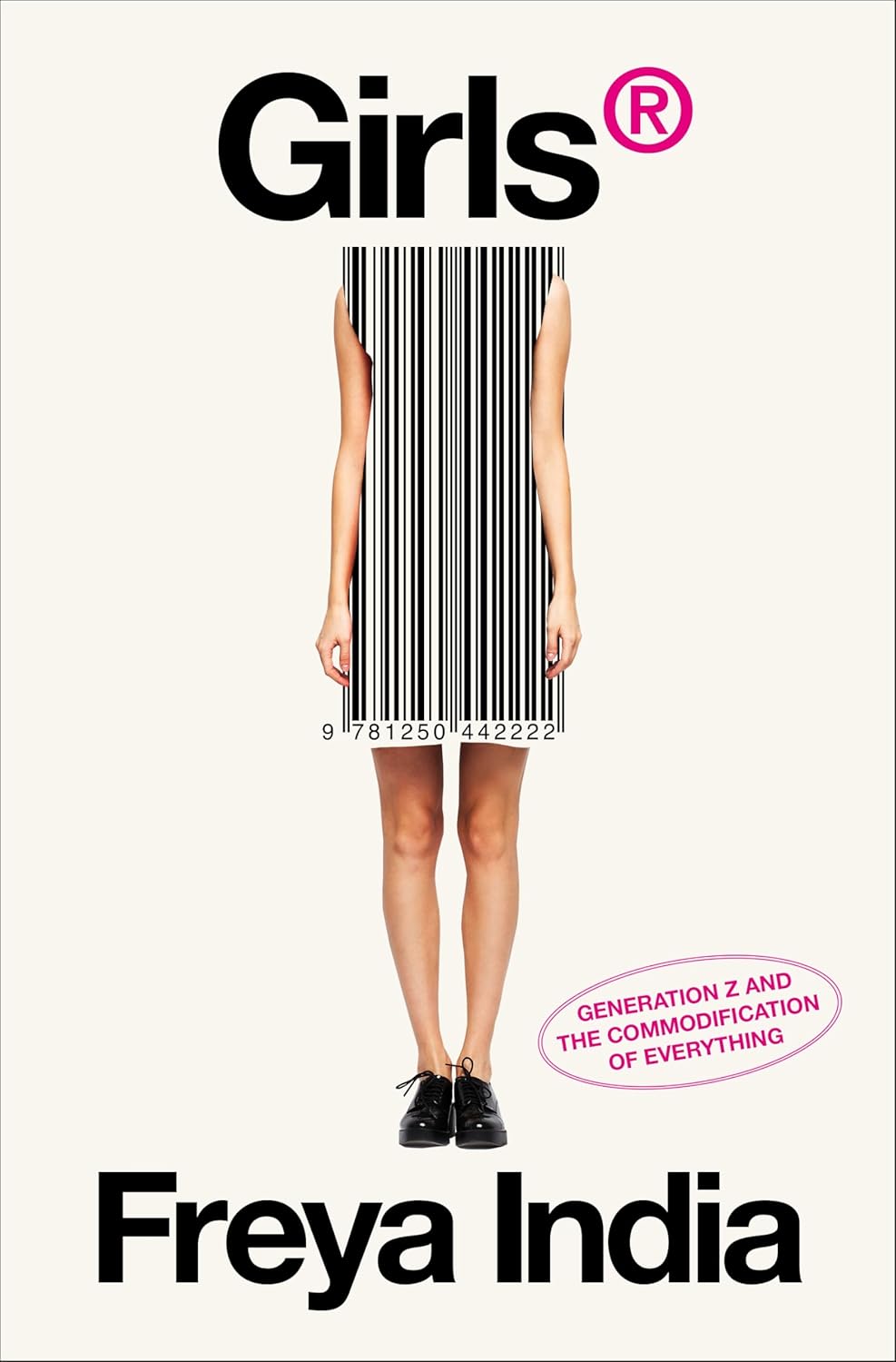
Girls®: Generation Z and the Commodification of Everything
Freya India
Girls®: Generation Z and the Commodification of Everything is a passionate, provocative, and deeply personal journey into the pressures shaping young lives today. Freya India shows that age-old anxieties of girlhood are now being amplified by modern life and exploited like never before. While previous generations of women were relentlessly sold products and procedures, girls today have become the product, displaying their lives on Instagram, advertising themselves on dating apps, and packaging themselves into personal brands, making anxiety feel overwhelming and unmanageable. As a society, we have transformed girls into Girls®, from people into products.
In Girls®, India double clicks on how this has affected Gen-Z women in particular. To alert us to the five-alarm fire that has been raging in this demographic, she reports that “in the US, nearly one in three teenage girls seriously considered suicide in 2021, up from 19 percent a decade earlier, and double the rate of boys” (8). This, by any measure, is a really bad emergency. India’s 356-page view from inside offers insightful analysis of what exactly has gone wrong.
India argues persuasively that rather than creating problems ex nihilo, “modern technology amplifies the age-old anxieties adolescent girls have always felt” (9). Young women are particularly prone to insecurity about their looks, romantic relationships, friendships, and social status. But India argues that these vulnerabilities have been ruthlessly exploited by social media companies, beauty influencers, porn sites, and corporations selling mental health–related drugs and services.
This crisis is no accidental conflagration. It is arson.
Facetuning as Empowerment
India’s Exhibit A is the phenomenon of “facetuning.” Under constant pressure to post selfies and videos on social media, Gen-Z girls spent untold hours on virtual cosmetic surgery. Facetune (a leading AI-powered app) slims limbs, plumps lips, shapes noses, smooths skin, and enhances breasts, so girls can post a perfect image.
But this process has a devastating side effect. India recalls facetuning as a teen: “Sometimes I would accidentally hit the Undo button, and see the real me flash up, and feel repulsed. My face and body were unbearable in ways I had never even noticed before but now could not unsee” (27).
As India observes, these virtual cosmetic surgeries drove surges in their real-life equivalents, and girls bought more and more expensive and invasive beauty treatments. But far from all this being recognized as detrimental, they were told it was empowerment. “Celebrate #InternationalWomensDay—reclaim the way you look at selfie editing, a habit which can actually be a powerful form of #selfexpression,” a 2018 tweet from Facetune declared (45).
India’s insightful unmasking of how exploitation has been passed off as empowerment is central to her argument. “This was not self-love but lying to ourselves, not empowering but degrading,” India observes. “None of these apps or filters or procedures were helping us find our true selves; we were losing ourselves, becoming so disconnected from who we were that we developed dysmorphia and anxiety disorders” (57). But this too was monetizable.
From Friends to Therapists and Meds
As girls spent more time online and less time with friends, they were driven to depression and anxiety. At the same time, they were used to market mental health products. “Opening up about our mental health was not only good for us,” India recalls, “but some sort of moral duty” (61).
As girls spent more time online and less time with friends, they were driven to depression and anxiety.
Girls shared their struggles to fight stigma and were told to stay online for the solutions. “As my generation opened up, algorithms were advancing, learning about us, logging our vulnerabilities, dragging us deeper into them,” India observes. “We were funneled further into our own insecurities, served more signs, symptoms, advice, and—of course—ads” (62).
More time online was the last thing girls needed. But business was booming. “Between beauty influencers selling us skin care routines and surgery plans,” India recalls, “we now had mental health influencers, ready to fix not only how we looked but how we felt” (63).
Social media platforms created problems they subsequently diagnosed, and influencers were both victims and perpetrators, as algorithms rewarded extreme behaviors and wild claims. Girls were told that negative emotions toward their bodies or not feeling like they fit in were signs of mental health conditions. But as India observes, “Not fitting in, feeling insecure, and hating your body are not only symptoms of disorders; they are also symptoms of being fourteen” (65).
One manifestation of this culture of self-diagnosis was in the realm of trans identity:
Maybe you go from finding out what gender identity is to being told by TikTokers that being “forgetful” and “always tired” are symptoms of gender dysphoria (yes, an actual TikTok), all the way to watching influencers showcase their mastectomy scars, vlog their vaginoplasty journeys, and wonder whether you need surgery. (67)
In line with the United Kingdom’s Cass Review on gender dysphoria, India blames online influencers for the “explosion of gender dysphoria diagnoses” among Gen-Z girls (88).
As girls were starved of embodied friendship, an army of therapists “framed more like friends than professionals” stepped in so they would have “someone to be there for [them]” (75), and influencers told girls they needed “medication for normal life stressors” (83).
India’s point isn’t to disparage therapy or antidepressants per se but to decry the runaway train of diagnosis and prescription. India’s argument here dovetails with Abigail Shrier’s in her 2024 book Bad Therapy. “Yes, girls are genuinely suffering in the modern world,” India affirms, “but a major part of this crisis is the marketization and medicalization of normal negative emotions” (93). Some of this was well intentioned. Some of it was calculated exploitation.
From Private Life to Public Post
As heart-to-hearts with best friends declined, sharing thoughts and feelings, first-date stories, and deepest insecurities online became standard. “Just as beauty and mental health influencers competed for girls’ attention with increasingly extreme content,” India observes, “vloggers were pressured to share ever more intimate moments” (97). Gen-Z girls followed suit. India’s analysis is insightful:
We were told it was about sharing our lives with our friends and family, when really it was about sharing our data with companies so they could target us better. We were told it was about connection, while we turned the people we love into tripods to take constant pictures of us. And in trying so hard to define and document ourselves, we lost ourselves. We weren’t sharing our lives on these platforms; we were living our lives for them, often for the approval of people we didn’t even know or care about. (132)
This constant posting came with moral strings attached. “The more we shared our lives online, the more pressure there was to post our political opinions,” India reflects. “Morality became measurable, judged instantly by what we had or hadn’t shared” (118).
Since young women tend to want to fit with social expectations, they were particularly keen to voice the right opinions to keep in step with their tribe. But this was hard. “The ‘right’ position kept evolving,” India notes, as “the most radical voices went viral, rising to the tops of our feeds.” To avoid being canceled, girls “were expected to have opinions on everything: climate change, abortion access, transgender rights, foreign conflicts” (123). Not posting was itself a moral act.
So, there was no retreat from engagement on every issue. Girls were increasingly exposed, both by publicly performing what would once have been their private lives and by being liable to judgment for political missteps. And even as the political narratives they parroted claimed to empower women, what these girls actually experienced was quite the opposite.
Ruin of Relationships
As India poignantly expresses it, Gen-Z girls grew up “in a world where you feel you have to advertise yourself like a product on dating apps, where you watch violent videos on porn sites before you reach puberty, where casual sex and self-commodification are sold as female empowerment” (10). Just as facetuning harmed Gen-Z girls’ sense of self and fed into real-life cosmetic surgery, so the ubiquity of violent pornography led to consensual sexual violence being normalized.
India cites a 2020 survey of British men aged 18 to 39, which found that “71 percent had ‘slapped, choked, gagged or spat on their partner during consensual sex.’” (201). But instead of this being recognized as flagrant misogyny, it has been billed as empowerment.
India isn’t the first woman to make this point. Louise Perry’s The Case Against the Sexual Revolution and Christine Emba’s Rethinking Sex both called foul on the positioning of sexual violence as feminist empowerment. But India grew up with a view of this world from within. “The 2010s were the era of sex-positive feminism,” India explains, “where female empowerment seemed to mean endlessly pushing for more sexual freedom, exploration, and expression. The more a celebrity objectified herself, the more she was seen as liberated” (185).
Girls were told that sexual violence and degradation were what they wanted and were made to feel ashamed if experience taught them otherwise. India quotes singer Billie Eilish, who at age 19 shared that (like many of her peers) she had started watching porn when she was 11. “It really destroyed my brain,” Eilish reflected in 2021. It also groomed her to consent: “The first few times I had sex I was not saying no to things that were not good and it’s because I thought that was what I was supposed to be attracted to” (199–200).
Girls were told that sexual violence and degradation were what they wanted and were made to feel ashamed if experience taught them otherwise.
The same bizarre framing of degradation as female liberation was used to redefine prostitution as empowering. India quotes not only celebrities and OnlyFans stars speaking in these terms, but also major U.K. universities (in their own words) “challenging the stigma attached to sex work” and offering student sex worker toolkits (191).
Meanwhile, girls were coached on “How not to catch feels” for the men with whom they were having sex (176) and, as India movingly explains, “what we used to call love—being affected by your partner’s feelings, putting their needs first, depending on one another—was increasingly labeled ‘co-dependency’ or ‘anxious attachment’” (194). And it was not just sexual and romantic bonds that were being eroded. It was love in all its forms.
Decline of Love and the Rise of AI
India anatomizes how all embodied love relationships have been declining in our online-centric world, and how girls have been told not to lament their loss. For instance, Gen-Z girls were raised in a culture that embraced divorce as self-love and liberation and downplayed the detrimental effects of divorce on kids. So, they were told they should not feel sad that their parents had broken up.
Instead of finding comfort in embodied friendships, Gen-Z girls were lured into pursuing friendship via apps and told that the community they needed was available online. As India observes, even the most toxic platforms promised this: “Facetune is more than just an app; it’s a community”; “170 million Americans find community on TikTok”; “The Pornhub community wants you!” (151).
“The overwhelming feeling from all this is disconnection,” India concludes. “Friendships have hollowed out. Family breakdown has left girls feeling lost and abandoned. Community is only simulated. We can keep pretending this is progress—that this is liberation, not loneliness. But girls have never felt more alone” (161).
And now this aloneness is being monetized. As India points out, AI “friends” and romantic partners are the ultimate example of corporations creating markets: “The very companies that hollowed out our friendships have the nerve to sell us their substitutes,” she observes. “Girls and young women are sold simulations of human connection like never before, each perfectly customized to our wants and desires” (162).
We humans are hungry to be known and loved. Deprived of real people with whom we can have truly reciprocal relationships, we starve. But with an intravenous line conveying simulated love into our veins, we can be lulled into thinking we are having our needs met. This is what millions of Gen-Z girls are getting from their simulated friends and lovers: the sense that someone is there for them. But in reality, there is no someone there.
Diagnosis Seeking a Prescription
India’s book offers a compelling diagnosis of what Gen-Z girls have been through. But at the time of writing, she was still searching for the right prescription. She urges a return to real relationships, but she knows that this is not enough: “Along with stepping back, becoming more private, investing in real relationships, and trying to take care of others, we need to find faith.” But then she shrinks back: “Not necessarily religious faith but faith in something more, a conviction that more than this life is possible, something beyond hedonism and consumption and competition” (264).
We humans are hungry to be known and loved.
After so many pages of insightful diagnosis, this prescription felt like an herbal remedy for cancer. If there is no God, there is no “something more.” Faith is delusion if it is not tethered to something real.
But in the time between submission and publication, India seems to have been on a spiritual journey. In an interview with British author and broadcaster Justin Brierley, India shares her experiences of first encountering Christianity. Having been raised in a culture that regarded it as “outdated,” “cringe,” and “presumably irrelevant,” she initially dismissed the faith. “I would listen to people talk about Christianity and everything I felt anxious about,” India recalls. “I felt, oh, there’s these answers that have been around forever that actually answer every kind of unmet need that I feel.”
As India recounts in Girls®, she grew up in a culture that expected her to make her deepest thoughts and feelings public, and seems to be resisting any pressure to do that when it comes to her burgeoning faith. She puts it like this to Brierley:
It’s a slow journey. . . . Personally, I can just feel that feeling getting stronger, and the more I write about it, the more kind of certain I feel about it, but . . . I’m trying to keep it more private just because I don’t want to, kind of, offer it up to the world.
People often confuse the truth that faith in Jesus is profoundly personal—grasping at our very hearts—with the idea that it should be kept private: undisclosed, not making any claims beyond the self. But in this instance, I suspect India is wisely giving a tender seed of faith the opportunity to grow away from the scorching light of public scrutiny.
“For me to even try to go to church was and still is a bit of a battle because it feels very foreign to me and almost kind of embarrassing in a way,” she confesses. I applaud her for focusing on winning that battle and getting embedded in a local church. At the same time, I’m grateful for the words of diagnosis she gives back to those of us for whom church is already home.
Recognizing that we are in the throes of a political division of the sexes, as young men have trended more conservative and young women more progressive, India observes,
I think the problem is now we have churches and Christians who are trying to attract young men and kind of just leaving young women because they think, Oh, we can’t even approach them. They’re so far on the other side. But they’re the ones who desperately need it.
Gen-Z girls have been exploited and abused, made to feel terrible about how they look and ashamed of their feelings. They have been cut off from meaningful relationships, strangled during loveless sex, and told this is empowerment. They have been told that Christianity is the last thing they need.
But like India, if they get a glimpse of real Christian love, they might just realize Jesus is the answer to their pain. “If you can say to young people, ‘You know, it’s really tragic that you feel this anxious, but there’s this whole institution, there’s community for you,’ and I think that can lead to faith,” India suggests. And she’s right.
After reading Girls®, I texted my friend Justine, who went through almost everything India’s book describes before joining our church three years ago. I told her I had read a book about how women of her generation had been hurt and lied to. She agreed with India’s description.
Gen-Z girls have grown up in the middle of a really bad emergency. Their only hope is Jesus. Girls® can help us understand what they’ve been through. But it’s down to those of us who know the Great Physician to reach out to these young women with his message of forgiveness, life, and love. If we do that, we might just be surprised by how plentiful the harvest is.