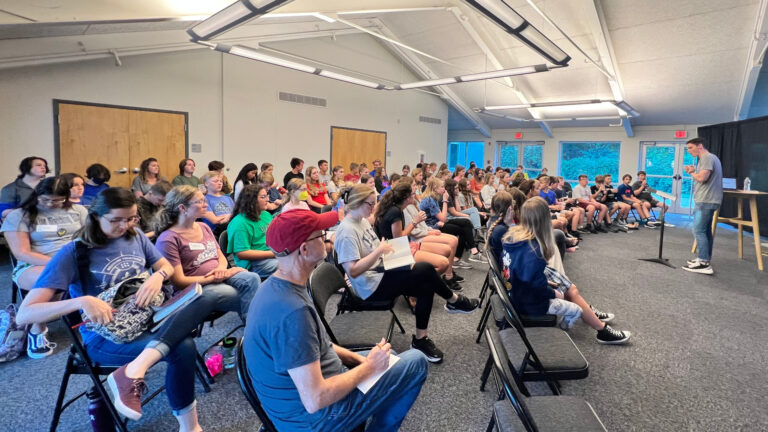





Imagine you could save your life through one simple, regular act. You wouldn’t always want to do it. Every week, you’d come up with multiple excuses. The night before would often be a struggle. Same with the morning before. Every time you finished, you’d feel refreshed, energized, and eager to undertake that day’s agenda. But then, when it came time to do it again, somehow you’d still struggle to do it.
I don’t know what comes to mind for you. Maybe the gym. Maybe a quiet time of Bible reading and prayer. Maybe a call or meeting with a family member or friend. But I’m talking about church and a new book by Rebecca McLaughlin, How Church Could (Literally) Save Your Life (TGC/Crossway).
Rebecca is widely known to Gospelbound viewers and listeners as the author of several of the most encouraging and successful books in TGC history, including Confronting Christianity, The Secular Creed, and Jesus Through the Eyes of Women. She’s also a fellow with The Keller Center for Cultural Apologetics. She returns to Gospelbound to discuss the life-changing research on what makes church good for your health.
In This Episode
04:30 – What makes church unique
08:00 – How many modern moral values come directly from Christianity
16:00 – Real benefits, real belief
23:00 – The church as family
30:00 – Sharing faith in a skeptical world
45:00 – Healing from church hurt
48:00 – Practical vision for believers
Guest Resources:
- How Church Could Literally Save Your Life by Rebecca McLaughlin
- Rebbeca’s website
- Confronting Christianity podcast
- Follow Rebecca
SIGN UP for my newsletter, Unseen Things.
Help The Gospel Coalition renew and unify the contemporary church in the ancient gospel: Give today.
Don’t miss an episode of Gospelbound with Collin Hansen:
Transcript
The following is an uncorrected transcript generated by a transcription service. Before quoting in print, please check the corresponding audio for accuracy.
[00:00:00] Rebecca: There’s a rising generation of people who’ve been raised on the diet of no church and who are realizing, oh, this is terrible. And actually finding in church the hope in Jesus that they need and the community of love that they need.
[00:00:27] Collin: Imagine you could save your life through one. Simple, regular act. Now, you wouldn’t always want to do it every week. You’d come up with multiple excuses while you don’t want to. The night before, it would be a struggle to get yourself up. Same with the the morning before. Even every time though that you actually follow through and you finish, you feel refreshed, you feel energized, eager to undertake that day’s agenda.
But then when it came to do it again, somehow you still struggled to do it all the same way all over again. Now, I don’t know what comes to mind for you when I lay out this scenario. Maybe the gym. Maybe it’s your quiet time, Bible reading and prayer. Maybe it’s a call or a meeting with a family member or a friend.
What I’m talking about here is church and a new book by re, Rebecca McLaughlin, how Church Could Literally Save Your Life. Published by Crossway and TGC and Rebecca is widely known to gospel bound viewers and listeners as author of several of the most encouraging. And successful books in TGC history, including confronting Christianity, the Secular Creed, and Jesus through the Eyes of Women.
She’s also a fellow with the Keller Center for Cultural Apologetics, and she returns to the gospel bound to discuss the life changing research on what makes church good for your health. Rebecca, welcome back.
[00:01:49] Rebecca: Hey, con, thank you for having me
[00:01:51] Collin: now. How did you just come across the research for this book?
It’s not like it’s hiding, but I doubt many people even know about it.
[00:01:59] Rebecca: Yeah. Which is a big reason why I wanted to, to write the book. I’ve been familiar for probably a, a decade at this point with the work that a Harvard professor named Tyler Vanderbilt is doing over at the Harvard School of Public Health.
I live in Cambridge, mass, and. Much as my sort of English Cambridge roots make me somewhat averse to Harvard as a concept. I’m, I’m sort of geographically close to Harvard University. And Tyler is, is running a a sort of center at the Harvard School of Public Health that’s looking at human flourishing in particular.
And his focus of his research is on the relationship between religious participation. And both physical and mental health outcomes. And it’s one of these sort of surprising secrets, I guess in the modern world, which at least where I come from in the uk. You know, we’re very much told culturally that if, if anything going to church is probably sort of psychologically bad for you you know, possibly neutral.
But we, we’ve all heard the, the horror stories of people who’ve, whose mental health has been ruined by their religious upbringing, et cetera, et cetera. And in a, in a cultural moment where people I think are increasingly desperate for the latest sort of mental and physical health hack. And, you know, we’re all busy Googling what are the top 10 things I can do to improve my mental health or, or my, my physical health And familiar with some of the things that are gonna pop up on that list.
One of the things that almost never pops up on those lists is going to church every week
[00:03:31] Collin: and go to church. Yeah.
[00:03:32] Rebecca: And yet that is one of the most. Well demonstrated interventions that, that you or I could, could undertake. Interestingly, it’s, it’s sort of similar to eating more fruits and vegetables, which I dunno about you, Colin.
I, I actually love fruits and vegetables, so it’s not much of a hardship to no problem to to do that. It’s, it’s not far off the benefit of exercise. And frankly, when you were describing like the thing that you know that you will be good for you, but you don’t wanna do, for me, that’s, that’s exercising every time.
And it, it’s similar actually in its benefit to quitting smoking. Now, I’m not a spoken myself, but if, if some listeners are, you know, maybe you could. Start going to church and, and you know, balance out your smoking habit with that
[00:04:16] Collin: or get double the benefits maybe, or double, you know, actually
[00:04:19] Rebecca: fun fact, you are more likely to quit smoking if you start going to church.
[00:04:24] Collin: Oh, okay.
[00:04:25] Rebecca: And you know, most people who are smokers are actually sort of trying or have tried at one point in their life or other to quit smoking. It’s really hard, I’m told, but apparently if you are regularly attending church, you are more likely to stick with quitting smoking.
[00:04:36] Collin: There you go. Well, I mean, again, just, just fascinating and for all places to come out of, out of Harvard it’s not, that comes with an a seal of seal of academic approval there.
Now is it religion that benefits people or is it Christianity? That’s the first part of the question. The second part of the question then is. What about spirituality? Lots of people say, I’m not religious, but I’m spiritual instead of the same of benefits.
[00:05:01] Rebecca: Yeah. So what Tyler and his, his married men and women at Harvard, and it’s not actually only at Harvard.
There are other institutions sort of studying this as well, but, but Tyler’s probably one of the, the world experts on this. What they’re, they’re looking at is what we might call organized religion, IE showing up on a regular basis to a worship service. And the studies that they’ve done haven’t been differentiating between sort of going to a Christian service versus a Jewish service or, you know, sort of different religious traditions.
But they, they have been looking at the, the difference between physically showing up for a religious service of, of some kind like that versus on the one hand. Physically showing up for some other sort of regular gathering. So maybe, you know, you play golf and you go to the same golf club every week and hang out with the same people.
And you get the sort of social benefits of that. It turns out the phenomena that they’re sort of seeing when it comes to religious participation isn’t just reduceable to the social benefits. That turns out to be about sort of 30% of the effect, but certainly not, not all of it. And, and it’s also not just kind of having spiritual.
Thoughts and feelings. It, it’s the, the act of, you know, the sort of incredibly unglamorous act of, of showing up for a religious service, you know, which again, there are probably many in our, our culture today who would consider themselves, as you say, sort of spiritual but not religious. You can find.
Recommendations to start, you know, doing yoga or meditating or sort of other things which might be, or mindfulness. Yeah. You know, somewhat like religion adjacent. And, and might have some, you know, benefits like stretching your body. A sort of form of exercise has certainly got some, some benefits to it.
But there seems to be a, a particular effect of what we, in the church seminar it’s called, kind of corporate worship. And, and doing that. On a regular basis. So the sort of dosage that you want for this to have its real effect is once a week or more.
[00:06:59] Collin: You and I have both. We’ve been together with, with Ross Daset at the New York Times when he’s described Christianity is only beneficial so far as it’s true and mm-hmm.
We know you look at first Corinthians 15, that’s in keeping with the, with the Apostle Paul argued there. If Jesus is not raised, then as believers in Christ, we’re worse off than anyone else. I’m thinking about this, Rebecca, in terms of distinctively American philosophy, pragmatism. Mm-hmm. Americans tend to see truth as a pragmatic category.
If it works, then it’s true, as opposed to is it true and then does it work? So I’m wondering how do we navigate that tension to help people see that Christianity works? Then help them, them to see that it’s true actually, no matter how you experience it, it’s objectively outside of yourself. True.
[00:07:52] Rebecca: Yeah. So the way that I, I’ve broken this exceedingly short book down, I, I want listeners to sort of know the, the shortness ’cause it’s sort of designed to something that people can read who may be.
Aren’t necessarily like big readers and that you could maybe give to a friend who is not a big reader, is to first look at the, the mental and physical health benefits of religious participation, which, you know, is, is what we can pluck from the, the pages of the publications of, of the Harvard School of Public Health, et cetera.
And then look at two other claims. So one, the, the moral health benefits of, of not just religion in general, but Christianity in particular. Then what I call the sort of spiritual health benefits. And the reason I think it’s helpful to kind of look at both of those is that many people in our modern world, and certainly in in, you know, in my neighborhood in in Cambridge, Massachusetts, think that you don’t have to be religious and certainly not sort of specifically Christian to hold certain fundamental moral beliefs.
That we all sort of buy into and we all know are, you know, good for the world. So whether that’s beliefs in sort of universal human equality care for the poor the equality of men and women you know, the fact that the, the strong and rich and the powerful shouldn’t be trampling on the weak and the poor and the marginalized.
Like these things that we hold to be right to quote the Declaration of Independence that have self-evident this idea of of universal. Human equality and that even if you look kind of across the political spectrum, people might have very different proposals about what it means to, for, for instance, benefit the poor or what it looks like for men and women to be recognized as equal, et cetera, et cetera.
But I could knock on doors of almost anybody in my neighborhood to in Cambridge, Massachusetts. And regardless of how they identify religiously, regardless of how they identify politically, et cetera. They would say, yeah, I, I agree with those things. You know, I think everybody’s fundamentally equal and that, and that that matters and that we need to live in sort of a accordance with that.
And because there’s so much agreement across different sort of religious and political allegiances in our culture here, we think that this is just basic moral common sense. You know, you don’t need any particular religious or philosophical undergirding for that. It’s just like the a, b, C of. Morality and being a good person is recognizing these things.
In actual fact, those are specifically Christian beliefs and, and that’s true. You know, if we look at the, the history of thought, how we came to hold those beliefs is because of Christianity.
[00:10:21] Collin: Yeah.
[00:10:21] Rebecca: And it’s also true, and this is acknowledged not just by, by Christians, but actually by, you know, many of our leading sort of atheist and agnostic thinkers.
If, if we take Christianity outta the equation and we say, okay. Sure. Maybe the teachings of Jesus were the reason why in the first place people started to hold these kinds of, of views about the universal human equality. But if we, if we sort of pull Jesus out, it’s not that those views just sort of stand by themselves.
They actually, you’re sort of left without any really kind of coherent, rational, and framework for believing what you believe. I had a. A really sort of interesting conversation a, a few years ago with a, a guy who was also working at, at Harvard in, in public health in a, in a different group. And he himself sort of culturally Jewish but convictionally atheist and the kind of work that he was doing was specifically targeted to benefiting poor people in other parts of the world.
It was sort of the, it was medical and, and sort of public health initiatives that, that were benefit fitting people in, in those categories. And he’s clearly very passionate about his, his work. And I said to him you know, gee, I’m just checking that you realize that your atheism doesn’t actually give you any grounds for your, your deep care, your evident care for those people.
And he just sort of quietly said to me, yeah, no, I know. And I found it honestly sort of sad because he was a man again, he was sort of giving his life to a work that was doing something truly good. And that I can say as a Christian is truly good, right? Yeah. And as a Christian, I can kind of put legs under why that is truly good, but in his mind, he doesn’t actually have, have the option.
And I think this is true for many who sort of, you know, very kind of. Highly educated and, and, you know, thinking themselves as, as kind of modern and, and progressive folks. He doesn’t think he even has the option of putting like real legs under those, under those claims. Like he, I don’t think, I don’t think he’d even like, considered Jesus as a, as a possibility because clearly Christianity was not credible or viable for an educated person in the, in the modern world.
And I don’t, I don’t think that’s true. So, so I think, you know, one of the things it’s, it’s worth looking at is like, do the claims of Jesus stand up to scrutiny in the year of our Lord 2025? And the answer is, you know, most definitely, yes. Now, I’m not saying you can, you know, prove to your most atheist friend that Christianity is true.
If you just sort of sit down with them long enough and read enough, you know, complicated books, that that’s certainly not true. Like Chris. I would also say that as a Christian, I believe a bunch of. Frankly, crazy things, you know, the Christian worldview is, is, is wild in the claims that it’s making about this first century Jewish man who was executed in what looked like humiliating failure and then, you know, claimed that that was actually the greatest triumph in the history of the world.
You know, redeeming humanity, redeeming anyone, anyone who put their trust in him. You know, the, the idea that, that the universe rotates around this first century Jewish man. Yeah. Who kind of basically died poor and obscure is a, is a wild claim to be making, but we’re not comparing it with a bunch of you know, far more credible and less crazy sounding options.
Like if we actually look carefully at the, the other options that we, we have, I think Christianity starts to shine really brightly. And so, so I think, and I think the kind of questions around. How Christianity’s sort of foundations for our shared moral beliefs is, is a, a piece of that. And then, yeah, and the, the last chapter, I’m looking at the, the spiritual health benefits of Christianity.
’cause at the end of the day. You could go to church every week of your life from the, the day that you were born till the day you die, age 95, having, you know, done all the healthy things you could have in, in addition to that, participated in midweek bible studies and, you know, participated in, in poverty relief efforts at your local church, et cetera, et cetera.
And if you haven’t actually accepted Jesus’ death on the cross in your place. According to Jesus, you are, you haven’t entered the kingdom of God. Yeah. And, and one of the ways that, that Jesus describes himself beautifully in the gospels is he says he’s the, he’s the doctor. You know, when he’s criticized for hanging out with a bunch of, obviously sinful people in the religious leaders of his day are sort of saying like, why, why is Jesus hanging out with these clearly sinful people?
And he responds. You know, it’s not actually the healthy who need a doctor, it’s the sick. I haven’t come to call the righteous, the good people. I’ve come to call sinners to repentance, and I’d love to have been there in that sort of moment when the religious leaders like heard that and, and see whether they, whether they thought, oh, you know, okay, that’s fine.
Like clearly we’re, we are righteous people. We don’t need Jesus. And he sort of smooth that over or whether they realize. Actually Jesus’ Point there is the, the sinners who he is hanging out with in sort of, you know, capital S sinners. Those are the ones they who realize they need Jesus. And it’s the, the religious leaders who don’t get it.
And until we can recognize Jesus’ diagnosis of us as profoundly spiritually sick, however seemingly religious we are, we are not going to be ready to fling ourselves into the arms of the. The one person who can, who can save us. You know, we’re not gonna put our case in Jesus’ hands. We dunno how, how sick we are.
[00:16:19] Collin: We’re talking here with Rebecca McLaughlin about how church could literally save your life. It’s a new book Rebecca wrote, published with Crossway and TGC. You’ve mentioned a lot of the different engagements and pushback and some of the arguments and debates that you’ve had. What do you anticipate, Rebecca, as the strongest secular critique of your book, but really about the research that’s behind it?
Would it be. The selection bias of the people who go to church, what would it be?
[00:16:49] Rebecca: Yeah. One of the things that I pride myself on is not being an expert in most things. And the reason I say that is that I tend to write and absolutely have written this book not on the basis of my own research and expertise, but actually on the basis of, of people who are by any measure, world leaders in, in this area of research.
And so, you know, one of the questions that, that Tyler Vanderville and and his colleagues have been looking at is how much of this is just sort of correlation, correlation versus causation. So for example, the fact that you are s significantly less likely to be depressed if you go to church than if you don’t.
Is that just because if you’re depressed it’s like really hard to Yeah. Go to church. Like, you know, there’s Right. The, for all sorts of reasons, the activation energy required to go to churches. It’s harder. So, or, or whether it’s in terms of happiness or health, like whether there are other kind of factors that are basically making it look like church tenants is good for you, when really it’s, it’s just sort of something else.
And, and I think people’s first thought is generally, oh, it’s just a social support or it’s a kind of selection bias of you know, the people who go to church are the people who are already more likely to be happy, healthy, et cetera. The research that’s been done has kind of looked at these different elements and shown well, yes, for sure you are more likely to go to church if you are not depressed than if you are.
However, if you regularly attend church, you, you are less likely to become depressed and you are more likely to recover from depression if you do. Now, I, I want to be very clear at, at this point you can absolutely be a faithful. Churchgoing in every sense, sort of, participating in the life of Gods people, Christian, and struggle profoundly with depression.
Now, I have dear friends who’ve, who’ve walked through various serious seasons of, of depression as, as very kind of convinced followers of Jesus who are absolutely participating in, in church, et cetera, et cetera. So it’s not the case that, you know, if you go to church, you won’t become depressed, or if you.
Depressed and you start going to church, you’ll sort of instantly you know, become the, the kind of happy and mentally healthy person that you, you would love to be. However, all of that being said, it seems like there is still a pretty strong basis of evidence that going to church makes a meaningful difference.
And that’s even when, when people have sort of looked at the different factors, you know, whether it’s. Eliminate, you know, comparing people of the same age or the same demographic background, the same of controlled for the other educational experience circumstances. Yeah. Controlling for all the, all the different kinds of factors that, that might be involved here.
And so the, the fact that this research is being done by people who have a genuine expertise and actually by a team that’s quite diverse in their own beliefs. Sure. You know, some of Ty’s colleagues are. Not believers in God and have you instead of tried going to church with their kids because if, if you’ve read the research that shows quite how good for your kids taking ’em to church is, even if you don’t believe in God at all, it’s sort of somewhat motivating to say, okay, maybe I should, maybe I should give this a try.
But it’s not only people who are coming in with a particular bias, right. Religiously, you know, as I clearly am and it’s people studying this who have. Decades of, of expertise in this area and, and are trying, like really trying to scrutinize the evidence from all the different angles that you could to sort of see like what’s going on here.
[00:20:21] Collin: Let’s go back, Rebecca, to the original introduction I gave. We, we know a lot about physical health. We know it’s kinda a calories in calorie out kind of deal in term when it comes to our weight. We know about diet and exercise, but even when we know these things, we often struggle to do what’s best for ourselves.
That, that Romans seven struggle continues to, to reach out. I wonder. Does something similar happen with, with church, or is it actually the case that people don’t know that they need to work out at least three times a week and eat lots of protein and vegetables? Is it a, is it a will problem or a knowledge problem?
[00:21:01] Rebecca: Yeah, I think it’s both. I, I think tragically there are millions of people around us who don’t know. That churches what they need, even a, even at a kind of data driven level and, and perhaps who are longing for the thing that will help them with their mental health. The thing that will give them a sense of a purpose and meaning and community.
And they ha they don’t see church as an option, or, and this is true of, of millions of Americans as far as the research shows would be open to coming to church if somebody invited them. I think it’s very easy if, if you, like me and Colin are followers of Jesus, it’s easy to sort of assume that everybody around you is right.
Hostile to Christianity. I think especially if you live in, you know, I, I live in Cambridge slash Boston, which is I think the third least churched. Mm-hmm. Metropolitan area in America. Still looks pretty church compared to the UK where I come from, but, you know, for sure there are people around me who have a, a pretty deep hostility to, to Christianity and would not be remotely interested in coming to church.
However, there are also a lot of people even around me up here, who were they invited to church would actually be quite open to coming. So I think there’s. There is a knowledge problem. I think there is a, a kind of opportunity gap or a missed opportunity there because I, I don’t think that those of us who are members of churches are sufficiently proactive about inviting people.
And I think there’s also, and this is something that I kind of harp on about whenever I have a chance, Colin say, you’ll be you know, you’ll be thinking Rebecca’s playing her, her usual tapes. I think we have a problem that all too often our churches are insufficiently Christian.
[00:22:42] Collin: Yeah.
[00:22:43] Rebecca: And what do I mean by that?
Well, one of the things I, I, I mean is that if you read the New Testament and you look at the kind of community ethics, the kind of deep family love that is involved in being a follower of Jesus, and then if you show up to church on a Sunday, you may or may not see a sort of mis mis mismatch between.
These two things. I think it’s really easy to see church for those who maybe were raised going to church or, or kind of have a regular habit of going to church to see church is something that you sort of do on a Sunday. Maybe if you like me and Colin have a, a sort of a biological family, live with that.
You know, you go to church with your family on a Sunday. In actual fact, we are going to church on a Sunday to be with our family
[00:23:32] Collin: and
[00:23:32] Rebecca: I think. One of the, the ways in which our churches, at least in my experience in in, in the West, I think there, there may be kind of different things going on in different parts of the world I wouldn’t wanna speak for, for other continents.
But if in my experiences of churches in, in the UK and the the US I think we are insufficiently leaning into the New Testament community ethics. When we start to do that, when we actually start to recognize, oh, the language of brothers and sisters isn’t just sort of nice, fluffy ideas. It’s real.
Like, I need to treat the people in my local church like they are my blood family, which means I need to show up for them when they’re sick. I need to hold them when they cry. I need to share my resources with them. Whether that’s like. Paying for their needs when there’s a shortfall or having them ran for meals or act letting ’em come stay in my house, act
[00:24:37] Collin: 2 42, et cetera, et
[00:24:38] Rebecca: cetera.
Yeah. It’s, it’s all there in, in the New Testament. And, and when we start to do that, we find that churches so much better than we ever realized actually. There’s a beautiful instances of, of this recently in my own church up here, a a young woman who. It was part of our church and had, you know, very surprisingly for her age, somebody in her twenties had a major sort of traumatic brain issue.
Sort of had a, a, a, a bleed in her brain, which, which left her hospitalized for, for a number of months, and then needing a whole lot of, of care and just practical support, you know, people to drive her to the hospital, people to bring her meals, people to help her with paperwork, like all of the things.
Our church mobilized around this need. Yeah. And it was an opportunity, you know, one among, among many sort of large and small that you’ll find if you, if you really dig into a local church community, opportunities to really act like the family that we are and that that involves a whole lot of work and a whole lot of giving of yourself and a whole lot of receiving in the most beautiful and profound way.
It’s also. Involves a whole lot of rubbing shoulders with very sinful people. Um Right. You know, like you and me, right. Like us, so, mm-hmm. I, I, I don’t wanna paint a sort of utopian picture of church community. If you, if you really dig into a local church, you’ll get hurt before long. Like, that’s just, that’s just true.
If you really invest in deep Christian fellowship. It’s gonna be painful. Your, your sin and the other people’s sin is going to erupt in various ways. And it’s gonna be rough. However, we we’re sort of used to that in the context of biological family, and we don’t think, oh, well, therefore we’re gonna give up on family.
In fact, we think no family is the one of the most precious things we have. And, and we’ll put up with the, we’ll bear with one another in family because we know, we know how good it is. You know, likewise in church, and I think one of the amazing thing that’s things that’s happening right now, at least around me, up here in Cambridge, mass, and I’m, I’m sort of hearing tale bit in various other parts of the US and, and the UK is, is a rising generation of people who’ve been raised on the diet of no church and who are realizing, oh, this is terrible.
And actually finding in church. The hope in Jesus that they need and the community of love that they need. A a couple of nights ago we, we hosted a Bible study in our home, sort of on a, on a weekly basis as part of part of our church. And we just started reading through the book of Acts together.
And at one point towards the end of the, the conversation where we’re sort of talking about like, what does this mean for us today this, this mission of going out. Like the, the first disciples were called to Jerusalem, Judea, Samaria, and to the ends of the earth are sort of starting where you are and then going to the people you really don’t like.
And then going beyond that and then going to the entire, entire world, the sort of global mission and how easy it can be to look at those around us and think, oh, you know, that like Colin, he’s the least likely person to become a cri. Like, I’m not even gonna bother trying to talk to him about Jesus or trying to invite him to church because clearly.
He has no interest whatsoever. And I said to this group of people, so there are probably about 25 of us you know, ranging in age from, I mean my kids are the youngest, but sort of ranging from mostly sort of early twenties to I and my mid forties, and my husband were kind of the, the, the top cap of the, the age range.
And I said, raise your hand if five years ago people would’ve looked at you and said, no way, that person, no way that person. I knew that some hands would go up, but actually we had some new people there that night and like their hands were popping up as well. It was this whole ew of Gen Zs or Gen Zs as we, we Brits say, who had come from a whole massive range of different backgrounds who have found hope in Jesus when five years ago people have said absolutely no way.
You know, the way that they identify, the way that they live, the way that they, they thought or, or, you know, talked about. Christian things. No way. No way. That person and here they are.
[00:29:02] Collin: Oh, amen. I love hearing that. In our evangelistic appeals, Rebecca, have we been underselling the temporal benefits of Christianity in favor of the eternal benefits?
[00:29:14] Rebecca: Do you know if, that’s a really good question. Because as, as you gestured toward earlier, the message of the gospel is not. Come to church and be happy and healthy. Sure. And in fact, if that’s all we end up saying, we are robbing people of the gospel.
[00:29:29] Collin: Yeah.
[00:29:30] Rebecca: And we’re, we’re making fool’s to pick your cross
[00:29:31] Collin: and follow me.
I mean, there’s a lot missing. We’re making absolutely false
[00:29:34] Rebecca: promises. However, I, I do think it is a, a useful hook for want of a better word to say to a society that is. Lonely. I mean, we’ve got a officially diagnosed epidemic of loneliness around us. And he was struggling for, for meaning and connection and purpose and all the things to say, actually, I know you, you, you may not have even considered church as being a place to find these things, but you know, experts at the Harvard School of Public Health, so maybe that that could be a place to.
Like, it’s just, just a sort of opening of the door. And yeah, a a nudge. A nudge in the direction of, you know, maybe just, maybe just try church. Maybe just sort of see, see what happens. One of the things that I try to be really clear about in my conversations for people who are, who are not Christians and maybe sort of various reasons, very skeptical of Christianity, is to be very upfront about the fact that Christianity is making wild, crazy, and offensive claims.
Yeah. I think there’s a temptation to try and adjust the message of Christianity to fit with what people around us believe that that may not align with Christianity at all. And instead, I think, I think we can, we can perhaps start with the things that we share as common beliefs. You know, we’ve, we’ve talked all about the ethical beliefs that we will share with our.
Friends, even if they’ve come to completely different moral conclusions than us on a number of, of topics that we’ll, we’ll actually have sort of very similar starting points in terms of universal equality and, and love and, and care, et cetera. But, but to then also be very open about the offense claims that, that Christianity is making.
But to do so in a way that is paired with the love that Christians are to offer, not only to one another, but also to even their enemies. I, I love what, what Peter says in his first letter where he says, always be ready to give a reason for the hope that you have, but do so with gentleness and respect.
And I think people can tell when we’re treating them with respect. It’s not the same as, as not disagreeing with them even with their deepest beliefs. You can actually fundamentally disagree with somebody’s beliefs. In a way that’s very respectful of them as a human being. And, and where we are kind of actively showing love to them and appreciation of them as a person, while at the same time being open about the, the profound differences between what we believe and what they believe and how we are not saying, oh, well, you know, UDU I’m not, you know, I’m not making, I, I’m saying Jesus works for me, but I’m not saying Jesus works right
[00:32:23] Collin: for
[00:32:23] Rebecca: everybody kind of thing, but saying no actually.
I’m saying that I’m, I’m saying that Jesus is the only way. Yeah. The, the only hope, the only truth, the only life, the only source of love that we have. And that without him, we will die forever. We will, we will face God’s everlasting judgment on our sin. I think we can be clear about those things with love in our hearts and tears in our eyes as we talk with our, our friends and neighbors who, who are not Christians.
Yeah, I mean there’s a, a, a gospel tract that’s coming out sort of in conjunction with, with this book, and I, I ran it by a friend of mine who I, I see routinely, who is identifies as an atheist, but has various sort of spiritual, like essentially pagan spiritual beliefs and identifies as a lesbian and has very, like in all sorts of ways, has very kind of different ideological beliefs.
Than I do. But I’ve had the privilege of sharing the gospel with her multiple times and of encouraging her to just take the message seriously. I’ve told her, you know, I pray for her every day. I have not soft pedaled on the offensiveness of
[00:33:31] Collin: Yeah.
[00:33:31] Rebecca: Of what I’m saying, but actually it’s the gospel that is the offensive, the, the major of offense of the Christian faith.
It’s not, it’s not actually, you know what Christians believe about? Sexual ethics or gender or whatever, like those things are sort of, flow outta the gospel and are subordinately offensive, I guess I’d say. But the central offensive of Christianity is the gospel itself. And many people on our culture just haven’t heard it.
They don’t, they don’t know what the claims of Jesus are, and we have the privilege and responsibility and the fearful task. Of telling them and inviting them to come and see what that looks like. Lived out.
[00:34:13] Collin: Yeah. Amen. I can’t remember. Rebecca, do you talk in this book about the Christians who stayed during the pandemics in Rome?
Do you bring that up in this book?
[00:34:24] Rebecca: No.
[00:34:25] Collin: Okay. Sorry. Maybe I should have
[00:34:26] Rebecca: done
[00:34:27] Collin: Well. Well, the reason I, I, I couldn’t remember because. It fits so well with what you’re talking about here of some of the temporal benefits, but how they lead to the eternal benefits. Because you see the motivation of Christians to stay in Rome when everybody else is fleeing during the pandemics.
And then you see the tangible benefit, which was 50% improvement in mort in kinda defeating the mortality rate of the pandemic, the survival rate, just if there was somebody there to care for them. Just to give them food, just to give them water and, and lo and behold, they were much more likely to survive.
And then afterward those people were much more willing to believe in Christianity and to, and to, and to profess faith in Christ after that experience. It seems like in some ways it’s fairly analogous to what you’re trying to do in this book.
[00:35:22] Rebecca: Yeah. And for those who might be con, I think when we hear the word pandemic today, we sort of immediately think COVID to 19.
You’re talking about like plague. Yeah, exactly. Yeah, exactly. Plague, yeah. Straight up plague. Yeah. Smallpox, whatever you wanna say back then. Yeah. And absolutely. I think this is. This is one place again, where I think often the, the radical call of the New Testament gets lost in people’s minds and gets lost.
Honestly, often in, in the minds of, of believers in Jesus, is that we are so used to the kind of polarization in culture and the, the derogatory, the sort of denigration of everyone with whom you disagree. That sort of, you know, so kind of normalized and the. The hostility toward those you might have, you know, fundamental disagreements with that.
It can almost feel like that participating in that will be like an expression of Christian faithfulness when actually the New Testament is calling us to actively love even those people who might be wanting to like actively persecute us. And, and that’s, you know. Often not the case or, or at least in a, in a much sort of scaled down way today than it was in the, the first centuries of the church.
Yeah. And so it, it’s not that I need to identify those people outside the church who, you know, I’m called to hate and be sure that I am loud in my hatred of them. Actually everybody, both inside and outside the church is somebody I’m called to love and
[00:36:55] Collin: mm-hmm
[00:36:55] Rebecca: loving somebody includes telling them the truth.
And it includes offering them hospitality and it includes sticking up for them when other people are telling lies about them. And it includes listening to the best version of what they’re saying and trying to engage with that rather than sort of strawman their arguments. And it includes. Laughing with them and, you know, just like seeking basic human connection with them.
You know, we know, we know what love looks like when we experience it and, and often non-Christians around us. If a followers of Jesus know what love looks like when they see it in us, even if they might have expected something very different from us.
[00:37:41] Collin: I mean, that’s part of the common grace. It’s part of the image of God to recognize that love and the, and the blessing of God to be able to see where the source and to trace back the source of that love as well.
As it relates to another question that I was wanting to ask, do we need to worry here at all about confusing the giver with the gifts or do you think we’re so far on the other side that we kind of need to work, work backward to be able to, from the gifts to find the giver?
[00:38:09] Rebecca: Yeah, it’s, it’s fascinating when you read the New Testament, how much it bangs on about love and how much it bangs on about Jesus’s death and God’s love for us being the source of our love.
[00:38:23] Collin: Yeah.
[00:38:24] Rebecca: You know, and, and John’s first letter, he says, especially for time, this is how we know what love is. Jesus Christ lay down his life for us. And we are taught also to lay down our lives to the brothers. And that’s, you know, the consistent theme. If we are inviting people into Christian community and saying, Hey come and hang out with us because we are really good people.
We’re really loving, we’re really nice. They will soon find out that that’s not true. We’re actually not like, we’re not really good people. You know, we’re, we’re quite selfish and, and proud and vain and lustful and envious and like all the, all the things. And people are gonna see through that pretty quickly.
If we, if we try to present ourselves as the savior, essentially, you know, if we sort of pre present a, a gospel of, of Christian moral uprightness,
[00:39:12] Collin: well, not to mention Mormons can be that way. Muslims can be that way. Mm-hmm. Gay communities can be very morally upright in many ways and very welcoming.
It’s not entirely distinctive.
[00:39:23] Rebecca: Yeah, yeah, yeah. Now it, it, it’s. It is unusual, I think in, in our modern world, not least when you see people just loving each other across Real difference.
[00:39:35] Collin: Yeah. Across the differences is different. Yeah.
[00:39:37] Rebecca: Yeah. I remember a, a friend of mine many years ago who had been involved in church for some time and then had had very much kind of left, and this was about a decade later.
She had become very successful in her career and was married to somebody who was very successful in his career. And everything was very, you know, there was the, a lot of money and a lot of material success and, and, and status. And she was reflecting on the fact that her life involves no meaningful overlap with anybody who is not kind of like her in those ways.
Her kids are in private schools. Her, she and her husband go to, you know, workplaces where they’re encountering other people similarly, you know, socioeconomically top of the tree. And how she sort of felt the gap of that, that it, it felt that, it felt like there was something off because she was really only associated with people like her.
[00:40:36] Collin: Yeah.
[00:40:37] Rebecca: And I think church is one of the very, very few places in our modern world. Where you are meaningfully connecting with people who might be decades older or younger than you. Massively richer or poorer than you have come from completely other parts of the world than you. I mean, that’s probably more so the case where I’m in Cambridge.
’cause there’s, you know, so much,
[00:40:58] Collin: right?
[00:40:59] Rebecca: People come from so many different places. I’m not saying like every every city in, in America or in the UK is gonna have the exact same sort of diversity of. As, as we do here, though, I do think it’s a little kind of glimpse of, of what the New Testament tells us to look forward to in the new creation.
People from every tribe in TGA nation worshiping Jesus together. But there’s just, yeah, meaningful relationship between people who just wouldn’t have it otherwise. And, and one of, one of the fun kind of byproducts of this is that if you are embedded in Christian community. Getting older doesn’t make you less relevant.
It actually in some ways makes you more needed. So I, as a woman in my, my mid forties young, sort of properly middle aged at this point, and I have multiple close, meaningful relationships with young women and some young men as well, who were one or two decades younger than I am.
[00:42:01] Collin: Yeah.
[00:42:02] Rebecca: And. Who, who sort of come to me for the kinds of things that you come to your mom for or your big sister.
You know, there there’s sort of, right, there’s a, a family kind of element to that. And I think, you know, people in their twenties and even thirties right now are actually desperate for older people in their lives. To give them, you know, whether it’s the advice they need or the comfort they need, or the hug they need or the meal that they need, the sort of sense of, of home that they need as they live far from their, their place of, of origin and their, their own parents.
Or if they’re kind of alienated from their parents for, for whatever reason. And yeah, I, I feel rather that, you know, in, in a culture, which I, I think it’s fair to say. Perhaps, especially for women, for Women makes you feel like, oh, well, you know, the older you get, the less, the less you matter as you far.
Mm-hmm. I think within a healthy church, it’s really not like that at all. I feel like I have, you know, middle aged women superpowers of, of being able to. To give the kind of love to the younger generation that people really need. You know, to give the, the young guy in his twenties who is starved for affection the hug that he needs, and also the kind of telling off that he needs to give the, you know, the young woman who is trying to navigate what on earth dating looks like in our crazy, modern world.
Yeah. The sort of, the pep talk that she needs to not not fall for any of the, the lies that are circulated about. Yeah. What women should expect from men, et cetera.
[00:43:33] Collin: Amen. Sounds like the church being the church. A couple quick questions here with Rebecca McLaughlin talking about how church could literally save your life.
New book with Crossway and TGC. Again, this could be very long questions, but looking to try to, try to see if we can sneak a couple more in here. What do you say to those who have been hurt in the church? Mm. And felt like to survive they had to leave.
[00:43:58] Rebecca: Yeah. Yeah. And that’s, that’s many people. That’s no small demographic.
And I think people have been hurt for a whole range of reasons including horrific abuse whether. Abuse that they’ve directly experienced themselves or whether they’ve seen abuse of others covered up and sort of perpetuated and enabled in church communities. And all of that is horrifying.
Or, or whether it’s people who’ve, who’ve been part of church communities and, and found themselves just left out for, for whatever reason. I was talking with a friend. A couple years ago, he was saying that her, her mom, who’s a single mother had raised her going to church and now doesn’t go to church.
And the reason is that married couples would make plans with one another in front of her face and not include her just like week after week. And so I think there are, it’s a whole range of reasons why and how people have got really hurt and become very disillusioned. In the context of church. And I think those, those wounds are real.
And I, I don’t wanna gloss over them for a second, but I think this is where the, the analogy of family, which is something that the, the New Testament gives to us is, is really helpful because the, the fact is an awful lot of abuse and hurt of various kinds happens in the context of family. We can recognize that that is true without saying, do you know what would be great is if we just didn’t have family.
In fact, I would just be, I would be so, so much happier living without any deep family connection because I’ve been hurt in the context of family and I, you know, I can understand how people might have that, that initial like visceral response. But actually what we need, if we’ve been hurt in the context of an unhealthy family is the love of a healthy family.
[00:45:55] Collin: Yeah. A healthy family. Yeah.
[00:45:57] Rebecca: And so if, if our response to having been hurt in the context of church is to just give up on church, we might be robbing ourselves of the very thing that we need to heal from our church.
[00:46:13] Collin: Oh, I love that. That’s, and again, the family analogy. You, you handle so well in this book and in so many of your other works.
Speaking of how you want this book to play out, how do you want Christians to use this book? You’ve alluded earlier to, to its, its shorter. I mean, I’ll just say the obvious here. It’s a really good book to share with somebody that you’re sharing the gospel.
[00:46:36] Rebecca: With,
[00:46:37] Collin: to get them to think about things in a different way.
Certainly it’s an easy one to share with anybody that you want, that you’ve maybe even made some progress with, but you’re trying to get them to take a next step, not just to talk to you, but to come to church. I think it would also be great for churches to buy in bulk and to study together and to think about, okay, how could we talk about this publicly and how could we make ourselves a very hospitable church for those people?
I’m gonna answer my own question here, Rebecca, but what are some other ways you have in mind?
[00:47:07] Rebecca: Yeah, I, I was actually super encouraged yesterday. A friend of mine texted me who she herself came back to church after a number of years of, of rebelling pretty hard a couple years ago. And, you know, most of her friends are not Christians and not only, not Christians, but sort of have pretty strong ideological disagreements with, with Christianity in various ways.
And one of the things she said was, I’d given her a copy of, of the book and she said, oh, this is a book I can imagine giving to a secular friend of mine when they hit rock bottom. Now I’m not saying that’s the only, you know Right. I’m not saying sort of rape wait for people to, you’ve tried else might as well tried jerks.
Yeah. But I was encouraged that she felt like, you know, this was something that she would consider doing, doing that you know, using in that context. Yeah. I think. I mean, I, anytime is a good time to share the gospel with somebody. I think at moments of life transition people can be particularly open to just kind of considering something new.
So maybe, maybe that’s when somebody has hit, hit rock bottom and they realize, you know what? I need to make some major changes in my life because things are not going well. Or it may be somebody going off to college for the first time and thinking, well, I mean, I’ve, I’ve always been to church, but like, I don’t know.
I dunno that I need a local church while I’m in college. Like, I’ll just come, I’ll maybe hang out with some Christians in Christian fellowships and I’ll, like, I’ll be at church when I come back for the vacation, but like, I don’t if I need to prioritize digging into a local church while I’m there. So maybe somebody in that situation, or maybe somebody who’s.
Got kids and is thinking, oh, I don’t know how best to raise children. And in fact, as I look around, I see a generation with the worst sort of mental health basically on record. You know, I see children and, and adolescents in particular, massively struggling with depression and anxiety and you know, all the, the things that are, are kind of plaguing our, a rising generation at the moment to say, do you know the parents in that situation?
Hey there’s actually a lot of evidence that going to church can be really good for your kids’ mental health. Wanna give that a try? Like, here’s about though, I’ll give you some of the evidence. So I think people at various life transition stages and, and I, I’d wanna include as well. You know, one of the really sad things that happened after the COVID-19 pandemic, you know, a lot of people were out of church for you know, reasons of sort of health considerations for a period of time.
And then some people came back and other people didn’t. And one of the saddest realities is that a lot of the people who didn’t were actually retirement age people there are there. Hundreds of thousands Hmm. Of people who have perhaps even been to church all their lives who are now thinking, you know what?
I’ll just, I’ll watch online, or I’ll listen to some worship songs and kind of, I don’t, I don’t need church, and church doesn’t need me. Hmm. And neither of those things are true.
[00:50:10] Collin: Is that why now millennials and Gen Z are the two most populous groups attending church? Or is that just because those are the younger people and it’s just kind of generat generational replacement?
Do you have any idea?
[00:50:22] Rebecca: Yeah, I don’t know. I mean, it is probably a little bit of both end. Yeah, we, the church, we’re part of trends young, like we Sure. We have some people, our oldest member is 92, but there’s a pretty, pretty large gap between her and the second oldest, oldest member. And we, she’s not, not pushing the average up too
[00:50:38] Collin: much.
[00:50:39] Rebecca: Right. Yeah. I, I think a lot of the influx at the moment is of younger people. We had last Sunday. Other than that, this past Easter was our largest service. Attendance on record. It was absolutely pa like, you know, basically standing remotely in our little Southern Baptist church in Cambridge, Massachusetts.
So yeah, I think there, there is an influx of, of younger people but I think that there is massive evangelistic opportunity among older people as well, and we mustn’t lose sight of that. And if you are. You know if, if you’re a Christian who’s retirement age or, or beyond, now is not the time to put your feet up.
Now is the time to knock on your neighbor’s doors to invite them in to see if you can help with their kids, to see if you can welcome those who are lonely, to see if you can invite people to church. There is a huge gospel opportunity right around you now, and you are on Jesus’s team. To get out there and do that with the years that you have remaining.
I’m a, I’m a huge believer in this, never kind of retiring out of the, the basic duties and joys of the Christian faith.
[00:51:51] Collin: And you never retire from church. Your gifts may change, your position may change, your circumstance may change. Your opportunities to give and to receive may change. Yeah. But your necessity for Corinthians 12, your necessity as part member of the body of Christ.
That never changes, and it’s never, there’s never never too many people. The of Christ, there’s always a place for somebody and there’s never, it’s never too crowded. Yes. Yes. Beautiful. I, I
[00:52:16] Rebecca: write in the book about Dorothy, our, our 92-year-old member who came originally from Jamaica, had eight children and age 92, still walks to church.
But now she has, we have a sort of rotation of people who walk with her to church or give her a ride if she’s having a kind of particularly rough day health wise. She shows up. She is by far the best dressed person at our church on a regular basis. She looks incredible. And I, I hope to be like Miss Dorothy one day if the Lord spares me.
[00:52:45] Collin: I love that. Our guest here, Rebecca McLaughlin, how Church could literally Save your Life. New book from Crossway in the Gospel Coalition. Rebecca, thanks for joining me.
[00:52:55] Rebecca: Thanks for having me.
[00:53:03] Collin: Thanks for listening to this episode of Gospel Bound. For more interviews and to sign up for my newsletter, head over to tgc.org/gospel bound rate and review gospel bound on your favorite podcast platform so others can join the conversation. Until next time, remember, when we’re bound to the gospel, we abound in hope.
Join The Keller Center mailing list
The Keller Center for Cultural Apologetics helps Christians share the truth, goodness, and beauty of the gospel as the only hope that fulfills our deepest longings. We want to train Christians—everyone from pastors to parents to professors—to boldly share the good news of Jesus Christ in a way that clearly communicates to this secular age.
Click the button below to sign up for updates and announcements from The Keller Center.
Join the mailing list »Collin Hansen serves as vice president for content and editor in chief of The Gospel Coalition, as well as executive director of The Keller Center for Cultural Apologetics. He hosts the Gospelbound podcast, writes the weekly Unseen Things newsletter, and has written and contributed to many books, including Timothy Keller: His Spiritual and Intellectual Formation and Rediscover Church: Why the Body of Christ Is Essential. He has published with the New York Times and the Washington Post and offered commentary for CNN, Fox News, NPR, BBC, ABC News, and PBS NewsHour. He edited The Gospel After Christendom, The AI Apocalypse, and The New City Catechism Devotional, among other books. He is an adjunct professor at Beeson Divinity School, where he has co-chaired the advisory board.
Rebecca McLaughlin holds a PhD from Cambridge University and a theology degree from Oak Hill Seminary in London. She is the author of several books, including Confronting Christianity, The Secular Creed, Jesus Through the Eyes of Women, and Does the Bible Affirm Same-Sex Relationships? You can follow her on X, Instagram, or her website.