

There’s a true gospel, and there are false gospels. There are believers in historic Christianity, and there are unbelievers. People genuinely remade by the gospel don’t seek to remake the gospel.
But this isn’t the way Matthew Avery Sutton—the Claudius O. and Mary Johnson distinguished professor and chair in history at Washington State University—describes American Christianity in his new book Chosen Land: How Christianity Made America and Americans Remade Christianity. As evident by his subtitle, Sutton contends that, in their 500-year quest to turn North America into a holy land, Christians have repeatedly reinvented their faith with virtually nothing tying the reinventions together in the way of creed or idea.
In the process of “reconstructing,” “rebranding,” and “recasting” Christianity, Sutton claims, Americans have “spun Christianity into the United States’ most popular and enduring product” (4, 7, 9). The only constants of American Christianity have been its malleability and its marketability. Rather than a faith once delivered to the saints (Jude 3), Christianity is “something packaged, advertised, and sold to Americans and exported to people around the world” (7).
This misrepresents the mission of the majority of believers in America over the course of 500 years, who were motivated to evangelize not by worldly profit but by the salvation of the lost.
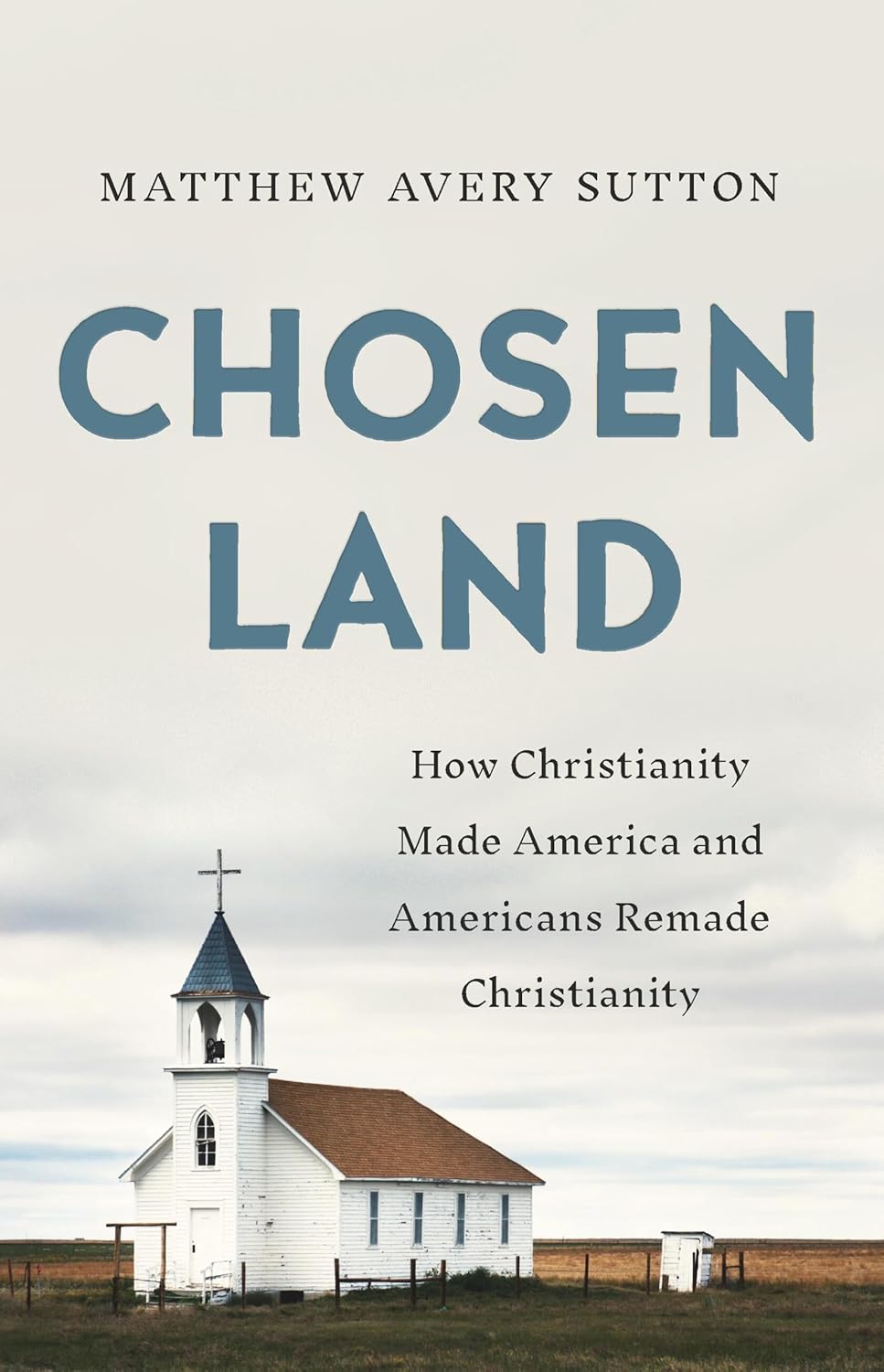
Chosen Land: How Christianity Made America and Americans Remade Christianity
Matthew Avery Sutton
Chosen Land: How Christianity Made America and Americans Remade Christianity
Matthew Avery Sutton
Constant Critique
Sutton artfully demonstrates that the history of American Christianity hasn’t been heaven on earth. However, he seems to highlight the most carnal, self-interested episodes. Chapter 4, for example, begins with the account of eccentric revivalist James Davenport taking off the pants of which he was inordinately proud during a bonfire for burning away vanities.
Around every turn in Chosen Land, Christians wield the gospel for personal power or prestige. For example, Great Awakening evangelist George Whitefield didn’t just preach to the lost; he “pitched salvation” as if it were a product in a window (61). The famous Haystack Prayer Meeting (1806) wasn’t just an effort to fulfill Christ’s Great Commission; the students at Williams College “acted both as ambassadors for the gospel and as American imperialists” (193).
The only consistent feature of Christianity in North America, according to Sutton, is its near-constant use for material gain: preachers become “entrepreneurs of faith,” Puritans sanction free market capitalism, and Christianity becomes a “commodity” (7, 192, 40).
Examining the Puritans, for example, Sutton quips, “Had they aimed to establish a New Testament–type communist community, things might have turned out differently. But for these faithful, God ordained the pursuit of wealth rather than equality” (40). Rather than engaging Puritan theology at length, Sutton frames the early church as protocommunists and refashions Max Weber’s “Protestant ethic” thesis to paint Puritans as forerunners of the prosperity gospel.
Rebranding vs. Reforming
Sutton is well versed in American religious history, having written five other books on the subject. In his American Apocalypse: A History of Modern Evangelicalism, Sutton pushed back against George Marsden’s authoritative telling of American fundamentalism. In contrast to a “militantly anti-modern Protestant evangelicalism,” Sutton framed fundamentalism as an “apocalyptic movement” oriented more eschatologically than doctrinally.
But Sutton’s more recent views of evangelicalism have come under increased scrutiny. In a 2024 article in the Journal of the American Academy of Religion titled “Redefining the History and Historiography on American Evangelicalism in the Era of the Religious Right,” Sutton argues that post-WWII evangelicalism is best understood as a “religio-political coalition” and as a “white, patriarchal nationalist religious movement made up of Christians who seek power to transform American culture through conservative-leaning politics and free market economics.” There’s little that’s actually theological in Sutton’s view of religion.
There’s little that’s actually theological in Sutton’s view of religion.
Sutton elaborates on these ideas in his new book. He considers the term “evangelical” in the 1940s to be simply a “rebrand” of fundamentalism: “The postwar evangelicalism that they promoted was not the continuation of an older tradition but the start of a new American religious movement, a reinvigorated fundamentalism. There is no singular evangelical throughline dating from the colonial period to today” (9).
Rather than identifying a consistent evangelical emphasis on the rebirth or the atonement or the Bible, and rather than positing that evangelicalism might be “reformed” according to Scripture, Sutton argues evangelicalism is just another “rebrand” or reinvention of American Christianity. He doesn’t simply deny a “singular evangelical throughline.” At times, it seems as if he denies one for Christianity itself.
Kingdom of This World
Ironically, Sutton’s approach to history has much in common with certain corners of ultraconservative scholarship and Christian nationalism. For example, “American Christianity and American history are not two parallel stories,” he explains, “they are the same story. The history of the United States is the history of American Christianity, and the history of American Christianity is the history of the United States” (15).
However, while these two entities undeniably overlap, they aren’t identical. Christianity shaped America. Christianity suffused America. But America was also molded by people and ideas and movements that weren’t Christian, in confession or practice or otherwise. American history is, after all, also part of the long history of sin. Many of the founders spoke Christian language without embracing historic orthodoxy.
Christianity suffused America. But America was also molded by people and ideas and movements that weren’t Christian, in confession or practice or otherwise.
Sutton’s atheological approach to religion is never more evident than in the way he defines who is Christian and who isn’t. In Sutton’s book, a host of groups—Unitarians, Universalists, Deists, skeptics, Quakers, Shakers, Mormons, and Baptists—all fall under the canopy of “American Christianity.” But there’s little theological continuity between these movements.
Based on this approach, are we to believe that Christianity was “reconstructed . . . over and over again” to meet “the demands of the public” as if it were a new iPhone? (4). Or are we instead to profess that an ancient faith was passed down consistently to each American generation—to a people who modified their beliefs and styles based on their understanding of the Bible in their own day and yet still combated heretical challenges to the Bible? One view of American Christianity is transactional; the other is traditional.
Christian Tradition
The church sits atop the greatest tradition of all. For two millennia, Christians have believed the kingdom advances not through clever reinvention but through fidelity to what has been received.
By conflating the entire history of America with the history of its Christianity, Sutton implies that all American religious expressions are equally Christian, that doctrine evolves as rapidly as politics, and that the nation’s sins can therefore be imputed to the church. Sutton is right to assert, “Christianity in the United States was political” (123). But it was much more than political.
The once-for-all delivered faith isn’t a Starbucks coffee we customize to the felt needs and cultural trends of our generation. Christianity has endured because of Christ’s faithfulness, not because of our inventiveness. Still, Chosen Land reminds evangelicals that if someone believes that the gospel can be reduced to a commodity, we shouldn’t be surprised when he longs for a Christianity that looks exactly like the world.