
Peter Kreeft has a new book out, a statement nearly always true no matter the month of the year. Nearing his 90th birthday, he remains one of the most prolific Christian writers alive today, rivaling the prodigious output of G. K. Chesterton and others. His latest book focuses on what he calls the two greatest novels ever written: The Lord of the Rings and The Brothers Karamazov.
As a longtime admirer of both works (I read Dostoevsky’s masterpiece again last year, for what I think was the sixth time), I can’t disagree with his selections. So I was curious to see what fresh insight he might draw from these novels, two books that continue to flow with wisdom long after the popularity of most others fades.
Ordinary Hope vs. Deep Hope
One chapter in particular is worth lingering over. Kreeft reflects on the nature of hope, contrasting ordinary hope with what he calls deep hope. Ordinary hope is often rooted in calculation. A bet on good odds. It’s the hope that arises when success is still a possibility, no matter how unlikely.
But deep hope is different. It’s the kind of hope that arises after ordinary hope dies. Hope against hope. The kind that Chesterton said “exists only in earthquake and eclipse.” It’s a confidence not grounded in statistics or circumstances but in the underlying order of things, in the conviction that life will ultimately triumph over death and that it’s good and right to desire and will the good.
Ordinary hope may come and go, depending on the circumstances or what we think the chances may be. But deep hope is heavy, so heavy it can make the heart light.
Star That Pierces the Darkness
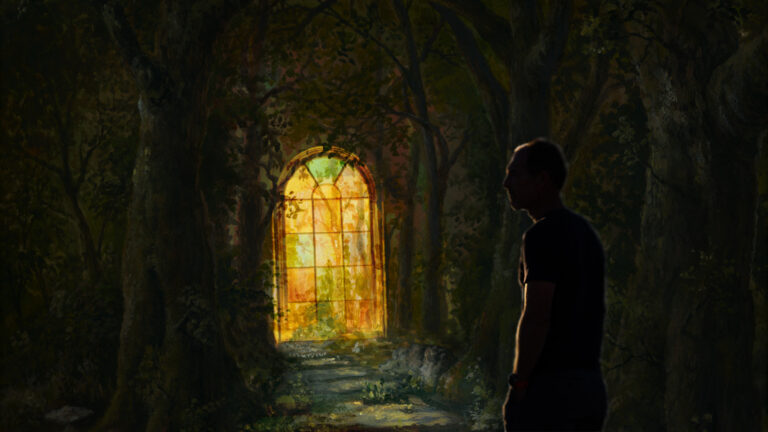
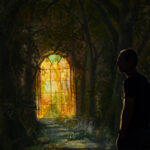
To illustrate this kind of hope, Kreeft turns to a memorable scene in The Lord of the Rings. Frodo and Sam are deep in Mordor, drawing closer to the heart of evil. All the last bits of ordinary hope are gone. Frodo is asleep. Sam is keeping watch. And in that moment of utter despair, something catches Sam’s eye.
There, peering among the cloud-wrack above a dark tor high up in the mountains, Sam saw a white star twinkle for a while. The beauty of it smote his heart, as he looked up out of the forsaken land, and hope returned to him. For like a shaft, clear and cold, the thought pierced him that in the end the Shadow was only a small and passing thing: there was light and high beauty for ever beyond its reach.
Kreeft tells us this is the scene Tolkien said he couldn’t read without weeping.
What makes that moment so powerful? It’s the sudden awakening of deep hope. A hope not grounded in self or chance or likelihood but in something metaphysical. A cosmic, objective foundation underlying all things. A good and living God is there. Kreeft puts it this way:
The tears we have when we read passages like the one above (Sam’s star) come from a human (or hobbit) heart that cannot hold the supernatural size and weight of its hope, like a cloud that cannot hold its rain.
Tim Keller loved this passage too. He appreciated Tolkien’s contrast between Sam’s defiance (when he was still looking at himself) and hope, when his courage came from looking away from himself and up to the heavens. Deep hope is what helped Sam fall into “a deep untroubled sleep.”
When the situation is dire, the world tells us to look into our hearts. To screw up our courage. To banish our fears. But Christian hope is different. It comes from outside ourselves. It’s a joy that pushes fear into its proper place and keeps it from becoming all-consuming.
When the Shadow Is Small and Passing
When Keller was first diagnosed with cancer, he went through a risky surgery. And yet, in a moment fraught with peril and fear, he experienced something remarkably similar to what Tolkien described Sam seeing in Mordor.
He wrote about it in Hope in Times of Fear:
In the moments before they gave me the anesthetic, I prayed. To my surprise, I got a sudden, clear new perspective on everything. It seemed to me that the universe was an enormous realm of joy, mirth, and high beauty. Of course it was—didn’t the triune God make it to be filled with his own boundless joy, wisdom, love, and delight? And within this great globe of glory was only one little speck of darkness—our world—where there was temporarily pain and suffering. But it was only one speck, and soon that speck would fade away and everything would be light. And I thought, ‘It doesn’t really matter how the surgery goes. Everything will be all right. Me—my wife, my children, my church—will all be all right.’ I went to sleep with a bright peace on my heart.
When the darkness descends, we need more than optimism. We need more than defiance. What we need—what Tolkien saw, what Keller clung to, what Kreeft writes about—is deep hope. Hope endures not because the odds are good but because the Storyteller is.
In the end, light and high beauty will outlast the shadow. And that even the smallest glimpse of that light—seen by a hobbit in Mordor, or a pastor in a hospital bed—can make us weep for joy.
If you would like my future articles sent to your email, as well as a curated list of books, podcasts, and helpful links I find online, enter your address.