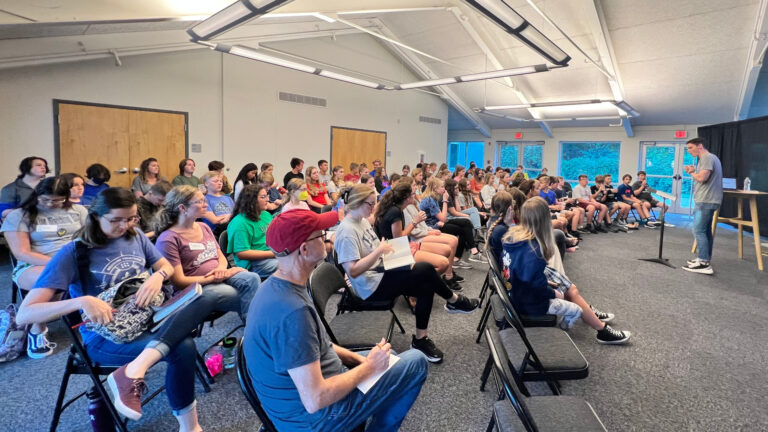




Loving others and communicating respectfully across differences isn’t easy—sometimes it’s not even something we want to do. It’s far more comfortable to stay in circles of sameness than to engage those with different beliefs, backgrounds, and perspectives. In this breakout session from TGC’s 2024 Women’s Conference, Vanessa Hawkins explains how growing in cross-cultural competence isn’t just helpful for communication; it’s a key part of our spiritual formation as disciples of Christ.
Transcript
The following is an uncorrected transcript generated by a transcription service. Before quoting in print, please check the corresponding audio for accuracy.
Vanessa Hawkins: As we’re talking about building cross cultural competence through holistic discipleship. For those of you who are wondering, what does one thing have to do with the other, or what does any of that mean? That’s a very long title, isn’t it? I know, I know, but let’s first define our terms and get us all on the same page, singing from the same hymnal, and all those other things, right? All right. So what is cross cultural competence? And so when I talk to you about cross cultural competence, what I’m really talking about is the ability to speak with love and respect across cultural difference. All right, the ability to speak across cultural difference lovingly and respectfully. And some, some people will also refer to CQ cultural intelligence. And I tend to use those interchangeably. The only difference really is trademarking and who owns what rights to what right. So I use those interchangeably, so they’re all very similar concepts. So what then do we mean when we talk about holistic or deep discipleship? As one of my pastors likes to say, discipleship involves all of life. It’s the whole of life, and it means becoming and remaining a lifetime learner and follower of Jesus Christ. And I like to describe discipleship this way. This is the Vanessa Hawkins version. All right. I think of discipleship like this. It’s growing in the knowledge of the Lord, in the likeness to the Lord, in affection for the Lord until we see the Lord. Okay, I’m gonna say that one more time. It’s growing in the likeness of the Lord, in affection for the Lord, in the knowledge of the Lord until we see the Lord. It’s all of life, it’s all of life. And so this kind of holistic deep discipleship comes through being in the Word of God and being with God’s people in healthy, gospel centered community. All right, so that’s how we’re defining holistic deep discipleship. It’s built through God’s word and being with God’s people in healthy, gospel centered ways. So then what does building cross cultural competence have to do with holistic discipleship or growing in the likeness to the Lord? I think it was David Livermore, the author of cultural intelligence, who points to Jesus as the ultimate example of cultural intelligence, leaving his context in heaven to put on flesh and identify with those who are the lacks of the lack of us. The likes of us rather radically different from him, he modeled what, what he invited us to do, and that is Love the Lord your God with all your heart, mind and soul, and love your neighbor as yourself. The he was the ultimate example of what it means to be cross culturally competent to love respectfully across cultural difference. So I grew up in a small town in southeastern Arkansas. It was largely a farming community, and I just have really fond memories of mud pies and rolling in tires and all kinds of great things, just good old fashioned, clean, well, dirty in the dirt fun, but, you know, good fun. And so some of the brokenness of our town had really become normalized to me. It was just the way it was. And after leaving and coming back, some of those areas of brokenness just became magnified and really clear to me. I considered the railroad track that went straight down the middle of Main Street neatly dividing the town into an east and a west side, and the east side was well manicured, teaming with businesses, beauty and attractive housing. The west side was much less manicured and even grown up in some spaces. Businesses were few, and all of the government housing was on the west side of town. And while there was certainly beauty to be found, there was also great disparity between the east and west sides. Now honestly, that profile fits lots of small towns in America. It always. Advantage. It’s always, you know, aside or areas that are advantaged in size or spaces that are disadvantaged, that’s common, right? But while that profile fits a lot of towns, there was an ongoing divide in our little town that I still find shocking to this day. The clinic in our town had separate waiting rooms for its black and white patrons, and the waiting areas were divided by a wall. And I know you’re thinking, Yes, Vanessa, that’s how it was back in the 50s and 60s. And I want to tell you, I’m not that old. I just want to be clear about that. Yes, I’m doing the panel on aging later, but I am not that old. All right, back to the story. And so those walls, that wall separated those waiting areas into a white side and a black side, and now it’s significant that I was born in 1973 that’s a full nine years after the Civil Rights Act of 1964 which made any type of discrimination or public segregation illegal. It was against the law. Yet when I left the town for college in 1991 that wall still stood. It remained so as a child, I quickly learned that separate was never equal. It always advantaged some and disadvantaged others. But as an adult now, I look back and wonder how in the world was something so physically polarizing and divisive allowed to stand illegally after all those years. It blows my mind. Sure there were faded markings on the wall of where the whites only and blacks only signs had been, but they had minimally complied with the law, right? But that wall was a standing symbol of the enduring distance between people groups in that town. So while most of the people in my town would have sworn to you that they loved God. I mean, there was a church nearly on every corner. Many townspeople were regular church attenders who went to Sunday school, went to Wednesday night Bible study, mid week Bible study. They were good. Bring you a casserole when you’re sick, kind of people. But if you ask them, the majority of them certainly would have told you that they love God. Yet the wall in the doctor’s office bore witness that they didn’t love all their neighbors. So now, how are blatant systems of wickedness allowed to stay in place and go unchallenged by people who say they love God? It’s a fair question, and while the people of my town were being discipled by the word of God. They were also being socialized in a system of injustice that was also discipling them. They were there were visible images of injustice that were teaching them that some people are inferior, some people are superior the images offered distance and separation that fed the narratives of fear and hate, narratives that would have gone unchallenged among their sameness, these are the kinds of spaces where polarizing talk finds quick expression, and there’s no shortage of polarizing talk in our broader culture right now, is it? It doesn’t take any special skill to find quick disagreement on the many hot button issues on regular rotation with our news affiliates. What is harder by far, though, is, how do we respond to polarizing talk in a way that doesn’t fuel all of the flames, but that infuses life into the broader conversation? How do we do that? How do we speak lovingly and respectfully across chasms of difference in our world. Well, I was recently struck by a very polarizing statement, but found great encouragement and helpful instruction, even in how it was responded to the statement came from Nathaniel, who was. Being invited to come see Jesus by his friend Philip in the book of John, John, chapter one records this exchange, starting at verse 43 and it reads the next day, Jesus decided to go to Galilee. He found Philip and said to him, Follow me. Now. Philip was from bethseda, the city of Andrew and Peter. Philip found Nathanael and said to him, We have found Him of whom Moses in the law and also the prophets, wrote Jesus of Nazareth, the son of Joseph, Nathaniel said to him, Can anything good come out of Nazareth? Philip said to him, Come and see Jesus. Saw Nathaniel coming toward him, and said of him, Behold an Israelite indeed, in whom there is no deceit. Nathaniel said to him, how do you know me? Jesus answered him. Before Philip called you, when you were under the fig tree, I saw you. Nathaniel answered him, Rabbi, You are the Son of God. You are the king of Israel. Jesus answered him, because I said to you, I saw you under the fig tree. Do you believe you will see greater things than these? And He said to him, Truly, truly, I say to you, you will see heaven opened and the angels of God ascending and descending on the Son of man. Jesus had found Philip in Galilee, this northern region of Palestine, and he invited Philip to come follow him now, an excited Philip found Nathaniel and said to him, we found him. We found him the one that Moses in the law and all the prophets have talked about, Jesus of Nazareth. We found him the son of Joseph, the Messiah, the Savior they had learned about and had anticipated since their youth, the one that they had longed and waited for. Philip couldn’t wait to tell Nathaniel about him, and so you might expect that Nathaniel would jump up and down and that he would scream and maybe even be dumbfounded. Yeah, none of that happened. No. Instead, Nathaniel replied, Can anything good come out of Nazareth? Now, I find Nathaniel’s statement curious for a whole lot of reasons, but for a few he is completely unmoved by Philip’s excitement and his message. He is clearly a student of the scriptures. They reference Moses and the prophets right the law that had been handed down to them, but Philip’s announcement that we found him suggests that they not only believed but they were looking for him. They were anticipating his arrival. They were waiting for him, this promised Savior. So it’s peculiar to me that Nathaniel responds the way that he does to Philip’s message. Can anything good come out of Nazareth? It’s bizarre. He didn’t believe that what he had anticipated, the Christ was possible any other way coming, any other way than how he had imagined it, and so he devalued an entire town and all of its people because he held to that view that was his truth. Now, while being a student of the scriptures, Nathaniel still had some faulty thinking. It is believed that the town of Nazareth during the time of Jesus would have had a populace of about 2000 people or so, and so, in his response, he has suggested that there was nothing and no one of any redeemable value. Are you hearing that in that entire town? No one and nobody, nothing and nobody, anything good not he didn’t even just say anyone. He said anything you. Hmm, so the town in his mind was worthless, and the people in it and the things in it were worthless. What an incredibly polarizing and arrogant thought. Scripture doesn’t give us any more insight than this into his thinking, but I can’t believe that Nathaniel’s statement just came out of the thin blue air. He clearly has some preconceived notions about Nazareth that he quickly expressed when he was given the opportunity. I just wonder if some of the things we’re hearing are things that are not just out of the clear blue but when they find expression, when they’re given the opportunity to come out, it’s pretty easy for us to see how very divisive and polarizing Nathaniel’s question was looking back, you know, hindsight, 2020, But what’s harder by far to see are our own polarizing views and our own polarizing language, polarizing views like those of Nathaniel’s often exist in what we like to call echo chambers, or an environment where you only encounter beliefs and opinions that agree with yours, so your existing views only get reinforced, and alternative ideas never get considered, right? You just kind of rehearse those ideas with people who think like you. These spaces are breeding grounds for elitist thoughts like Nathaniel’s about entire people groups that just get normalized in conversation. Now before you quickly dismiss this as somebody else’s issue, I know y’all. I know how you think. I know how you think I want, I want you to do a quick echo chamber search with me. Would you? Would you do that? Let’s do it together. We’re gonna do a quick echo chamber search. Now. Don’t look beside you. Gonna do a quick echo chamber search. You ready? You ready? Come on. You ready? All right, let’s, let’s look for it. All right. So here we go. Who are the people that you hope don’t show up for Thanksgiving dinner, because you know they going to rub you the wrong way. Who are they? I don’t know. Aunt Jackie, Uncle Pete. I don’t know who they are. Get them in your head. Who is it? You got them. You got them. All right. Now here are a few diagnostic questions to help you locate your Echo Chamber buddies. All right. Now, who are the people in your circle who would be just as offended as you by your Thanksgiving guests because you hold the same views. Who are those people? You got them? Come on now, we searching for an echo chamber. Let’s hope we don’t find it. But if we do, we’re gonna be honest about it, right? Let’s do this together. We’re friends. There’s a few of your a few 100 of your favorite friends. All right, what is the people group who causes you to slip into those emotional global qualifiers, like they all do that, or, I wish they all would just what’s the people group that makes you slip into that space whose views are so clearly wrong that you could never have anything common with them. Who is that? Who are the people you can unfavorably bring up in regular conversation, and no one in your friend group would challenge you if you can’t say, Amen, just say, ouch. It’s all right. It’s all right. We friends, we family. Come on, those are the ones for whom you might be holding a little Can anything good come out of Nazareth energy? The ones whose names may be bouncing off the walls of your echo chamber. So how then do we disrupt our noisy echo chambers? How do we disrupt that once we find it? I love Philip’s response to Nathaniel, he didn’t rebuke him or engage in his polarizing talk. I love that because, you know that’s easy to do, right? I can easily get with you. That’s easy. But instead, he invited him to be curious. He said, Come and see. Come and see. See. Curiosity is. Vehicle by which we move from behind the walls of our echo chambers and towards neighbor. Love, I’m going to say that again, Curiosity is the vehicle by which we move from behind the walls of our echo chambers and towards neighbor. Love. Being curious disturbs those normalized beliefs that you’re holding is true in pursuit of more information and greater understanding, it takes great humility to admit that we simply don’t know everything there is to know about any given topic or any given people group. We just don’t. We don’t and Nathaniel accepting the invitation to come and see was his accepting the invitation to be culturally curious, to hate to have his views challenged rather by what he had normalized as truth. And what topics do you have deep emotion and little curiosity. Where has experience informed your thinking and you just simply know what you know? Where are you fearful and find comfort and distance from a certain people group. These are the heart postures of the convinced and not the curious. Curiosity leads to greater proximity. It means I’ll move towards you. It means nearness and nearness leads to greater clarity. So being near someone invites intimate seeing and knowing that silences assumptions and humanizes the hated. Nathaniel likely wasn’t the only one who held his views. He’s just the only one we hear about. But to his credit, he was curious enough to accept Phyllis Philip’s invitation to go to come and see this, Jesus of Nazareth, you got to give him credit for that. You got to give him credit for that. So now, as Nathaniel walks toward Jesus in curiosity, Oh, I love Jesus. Ah, Jesus encouraged Nathaniel by affirming what was good, he says, Behold an Israelite indeed, in whom there is no deceit. Now hear how amazing this is, because of all the differences he could have called out and they were vast. He found a connecting point. They lived in different regions, but he was like, well, but we’re both from Israel. So he found a way to connect them when he could have, you know, found a way to find their differences which were so much easier to find out of all the things he could have named, he named the thing in common, and then he affirms what’s good about Nathaniel? He says his integrity. He says there’s no deceit in him. He’s like, I see you intimately. I see you My goodness. And so Jesus uses his words to encourage Nathaniel to keep moving towards him. And I think about it like this, it’s kind of like a this is, see, this is where I need those wireless mic because I need both my hands. But this is like a parent kind of teaching a toddler how to walk. Jesus words, he’s kind of holding out his hands and say, Come walk to me. Walk to me. Nathaniel, come on. Keep walking towards me. And he’s just joyfully urging him to keep to find his footing. Keep walking towards me. That’s what he’s doing with his words. Nathaniel recognized from Jesus’ words that Jesus had intimate knowledge of Him. He saw him through and through. He saw him and he knew him. So when Nathaniel questioned how Jesus knew him, he explained that before Philip ever called you. He saw you. I saw you. And seeing how Jesus has supernatural knowledge of who Nathaniel was. It’s interesting to note what he didn’t say, right? He didn’t rebuke him for that whole Nazareth comment, right? He let, he let that go. He didn’t scold him for doubting that he really was the Christ. He saw him, knew him and created belonging. He invited Nathaniel closer with his words, even before Nathaniel expressed belief. Oh, it’s just a good spot right there, just to ask, Who is it in our churches that we are creating belonging for before they believe? Who? We doing that for how often are we creating belonging for people when they have no shared belief? How often are conversations with those with opposing views characterized by our differences instead of our commonalities by criticism, not kindness? How often do we use our words to make room for people and to move them towards us and us towards them? How often do we create space for those with opposing views to feel seen and known, not vilified and cut down? That’s easy. This is precisely what Jesus modeled in his interaction with Nathaniel. He had a beautiful way of drawing people near to him in kindness, without compromising on what was good, right and true. You can do both. You can do both. Nathaniel had his polarizing thoughts upended in the most extraordinary of ways. The long awaited Messiah came through a devalued people group and in a way that was unimaginable to him, Can anything good come out of Nazareth being seen and known by Jesus disrupted his faulty thinking and moved him into a declaration of belief, Rabbi, You are the Son of God. You are the king of Israel. So did Nathaniel gain perfect sight that day and instantly have all of his learned prejudices washed away in that moment of belief. No, that’s not how it works. Jesus tells Nathaniel that he will see greater things than these. He had new sight, but not perfect sight. There was more to see, more to understand, more to be curious about and so it is with all who are in Christ. We have sight. Thank God for sight. We don’t have perfect sight. So we have to keep looking. We have to stay curious, keep moving towards one another. And so growing in spiritual sight and understanding requires accepting the invitation to come and see over and over and over again. My prayer is always, Lord, Sanctify these lenses. Sanctify them so that I can see right. Because mine get dirty, Sanctify them. You can do that. You’re God Sanctify these lenses. And it’s having our lenses washed clean again and again in the presence of Jesus. It’s having awareness of our less than perfect vision and embracing a posture of humility about what we are possibly unable or sometimes unwilling to see now, now that we’ve laid a bit of foundation on helpful ways to think about neighbor, love across differences, now I’m talking to you a little bit about just kind of some framework of cultural intelligence. Okay, we’re gonna move into the classroom portion now, okay, we’re coming out of church, and we’re going to go across the street to the university, right, okay, all right, I’m now Professor Hawkins, and we’re going to talk about cultural intelligence. So I want to so this cultural intelligence framework, we’re going to explore that a little bit, and then I’m gonna sink you down into the details of some research that I’ve done that I hope you’ll find helpful, just at a very practical level. Okay, all right. All right. So in your in cultural intelligence, there was a time in the not too distant past that if you were looking for a job, one of the qualifying things that people would ask, one of the determining factors, was they’d give you an IQ test. It’s an intelligence quotient. So basically, they wanted to see how well could you problem solve, right? And so that was one of the big qualifying factors measures your reasoning and ability to solve problems, and now more employers are testing for EQ and CQ. So EQ is emotional intelligence, or emotional quotient that has to do with your ability to understand your own emotions and to regulate them and to empathize with others, et cetera, et cetera, okay? And CQ, then is what we’ve been talking about, right? We’ve discussed it involves being able to communicate well over cultural difference. So employers are now finding this an important skill to have in an ever changing workforce landscape. Eight, right? So let’s briefly. We’re going to look at four parts of cultural intelligence. I can’t let you go without giving you some cultural intelligence framework. It’s on the name of the class. I got to do it. I’m obligated, all right. So the first aspect, the first component of cultural intelligence is knowledge. Okay, knowledge and so knowledge measures your ongoing growth and understanding of cross cultural issues, including understanding languages and customs, et cetera. It’s the basis for growing overall cultural intelligence. But it’s just the basis, which means that it’s possible to grow in knowledge of cultural intelligence and not grow well in knowledge of other cultures and not grow in your cultural intelligence. Let me tell you why that is so you can read about other lands, you can read about other people groups. You can read about their you know, languages and their customs. But if you don’t actually engage, you never grow in the cultural intelligence, right? So, knowledge is one of the components, but it is not a one to one correlation. It doesn’t mean knowledge equals cultural intelligence, okay? It’s a component. It’s the basis, all right, but you at least need the knowledge all right. The second component is strategy, and this strategy component measures your ability to be mindful and aware as you interact with people from different cultural contexts. So it’s your ability to accurately make meaning from what you observe. So this component has a strong connection to knowledge, because you use the knowledge that you’ve gained, and you create strategy for how you will engage going forward, right? And so it means you reflect on your cultural your cross cultural encounters and that you’ve had, and you devise a strategy for your next cross cultural encounter. So for example, when I lived in St Louis, as I did for 25 years, I volunteered as a counselor at a school over the river in Illinois, and it took me a minute to recognize that these kids weren’t letting me in honestly. The populace of the school were they were black, and I thought, you black, I’m black. What’s the problem? Right? That’s not how it worked, because most of the kids from that school came from a housing project, probably about 90% of them did, and so they had been on government assistance all their lives, and people you know had come do gooders had come to their school over and over and over again, and had helped for a little while, but hurt them terribly when they pulled out and left. And so there was this insider outsider culture there that I had to try to navigate right and so learning that, it meant that, you know, I had to be really intentional about showing up on time, having certain rhythms, because there were trust issues. And so I was earning their trust. I was earning their trust. And so that affected my strategy, right? So having that knowledge, then gave me the ability to create strategy for how I would engage that culture. All right. Strategy, perseverance is three. Perseverance, the perseverance component measures your level of interest, your drive, your motivation to adapt cross culturally and so effective perseverance requires an awareness that to keep going, and an awareness of what slows you down. And you know there are, as I’ve done my research, what I have noticed is that perseverance was often the game changer, the game the break in people’s progression to move forward. It’s like they go to a certain point. But this was the straw that broke the camel’s back, right here. I’ll go this far with y’all. It said, US versus US versus you. Thing. I’ll go this far with y’all. But now that’s too far. That’s, that’s too much, and so it’s, it’s not being motivated to keep going and then behave. This behavioral component refers to actions and words that we use to interact cross culturally. It involves the ability to observe, recognize, regulate, adapt and act appropriately in intercultural settings, and sometimes what people will tend to do is just modify their behavior. And that’s not what this is. This behavioral this is, this is about transformation that comes from learned interactions, that comes from using that strategy, that comes from reflecting. Uh, for example, when I did my research, I had this lady, sweet as she could be, older lady who was around during the Watts riots, and she just had terrible trauma from it, terrible, terrible trauma. Had been in counseling for many years, and she honestly hated white people, she just did, and she didn’t want to, but she did, and so we were working through this. And again, she had had years of trauma counseling and such, but she participated in this, this one year research project that I’m going to tell you about in just a second. And she was amazed that Derek Chauvin, the police officer who was responsible for killing George Floyd. She was amazed that when she saw him on TV and heard how persecuted he was being and how he has been treated, she was just amazed that she had compassion, she felt sorry for and she said she knew that that was something she hadn’t had capacity for at all before there had been a transformation of how she existed in the world, and only the gospel can do that. Only the gospel of Jesus Christ changes hearts and minds like that. And so that’s what we’ve seen in this that this discipleship. So let me, let me go right into let me tell you about the study, and then I’m gonna let you guys go, or I’m gonna have to let you do calisthenics or something. I don’t know. I know it’s research. It’s research. I know you want to just talk about Nathaniel. That’s why I had to hook you. I know you wanted the Bible. I know you. Tgcw, women. You just want Bible all the time. All right, so, so my my research was from August 2020, to August, 2021, if you can remember what that climate was like, okay, that climate was a little cray, cray. Wasn’t it just a little cray, cray. And so I had a team of people, and we set out to disciple a local church and loving their cross cultural neighbors amidst all these polarizing conditions, right? And so the factors contributing to that tension was the murder of George Floyd, the conviction of Derek Chauvin, the presidential election year, conflict and alleged insurrection, growing distrust, accusations of police brutality towards minorities, strained relationships between police and minority communities. Asian hate, a global pandemic was happening, and so all of these things were major contributors to just that polarizing conditions of that season. It was a interesting season to be alive, wasn’t it, and so in that climate, we asked 53 people, 14 white couples, 10 couples who were persons of color, and then three persons of colors who were single, all right, and all of them were part of the same church, all right. And so all the participants agreed to take a standardized intercultural competence inventory so that we could assess where they were at the beginning of the year and where they were at the end of the year, all right. And so they agreed to meet monthly to discuss a chapter of a book that was about cross cultural engagement. So they did that. In addition, they agreed to meet separately each month with their assigned cross cultural group, and each of the different cultures alternated what they chose that they would do. The only thing, the only limitation we gave them was that they couldn’t just do something they wouldn’t normally do. They had to. It was about doing life together okay, and alternating how they did it. And so they were given talking points so that they could share parallel social experience, okay? And then they also agreed to be prayerful in their engagement and to communicate with gentleness and respect. Those were the ground rules, okay? For one year, that year that I described to you, all right, that’s, it’s significant. It’s significant. So it’s really, it’s most helpful when I show people this in pie charts. I don’t have pie charts for you today, so try to follow me for these, for this, this data, just try to follow me. It’s brief. I promise it’s brief. So out of the 53 people that we asked to participate in this one year long study, 30 of them completed the one year commitment. 30 okay. And of the white participants, about 60% of them completed the study. Of the black participants, about 72% of them completed. At the study. And so of those 30 people total who completed the study, you with me, still okay. Of those 30 people total who completed the study, 10 showed significant growth in their cultural intelligence, and six showed significant regression. And so those 16 persons became the subject of my case study. And so I interviewed them extensively to understand discipleship practices, to understand how does this happen? How do you regress, and how do we grow? That’s key for the church. What are the things that we can do. How can we grow? How can we be discipled in this? And so here are some of the findings I this was, I found this pretty amazing. Can I tell you that 100% that means everybody, 100% that’s all 53 that was before anybody dropped of those participating in this study believed that they were more cross culturally competent than what they really were. 100% everybody, everybody thought that they were more cross culturally competent than what they were. What does that say to us? That says that we’ve got to approach this thing with some humility and with some curiosity. All right, that’s what that says. And so we need a humble and a teachable posture in communicating across these differences. I Yes, so in the in the big areas of cultural intelligence, knowledge, everybody who showed significant growth in knowledge were the people who remained culturally curious. They were the people who wanted to know more about other people who were different than them. They were the ones who grew in knowledge, the ones who grew in strategy, interestingly enough, were the people who were just intentional learners. They were the ones who didn’t just brush past a cross cultural encounter. They were the ones who would turn it over in their head and in their heart, probably would pray about it and try to understand okay, how can I do a better job at that next time. That helps you be better at anything, by the way, right? And so people who grew in that skill, that strategy, were people who did that, all right, people who persevered, were people who actually were really if, if I could put it in these terms, they were the ones who could have who couldn’t afford not to. So the people who dropped generally, there was a power differential. They had the power to walk away. The people who held on were the people who needed the other culture to understand, because their flourishing depended on it right, and so their perseverance was notable. Those who tended towards regression were those who re entrenched into their sameness, right? They were those who, you know, I could, I could tell just from interacting with them, they would, they would articulate some point in which they just couldn’t go past that. You could hear it in the language of it. And it’s like, I, you know, I won’t persevere beyond this juncture right here, that hurt too much, that’s too scary, that’s too close to home, that’s too something, right? And so then the there’s, there’s a lack of perseverance. And so you they don’t grow in that area. And then behavior, most of those who experienced significant growth were able to also articulate at that, you know, a spot in which something fundamentally shifted for them, some light bulb came on, something I understood. I now see this people group as this. When I once saw them as this, there’s a new grace that’s there. There’s a new grace, there’s forgiveness. That’s there. And so when I see that, when we see the big behavioral transformations, that’s what we’re seeing. We’re seeing the Spirit of the Living God operate on the hearts of man. That’s what’s happening when we see the transformation, right? You? All right, a couple of things about the power differential, and we’ll give you some resources, and we’re going to get out of here. The. Those with less power had greater motivation for engagement, as I told you, and there was evidence in their higher attendance and their higher completion rates. They were locked in, locked in those position and higher levels of power were less motivated towards community communicating. Well, they really wanted to learn how to navigate relationships in other cultures become, well, yeah, the minority cultures really had more of a desire to do it. They were motivated to do it out of need the common agreement, I found interesting, was that the church, they both groups, agreed that the church wasn’t using its power to create belonging for minorities. Again, this is one local church. If you see your church in here. You see your church in here, but I’m just saying this was one local church. The church was perceived at doing a better job of being open to diversity, wanting to see people groups, but not wanting to create belonging for people groups, right? And the last bit of information in the power dynamic, I found this so interesting. They were asked to rotate back and forth between majority culture home people homes, and minority culture people homes. And so many of the groups only met in the majority culture people homes. There was no mutuality, and the one group that had mutuality, the one group that had mutuality, the gentleman willingly admitted he was like, Man, this is I’ve never had this. And so he looked back on his childhood and recognized he had never experienced that kind of mutuality in hosting and being hosted by minority persons, even when it was the same socioeconomic class and all of those things. He was usually the one who was hosting. Was hosting, and the importance of the practice of mutual and intercultural hospitality just can’t be It can’t be minimized here. But unfortunately, this was a takeaway that most of them realized in hindsight. Right? All right. So our big takeaways, then, people need to hear the gospel over and over and over again. Love God, Love your neighbor. Refocus on the solution, the Spirit’s power to transform hearts and minds, because it’s easy to get caught up in this is impossible. Can change even happen not just through you. No, you can’t change it, but the Spirit of the Living God can. And so refocusing often and remembering the power to make the change is through the Spirit. Now he will use your hands, and he will help you persevere. He’s the one who causes the saints to persevere, right and so refocusing on the solution and not getting so overly caught up in the problem. And then people will generally affirm with you know this, the people who assessed a certain way in the cross cultural competence exam or the inventory, know that if people assess as polarizing well, they’ll act polarizing. They’ll act polarizing. And so prepare your heart and give people a grace if you ever decide to do anything like this at your church to try to help disciple people. The last thing is do the pre work of prayer for those whose hearts are hardened towards the gospel, but also for your own, for your own. All right, a few resources I would recommend deep discipleship by JT English, I love that the focus is very much on what we were talking about as we were talking about discipleship. You know, we often tend to focus on community, or the Word of God. He does a good job of bringing them together, because you need both. The Word of God is practiced and lived out in community, right? But you need the word of God. It is living and active, so you can’t do one or the other. You need both. So JT, pulls those together nicely. JT, English, deep discipleship. You want that book. There’s one called compassion and conviction by Justin gimini. I highly, highly recommend that one. Justin is an attorney in. Uh, Atlanta, who is full of Jesus and says that, you know you don’t have to just talk about justice and or compassion, that those two things can live together. It’s what Jesus demonstrated, right? And then the beautiful community by my dear brother, Erwin Entz, I highly recommend all of those works. All right, let me pray for us, and then I’m going to let you thank you for being so attentive. I know I gave you a lot of data. I know I gave you a lot of data. I appreciate you hanging around and sticking in with me. Let’s let’s pray, gracious God, there’s just nobody like you. There’s nobody who sees us and knows us and yet loves us like you, Jesus and so God, we praise You. Lord, we admit that in situations and conversations of cross cultural competencies, Lord, sometimes we feel most incompetent Lord. Sometimes we don’t know what to say. We don’t know the right thing to do. But Lord, Your spirit is the teacher, and so Lord, would You guide us? Would you help us to use the resources of faithful sisters and brothers that we would grow and that you would disciple us, that you would cause us to look like Jesus in this area of our discipleship. Lord. We long to look like you. We long Lord to love others like you. We long Lord to be bridges in conversations, Lord and not to pour fire on the divisiveness of our culture. We long Lord to to to put out some of the polarity the polarizing conversations, Lord and to walk together and to agree teach us how to do that. You said, If any man lack wisdom, that you would give it liberally. Lord, we need your wisdom, and so, Lord, I pray that you would empower us by your Spirit, Lord, that we would walk in humility, that we would be curious, that we would lean into each other, that we would be curious and that we would, Lord, move towards one another in love by your spirit. Teach us your ways. Oh God, help us to walk in them. We love you, Lord. We give you great praise in Jesus’ name. Amen, we all want to grow in our faith and knowledge of the Bible, but it’s hard to do it on your own. Did you know that the gospel coalition offers live online cohorts where you can learn and grow alongside others, led by trusted pastors, teachers, authors and speakers. TGC cohorts dive deeper into topics like parenting, sexuality, biblical theology, cultural apologetics and more so, visit tgc.org/cohorts to see which ones are available now, or you can click the link below.
Vanessa K. Hawkins (MDiv, DMin) is the director of community life at Redeemer Lincoln Square in New York City. She is a Bible teacher, a conference speaker, and author of the forthcoming Justice and the Heart of God, a Bible study on the book of Amos. She serves as a fellow for The Keller Center for Cultural Apologetics. Vanessa is married to Marcus, and they have three daughters. You can follow her on Instagram.