
What if the rise of AI is exposing a crisis that was already there?
That question lies at the heart of this episode with Stephen Driscoll. As AI becomes more capable, many people feel a growing sense of anxiety about what human beings are for. If our value rests on intelligence, creativity, or productivity, then AI will always seem to threaten our worth. But Stephen argues that this fear reveals a deeper problem: We were never meant to ground our identity in performance in the first place.
Stephen is a Christian ministry worker in Australia and the author of Made in Our Image: God, Artificial Intelligence and You. In our conversation, he turns to Genesis 1 and 2 to show that human dignity isn’t something we achieve but something we receive. We’re made in the image of God, and that means no machine can take away what God has given.
Stephen joins me on Silicon Spiritualities to explore why AI is forcing fresh questions about identity, and why the Christian answer offers a surer foundation for human worth than any technological vision ever could.
Resources Mentioned:
- Made in Our Image by Stephen Driscoll
- Dominion by Tom Holland
- “The Experience Machine” by Robert Nozick
- Your Brain on ChatGPT by MIT Media Lab
REGISTER for our 6-week cohort, Get Ready for the Age of AI, where you’ll get an exclusive, early, free copy of the book The AI Apocalypse, featuring Watkin and many others, such as Ben Sasse and Alan Noble.
PREORDER The AI Apocalypse: A Survival Guide for Humanity.
JOIN the conversation on Discord, along with other Silicon Spiritualities listeners.
Help The Gospel Coalition renew and unify the contemporary church in the ancient gospel: Donate today.
Transcript
The following is an uncorrected transcript generated by a transcription service. Before quoting in print, please check the corresponding audio for accuracy.
0:00:00 – (Stephen Driscoll): Foreign.
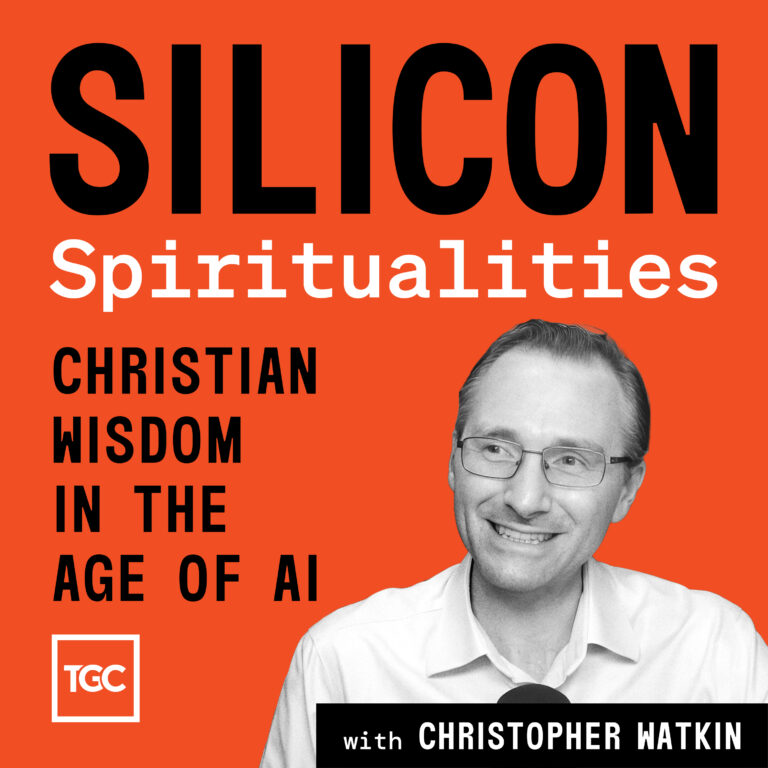
0:00:08 – (Christopher Watkin): Welcome to Silicon Spiritualities, a podcast from the Gospel Coalition about what it means to be human in the age of AI. I’m Christopher Watkin, and in this series we’re going to unpack three crucial questions. What can AI do for us? What is it doing to us? And what is it showing us about who we really are? Today I’m joined by Stephen Driscoll, author of the award winning book Made in Our God, Artificial Intelligence, and you.
0:00:44 – (Christopher Watkin): And we’re going to explore how AI might actually help us to understand ourselves and God better. Stephen, welcome to the podcast.
0:00:53 – (Stephen Driscoll): Thanks so much for having me on, Chris.
0:00:56 – (Christopher Watkin): Stephen, you’re a staff worker with a Christian student group in Australia, and most people in your position, I guess, would write books on evangelism or Bible study, but you’ve written a theological book on artificial intelligence. Why was that the book you wanted to write? And what itch are you trying to scratch with it?
0:01:18 – (Stephen Driscoll): Yeah, every few years a new technological revolution comes through. It could be smartphones, could be wifi, fire could be whatever it is. But as they come through, they are always practical topics. They reshape the way we, we, we do parenting. They reshape the way we think about marriages or faith or church, what it looks like to go to church, how we do our Bible study. So technological topics on that scale end up being practical topics. And so I wanted to help think about this, this topic from a Christian point of view. I mean, a lot of people are thinking about AI, but I wanted to help people to think BiB about AI, to marshal the resources of the Christian faith and the Christian Bible to help us to think about this. Well, but I do have a second reason, which is actually, I think the main reason that I wanted to get into this topic, which is I wanted to help us to keep practicing connecting the word, the ancient word, to the modern world, to the world, that we can be bad at this. We can have a big gap between the modern world we live in and the ancient Bible.
0:02:27 – (Stephen Driscoll): And we don’t know how to bring it to bear. We don’t know what wisdom it offers for us as we try and live our modern lives. And I thought if you can connect the Bible to a topic as modern as AI, if it has wisdom and principles and guidance for AI, then that should give us confidence that it has wisdom and principles and guidance for all sorts of modern issues along the way. So they’re my two reasons.
0:02:48 – (Christopher Watkin): Let’s dive into that modern world in a very specific way. I want you to imagine this scenario. So imagine Nate He’s a new dad. He’s at the hospital. It’s 2:00am he’s holding his newborn daughter, Ellie in his arms. Now, of course, she can’t speak, she can’t reason, she can’t do anything remotely useful yet she’s staring and squirming and squealing and sleeping. And while she rests in his arms, Nate’s scrolling his phone and he sees a headline.
0:03:23 – (Christopher Watkin): A new AI model that’s just passed the bar exam and the medical boards in the same week. And he looks back down at Ellie and suddenly Nate feels a chill because he realizes that this baby is going to grow up in a world where she is never going to be the smartest one in the room. And if being human means being intelligent or capable, then Nate realizes that it’s game over. The machine has won. And so he looks down at this fragile, helpless little bundle of flesh and he wonders, is she actually as valuable as the machine? At the end of the day, Stephen, I’d love you just to speak to Nate in that moment.
0:04:14 – (Christopher Watkin): What is that fear that he’s feeling? Is it justified? What would you say to him?
0:04:18 – (Stephen Driscoll): Yeah, I’d say, Nate, it’s 2:00am Your newborn has finally gone to sleep. Go to sleep, mate. It’s going to be a long road. Take whatever sleep you can get. And this is a very real question for me. I’ve got a two year old and a baby, so I’ve been in situations like this late at night in the hospital ward. Are you thinking about the future and all those sorts of things? I don’t know if my kids will ever be smarter than the artificial intelligence around them.
0:04:49 – (Stephen Driscoll): So it’s a very real, a very real threat. And if I could just tease it out a little bit, I think there’s three threats that, that we’re going to face. Three big identity threats that are kind of coming towards us. The first one is, I think they are going to be more intelligent than us. However you define that, however you describe that they can already win gold medals at the International Maths Olympiad. I can’t do that.
0:05:09 – (Stephen Driscoll): I think they’re going to be more intelligent than us. I think they’re going to be more creative than us. So the artsy people aren’t safe either because they will produce great music, they will produce great artwork, they’ll write stories, they’ll think of creative ways to play chess, they’ll think of creative ways to solve scientific problems. So I think they’re coming for our creativity, they’re coming for our intelligence. I think they’re also going to be more economically useful than us. There’s so many different professions that bit by bit, they’ll encroach on and eventually take over.
0:05:41 – (Stephen Driscoll): So there’s three threats there. Intelligence, creativity, and our economic usefulness, all of which Ellie’s going to have to grow up facing.
0:05:50 – (Christopher Watkin): And for a lot of people, I think the next question would be, well, where on earth does that leave us then? Because in the modern world, we’ve sort of built our sense of who we are, haven’t we? Around these things like, I’m special in the universe because I’m intelligent, or I’m unique in the universe because I’m creative. And what I hear you saying is AI is just dropping nuclear bombs on all of those things.
0:06:18 – (Christopher Watkin): And so I’d love you to speak, first of all, just into the idea of what is that doing to our view of ourselves in the modern world and what is it showing us? That was always really, really unhealthy about that view. But we might just not have realized it until AI came along able to do these things better than we can.
0:06:38 – (Stephen Driscoll): Yeah. And now you should be careful saying AI is just, quote, dropping nuclear bombs. I mean, that’s quite a sentence to stay out of context
0:06:48 – (Christopher Watkin): there, perhaps.
0:06:50 – (Stephen Driscoll): Yeah, well, maybe that’ll happen in 10, 20 years if Terminator 2 is correct. Yeah, you’re right. We already have a crisis of identity. We say that identity is. Is more important than almost any other issue. This is the single thing that young people must figure out, who are you? Who are you becoming? I mean, it’s the plot line of every second Disney film. It’s such an important issue, but I think we give less than. Than almost any other culture in history in terms of grounding people’s identities. Your surname might be Smith, but you’re not a Smith. You can be whatever job you want to be.
0:07:27 – (Stephen Driscoll): You know, your surname’s Baker, but you don’t have to be a Baker. You can be anything in the world. We say that it’s important, but we don’t give anyone really anything to ground them. I think we’ve moved away from a sense of nationhood for good reasons as well as bad. We’re not as strongly nationally proud as we once were. We don’t have a faith tradition. A lot of people don’t have a faith that gives them a sense of identity. So what are you? Well, you know, you’re a Goth, or you’re a skater, or you’re someone that likes Japanese TV shows, but that there’s nothing more Durable than.
0:08:00 – (Stephen Driscoll): Than that. So I think on top of that, more often than not, we attach identity to competency. You are what you can do. It’s a very Marxist way of thinking about identity. It’s also the way of thinking that is expressed in the work of the Australian philosopher Peter Singer, who’s an atheist, who’s. Who’s been very influential, and I’m sure you know him very deeply and know his work very deeply. But he attaches your moral importance, your sense of how important you are as a human being to really what you can do and how conscious you are of what you’re doing.
0:08:40 – (Stephen Driscoll): And therefore he’s always been saying that humans aren’t this kind of one unified block, that different humans have different moral value and importance, that how old you are, how capable you are, how disabled you are, you might not be very morally important. You might be less important than an animal because you don’t have high cognitive functions. He’s always said that, and I think that’s been a view held by a lot of elites, if you will, without them expressing it publicly, that now some people are more important than others.
0:09:14 – (Stephen Driscoll): Now, AI makes. Makes that even more troubling because AI is going to be more competent than us, it’s going to be more intelligent than us. Does that mean it’s way more morally important than we are? Are we like ants compared to this AI, which is the really morally important, really competent thing out there? I think there’s all sorts of issues there, threats to our identity. And I would say it’s not just abstract, isn’t it? Because identity flows straight into anxiety, identity flows into mental health, identity flows into all sorts of really important realities.
0:09:51 – (Christopher Watkin): Could you look, this is slightly provocative. Would you agree with this, that AI is actually, in this sense, really helping us? Because it’s always been dangerous and misguided to ground our identity in our intelligence or our creativity. It’s just that we got away with it for centuries because we were the smartest species on the planet, and there was no challenge to that narrative. But now AI comes along and says, well, if that’s the way you find your value, then if something comes along more intelligent than you, you’ve got to demote yourself. And it’s making us realize what has always been problematic, but we’ve been able to get away with for a long time.
0:10:37 – (Stephen Driscoll): I think you’re right. I think it brings the crisis to a head, doesn’t it? And sometimes that’s when we’re forced to finally confront the thing that’s been obvious for A very long time. Your tent slowly simme. But you think, I don’t need to put that fire out until finally it reaches the point where everything’s aflame. And I think we are close to
0:10:54 – (Christopher Watkin): that point and we’ve been here before. This is the irony of the situation, isn’t it, especially for Christians, that if you think back to the 19th century and this whole God of the gaps debate, that some Christians tried to locate God in whatever bit of the world science hadn’t yet described, in the gaps that science hadn’t filled. And as the century progressed, those gaps got smaller and smaller. And so God got smaller and smaller. And the idea was that God became increasingly irrelevant because science was explaining more.
0:11:28 – (Christopher Watkin): And the problem was that was always a misguided way to think about God. He is not just in the gaps that science can’t explain. And we find ourselves now being tempted into a sort of humanity of the gaps approach, where we say, exactly as you were explaining a moment ago, oh, yeah, AI might be able to do X, Y, Z, but it will never be creative. It will never write a sonnet, it will never produce great music. And then, lo and behold, it does.
0:11:58 – (Christopher Watkin): And then we find ourselves squeezed in our humanity into those smaller and smaller crevices of what AI can’t do. And the opportunity there, rather than simply to feel squeezed by that, is to say, well, hold on. Were we right in the first place to think that we are our intelligence or we are our creativity? Perhaps that was the wrong move that we took. And so I think this is a wonderful opportunity for all the pain that it’s causing us as human beings, to reflect on where we do actually get our identity from.
0:12:32 – (Christopher Watkin): And I wonder if we could turn now to where you think the Bible hits in this debate. I’m asking each guest on this show to bring one particular Bible passage that’s been a real help to you in thinking about AI and Stephen, you’ve nominated Genesis 1:26 to 28. Could you just begin by refreshing our memories as to what are the main points of that passage? And then I’d love to hear how you think that speaks into these ideas of value and identity and worth for human beings.
0:13:13 – (Stephen Driscoll): Yeah, absolutely. So Genesis 1 and the start of Genesis 2 are so helpful in helping us think about identity. And I’ll just pick up on one sentence you used there. You said we tend to say, AI will never do X. I think that’s absolutely the. The tendency that we’re at risk of here. We want to put AI in. In a. In a sealed box of limited competency where it can’t threaten us. And it’ll never do. It’ll never understand commas or grammar or sarcasm or tone, or it’ll never make images, it’ll never do maths. And of course, AI is just constantly bursting out of that box and threatening our identity. So we need a different way to think about identity. Genesis 1 and Genesis 2 are our helps here. So the first page of the Bible, you’ve got the creation of the, of the cosmos, the world. You’ve got God laying out the, the different aspects of his good creation.
0:14:06 – (Stephen Driscoll): And, and then it culminates in verse 26, when God says, let us make man in our image after our likeness. And he says, let them have dominion over the fish of the sea and the birds of the heavens and over the livestock and all the earth and every creeping thing that creeps on the earth. And then it says, so God created man or humanity in his own image. In the image of God, he created him. Male and female. He created them.
0:14:35 – (Stephen Driscoll): There’s this offering of identity from the first page of the Bible. Some people are desperately striving to try and find who am I? What was there from the creation of the world. Your identity existed before you existed. You’ve got this wonderful identity given by, by God firstly, that, that, that in some sense we’re in his image. And that’s the thing to explore. But we’ve also got this vocation that runs with that, that we, we, we’re given a role to kind of, to, to bring order to this world, to have dominion over the place.
0:15:10 – (Stephen Driscoll): And, and it says God said to them, be fruitful and multiply and fill the earth and subdue it, and have dominion over the fishes of the sea and the birds of the heavens and every living thing that moves on the earth. I guess the first kind of big point is the direction of identity. It’s really simple. It’s not us trying to establish an identity to kind of work it out and figure out who we are.
0:15:32 – (Christopher Watkin): It’s.
0:15:33 – (Stephen Driscoll): It’s a gift. It’s, it, it’s coming from above down to us as an offering of God by grace.
0:15:41 – (Christopher Watkin): It’s such a powerful contrast, isn’t it? I don’t have to produce or perform my identity and therefore reaffirm it every day, every hour in order for it to be real. It is a gift that I receive. I’d love to just press on a couple of points in relation to that. So you were saying that we’re given this commission, have dominion. Well, couldn’t someone say, in the same way that AI is probably becoming more intelligent and creative than us, that AI might be better at having dominion than us, and where would that leave us in terms of the image of God?
0:16:21 – (Stephen Driscoll): We were never selected for the role because we were the best. God didn’t look at all the angels and carry, oh well, he’s got a good cv. He’s, he’s quite good at shrubbery. But let’s pick the humans. They’ll do a better. They know how to bring. No, no, that’s not how it works. And in fact, this is, I think, the deep pattern of the Bible, a pattern that Paul think hints at in, in the fourth chapter of Galatians, that God isn’t choosing the, the most noteworthy things, that his way is the spiritual way and the supernatural way, that he wants to work through weak objects that do incredible things because of His.
0:16:58 – (Stephen Driscoll): His grace to them. I think you, you see throughout the Bible that God chooses Israel not because they’re great, but in fact because they’re not great. He chooses David instead of Saul. He doesn’t choose Rome, Persia, Greece. He chooses Israel. He chooses Rachel. He chooses Hannah. He chooses Nazareth. He chooses the disciples. He’s not interested in the Pharisees and he chooses grace. He’s not interested in works. So I think this is this common thread of God wanting to work through people even though their competencies aren’t the most amazing thing in the world. And I’m sure some people are listen and they’re thinking, my competencies are not the greatest thing in the world.
0:17:43 – (Stephen Driscoll): I don’t think I’m the world. You know, I went in an international Mass Olympiad medal. Oh, that’s all right. Because God wants to work through you to achieve his good purposes in the world. Perhaps you see this most clearly in the Bible in the contrast between Abraham and the Tower of babel. In Genesis 11:4, the people say, let us make a name for ourselves. So they get out there with their big construction project and God just knocks the tower down. Not interested.
0:18:16 – (Stephen Driscoll): A chapter later, in Genesis 12:2, God says to Abraham, I will make of you a great nation. Again, it’s that direction thing. God’s saying to Abraham, I’m going to give you an identity.
0:18:28 – (Christopher Watkin): And so we’ve got two things going on, haven’t we? We’ve got the, the huge contrast between a modern world that’s saying your identity is an artifact, it’s what you construct. And therefore you’ve got to construct it well and you’ve got to keep repairing it and The Bible that says your identity is, is a gift given to you, it’s something you’re invited into, it’s a host welcoming you into their world.
0:18:56 – (Christopher Watkin): And we’ve also got this difference between my identity is something that is solely located inside me. We will make a name for ourselves. With Babel, it’s my project and my identity as something that’s actually relational. You know, when God says, I will make your name great, it’s not I will give you this thing that is your sole possession, it’s you will know yourself in relationship to me. So the Christian view, the biblical view is that our finding our identity always draws us out of ourselves into rich, loving relationships, primarily with God and with other people.
0:19:36 – (Christopher Watkin): And I think that that’s so refreshing in a society where we’re being forced into ourselves all the time and where the, our default position in relation to AI is that of competition. Am I going to win against this machine in terms of, you know, the most valuable species on the planet or whatever? But the Bible is encouraging us to think about who we are not as a zero sum competition with other people or even with other species, but as more of a, you know, this wonderful biblical idea of shalom, this web of interconnected relationships working for good together.
0:20:15 – (Stephen Driscoll): And I think that’s where the second page of the Bible, if you will, is really helpful, that we have relationships, we have relational capabilities that AI cannot have. I’d go to Genesis 2, verse 7 to make this point. In Genesis 2, verse 7 is an account of the creation of the first human beings. And it says, then the Lord God forms the man of dust from the ground and, and breathed into his nostrils the breath of life, and the man became a living creature. And further down, God makes Eve.
0:20:48 – (Stephen Driscoll): But if you look at it, the human, the man is made out of two things, not just one. He’s made out of the ground, the dirt, the adama. But that’s not enough to give a relational living being. God has to breathe his spirit, his ruark, into the, into the dirt man. And then the dirt man comes to life and becomes Adam. And, and so I think we’re made out of two things, not just one. I think we are made out of something physical. There’s, there’s some dirt in us, you know, if you will. We’ve got a biological system, but that, that’s not enough.
0:21:24 – (Stephen Driscoll): We’ve also got God’s spirit animating us, breathed, breathed into us. And I think that AI is just the former. You know, it’s, it’s, it’s Rare earths, if you will. It’s dirt of a sort of. That’s been very carefully and intricately arranged in order to do incredibly impressive and helpful and helpful things. But it’s not a living being. It doesn’t have the spirit of God in it. And so there’s always this category difference between us and it.
0:21:55 – (Stephen Driscoll): I don’t think it goes into the category of being a, a person because I think that’s a God given category. I think what it is is an incredibly intelligent and intricate object. We’ve figured out how to arrange dirt in such a way that it can write poetry. That’s incredible. That’s fantastic. But don’t worry because it’s not a person. Your robo vacuum is never really going to threaten who you are in relationship to God and the world, but it’s a great tool.
0:22:22 – (Christopher Watkin): I want to play devil’s advocate for a moment because a while ago you were saying we have all these AI will never statements and we should be very wary about using them. And I’ve just heard you just say, AI will never be anything but dirt. So why is this statement different to all the others? Why is it not just one more, AI will never be intelligent. AI will never be creative.
0:22:53 – (Stephen Driscoll): Yeah, I am very wary of sentences that begin with AI will never do X, but I’m okay with sentences that begin with AI will never be X. The difference is the difference between a performance and an identity. An ontology, if you want to throw in a really complex word. But it’s not a person. In my view, God bestows that to an individual. The internal experiential reality of being a person, I think is very different to the internal experiential reality of millions of lines of magic matrix algebra. Now there is no internal experiential reality to what an AI is. There’s nothing deeply going in there. There isn’t a single unified consciousness behind the AI.
0:23:44 – (Stephen Driscoll): There’s a lot of mathematics. So for me, AI will never be what we are, but it may well do, at least outwardly, a lot of the things we can do. So I think that AI is very good at being sympathetic and empathetic, or at least very good at producing sentences that look sympathetic and empathetic. But I don’t think it’s feeling anything towards me. And I would jump to the point of saying I don’t think it ever will. Now maybe that will be the point where someone will grab me in 20 years and go, steve, you were wrong about this. But I don’t see it because I Think I’m making a different kind of claim.
0:24:24 – (Christopher Watkin): And I think the key difference again is between gift and grasping. Isn’t it in all of these things, like being intelligent is something that I perform that, that I can manufacture and can be measured. But if I didn’t manufacture my identity to begin with, if it was given to me, then it is not up to me to say whether something else has it or not. It’s the giver is their prerogative. So it’s up to God whether AI is ever anything more than dirt, as you put it. And I think that’s a huge category difference.
0:25:05 – (Christopher Watkin): It’s not, as you say, something it can perform because my identity as a human is not something I can perform. If I had serious injury that left me unable to speak and unable to think and to move my limbs for many ways of understanding human beings, that would at least put me on the borderline of humanity. It would raise a question as to whether I’m fully human at that point. But not for the Christian, because I didn’t get it from any of those things to begin with.
0:25:36 – (Christopher Watkin): And I think that’s a very different way of thinking about what the threshold of humanity would be for AI because it completely decouples it from any wonderful sort of calculations that AI can perform.
0:25:50 – (Stephen Driscoll): The, you know, it’s a side point. But in Tom Holland, in his brilliant book Dominion, just points out the extent to which the Nazi party hated this whole way of thinking that you’re, that you’re espousing this radical equality of human beings. They absolutely hated it. And, and they said one Nazi party document said, you know, it’s, it’s the Jew Paul, who must be considered the father of all this equality nonsense, as he in a very significant way established the principles of the destruction of a worldview based on blood. And they wanted a worldview based on blood in which different races and different individuals were fighting in a battle for survival so that only the best would, would continue and have, and have value.
0:26:35 – (Stephen Driscoll): And I think Tom Holland says that Galatians 3:28 is where Christians came up with it. There’s neither Jew nor Greek slave nor free man or woman. We’re all one in Christ Jesus. But I think as we’ve seen, this notion goes right back to the first page of the Bible that people do have this God given value, regardless of their capacity. Incompetency. Yeah.
0:27:00 – (Christopher Watkin): And therefore I think as Christians, as the age of AI increasingly sort of engulfs us and as AI becomes more and more competent, one of the things perhaps that we can say to the modern world is, look, there are two worlds in which you can live in the age of AI. There’s the world in which you are your performance, you are your metrics, you are your intelligence. Good luck living in that world today because AI is coming for you.
0:27:34 – (Christopher Watkin): It is gonna outthink you and out create you. And if that’s what you build your identity on, it’s not looking good for you. But let me invite you into another world where you aren’t what you think or what you create or even what you produce relationally, but your identity is a wonderful gift bestowed on you, not because you were the greatest, but because the greatest God has loved you. And that is so much more of a robust foundation in which to enjoy and thrive in an age of AI than that first flimsy, sort of paper thin view of who we are.
0:28:21 – (Christopher Watkin): And I think that’s probably one of the reasons why AI is such an exciting moment for Christians, because the biblical view of who we are does stand up incredibly robustly in this world and reveals itself to be healthy both for individuals and more broadly in society in a way that other modern views of humanity are at the moment where they’re really stumbling and failing and raising all sorts of questions about, well, where does that leave human beings?
0:28:56 – (Stephen Driscoll): Yeah, absolutely, yeah. There’s a great opportunity there for Christians just to say what we’ve always believed.
0:29:04 – (Christopher Watkin): I wonder if we could move now from identity to the question of ease and comfort and the way that AI is doing a lot of the busy work and a lot of the other tasks that traditionally have occupied a lot of our days. I want to come at it through a really interesting thought experiment from a philosopher called Robert Nozick. He’s got this idea of an experience machine, and he says, imagine a machine that could give you a simulated life of constant happiness and zero pain.
0:29:43 – (Christopher Watkin): Just the experience of those things, not the objective reality, but everything in your subjective experience would shout complete happiness. Now, he argued that deep down, humans would actually reject that because we value being someone real over just, you know, feeling good about life. But I wonder whether in the current AI landscape, that refusal of the experience machine is getting a little bit harder to maintain.
0:30:17 – (Christopher Watkin): There’s a recent book by a leading AI thinker, Nick Bostrom, where he says, we’re predicting that this sort of deep utopia where AI solves all of our human problems and it removes all the need for struggle from our lives. I want to bring this down to earth in the life of a busy pastor, say, or an exhausted Parent for whom the efficiency that AI brings is just incredibly seductive, isn’t it? We want AI to write the sermon, to organize the roster, to invent the bedtime story.
0:30:54 – (Christopher Watkin): And that saves us from a lot of pain and struggle and tiredness. And I’d love you, Stephen, to make the case that that path of least resistance might not always be the best path for a human to follow. If I let AI handle the drudgery, you know, some people would say, well, look, I’m just being efficient. It’s just like using a dishwasher. It’s just like using a vacuum cleaner. I’m getting things done.
0:31:24 – (Christopher Watkin): How would you respond to that sort of view?
0:31:27 – (Stephen Driscoll): Well, we all live in an experience machine. I think that’s what Romans chapter one says, that we are all suppressing the, the most important truths in our world all the time, in a sense, because it makes things a little bit easier for us as sinful people not to face this, this, this God of righteousness. So we suppress the truth and, and go on with our lives and we eat and we drink and we’re merry.
0:31:56 – (Stephen Driscoll): So in a sense that that is an experience machine, isn’t it, that we’re all kind of living in until we come to God and accept the reality. Of course you might. Mine mind goes to the great film filmed in Sydney, the Matrix, and the choice between living in the reality or coming back to the true world. But it’s a hard world. I think that young people in particular are spending more and more time in inexperienced machines called YouTube, TikTok, video games and many other things. There’s a, a term called marinating, describing what a lot of young people do, that this is their term. I, I’m too old to be using it in all fairness, but they, they get into their beds in nighttime, they make themselves a nice cup of tea, they put the blanket up and then for three, four hours they just scroll. They just scroll Instagram or they scroll TikTok. They, they just watch video after video after video with their of totally passive, in the most comfortable place they can, as well hydrated as they can possibly be.
0:32:57 – (Stephen Driscoll): The data suggests that people, particularly young people, are spending enormous amounts of time on Netflix, on YouTube and all these different things. So in a sense we are already in the experience machines. And each year they get better and better and better. And it’s very hard, I think, to proclaim the gospel, to get people to live for something meaningful and real when the seduction of entertainment is, is just so enticing as it currently is.
0:33:27 – (Stephen Driscoll): So I think the first call is just to Christians to be really aware of the amount of time we’re investing in these experience machines and to think about whether that’s the way we want to spend our lives. AI will allow for the personalization of all these experiences in a way that makes it more enticing. Back in the day, there was, you know, five or six TV stations in Australia. The Netflix era brought, you know, thousands of options.
0:34:00 – (Stephen Driscoll): But I think the optionality will just grow and grow and grow instead of. Well, what the TV did, according to Putnam, was it roughly halved the amount of civic engagement In America between 85 and 94, the amount of, you know, barbecues, the amount of people going to parent teaching us, the amount of people voting. All these sorts of things puts it all together, one metric. And he said, as it roughly halved in 10 years, the TV pulled families apart.
0:34:25 – (Stephen Driscoll): Absolutely. No, no debate. But what we’re seeing now is pulling families apart internally, not just pulling them apart from each other. Each person has their own device in their own room with their own experience machine. And what I watch, it could be totally different to what? To what, you know, my kids are all watching. They’re all watching different things to each other. You’re losing a sense of relationships, a sense of shared community, and you’re taking away the hardness of life in lots of little ways that actually, I think, makes people more fragile and unable to think deeply and to cope with deep realities.
0:35:06 – (Christopher Watkin): I can think about someone listening to that last answer who would have the following objection. They would say, you could have made that argument about every technological advance since the invention of the spear or the arrow. You’re taking away the hardness of life. Hunting and gathering by agriculture. Supermarkets take away the hardness of life. Vacuum cleaners take away the hardness of life. What is different then about AI that it’s not just one more technology that we’ve invented to be.
0:35:40 – (Christopher Watkin): Have dominion and make life a little easier. Just like spectacles you wear on your face or supermarkets you go to, or, you know, the invention of the wheel.
0:35:49 – (Stephen Driscoll): Yeah. I think the spear was a tragic mistake that we’ve never recovered from. That’s my position. Chris. No, I’m just kidding. I think the spear was great. I think the wheel was great. I think WI fi is great. And can I say, I think I’m an optimist about AI more than I’m a pessimist. So we’re following a particular danger or a particular line of thought. But that’s not the only line of thought. We live in a fallen world and I think we forget that sometimes we live in a world in which the ground is cursed and there’s not enough.
0:36:22 – (Stephen Driscoll): It’s a world of scarcity. It’s a world in which a lot of countries still have a GDP per capita under $1,000 per annum. So technology often allows us to bring an abundance and an efficiency to life. That’s just absent otherwise. And I don’t think anyone wants to go back and live a Middle Ages life. I don’t think anyone wants to go back to the Bronze Ages and feel what it was like. And it was. Maybe it was all right for the elites in certain ways, although most of their, you know, most of their children were suffering with diseases that we could easily cure.
0:36:56 – (Stephen Driscoll): But for the average person, I mean, it was just unbelievable hardship. So I don’t want to go back to any of that. And I think that my default position towards efficiency is that efficiency is a good thing. I’m thankful for the many technologies that spread the gospel from someplace I’ve never been to the great southern land of Australia. Roman roads, sales, rigging, all sorts of printing presses. All these sorts of things came together to help me hear the gospel message.
0:37:27 – (Stephen Driscoll): So all of that said, there are some dangers to efficiency and some dangers that we’re going to have to face, particularly if our lives rise to a point where we can have enormous leisure time. Just unbelievable leisure time and leisure of a quality that we’ve never seen before. Leisure that is just intoxicating. And we can have that. And we don’t need to work to the extent that our forefathers worked. What are some dangers about that? Well, I’m sure we can all think of some things that could be dangerous as we move towards that sort of a world.
0:38:07 – (Christopher Watkin): And so are you seeing AI just as one more dishwasher or vacuum cleaner, helping us to get stuff done a little bit better, improving our lives, bringing dominion. Or is there anything qualitatively different about this technology that puts it in a different category to those things?
0:38:27 – (Stephen Driscoll): Yeah, there’s probably a few things. The first is, well, drawing the example of horses, when horses. When the motorcar was invented in the 1920s, the number of horses in America declined, something like an 80% decline in the number of horses in America because, and this is crucial, it wasn’t that there was this emerging partnership between cars and horses and they worked together, and it was actually good for both of them. And no, it was a replacement effect.
0:38:56 – (Stephen Driscoll): The automobile replaced the horse in its central function, which is movement, transportation. Therefore, less horses were needed. Horses, if you will moved into the leisure economy of racing and a question and all these sorts of different things. But they weren’t in the same economic lane that they used to be in. And my biggest concern would be that AI kind of does that to human beings through robotics in the physical trades.
0:39:29 – (Stephen Driscoll): And already I think in the intellectual trades, it’s really on the cusp of threatening a lot of jobs. And the point will be, can we work with it? Maybe in some occupations, but in other occupations it might just be a replacement effect. And then you start to get to some harder questions about human beings, about what human beings are made for. And I think we’re made for work. So I think if we get to the point, oh, I don’t need to work, I can just worship God.
0:40:00 – (Stephen Driscoll): I think there’s something a little bit dangerous about that. I think we’re made to worship God as we work. That’s the pattern that was there before the fall even happened. Get out there and do some gardening. That’s going to be good for you. That’s going to be part of the way you, you serve and worship God.
0:40:17 – (Christopher Watkin): What I love about this position that you’re sketching out here is that you’re not falling into either the sort of AI Boomer camp, which is this will solve all our problems. It’s what we’ve always been waiting for. This is absolutely wonderful. And you’re not falling into the AI Duma camp, which is some sort of Terminator idea that this is the end of humanity. This is the worst thing that’s ever happened to us.
0:40:47 – (Christopher Watkin): And I’d love to try and lift the bonnet on that attitude and say, what’s got to be going on under the hood for that to be your sort of your way of approaching these things? Because in the book you’ve got this wonderful way of getting behind the latest headline and just reacting to whatever’s new in the AI world to a much more longer term view. And I think in the book, if I remember, you talk about four pillars that this view is built on.
0:41:17 – (Christopher Watkin): I’d love you to just help us to get a rich, rounded view of AI that doesn’t have to respond to whatever the latest headline is.
0:41:28 – (Stephen Driscoll): So I think that sometimes people are very optimistic or very pessimistic because they’re taking one part of the Bible, one theological thread, they’re applying it to the issue, but they’re forgetting about some of the other threads. For instance, if you take the thread of sin and you go, well, sin is an important part of the biblical message, let’s apply the doctrine of sin to the issue of AI. Well, you’ll end up thinking of 10,000 ways that human sin will be perpetrated through.
0:42:00 – (Stephen Driscoll): Through this new technology that we have. We’ll think of new ways to sin, even itself. It is trained on human sin. It’s an expression, a mimic of human sinful nature as scraped from the human Internet. So, yeah, you can explore the doctrine of sin, but you need to remember that sin isn’t the only category. God’s sovereignty is a really important thing to think about as you think about artificial intelligence, that God is in control.
0:42:25 – (Stephen Driscoll): The great story of Daniel, as of these different kingdoms with their different technologies, and they all rise and fall, but God’s still sovereign. He’s still working his plans so you don’t become catastrophic. The doctrine of creation is so helpful, isn’t it, as you think about what we’re made for. And actually we are toolmakers, and it’s in us from the beginning. Isaiah 28:27. Such a helpful passage as you think about the positive side.
0:42:52 – (Stephen Driscoll): And it says, deal is not threshed with a threshing sledge, nor is a cartwheel rolled over cumin, but dill is beaten out with a stick and cumin with a rod. Does one crush grain for bread? No, he doesn’t thresh it forever. This also comes from the Lord of Hosts. He’s wonderful in counsel and excellent in wisdom. God’s wisdom here is actually technological prowess that he’s giving to people. So fantastic. So, yeah, in my book, my four, the four pillars are sort of creation, sin and the fall, the cross, and the new creation.
0:43:26 – (Stephen Driscoll): And I try and use each one of those to think about the topic, and you come to just really different conclusions and. And throwing it all into the mix and trying to look at it in a unified way. I think I didn’t end up as this AI optimist, but I also didn’t end up as an AI doomer because I believed that God’s ultimately in control.
0:43:45 – (Christopher Watkin): As we come towards the end of this episode, I’d love to get really practical with you if I could, and I’d love to know, what are you seeing on the ground? So you’re in university ministry. How are the people you’re ministering to using AI? What’s AI doing to them?
0:44:09 – (Stephen Driscoll): I think that when I was talking about this topic in 2023, 2024 and 2025, there were many people using AI, but it was inconsistent in its usefulness, and so it was a bit of a joke. And there was a sense of laughter. I put that into ChatGPT. Oh great. What did it say this time in 2026? I think it’s not a joke. I think it’s profoundly useful. And I’m at a university in Australia and from many disciplines.
0:44:45 – (Stephen Driscoll): I mean, it’s so far beyond the knowledge and competency of the students that if they gave their assignments or work to it, it would just get a perfect score in almost everything that they are assessed on. I think that’s a bit of a paradigm shift. We just can’t joke about it in the same way. It really is what, what it was supposed to be. You know, there’s still some things it can’t do and, and so on, but it’s quite impressive.
0:45:14 – (Stephen Driscoll): And I think the scary thought is, well, what’s it going to be in 2027? You know, how, how incredible is this? There’s a famous graph produced by an organization called METR that looks at the time horizon of tasks. Can you do a one minute task? Can you do a ten minute task? Can you do a one hour task? Can you do a 24 hour task? And the ability of AIs to go from doing three second tasks with a certain accuracy rate to doing four hour tasks.
0:45:47 – (Stephen Driscoll): I mean, that’s a paradigm shift. Now what happens when it goes from 40 to 40 hours and you click a button and it does something that would have taken you 40 hours of an expert’s time? That’s quite incredible. I think that’s a big change. As a result. We used to ask, I think, more theoretical questions and I think we’re asking more practical questions now. We’re going, all right, well, what’s my policy? I mean, there’s a church here. What’s the policy going to be for the, for the young ministers in the church?
0:46:13 – (Stephen Driscoll): Are we, okay, how do we all feel about Bible studies that were written by AI and so on? Do we need to put limits on certain things? I think these questions are becoming very, very real for us now.
0:46:24 – (Christopher Watkin): I completely agree and I would love you to help listeners and viewers to begin thinking that through. So say you’re a ministry leader or you’re a parent and you’re faced with these sort of decisions. In what ways is it okay to use AI in writing a sermon? And in what ways is it okay to let AI invent the bedtime story that I say to my students at the end of the day? Can I write a letter to my wife on Valentine’s Day and use AI to help me?
0:46:58 – (Christopher Watkin): What are the Boundaries. What principles should we be thinking about when we’re faced with these individual decisions? Is it okay in this situation or not?
0:47:07 – (Stephen Driscoll): All right, well, three reasons why it’s not always bad, if that’s okay. Firstly, ministry and life has always occurred in the context of change. Our technologies are different. We can’t just privilege the things that existed when we were growing up as if they’re totally fine and natural, but then just be wildly negative about the new technologies that come along. Even in biblical times, they were moving from scrolls to codexes.
0:47:36 – (Stephen Driscoll): From the sense that, you know, you could have one letter, perhaps to. To this sense of multiple letters in a canon and turn to page 70 on your Pew codex. And so that would have been a big technological. And I’m betting there were some churches that said, no way. You know, we’re traditionalists, and other churches that were running contemporary services with their codexes. And, you know, so ministry has always been in this context and life’s always been in this context. So we need to relax a little bit. There’s.
0:48:03 – (Stephen Driscoll): And there isn’t anything in principle wrong with technology. You know, Paul wanted the scrolls and the parchments. I don’t think technology has to threaten the role of the Holy Spirit, because the Holy Spirit is great at working through second courses through all sorts of different means. And the fact that he even works through people is astonishing. But he works through the technology made by people as well. He works through sound equipment and PowerPoint slides and all sorts of things. So I don’t want to. There’s nothing in principle that’s actually wrong about using AI, but there are dangers and particular cases that we’ve got to think about. We’ve got to get our heads around just to throw out something to start with.
0:48:43 – (Stephen Driscoll): I think it’s scary that as we speak, hundreds of Bible studies are being written by various different programs because we have subtly just introduced a new editor into the process. I remember a long time ago, a particular AI program. I put a sermon about sin and the cross in and it removed every mention of sin on the cross. Now it understood my sermon really well, but it turned it into some positive, you know, therapeutic language. And all religions are passed the same, all this sort of stuff. I didn’t say that, but it put that in.
0:49:17 – (Stephen Driscoll): Now, it was very clumsy back then when it did it, and I was able to just immediately get rid of that. But I think it’s less clumsy now. I think we are now subtly under the auspices of the code of conduct of Microsoft and Google and other companies that are that are shadow editing our sermons in our Bible studies just a little bit, even just 1 or 2%. They might, you know, they might move the, the sense of sin away from objective guilt to subjective guilt to a feeling instead of a reality before a holy God.
0:49:50 – (Stephen Driscoll): They might, they might talk about brokenness a little bit more and about sin a little bit less. So there’s all sorts of. Just little ways that they might be subtly editing the Christian message on a global scale. So I’m a little bit. I’m a little bit worried about that. What other dangers are there? There’s a. There’s a huge danger, I think, to our thinking. The. In 2008, the review of General Psychology had an article, Writing as Thinking.
0:50:16 – (Stephen Driscoll): And they argued that writing is a form of thinking, just as speaking is a. Is a form of thinking. Now what happens when, you know, 100 words, 200 words here, then a thousand words here, then all this thinking is, is getting aut and where just the people just kind of moving blocks around. I think that’s dangerous. It’s an MIT study that showed that people using ChatGPT for their essays had remarkably lower retention even of the things they had put in their own essays. They. They had not processed it nearly the same extent.
0:50:49 – (Stephen Driscoll): And I think that pastors and other people trying to do ministry are going to lose thousands, tens, hundreds of thousands of words of thinking that are so crucial, that are so crucial to us.
0:51:01 – (Christopher Watkin): The difference again, isn’t it? And I think you’re absolutely right. Between measuring your value by what you produce, I. E. Do I have a sparkling sermon that’s gonna deliver really well on a Sunday morning, or do I have the great bedtime story that’s gonna make my kid, you know, really excited? And what that is doing to you, who you are becoming through writing that sermon or thinking of that story and it not coming out quite right and you struggling with parts of it, there’s a work that’s happening inside you, isn’t there?
0:51:38 – (Christopher Watkin): That. Is the work that’s happening inside you more important than what you’re producing? I’m just trying to think about what’s the relationship between those two.
0:51:50 – (Stephen Driscoll): I don’t want to go too far the other way. I once was talking about some of this stuff and someone said they were just against efficiency. They’re in industry. They said, they’re just against it. And my first question, maybe it was a bit impetuous of me, but I said, do you use a printer or do you use a pen and paper? Said, oh, of course I use a printer. So I don’t think they’d fully processed how wildly efficient their life already was because of 10,000 different technologies they were using on an hourly basis.
0:52:21 – (Stephen Driscoll): The only problem they had was with the new one. And I think that’s a really unhelpful way to think about it, but you’re right. So I want to say efficiency is good, narrow efficiency is bad. And we are so often tempted to optimize narrow efficiency. So we forget about all the character growth and training and godliness that comes with preparing a message from God’s word. We forget about all that. That’s not what we’re optimizing. We just optimize for what is the best sermon that gets the best reaction. Now you’ve optimized for the wrong thing.
0:52:55 – (Stephen Driscoll): And in the long run, even from an efficiency point of view, it’ll all break down. Your ministry will not be efficient in the long run. It’ll just. You’ll get a little short run sugar hit.
0:53:06 – (Christopher Watkin): I love that distinction between narrow efficiency and broad efficiency. It’s putting a label on something that I’ve been struggling to understand. So you are through struggle inviting the sermon through, trying to work out a bedtime story out of your own imagination. You are optimizing for efficiency, but it’s a wider efficiency. It’s the efficiency of becoming the sort of person who is able to be a good parent, is able to be a good pastor teacher, which is actually a richer and deeper efficiency than just delivering a sermon. That’s going to have people sort of rhapsodizing in the pews. There’s such a helpful way of looking at it. Thank you.
0:53:49 – (Christopher Watkin): As we come to a close now, I’d love to just ask you two closing questions. What is one inefficient human habit that you’re committed to keeping in the age of AI? And if AI is a mirror, what is one thing that it’s revealed to you personally about your own heart?
0:54:09 – (Stephen Driscoll): Thank you. Yeah, one efficient habit, which I want to get better at, that we need to keep in the age of AI is prayer. I suppose you could get chatgpt to pray for you, but it misses the whole point, doesn’t it? Now, the second question. One thing that AI as a mirror has exposed about me. I think there can be an addictive kind of curiosity. I love learning stuff. You know, I was the kid that just wanted to sit down and read whatever.
0:54:46 – (Stephen Driscoll): Then Wikipedia came along and I thought, this is fantastic. But ChatGPT or Gemini can be even better. I mean, you can find out you can explore all sorts of things about God’s world. There is a real goodness to that because God made that world, but it’s an individualistic sort of curiosity.
0:55:07 – (Christopher Watkin): Wonderful. Stephen Driscoll, thank you so much for helping us to think about AI today.
0:55:12 – (Stephen Driscoll): Thank you. Thanks for having me.
0:55:14 – (Christopher Watkin): If you want to take these ideas further, come join the Silicon Spiritualities Discord, where we’ll be learning together how to follow Jesus in a tech saturated world. Inside, you’ll find practical experiments for every episode and details of an upcoming online cohort you can join. The link is waiting for you in the show notes right now and we’d love to see you there.
Join The Keller Center mailing list
The Keller Center for Cultural Apologetics helps Christians share the truth, goodness, and beauty of the gospel as the only hope that fulfills our deepest longings. We want to train Christians—everyone from pastors to parents to professors—to boldly share the good news of Jesus Christ in a way that clearly communicates to this secular age.
Click the button below to sign up for updates and announcements from The Keller Center.
Join the mailing list »Chris Watkin (PhD, University of Cambridge) is an Australian Research Council Future Fellow and associate professor in European languages at Monash University in Melbourne, Australia. He has written many books, including the award-winning Biblical Critical Theory: How the Bible’s Unfolding Story Makes Sense of Modern Life and Culture. You can follow him on X, his academic website, or his Christian resources website.
Stephen Driscoll is a university minister in Canberra, Australia, working for the Australian Fellowship of Evangelical Students (AFES) at the Australian National University. He wrote Made in Our Image: God, Artificial Intelligence, and You, which won the 2025 Australian Christian Book of the Year award. Stephen and his wife, Lauren, have three children and attend Crossroads Christian Church in Belconnen.