



Everyone I know is longing for rest. The teenagers in my life are worn out with studying, extra-curriculars, and relational drama. The moms and grandmas are juggling everyone’s schedules while squeezing their own tasks in the margins. My co-workers are putting in extra time and marking the days until the next paid holiday. Our alarms get us up early and our to-do lists keep us up late, and each week brings a fresh set of urgent responsibilities. We are tired.
Thankfully, the Bible consistently presents the Sabbath as the Lord’s gift to the weary. The Sabbath is the pattern God established from Genesis to Revelation, and we should recognize it and defend it in our lives. One day out of every seven, the Lord invites us to set aside ordinary things and experience the blessing of spiritual things.
Let’s consider five ways Sabbath rest reorients worn-out people toward what matters most.
1. Sabbath rest reorients our time.
As tempting as it might be to believe we’re masters of our time, carefully manipulating a complex puzzle of Google Calendar entries, we aren’t. God is the One who created time, who set us in it and bound us by it, and God is the One who rightfully directs us how to use it. When we submit to his pattern of six days for work and one for worship, we acknowledge that God is the Lord of time.
The Lord invites us to set aside ordinary things and experience the blessing of spiritual things.
The disruption of Sabbath rest is a chance to remember that even our schedules are under the Lord’s authority. Once a week, the Lord breaks into our routine and reminds us that our appointments and plans aren’t ultimate, nor are they prioritized according to our desires. When the first day of every week belongs wholly to him, it reorients every minute of every day that follows.
2. Sabbath rest reorients our work.
I love a to-do list. I’ve been known to complete a task and then add it to my to-do list merely for the pleasure of crossing it off immediately. I measure the success of each day by how many items have a dark slash through them. Phone meeting? Done. Pick up prescriptions? Done. Order groceries? Done. Submit project? Done. Satisfied by my labors, I go to bed happy.
Except on Sundays. On Sunday nights, I have to reckon with the fact that I accomplished very little. I didn’t clock in to my job or run any errands. I have less money in my bank account, having left some in the offering plate. I’ve completed no assignments that I can cross off my list and congratulate myself with. But guess what? I had food in my stomach and breath in my lungs; the sun continued to shine, and the earth continued to turn. I did nothing, and the Lord did everything.
We’re often tempted to think our effort is what keeps us afloat, but Sabbath rest reminds us that it’s the Lord who gives us daily bread, who provides our clothing, and who supplies a place for us to live (Matt. 6:11, 25–30).
Even more importantly, Sabbath rest reminds us that we don’t secure any spiritual blessing by our own hands—including our salvation (Heb. 4:1–13). On the cross, Christ did everything, and we did nothing. We begin every week not with labor but with rest, remembering that Christ has already worked for us.
3. Sabbath rest reorients our allegiances.
Most of us interact with hundreds of people in a given week. We exchange smiles with the mail carrier and texts with a best friend from elementary school. We spend time with classmates, coworkers, neighbors, family members, and acquaintances at the gym. Sabbath rest, however, clarifies whom we’re most significantly connected to: the members of Christ’s family.
Throughout the week, we make time in our schedules for people who matter to us, but on the Lord’s Day, God makes time in our schedules for the people who matter to him. When we gather with the church, we gather with those for whom Christ died.
They may not be the people we’d choose for ourselves, but they’re the people God has chosen for us. They’re the people Scripture calls us to love (John 13:34), greet (Rom. 16:16), know (3 John 15), pray for (James 5:16), serve (Gal. 5:13), forgive (Col. 3:13), and show hospitality toward (Rom. 12:13). Like me, you probably struggle to do these things in your busy week, but on one whole day, we have the opportunity to live out our commitment to God’s people in the church.
4. Sabbath rest reorients our priorities.
I live in the most secular metropolitan area in America. On Sunday morning, I pass neighbors mowing their lawns or on their morning runs. Some are loading up their cars with chairs and umbrellas for the beach; others are organizing the supplies for a home-improvement project. I’ve never seen my neighbors headed to church.
Their Sunday practices testify to what’s important to them: a nice home, a healthy body, time with family. There’s nothing wrong with any of those, but none is the most important thing.
Puritan pastor David Clarkson writes, “The most wonderful things that are now done on earth are wrought in the public ordinances, though the commonness and spiritualness of them makes them seem less wonderful.”
In other words, what goes on in your church on Sunday may not look like much, but it’s the most significant thing happening anywhere in the world. When God’s people gather for worship, the Lord promises his presence (Matt. 18:20), proclaims his Word (1 Thess. 2:13), receives our prayers and praises (Rev. 5:8), makes us holy (Eph. 5:25–27), converts sinners (Rom. 10:14), and seals us to himself in baptism and the Lord’s Supper (6:4; 1 Cor. 11:24).
Seen through the lens of Scripture, church worship is the pinnacle of every week. Truly, “a day in [the Lord’s] courts is better than a thousand elsewhere” (Ps. 84:10).
5. Sabbath rest reorients our pilgrimage.
For several years, I used a planner that had space every month and again every quarter to list big-picture goals for the upcoming weeks. Without those prompts, one day’s to-do list rolled into the next. The blank pages functioned as opportunities to stop and consider where I’d been and where I was headed.
We begin every week not with labor but with rest, remembering that Christ has already worked for us.
Similarly, Sabbath rest is a regular nudge for Christian pilgrims: Stop here and orient yourself. Reflect on your journey. Set your heart on your goal. One day a week, we have a chance to take stock of where we’ve been. Where have I experienced the Spirit’s work? Where have I seen answered prayer? Where have I stumbled into Satan’s traps? Where have I grown in grace?
Although we can (and should!) ask these questions as we go through the week, Sabbath rest frees us to step back and consider the big picture. Like Samuel’s Ebenezer stone, it prompts us to remember: “Thus far the LORD has helped us” (1 Sam. 7:12, NKJV).
Then it turns our hearts toward the future. God created us for a greater end than endlessly repeating monotonous tasks. Our earthly work is under a limited contract, and the pause of Sabbath rest reorients us toward that final day when we’ll rest from all our labors (Rev. 14:13). Weekly, we stop to consider where we’ve been, and then, refreshed, we again set out toward that holy city where Christ is.
This article is adapted from Sabbath Rest by Megan Hill (TGC/Crossway, February 2026), part of TGC’s new booklet series for women—Disciplines of Devotion. Purchase through the TGC Bookstore or Amazon. Interested in learning more about spiritual disciplines? Check out the Flourishing Faith cohort presented by TGC Women’s Initiatives.
Free eBook by Tim Keller: ‘The Freedom of Self-Forgetfulness’
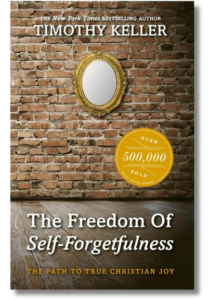 Imagine a life where you don’t feel inadequate, easily offended, desperate to prove yourself, or endlessly preoccupied with how you look to others. Imagine relishing, not resenting, the success of others. Living this way isn’t far-fetched. It’s actually guaranteed to believers, as they learn to receive God’s approval, rather than striving to earn it.
In Tim Keller’s short ebook, The Freedom of Self-Forgetfulness: The Path To True Christian Joy, he explains how to overcome the toxic tendencies of our age一not by diluting biblical truth or denying our differences一but by rooting our identity in Christ.
TGC is offering this Keller resource for free, so you can discover the “blessed rest” that only self-forgetfulness brings.