
In Christian spiritual formation, image-bearers are conformed to Christ, the true image of God (Col. 1:15; Heb. 1:3; see John 1:18; 14:9). Scripture consistently frames the Christian life as following in Jesus’s steps (1 Pet. 2:21), walking as he walked (1 John 2:6), and being shaped into his likeness (Rom. 8:29). Therefore, Christ isn’t merely the inspiration for spiritual formation; he’s its form—the definitive pattern into which believers are being fashioned.
For this reason, spiritual formation isn’t a self-directed project of personal optimization or a set of therapeutic life-hacks. It’s the shaping of human life according to a given norm. And because God has predestined his people “to be conformed to the image of his Son” (Rom. 8:29), that norm is irreducibly christological.
This raises a pressing question: What’s the role of God’s law in this process of becoming like Christ? Haven’t Christians, freed from the curse of the law (Gal. 3:10–13) and the debt it held over us (Col. 2:13–14), also been released from the law (Rom. 6:14; 7:1–6; Gal. 2:19; 3:24–25; 5:1, 18)?
In answer to these questions, Reformed theology has long been clear: Christlikeness isn’t opposed to God’s law but is its embodiment. To be formed into Christ’s image is to be conformed, by the Spirit, to God’s moral will—not as a means of earning life but as the shape of a life lived in filial communion with God through union with his Son.
Christ Came Not to Abolish but to Fulfill
Jesus fulfilled all righteousness on our behalf (Matt. 3:13–17; 2 Cor. 5:21; Gal. 4:4–5). He obeyed where we failed, and he accomplished what we couldn’t in our sinful flesh (Rom. 5:18–19; 8:3). Yet the One who fulfilled the law also insisted he hadn’t come to abolish it (Matt. 5:17–18).
Reformed theology has long been clear: Christlikeness isn’t opposed to God’s law but is its embodiment.
In the Sermon on the Mount, Jesus deepens and intensifies the law’s demands (vv. 21–48), warns against relaxing its requirements (v. 19), and insists that true discipleship involves hearing his words and putting them into practice (7:24). He affirms the commandments when speaking with the rich young ruler (Luke 10:25–28), teaches that love for him expresses itself in obedience (John 14:15), and commissions his church to make disciples by teaching them to obey all he has commanded (Matt. 28:18–20).
Indeed, a stated aim of Christ’s redemptive work is that “the righteous requirement of the law might be fulfilled in us” (Rom. 8:4, emphasis added), so Paul calls us to fulfill the law of Christ in our lives (Gal. 6:2).
Perennial Threat of Antinomianism
One of the most persistent threats to this vision of Christian formation is antinomianism—what Dietrich Bonhoeffer calls “cheap grace.” Literally meaning “against the law,” antinomianism denies that God’s moral law has any constructive role in the believer’s life. Often framed as a safeguard of grace, antinomianism frequently functions instead as a license for lawlessness. The result isn’t freedom but deformation.
This error cuts deeper than is often recognized. Lawlessness isn’t merely one sin among others; one could argue it’s the sin beneath all sins. Scripture defines sin precisely this way: “Sin is lawlessness” (1 John 3:4). The Westminster Shorter Catechism echoes this logic, defining sin as “any want of conformity unto, or transgression of, the law of God” (Q&A 14).
Rejecting the law repeats Eden’s primal distortion. The Serpent portrayed God’s command as restrictive, Eve embraced that lie, and Adam acted on it. Every sin since echoes this gesture, treating God’s commands as obstacles to joy rather than gifts for life.
The Reformed tradition has consistently resisted this lie. The Westminster Confession affirms that the moral law remains “of great use” to believers as a rule of life, directing them in God’s will (19.6). The law isn’t a burden imposed on redeemed people; it’s instruction for living in fellowship with the God who redeems.
Legalism and Antinomianism: Twin Christological Errors
Antinomianism is often contrasted with legalism, but the two share a common root. Both are, as Mark Jones explains, “fleshly” approaches to holiness. Legalism treats obedience as the ground of acceptance; antinomianism treats obedience as unnecessary. In different ways, both displace Christ from the center of sanctification.
The solution isn’t to strike a balance between law and grace, as though sanctification lay somewhere between license and rigor. Both errors are christological failures. The true alternative is union with Christ, in whom believers receive both full acceptance before God and real power for obedience by the Spirit.
Christ, the Pattern of Holiness
Biblical holiness begins not with projects of self-optimization or pure moral effort but with God himself: “You shall be holy, for I am holy” (1 Pet. 1:16; see Lev. 19:2). Fellowship with the Holy One requires corresponding holiness in us.
Jesus Christ stands at the center of this correspondence. He embodies God’s moral will in his human life. As Marcus Peter Johnson observes, “Conformity to Christ is . . . conformity to the law,” since “the law is an expression of God’s holy character.”
Christ, therefore, is both our holiness and our pattern of holiness. His obedience is imputed to us for justification, and that same obedience is replicated in us through sanctification. Scripture holds these together. God justifies the ungodly (Rom. 4:5), choosing us while we were still dead in sin (Eph. 2:1) and enemies (Rom. 5:10). Yet he chose us “that we should be holy” (Eph. 1:4), and he predestined us for conformity to Christ’s image (Rom. 8:29). To belong to Christ is also to be summoned into his likeness.
Christ’s Human Obedience and the Spirit’s Agency
It’s crucial to see that Christ’s obedience was genuinely human. Jesus kept the commandments perfectly (John 15:10; Heb. 4:15; 1 Pet. 2:22) without bypassing his humanity. John Owen is emphatic on this point: Christ’s divine nature didn’t replace his human faculties; rather, his obedience was exercised through his humanity empowered by the Spirit. In this way, Jesus lived the obedient human life precisely as human beings were meant to live it.
This has decisive implications for formation. The same Spirit who empowered Christ’s obedience is given to those united to him. Progressive sanctification isn’t Christ acting instead of us, nor the erasure of human agency, but the Spirit restoring and enabling it. As Paul writes, “God works in you, both to will and to work for his good pleasure” (Phil. 2:13).
Antinomianism regularly stumbles here. While rightly affirming Christ’s obedience on our behalf, it wrongly infers that sanctification consists merely in believing that obedience is already complete. Salvation is collapsed into justification, and sanctification is reduced to correct thinking about forgiveness. The result is, as Jones argues, an ethical “hyper-Calvinism” that denies genuine human participation in holiness.
The Reformed alternative is richer: Christ’s obedience is the ground of our righteousness, but sanctification requires our active cooperation—dependent on the Spirit, yet involving our wills. God works in us, not instead of us.
Law as a Rule of Life in Christ
A decisive fault line, therefore, between Reformed orthodoxy and antinomianism concerns the law’s role in sanctification. Antinomians deny it any positive function. Reformed theology insists the law remains a rule of life for believers, guiding them in grateful obedience.
The Westminster Confession affirms that Christ and the gospel do not “dissolve, but much strengthen this obligation” to the moral law (19.5). Jones explains this through the classic Reformed indicative-imperative framework: Because the indicatives of the new covenant are greater, the imperatives aren’t relaxed but intensified.
Jones clarifies this by distinguishing between the gospel “narrowly” and “broadly” considered. Narrowly, the gospel announces what Christ has accomplished. Broadly, it includes the Spirit’s application of that work, writing the law on the heart.
Here’s how Richard Gaffin memorably puts it: Outside of Christ, the law is a condemnatory enemy. In Christ, it becomes a “friendly guide” for life with God. This is implicit in what the Reformed tradition has identified as the “third use” of the law (even though the “first use” of the law—convicting us of our failure to perfectly keep the law and driving us to gospel repentance—is never abrogated).
Romans 8 brings this into focus: What the law couldn’t accomplish because of sin, God accomplishes by the Spirit, fulfilling the law in us. The law no longer condemns, but neither does it disappear. It becomes both an instrument of sanctification and a goal of salvation as we’re conformed to Christ’s image.
Union with Christ and the Restoration of the Image
All this depends on union with Christ. As John Murray insists, union with Christ is “the central truth of the whole doctrine of salvation.” Murray is inspired by John Calvin, who expounded on the relation between union with Christ as our reception of the benefits of Christ’s saving work: “As long as Christ remains outside of us, and we separated from him, all that he has suffered and done for the salvation of the human race remains useless and of no value for us” (Institutes, III.1.1).
Union with Christ is the ground of every saving benefit—justification, sanctification, adoption, and glorification. “Indeed,” Murray argues, “the whole process of salvation has its origin in one phase of union with Christ and salvation has in view the realization of other phases of union with Christ.”
This is why Calvin speaks of the duplex gratia, the double grace of justification and sanctification. Christ never gives one without the other. To separate them is to tear Christ apart (Institutes, III.16.1). Justification frees us from condemnation; sanctification restores us to the image of God. Both flow from the same union with Christ.
The goal of formation, therefore, is nothing less than the restoration of God’s image. Jesus Christ is the true image, the true human, the archetype of humanity as God intended it. To become most fully ourselves, to be “authentically” human, isn’t to look inward but to be conformed to him. As Coleman Ford writes, “Christ in us is the best version of ourselves. . . . Our ‘true’ or ‘authentic’ self is the self that is in Christ.” Sanctification isn’t mere morality; it’s participation in Christ’s holiness through union with the One who is that holiness.
Adoption and Family Likeness
Union with Christ reaches its height in adoption. As J. I. Packer argues, adoption is “the highest privilege the gospel offers.”
To be joined to the Son is to share in the Son’s relationship with the Father. We’re loved with the love with which the Father loves Christ. God doesn’t merely forgive us; he welcomes us as his children in love. And as Johnson says, “To be joined to Jesus Christ is to participate in the love the Father has for the Son. It means to belong to God as his children.” We’re loved as the Father loves Christ (see John 14–17).
This reframes obedience entirely. We don’t keep the law to earn life, nor merely out of abstract gratitude, but as sons and daughters who desire to please their Father. Obedience becomes family likeness. As children resemble their parents, so the children of God are conformed to their Father’s character (Matt. 5:45).
We don’t keep the law to earn life, nor merely out of abstract gratitude, but as sons and daughters who desire to please their Father.
Holiness, in this sense, is “simply a consistent living out of our filial relationship with God,” Packer explains. It’s a matter of being true to type—expressing adoption in life. The Spirit is key here. He reminds us of our filial status and works within us to shape us into children who resemble the Son and seek to glorify God the Father.
Christian formation isn’t about becoming someone else, engaging in self-directed self-improvement, or working our way to salvation. It’s the working out of the salvation already given to us—living out our fundamental union with Christ and adoption into God’s family. It’s about becoming, more fully and faithfully, who we already are in Christ.
God’s love precedes our obedience. God’s law gives shape to our obedience. God’s Son is both the source and pattern of our holiness. God’s Spirit enables real, human, joyful conformity to Christ.
Formation, then, is learning to live as beloved children—being remade into the likeness of the Son, by the power of the Spirit, for the pleasure of the Father.
Free eBook by Tim Keller: ‘The Freedom of Self-Forgetfulness’
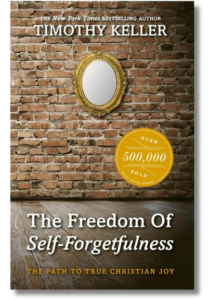 Imagine a life where you don’t feel inadequate, easily offended, desperate to prove yourself, or endlessly preoccupied with how you look to others. Imagine relishing, not resenting, the success of others. Living this way isn’t far-fetched. It’s actually guaranteed to believers, as they learn to receive God’s approval, rather than striving to earn it.
In Tim Keller’s short ebook, The Freedom of Self-Forgetfulness: The Path To True Christian Joy, he explains how to overcome the toxic tendencies of our age一not by diluting biblical truth or denying our differences一but by rooting our identity in Christ.
TGC is offering this Keller resource for free, so you can discover the “blessed rest” that only self-forgetfulness brings.