Primarily known today as a rebellious German intellectual, Friedrich Nietzsche (1844–1900) was first recognized in his own time as a highly gifted classical philologist: a scholar who studies ancient languages and texts.
Beyond academics, he enjoyed the arts, loved music, and maintained a famous love-hate friendship with the composer Richard Wagner. After beginning his studies in theology at the University of Bonn, he shifted to classical philology at the University of Leipzig. Then, at just 24 years old, he joined the faculty of the University of Basel as chair of classical philology.
This academic background matters for one key reason: Nietzsche’s philology shaped his philosophy. Understanding how he approached language and ancient texts helps us understand the philosophical goals he later pursued.
Before moving further, it helps to clarify the term “philology.” A philologist studies how language develops over time—how words originate, how they change, and how cultures shape their meaning. In today’s terms, philology is like doing “ancestry testing” on words: By examining them closely, we can trace their origins and the cultural histories they carry.
In the 19th century, philology was a rapidly growing field that captured the imagination of many German scholars. It connected naturally with new academic methods such as source criticism, redaction criticism, and historical-grammatical analysis, all of which used language to reconstruct the past. Using these tools, Nietzsche attempted something bold: to break apart the foundations of Western moral history, which he believed had been distorted by Christianity, and then propose an alternative.
Morality’s ‘Big Bang’
Throughout the 1880s, Nietzsche worked to overturn long-standing Greek and Christian ideas to imagine a new future for Europe. Earlier Enlightenment thinkers tried to rethink morality without Christianity, but Nietzsche went further. He tried to build a new moral world from the ground up. To do this, he believed Europeans needed new categories to describe themselves as they entered what he saw as a new cultural era.
This is where philology takes center stage.
Nietzsche attempted to break apart the foundations of Western moral history, which he believed had been distorted by Christianity, and then propose an alternative.
As he studied Western moral pairs such as “good and bad” or “love and hate,” Nietzsche asked a simple but radical question that formed the central tension in On the Genealogy of Morals: Where did these ideas come from, and who created them? For Nietzsche, these moral concepts aren’t universal truths. Instead, they have specific historical and cultural origins—what he called their “genealogy.” Thus, morality itself has an origin story, an ethical “big bang.”
According to Nietzsche, the terms “good” and “bad” trace back to Jewish and Christian communities. He read the Old Testament, especially the exodus story, as a case study in how moral values emerge through power struggles. Nietzsche argued that the Hebrews, observing their oppression in Egypt, developed deep resentment. This bitterness didn’t fade but grew into a deliberate moral reversal: the powerless rebranded the traits of the strong as “evil” and their own traits as “good.” Christianity, in his view, inherited and spread this value reversal across Europe.
For Nietzsche, this inversion is more than a shift in moral language; it reshapes cultural psychology. Ressentiment, which Nietzsche understood to be a psychological angst that grows in the powerless and flips moral categories, fuels a mindset that distrusts strength and prizes weakness as a virtue. He argued that Christian morality promises “life” but actually drains vitality by turning people’s hopes away from earthly flourishing and toward an imagined afterlife. As a result, he believed, European culture has been slowly weakened by Christian morality (and in his context, German Lutheran Pietism) that denies physical life instead of affirming it.
Instead, he insisted that life strives for expansion, intensity, and overcoming, or what he called the “will to power.” Engaging critically with Charles Darwin and Arthur Schopenhauer, Nietzsche rejected the idea that mere survival drives life. The will is the basic instinct to transcend limits, shape one’s character, and impose creative order on the world. Charles Taylor notes that Nietzsche saw the will to power not simply as dominance but as the pursuit of higher human potential.
Thus, Nietzsche urged people—especially those shaped by Christian morality—to break free from inherited values, create new ones, and prepare the way for the Übermensch: an ideal of humanity courageous enough to affirm life with creativity and authenticity.
It’s a massive understatement to say that Nietzsche’s thoughts on creativity and authenticity have haunted our anthropologies and moralities for the past 125 years since his death. He continues to cast a long, disruptive shadow over our sense of self and morality.
It’s Nietzschean Air We Breathe
Alasdair MacIntyre once called Nietzsche the most important moral thinker of our age, going so far as to say that we live, move, and have our being in a Nietzschean age. Even without reading Nietzsche, many modern people reflect his influence (and that of other figures in modernity): doubting God, celebrating the “true self,” searching for identity within, and viewing Christian morality with suspicion.
Nietzsche continues to cast a long, disruptive shadow over our sense of self and morality.
His ideas of ressentiment and the will to power help explain this shift. Nietzsche had a particular disdain for those who call strong “bad” and weakness “good.” As an alternative, Nietzsche proposed the will to power, the drive of the self to rise above its cultural limitations to create one’s own individualistic values.
Even a modern story like Wicked echoes these themes through a quasi-Nietzschean genealogy. The musical (and its movie) “reconstructs” the familiar Wizard of Oz to reveal the characters’ pasts, showing that their conflicts stem from jealousy, insecurity, and resentment—not simple good versus evil as first portrayed in the 1939 film.
Elphaba and the Wizard clash out of mutual fear and misunderstanding, while Boq’s bitterness urges him to lead a mob against Elphaba for his “tinned” situation (sorry for the spoiler). The story resonates with so many Nietzschean themes: genealogy, resentment, and how the pursuit of power shapes communities in similar categories to what Nietzsche described.
Beyond entertainment, we see similar patterns in American culture today. Many groups claim moral superiority by presenting themselves as victims and labeling opponents as “oppressors,” fueling identity battles where resentment often replaces dialogue and hospitality.
Out-Narrating Nietzsche
The challenge, I believe, isn’t merely critique but narrative capacity: Whose story can truly hold the weight of human longing and cultural meaning? As Chris Watkin aptly clarifies, “Out-narrating is not about telling the better story in the sense of being the most gripping or necessarily satisfying; it is about telling the bigger story, the story within which all other stories find their place.”
Even though Nietzschean categories of genealogy, power, authenticity, and endless self-creation are adopted and adapted nowadays, I’m convinced the Scriptures still out-narrate Nietzsche.
Nietzsche rejected Christianity yet repurposed its narrative framework for his own ideas: Dionysus (and the self) becomes the god figure, humans are always in flux, morality emerges from social revolt, Zarathustra speaks prophetically, and the Übermensch embodies a future messianic ideal. Nietzsche still included Scripture’s narrative framework: a god, a fall, a prophetic expectancy, a messiah, and an ushered-in eschaton. Though he sought to move beyond Christianity, he depended on the creation–fall–redemption–new creation structure, tacitly affirming Scripture’s narrative power even as he opposed it.
Though Nietzsche seeks to move beyond Christianity, he depends on the creation–fall–redemption–new creation structure, tacitly affirming Scripture’s narrative power even as he opposes it.
This engagement with Nietzsche serves as a case study for how the church might interact with contemporary cultural stories and philosophies. We can attend to these alternative narratives, hearing their longings and anxieties, while recognizing the gospel’s greater depth and breadth. Through Christ’s cross and resurrection, God absorbs the world’s anger, fear, resentment, and desire for control, dismantling their power through self-giving love.
To participate in Christ is to be carried by a narrative capacious enough to engage the world’s desires without surrendering to them and discerning enough to redeem culture without baptizing any Nietzschean illusions.
Free eBook by Tim Keller: ‘The Freedom of Self-Forgetfulness’
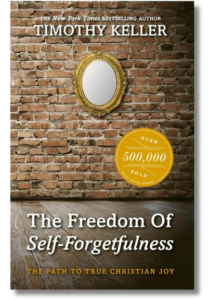 Imagine a life where you don’t feel inadequate, easily offended, desperate to prove yourself, or endlessly preoccupied with how you look to others. Imagine relishing, not resenting, the success of others. Living this way isn’t far-fetched. It’s actually guaranteed to believers, as they learn to receive God’s approval, rather than striving to earn it.
In Tim Keller’s short ebook, The Freedom of Self-Forgetfulness: The Path To True Christian Joy, he explains how to overcome the toxic tendencies of our age一not by diluting biblical truth or denying our differences一but by rooting our identity in Christ.
TGC is offering this Keller resource for free, so you can discover the “blessed rest” that only self-forgetfulness brings.