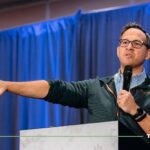
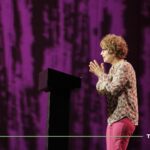
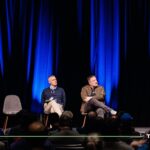
This panel discussion, recorded live at TGCW24, considers the importance of human dignity as we seek to develop an all-encompassing approach to valuing life. Join Missie Branch, Portia Collins, Lauren McAfee, and Bri Stensrud for a thoughtful conversation on compassion, respect, and protection for human life from conception to natural death.
Transcript
The following is an uncorrected transcript generated by a transcription service. Before quoting in print, please check the corresponding audio for accuracy.
Portia Collins
I am joined by some lovely ladies, and I am excited to have them to introduce themselves, so you can know who they are and where they’re from. And if you want to share a fun fact, you can do that too.
Lauren McAfee
Okay, I’ll start I’m Lauren McAfee. I am from Oklahoma City, and I am married to my husband, Michael. We will celebrate 15 years later this summer. And my husband and I met when we were seven years old. So we are Sunday school sweethearts, that’s where we met. And we together have two daughters through the blessing of adoption. And our daughters, Zion is six and Zara is one. So I am the founder of stand for life, so we have a booth out there. And I am also a PhD student studying ethics and public policy, focusing on issues of women’s reproductive health. So I kind of live in the in and around the pro life space through both my work, my personal story, as well as my studies. So that’s me. Hi.
Missie Branch
My name is Missy branch, and I actually work for the organization that Lauren founded. I love it. My title is VP of community engagement. And I think the way that I have come into even this kind of work is really just by the Lord’s sovereign, the way you might have wound up in this room, right? The Lord’s kindness. I have four kids. They’re grown. One of them’s been bossing me around this conference all week, so having a good time and I just I used to work at Southeastern seminary, and the work there really taught me the value of quality education, theological education and just knowing God’s word.
Bri Stensrud
My name is Bri stensrud, and I am a former director of sanctity of human life at Focus on the Family. And now I am the director of women of welcome, which is a project of World Relief. And this is a community of women who seek to engage issues of immigrants and refugees from a biblical perspective, instead of a politically partisan perspective. We want to know what the word of God says about how to treat image bearers across the whole spectrum of life. And I just happened to have landed, used to be in the pre born space, and then got into the adoption and then the foster care space, adopting myself personally, and then kind of got called into this really fun topic of immigration. So I live in Colorado Springs, Colorado. I have two kids. I serve on the board of the National Association of Evangelicals, and I love doing this kind of conversation, because I believe that women are hungry to have hard conversations, but good ones that are full of conviction. So I’m really glad that you’re here, because I think you probably have compassion, and hopefully this panel will be able to attach confidence to that compassion. So I’m glad you’re here.
Portia Collins
Y’all can tell already that this is going to be good. So as each one has already kind of alluded, this is a very important topic, but often a very hard topic to gage. As I was thinking and preparing, I started doing a little digging online and a Lifeway study from a couple of years ago basically showed that seven out of 10 evangelical women, that means women who are identifying as Christians, seven out of 10 have had abortions. Now pause, because this is not a shame time, because if I’m being honest, I’m one of those seven and 10 that is something that I thought would be tucked away in the closet, in the skeletons of my life, and when I came to Christ, I carried an immense amount of shame and guilt, so much so that I lost my voice to speak out on this issue because of the guilt and the shame that I carried. And so I think, because we are evangelical women in here and we all, I think the consensus is we all know that pro life is the right way, but what I would hope from this panel is that everyone would walk out of this room, whether you have been impacted by abortion personally or not, but that you would walk out of this room finding your voice to speak up And to be able to defend the sanctity of life and to know that every life matters, from womb to tomb. Okay, so with that being said, I want to just throw this out with our ladies. How or why do you believe it is crucial for women in the church? Church to engage in discussions like the one that we are having today regarding the pro life movement.
Lauren McAfee
I think that this is an important issue because it as you mentioned already. Portia, thank you so much for sharing that your story. It impacts our communities, not only for the women in our churches, but also in the community around our churches. And it’s impacting conversations that are happening in public and political spaces. And this is an issue that people are having conversations about. And so it, it is a it is a hard topic because of, I think, the way that the politics of it has made things so volatile. But I in what we do at stand for life, we really approach the issue wanting to think about it theologically and ethically. How do we, how do we as believers think about this issue, and that is separate from politics, because this is not first and foremost, a political issue. This is a theological issue. If you are reading the Bible, you will see the evidence of why this issue should matter for us. And so we see it in Genesis. One God created man and woman in His image. So everything that God created before that had not been called something that was an image bearer, it had just been God spoken into existence. And then God pauses and creates man and woman. He says, Let us the Trinity. Let us create man and woman in our image, in the image of God, we are created. So that means we as humans have this uniqueness about us, and that we are image bearers, and that every single person as an image bearer has that unique dignity and value that is not based on anything we can do to perform or achieve, but it is inherent in who we are, because of who God has created us. And so we as believers should be able to speak to this issue with great confidence because of that, and have great conviction about it, and also have great compassion, because as we engage, we see that every person we engage with, whether we disagree with them on this issue, whether we’re having hard conversations with someone, whether we’re having a conversation or stepping into the space of someone who is facing an unplanned pregnancy, We see them with the compassion and love of Christ. And so I think that this is an important issue for this moment, for our churches to understand theologically, why this it matters to us, because we are to be then living that out as an example in a broken and hurting world, so that hopefully, as we do so, we point to God, we point to the creator and the one that created them as image bearer, and then also ultimately point them to Christ, who was the perfect image of God and came to earth and lived that perfect life that we might be able to then be an example and try and point towards him. So I think that this is really important because of all that, because we as believers should be those who are living out as an example, but we often fail at that. Unfortunately,
Missie Branch
yeah, I would everything you say makes me just what comes to mind is that knowledge is power. I think it’s when people die for lack of knowledge. And I think in our communities, we know on a certain level, on a very basic level, that we’re pro life, and we know on a basic level that Jesus says this And Jesus says that, but I don’t think we know the depths of what it means to actually be pro life. And I think when we skate around the surface of this issue, we really don’t understand how many people are being affected and why people are being affected, and the role we can play in changing that.
Bri Stensrud
I think so second one too, but I also I think it’s so important for us to show up in this conversation, because your voice matters. Your experience matters. You’ve had an abortion, you’ve had a miscarriage, you’ve not you’ve not had either. You matter. You are a woman of God, full of conviction and hopefully just as full of compassion. And you can see all around the country where we’re getting this wrong. You can see all around the country where it is so volatile that sanity has gone out the window. We need some sane women lifting their voice that are advocating not only against the violence of abortion because it harms a child, but the violence of abortion because it harms a man and a woman and a family and a generation, but also sound of mind to say we can. Not legislate people’s hearts and minds. Laws save lives. Let’s just be clear about that. Laws do save lives, so it’s important to legislate the ways that eliminate those pathways to legal abortion. But it is also, as we all know, women need good health care. Women need to be acknowledged in that waiting room. Women need to be acknowledged in that doctor’s office, but not in the ways that the world is telling you to be acknowledged your body, your choice. That’s not what we’re believing in. It is our body. It’s also another image bearer’s body as well. So we have to be women that say, All right, we’re not going to join the fray of crazy. We’re going to show up with conviction and say, Yeah, abortion is a violence against human beings. It also is something that needs to be paired with very tangible supports for women. And that makes sense. So some of this legislative talk that is happening is bananas, and we have to call it as such. And if we don’t show up as women full of conviction who love Jesus, to do that, other people will make craziness happen for this movement and for our communities and personally, for us individually as well. So we have, we have to. It’s of utmost importance that our convictions show up in this space, because otherwise it’s it’ll go off the rails, as we see it doing in so many states.
Portia Collins
Amen. Amen. So I like where you’re leading us here in terms of tangible ways to support women. And I think that lends itself to this whole topic of pro life. For all of life, I’ve found that there is a difference in being pro life and just anti abortion. There is a difference, and there are a lot of people who are anti abortion, but they’re not pro life, whether they are just ignorant of knowing how to live that out, or they you know, behind whatever political thing that they’re doing. And so I really want to ask, When did this concept of all life actually coming alongside knowing how to support women. When did this concept really become solidified for you as an expanded Christian ethic, as a worldview, and was there a specific moment or experience that you’ve had that really connected the continuum of life for you, whoever wants to go? Bri, I know you go, go, go.
Bri Stensrud
I’m on the end here, so I’m always like, Okay, let’s see who else wants to go. I grew up, probably, like a lot of us, I’m an Evangelical, free church pastors kid. I grew up in the Midwest. I went to all of the pregnancy center fun runs, and, you know, all the activities and donations and baby bottle donations and, you know, jars and stuff like that in the lobby of the church and all the things. And so you just kind of grow up. This is who we are. This is how we value life, and we hate that. It’s gotten so political, but it is so ingrained in us, and that when you get older and you really start reading the scriptures for yourself, and then all these other issues, because social media has just lit up all of these other human dignity issues, we start to realize that what we believe about the dignity and sanctity of a pre born life is the same Christian ethic. It’s the same theology that connects us to all of these other human dignity issues. And so it’s not scope creep. Let’s just be very clear. It’s not theological sliding into progressivism to continue your whole life, your pro life ethic to the whole of life. I’ll give you a very clear example. This isn’t, wasn’t the start of my journey, but in the middle of my journey, I had just taken a break. I just stepped back from my role at Focus on the Family to adopt my son. And when I did that, I got invited to southern Mexico for five days, and they were like, This is World Relief. They invited me on this trip. And I said, they said, Do you want to come and learn what is going on with vulnerable migrants around the world? And I said, Sure, that’s part of my whole life. Pro life ethics, sure. So I’m fully anticipating I’m going to go on that trip, and I’m going to learn about immigration only, immigrants and refugees. What does the Lord say about that? What’s going on? And every moment on that trip, I was slapped with my pro life convictions. I went to a child center for unaccompanied minors, and I met two girls in their age, 11 and 13, who were both mothers. I was devastated. I was like, Lord, I’m not trying to be. Bring my pro life stuff up in here, and yet, that’s what he was doing. He said there are vulnerable women and children at the doorstep of America, and we’re not gonna get into this conversation, but so is there, right? So then I go to a shelter just for women, and it’s women who are experiencing pregnancy for all kinds of reasons. And I’m like, Lord, I’m not trying to. I just want to learn this particular thing on this trip. And it was just everywhere I went, the Lord was like, This connects to being pro life. This connect and you could step into any avenue. It could be poverty, it could be it could be human trafficking. It doesn’t matter. The whole spectrum of life carries these things that we anchor in Scripture. And what I mean by that is I was kind of like, All right, there are certain areas that feel a little too maybe progressive for my theology to enter into, but then when you start getting close into those spaces, you realize that the same Biblical verses and principles that anchor you in the pre born space are the same exact verses that anchor you in these other human dignity areas where we’re not in the pro life movement because of a dictionary definition, you know, because the dictionary definition is just anti abortion, but we’re in it from a biblical conviction About the dignity and sanctity of every human life. And so that doesn’t stop once the baby is born. And so I, what I want to is kind of maybe free you up to say, All right, there is no place when it comes to humanity that is off limits for the love of Jesus. And if you are a human being walking and breathing on this earth, we are not walking around trying to bestow dignity to people and say, yeah, yeah, you’re no. We’re there to affirm it because it’s already there. And so there is no place in humanity that Jesus would say that’s off limits, that don’t take your pro life ethic into there no each and every person on this planet is an image bearer, and we believe in the dignity and sanctity of every human life. So don’t let your compassion be discredited because of someone else’s lack of depth in their own theology. You can go there because we have biblical foundation for it?
Portia Collins
No, I was just, I already dropped. I dropped the mic once. I
Missie Branch
can do it again for you. Drop the mic. You know I was going to say, I, I’m sure I entered into this space from a different perspective. I come from the broken I come from the community where abortion is normal, not because it’s normalized, not because it’s I don’t come from a community that says, yes, go get an abortion. I come from a community that understands why a person would have an abortion. I come from a community where I have, as a teenager, begged friends not to have an abortion, and I have, I come from a community where I come from a family where there have been multiple abortions, but I also have a life experience where I understand, I couldn’t see the value in me, and I don’t know necessarily why God had created me and put me in The space he put me in. And I was told I was valuable, but couldn’t understand it or see it or feel it, or it wasn’t tangible. So the only difference between me and another woman who’s had an abortion is just God’s grace and the decisions that I’ve been able to navigate. And I think for me, what that says is that I’m not beyond making those decisions. God has just been kind, and I’m not better than anyone who’s made those decisions, because I wrestled through that with my sisters and my friends, and I’m not insensitive to why someone would make those decisions. And so my passion now is to walk alongside you and help you just see a better way to help you understand your own personal value and how your personal value is tied to something bigger and wider and deeper than you, and then help you to understand the value of all the people around you, particularly the one inside of you.
Lauren McAfee
And I just want to add something with what Brie touched on is that it can often seem like in these in conversations around issues that are related to human dignity, that they can vulnerable populations can often be pitted against each other. And I just don’t believe that we live in a world and with the God that we have who is so big and so sovereign that we have to have one vulnerable population pitted against the other. It’s not an either or it’s a both. And yes, of course we care about the vulnerable in the womb. And yes, of course we care about in immigration and those that you’re coming across that are in really challenging circumstances. And yes, we care about and fill in the blank with whatever I. A, you know, human dignity, pro life, whole life population that we’re talking about, because that is the God that we serve as the God that is big and is able to care for all of his created image bearers, and that we as a church are called to step into all of these spaces. And it doesn’t mean that me, individually am able to step into each of them, but it does mean I care about each of them, and I care about speaking about each each image bearer in a way that is honoring to who they are, as someone creating God’s image. And I think this became really real for me whenever I started to step into proximity of different populations that could often be pitted against each other. And so Bri always talks about proximity. You guys, even, I think, have hats that say proximity. And so I’ve really latched on to that because I’ve seen it in my life. So whenever we had our we had a birth mom in one of our domestic adoption processes, we had a birth mom who chose to place her son with us to parent. She chose to have us parent, and we built an open relationship with her. And this was a birth mom who was a teenager, an orphan herself, and was trying to finish high school, was working in a fast food restaurant and just didn’t have any support family around her, and so she made the brave decision to give life to her son, Ezra, and then made a brave decision to make an adoption plan, and we built an open relationship with her, and seeing her and invite her to be a part of our family was such a formative experience in my life, because I think in the adoption process, you can often pit birth mom against adoptive mom or any or the child, the adoptee, or any of those in the adoptive triangle, against the other. And I just lived that out in a different way. That was like no, like God loves her and cares for her and she is an image bearer, and God cares for her son. That is now my son, and he cares for me. And so how can I honor the image bearer of each of the people we come in contact with as well? My our son that we were in the process of adopting was African American. And so as well, the conversations now about how we think about those with different skin color, and how we might pit particular groups against each other was now like, this is my son, and like, this is his mom, who I feel is a part of our family. So these were conversations that were now in my home, and the proximity of that made me care about issues of human dignity, about race as well, and how do we have those conversations in a way that honors the image barrenness, the human dignity of all people, even on those that look different than us? So I think that this is the whole life. Pro life is an ethic that is such a gift that the body of Christ has to offer our world, that is an expanded perspective of dignity for all people, that is beautiful and that is that is an amazing thing that we as a church should be, if we live this out well, is a beautiful gift to the world that we believe in the God who created all life and all life has value, and if we show the world that picture of what our beliefs are, that is beautiful. And so I I am grateful that kind of circumstances in my life pushed me into digging deeper into that in a way that helped expand my perspective. Because I don’t think I always had that perspective that was really holistic, and having walked alongside in proximity, just through different circumstances in my life, it helped to really make that more clear for me in my own life, just the expansiveness of that theology and how beautiful that is when we live it out holistically.
Bri Stensrud
Portia, I think it might be helpful just right? This is like the easiest way that I can think about this as a definition. It’s like being holistically pro life. Being pro life means that we it’s a it’s a way of looking at people that transcends culture, class, race, age, status and opinion, knowing that each and every person is made in the image of God, so being pro life is a way of looking at people. It’s a way of proximate to people, and it is because we want to see people as Jesus does, that transcends all of the cultural nonsense that is going on, that transcends all of the places that we are told are off limits to us in this world. And so that is, that is the whole life pro life, Transcendence that you get when you anchor yourself biblically in the dignity and. Sanctity of life,
Portia Collins
amen. Amen. What are some of the biggest opportunities for the pro life movement in our country today? When I say our country, America, but I’m seeing it for the record, in case somebody outside of America is watching, I
Lauren McAfee
think there’s a lot of opportunity, because there’s a lot of challenges. So where there’s challenges, there’s opportunity. Stand for life. Recently did a survey of 5000 women of reproductive age and asked, and this was across the country. So we asked 5000 women their thoughts on a variety of things around the abortion issue, trying to get a good understanding of what is shaping women’s thoughts about the abortion issue, what is influencing their decisions if they have faced an unplanned pregnancy, and how are they thinking about things that would kind of shape their opinion about it? So one of the things that really stuck out to me from the study was that in terms of trusted voices. So a woman, if she is facing unplanned pregnancy or she knows someone that is, what would a trusted voice be that you would turn to if you’re trying to make a decision about unplanned pregnancy? Unfortunately, the lowest ranked option was the church, with 3% 3% of women saying they would see the church or parish as a trusted voice to help them think through the unemployed pregnancy situation. The number one ranked source is an organization that is the largest abortion provider in America, that is seen as the number one trusted source to turn to in an unplanned pregnancy. That is very challenging for Christians in the church to be facing that, but it provides, I think, a lot of opportunity for us to continue to live out our beliefs about this issue in a way that hopefully begins to change the narrative and show women that we as the body of Christ, we as believers, want to step in and care for that woman so that the church is a safe place for her to come and find support and for us to speak into her her own dignity and value, as well as the dignity and value of the child in the womb. So I think that’s a great opportunity for the church in America that I’m prayerfully hoping we see that begin to shift.
Missie Branch
Yeah, I think we clearly, we’re dealing with abortion at alarming rates, so clearly there’s a lot of work to be done. And I think even when you think about Planned Parenthood being considered a trusted space, the answer to that, to the why of that, was because they showed up. They’re in the community, they’re accessible, they’re not casting judgment. They’re not you said, I’m saying and so they’re meeting them where they’re at. They’re meeting for free, right? For for free. And I’m going to be honest, I come from that community where we I didn’t have health care when something, if it was an emergency of any kind of thing. For a woman, you went to Planned Parenthood, and you didn’t go there thinking, I’m getting an abortion, you go there saying, this is the place that is trusted for me to get help. And I think when we recognize that the church has a responsibility to do more than just be angry, but has a responsibility to show up in the same way that Planned Parenthood has, because Planned Parenthood, when you call them, you hear a voice that’s compassionate, what they’re doing is not compassionate, but that’s what you hear. And I think what we need to recognize is that this is a organized, well oiled machine, and we need to not be this, hit it and quit it kind of thing. Throw it all together. But we need to see this as work that we need to come together to do.
Bri Stensrud
And I think we say these things, right? We say these things, and then, unfortunately, the American church is so out of practice of long suffering with people and being proximate to people in their pain in very tangible ways, not in the Oh, bless you. I’ll pray for you what I mean putting your reputation on the line to walk with a woman who is in a lot of pain and a lot of fear and probably a lot of shame. So it’s like we’re talking big sea church, like we, you know, are the big sea church. But also, ladies, this goes back to kind of what I said before, about how we’ve got to be voices in our own congregations. Some of this stuff needs to be talked about from the pulpit. Some of this stuff needs to be advocated for for a weekly class during the week. Some of this needs to be included in a sermon series, and if the pastor. Pastor isn’t hearing the squeaky wheel Be the squeaky wheel, because sometimes pastors can get soft, right? We love to support them. We want to support them. We also need convictional leadership, and we can’t make we can’t hide from issues that the world has deemed too political to talk about entering into human dignity. Spaces will cost you something. Let’s just be very clear about that. There it will cost you something. It will cost you maybe finances. It maybe cost you reputation. It maybe will cost you congregants and donors. Guess what? Jesus doesn’t care about any of that. He certainly didn’t. He lost his reputation, he lost all his friends. He didn’t have the church’s backing, but he was saying the right things. And so to me, this is like, all right, if other people in the world can show up and be a trusted source, it’s because they are showing up in very clear and close ways to people, and so we have to have an honest evaluation about how we are showing up in our own communities and how we’re showing up in our churches, and what we are asking our leaders to do to create change. Because change doesn’t happen because I feel bad. Change happens because you have strength and conviction from the Holy Spirit to do something different. And a lot of times that’s gonna mean you’re gonna have to forge a new path forward. You’re gonna have to create something now. Thankfully, there’s all kinds of ministries and organizations out there that are doing a lot of really good stuff, like, I’ll just shout out, embrace grace, because we love them so much, and that, if you don’t, I mean, it’s a pre packaged do it in your church thing, so they have a booth here. You can go look at it. But I do think it’s something to be said, that it just can’t be something we keep here. It has to be something we have some conviction and some courage to actually speak up about. And I
Missie Branch
think what’s beautiful about Jesus as a model is that Jesus, of course, when he spoke to the Pharisees, he was pointed. He had a way of communicating with them, but he was different when he spoke to the woman at the well. So he understood the humanity of all of them, but he understood what it meant to talk to a vulnerable person in their moment of need and see it and not treat them the way he would treat the Pharisees, because that’s a different group of people with a different situation. So when we show up having conversations about legislation, we understand that the woman on the corner who’s about to walk into an abortion clinic is not interested in a conversation about your left or right leaning. You know, she’s, she’s interested in you seeing the humanity in her.
Bri Stensrud
She’s She’s interested also in you showing up to say, You know what? I know you’re wondering how you’re going to feed the child.
Missie Branch
I know you’re wondering yourself
Bri Stensrud
and yourself. I know you’re wondering how you’re going to pay the medical bills. I know you’re wondering about if you can continue school or keep your job or keep your boyfriend, or whatever it may be, disappoint your parents. She needs someone to show up and say the long term looks really frightening. I see you. Being pro life is a way of seeing people and their long term needs for flourishing. She cannot see beyond that clinic parking lot because the clinic parking lot provides something for her that seems to eliminate a problem. But if we show up and we say, I see all of the things you’re afraid of, and I want to walk with you, because you matter that much, and I’m going to show up and legislate for the things that I know we need. We need better health care, we need paid family leave. We need scholarships for women for their education. We need job assurances. We need like there’s some protections for women who are vulnerable while they carry a child that we as convictional Christians should be show up and say, I actually see why you’re saying, Yes, I get it. I get it because the other side of this parking lot is really frightening, and you have a lot of need on the other side. But I want to walk with you, not just past this parking lot, but down the street, and I’m going to walk with you through those years, and I’m going to connect you to things, because I’m going to take it on myself to help be pro life for your life. So it’s got to be tangible too.
Lauren McAfee
Into the tangible piece, I’ll say that whenever we did the survey of the 5000 women, we asked them what would be the most valued resources that would allow them to make a choice for life or make them feel like they could make a choice for life. And the top things that were listed in terms of the things that would be most likely to cause a woman to keep a pregnancy if she were facing an unplanned pregnancy, were paid maternity leave a. Affordable health care, affordable housing and a livable wage were the top most things. So we’re all really financial things. In other surveys that I’ve seen so many of the things that women who are facing no plan pregnancy said that they were most interested in were financial support. So I think that knowing that provides us opportunity as well to know how the church might be able to step in and serve women. If we’re engaging with women in our communities who are facing an unplanned pregnancy and are considering abortion is okay, what are those things that she might be thinking in her head, like, I just don’t see the way forward with having this baby and then stepping into that in whatever creative way we can right? I mean, the church can get creative in how we think about serving that woman. And just as you mentioned, Bri thinking about those things that she she is trying to figure out in her head, there’s, is there another way? And usually the answer is no, the abortion is the only way. And we get to step in and say, Hey, how can we care for you? And these things that we might be able to serve you in as someone that we care about, to help you see how you can make this work. And we want to be there with you in that. And that’s a beautiful opportunity,
Portia Collins
absolutely. And as you guys are saying, Excuse me, are saying these things. You know, sometimes it’s for us. We hear it and it’s like, okay, this is all theoretical, and everything that you’re saying is everything that I experienced as a woman who made the choice of abortion. I didn’t need anybody to tell me that abortion was wrong. I already knew that it was wrong. I needed someone to say there’s a way forward on the other side of this. And nobody said that I didn’t have the people in my life speaking the things that you are, or the support. And it was like, how am I going to get through the shame of this because I wasn’t married, I was, you know, I’m a college student. How am I going to get on the other side of this? And so I see the realness, the reality and everything. You’re not just up here shooting out words like I live the very things that you’re talking about. And so it is so wonderful to hear you basically coaching the women up in this room to go out and to truly be advocates, not just with their words, but with their hands and their feet and their hearts.
Bri Stensrud
Can I say something real quick? What I will say in that too is that it just kind of popped into my mind, just this reminder of how we reference women in this vulnerable stage, a woman, as you all know, can tell the sincerity of person, sometimes by their countenance, but most times by their language. And so we have to be very careful about how we are describing the situation that a woman is in. We have to be very careful about how we affirm her dignity and also her fears. So I’ll give you a very clear example. I don’t think it would have been helpful to Portia if I would have said abortion is mad or bad because you’re going to murder your child. Portia, you’re about to murder a baby. Did you know that? Does that meet her where she’s at abortion is intentionally taking the life of a child. But do I have to tell Portia publicly on social or even personally, the harshness of the reality that she’s already thinking about? She
Portia Collins
knows, she knows. So
Bri Stensrud
she knows. So I guess some I have, I’ll just be honest, I have a lot of I have a hard time personally sharing a lot of pro life stuff on social media because I feel like it really lacks compassion. You don’t have to compromise truth to be compassionate. And so some of the ways that we’re talking about it, I’m not suggesting that you softball it. Absolutely not. Abortion is a violence against children and women, but the way in which we talk about it publicly and the way that we meet women personally has to be truthful and compassionate. So I can tell Portia, you know, you’ll be intentionally, really ending a life that I’m sure you’re really struggling to do, and she’d be like, wow, this person wants to have a conversation with me, as opposed to, you know, abortion is murder, right? That shuts her down, that doesn’t invite her into any kind of common space between us, where I can actually hold her hand and then walk with her. It doesn’t earn any trust with her. I didn’t compromise. Truth, but I did it in a way that would meet her where it matters most, and that is in her heart, right? So I just wanted to say that as we engage very tangibly,
Portia Collins
absolutely, absolutely, I think you guys have coached us up. I would love to continue this, this conversation for the remainder of the conference, because it is, it has been so edifying for me, and I just, I really pray many blessings in your work and what you’re doing. Keep going, keep moving. I I believe that every woman in this room has been impacted, and they’re going to go back home ready to not just say that they’re pro life, but to live in a way that actually shows that. And so can I pray for us, Father, Lord, we thank you so much for just the truth of your word and that you have made us women who bear your image, and that we have dignity and value. Because Because of you, all life is valuable because of you. Lord, I pray that you will take the things that have been discussed in this room today and that you will make it tangible in our lives, in every person’s lives, in here and beyond, and Lord, I pray that you will help us to live out our pro life convictions in a way that is compassionate, a way that is courageous, and most of all, in a way that truly honors you and your word and who you have called us to be as people, your people, Father, we love you, we thank you and we praise you. I thank you for these sisters here on the panel with me in the ways that they have poured out. I pray that you richly bless them and all of the sisters in this room. It’s in Jesus Christ’s name that I pray Amen.
Free eBook by Tim Keller: ‘The Freedom of Self-Forgetfulness’
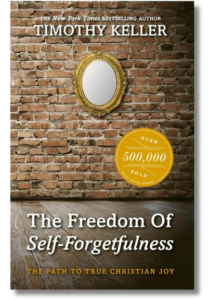 Imagine a life where you don’t feel inadequate, easily offended, desperate to prove yourself, or endlessly preoccupied with how you look to others. Imagine relishing, not resenting, the success of others. Living this way isn’t far-fetched. It’s actually guaranteed to believers, as they learn to receive God’s approval, rather than striving to earn it.
In Tim Keller’s short ebook, The Freedom of Self-Forgetfulness: The Path To True Christian Joy, he explains how to overcome the toxic tendencies of our age一not by diluting biblical truth or denying our differences一but by rooting our identity in Christ.
TGC is offering this Keller resource for free, so you can discover the “blessed rest” that only self-forgetfulness brings.
Missie Branch is a speaker, Bible teacher, podcast host, and author. She has a master of arts in ethics. She’s a contributing author to The Whole Woman and the cohost of the Women & Work Podcast. Missie serves on the SBC’s Racial Reconciliation Steering Committee and as chair of the board of trustees at Lifeway Christian Resources. She is married to Duce, and together they have four children.
Portia Collins is a Christian Bible teacher, writer, and podcaster passionate about sharing God’s Word. Portia is the founder of She Shall Be Called, a nonprofit women’s ministry focused on Bible literacy, and she serves on the Revive Our Hearts staff as the Revive partner specialist and cohost of the weekly videocast Grounded. Portia and her husband, Mikhail, have a daughter and live in the Mississippi Delta.
Lauren Green McAfee is the founder and visionary of Stand for Life and the director for ministry investments at Hobby Lobby. She is the author of Only One Life, Not What You Think, Legacy, Beyond our Control, and Created in the Image of God. Lauren has an MA in pastoral counseling and theological studies and a master’s of theology, and she’s pursuing a PhD in ethics and public policy. She and her husband, Michael, have two daughters through the blessing of adoption.
Bri Stensrud (MBTS, Dallas Theological Seminary) is the director of Women of Welcome, a nonpartisan advocacy group for immigrants and refugees. She is the author of The Biggest, Best Light: Shining God’s Love into the World Around You and Start with Welcome: A Journey Toward a Confident and Compassionate Immigration Conversation. Bri lives in Colorado with her husband and two kids. Find her commentary and resources on Instagram.