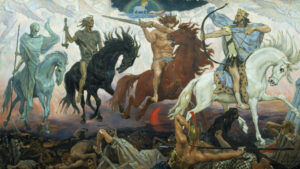


Revelation is a book of the Bible many of us fear or avoid: It can feel opaque at best and terrifying at worst. Popular conceptions in movies and fiction have added to the confusion around its message. But we don’t have to view this hope-filled book as inaccessible or weird.
In this conversation recorded at TGC25, Mike Kruger and Jen Wilkin talk about the riches behind the symbols and story of Revelation—a message its original listeners heard and understood, and one we can too.
Transcript
The following is an uncorrected transcript generated by a transcription service. Before quoting in print, please check the corresponding audio for accuracy.
Jen Wilkin
This is my fault.
Mike Kruger
Sorry about that, everybody. We had a
Mike Kruger
little mix up in timing there. Jen, do you want to share
Mike Kruger
about the secret rapture? I
Jen Wilkin
wanted Mike to think I got raptured. That was basically what it was. Yeah, no, I was. We had a time zone problem with my calendar, and so I was definitely going to be here an hour from now. So anyway, I’m so sorry, and I’m out of breath.
Mike Kruger
Well, while Jen is catching her breath, let me welcome you to this session on the book of Revelation. We’re so excited you’re here, and I’m really excited Jen is here now, right?
Jen Wilkin
Dramatic entrance.
Mike Kruger
I gotta admit, I did think the rapture happened, and she was gone, and all of us are apparently non Christians. So I don’t know exactly what to think about that it’s like, but the whole room is here, so either she’s extra holy and we’re all in trouble. I’m not sure what to make of it, but this was all designed to be an illustration of the way the book of Revelation has precarious ups and downs to it. But no, we’re thrilled you’re here, and sorry for the delay, but we’re excited to jump into this book because we love this book together and have talked about it a number of different times, and we think it’s just a fantastic chance to dive into this with you and talk about the riches of Revelation, which this title is all about. If you don’t know me, I’m Mike Krueger. I’m the president of Reformed Seminary in Charlotte and professor of New Testament. And Jen is, of course, needing no introduction, author, speaker and a recent author on the book of Revelation. Jen say something about the book you just published.
Jen Wilkin
I swore I would never, ever write a study on the book of Revelation, and I really tried to stick to my guns. And then I had taught on Genesis and on Exodus and revelation, all of a sudden began to seem less opaque after spending time in those books. So I screwed my courage to the sticking place and wrote a study. And that’s how I got roped into showing up 10 minutes late for a session with Mike.
Mike Kruger
One of the things that we joked about when I was like, someone asked me to do this session on Revelation. I’m like, Why in the world would I do a session where at the end, half the room loves me and half the room hates me at the end of the topic? So we don’t know exactly where this is gonna go, but we love this book, and we think there’s all kinds of rich things about it. Let’s start with this question, though, and this is something that I think will be helpful for the audience, Jen and for me and you together, just talk about the background you have in your life with the book of Revelation? Did you grow up in a church that talked about it, read it, thought about it, and I’ll share a little bit of my own background too, but give us some insight on that.
Jen Wilkin
Yeah, there is a building in my hometown in North Texas that when I’m back visiting my parents, when I drive by this building, I feel vaguely nauseous in the pit of my stomach because it’s where I went to a screening of the movie a thief in the night. Can I get a witness in here who’s been through that? And I have said, and people laugh when I say it, that that movie pretty much almost sent me to therapy, but I’m not joking when I say that, like I seriously by the time I left for college, I was having full blown panic attacks that involved, like, I remember one night there was a lunar eclipse, and I thought, it’s happening, it’s going down right now. It really messed with my head. And so after the way that that book was approached in my childhood, I kind of got to a place where I was like, whatever’s in there, I can’t look at it like I’m gonna need someone else to figure all that out. Because I was I just couldn’t, I couldn’t rationally read it. I felt like it was gonna jump scare me at every moment. So, yeah, that’s my history. Thanks for bringing
Mike Kruger
it up. It’s funny. That’s mine. Yeah, absolutely. And we have a therapy session after this, we’ll go in together. I actually had the same exact experience. I very vividly remember watching movie thief in the night scared the living daylights out of me.
Jen Wilkin
They chopped a child’s head off with a guillotine. Guy, yes, yeah, okay, that’s what I’m looking for. A little more of that response.
Mike Kruger
And the other thing I remember, and I think we grew up roughly in the same era, which is, if you grew up in the 1980s Cold War peak, the book of Revelation was wrapped around the United States versus the Soviet Union. So everything I was taught about the book of Revelation growing up was, well, you know, it’s cold war dynamics, Cold War interactions. And I don’t know if that was your experience too. In fact, if you go back and look at the book covers from the studies on the book of Revelation in the 1980s they’re almost all related to Cold War themes. Yeah.
Jen Wilkin
And I remember entire sermon series devoted to linking things that were in the headlines to what was in the book of Revelation. Yep.
Mike Kruger
And I’m disappointed your book cover didn’t have something you know from the Cold War on it,
Jen Wilkin
Jan, not, not only did it not there’s a unicorn down in the left hand off.
Mike Kruger
Yep, yeah. I’ve taught the book of Revelation for a long time in there, but no so Jen has written a book on the book of Revelation. This is a class I’ve taught at reformed Theological Seminary for 24 years on all the corpus of Hebrews Revelation. In fact, in my class at RTS next week. In fact, when I get back to Charlotte, I’ll be teaching three straight weeks of the book of Revelation. So this is on the brain for me already, and I’m excited to have this discussion now, one of the things I’ve learned over the years about the book of Revelation, and Jen, I want to get your thoughts on this, is I’ve noticed two extremes out there. One extreme out there is what you might call a near obsession with the book, where it’s all you talk about, it’s kind of everything’s read through the grid of Revelation, and every current event news is interpreted to the book of Revelation. And by the way, that first option has the they got. They have the best graphs and charts, I gotta say. And they’re they’re beautiful. And there’s that side, and then the other side, which I think probably captures my tradition more in the reform space is is almost near neglect, where I can’t remember, aside from my younger years when I saw a thief in the night, in my later years, ever even hearing a sermon on the book of Revelation? And it’s almost like it didn’t exist in the Bible. It’s so scary, so so hard to read, so controversial, we’re just going to ignore it. And of course, famously, John Calvin never wrote a commentary in the book of Revelation, even though he wrote a commentary on all the other books of the New Testament. So no one can appeal to Calvin’s view, apparently, on this particular Do you think he saw a thief in the night too? I think he saw a thief in the night. Yeah, he’s worried about the Rapture as well. So what do you think about that those two extremes out there?
Jen Wilkin
Well, they definitely exist, I think there. And I think another thing that feeds into either the obsession or the neglect piece is the belief that you need some sort of expert level ability to understand the book. And so then there are the overachievers who are like, I think I can get really granular with this and figure it all out. And you know that they’ve got the like chart on the wall with the red string attaching all the different events. And then you’ve got people who are like, this is way above my pay grade and and in the same way that you wouldn’t want to, like just pick one of the Gospels and only read it, you know, we don’t want to choose one book of the Bible over another and either let it vanish out of the of the 66 books or draw our attention in a way that potentially distorts our view of the other 65 books. We know that all scripture is God breathed and profitable, and so we need all of Scripture, and in particular the 66th book of the Bible completes what is a full circle story. You probably have full circle stories that you love. This is a Christian conference, so you’ve all read Tolkien, and you quote him constantly. What is said with such affection? Yes, what is the my husband’s gonna like throw his shoe at me for saying that? What? What is the subtitle of the book, The Hobbit. Do you remember it? There and Back Again? There and back again? Why? Because we love full circle stories. I would, I would go so far as to say they’re your favorite kind. When you hate a movie, it’s because it left you had didn’t resolve the tension at the end, right? And the Bible, I think the reason we love full circle stories better than other stories is because the story of the Bible is a full circle story. I think there’s something in us that craves that conclusive ending, and that is what Revelation does. And it is an ending that takes you back to the beginning and talks toward where we started.
Mike Kruger
Okay, now you brought Tolkien up Jen, so you know where I’m going with this. Actually, Revelation was quite influential on Lord of the Rings. The eucatastrophe theme in Lord of the Rings largely flows out of that.
Jen Wilkin
If you say Silmarillion, I’m walking Exactly.
Mike Kruger
We got Jenna now she’s gone so. But I think one of the things I think revelation brings up, which is, which is the bigger umbrella issue? Which is this issue of eschatology, right? Eschatology is a big word we use in theological circles to talk about the last days. Eschatos is just the Greek word for last. So eschatology is the study of the last things. And people get nervous about eschatology, which is one of the reasons they’re nervous about the book of Revelation. But here’s the thing about eschatology that I think is important remember, is eschatology. Remember is eschatology is not about Code Cracking. It’s not about puzzle solving. Eschatology, when you get down to the nub of it, is about solving the problem of evil. When you when you think about what, what eschatology does? We all live in a broken, fallen world, and everybody, both Christian and non Christian, by the way, are all asking the same question, Will this ever be fixed? Will this ever be resolved? Will this ever be made right? Will everything that was sad going to come untrue, as as Samwise Gamgee said, and, and one of the things that you get in the book of Revelation is people say, well, what’s the solution of the problem of evil? Read the Book of Revelation. Doesn’t answer everything you want to know, but it does show you that God is not unaware of the evil in the world, and one day, it’ll all be set right
Jen Wilkin
well, and I think too, another thing that we have forgotten is the way that the book of Revelation was delivered to its original. Audience, people sat and heard John’s vision read to them. And it takes about the amount of time that it takes to watch a full length feature film to hear the book of Revelation read to you. And I think that’s significant, because someone who is listening to it being read from start to finish. Who we can assume, or should assume, I believe they heard and understood the message of the book. They don’t have time to come up with charts and graphs, and they don’t have, probably, in front of them a physical copy of the entire rest of the Bible, so that they can be doing all these hyperlinks back to the Old Testament, and I think there’s two things to take from that. First is that we should allow the book to wash over us in cinematic fashion. It is given to us in bright colors and vivid images. I think there’s something to be said for pulling back and letting the entire thing from start to finish. Just roll over your senses so that you can hear it in some sense, in the way the original hearers did. But there’s something that most of us are missing that the original hearers did have, and that is a literacy around the Old Testament. And so we read it, and we’re like, what just happened to me, whereas someone in the first century, in particular, a converted Jew in the first century listening to this being read. And I actually like to picture the Converted Jews leaning over to their converted Gentile neighbors and saying, oh my gosh, this is what’s happening here. This is coming from here. You wouldn’t know this, but let me tell you. And I think of the gospel coming first to the Jew and then to the just kind of a sweet idea to me that that might have played out in first century churches. But because we have, most of us have a deep and abiding unfamiliarity with the Old Testament, we find a genre of writing, and a style of writing is in Revelation to be of a greater opaqueness than it would have been to those who heard it first. Yeah, one
Mike Kruger
of the fascinating things about the book of Revelation that always point out to my students is that it is absolutely loaded, packed with allusions to the Old Testament, dripping off almost every sentence, to the point where scholars have tried to add them up, and they’ve added up anywhere from 400 delusions to over 1000 allusions to the Old Testament. But here’s the thing, not one time does the book of Revelation quote the Old Testament. Not a single time never, never says, well, in the book of Genesis, it says this, And the scripture says in Exodus that it never quotes the Old Testament explicitly, but it has the Old Testament sort of infused into it everywhere. Now there’s so many things about that that are important. One is the one you mentioned, which I want to come back to in a second, which is it tells us about the genre of this book and its links to Old Testament counterparts. But the other thing it reminds us of is, how does a human being do that? How does a single human being weave together so many passages of Scripture, so many illusions, so many connections, so many dots to link together in one book like that. I think there’s few books in the entire Bible more self evidencing of inspiration than the book of Revelation. Because of that intricacy,
Jen Wilkin
I would agree. And it’s one thing to have a full circle story that just sort of simply ends up, in some sense, where it started. It’s another to have a full circle story that helps you understand how all of the places along the way were pointing toward this conclusion. And one of the things that I just, I really, I worshiped as I was writing that study. Because I think we’re always asking God to show us a miracle in our day, like Lord, show me a sign. Show me a sign. And I wish I was holding my Bible right now. The Bible is a miracle that we hold in our hands every time we pick it up, there should not be the degree of overlap and agreement and reiteration. We just did a panel on disagreements in the church, and I wonder if the writers of Scripture had had given into the degree of disagreement that we do, the Bible would never have come to be. And yet, the clearest evidence to me of the Spirit inspiring the scriptures is that that agreement across all of these books, and I think you see it with such clarity when you devote time to the book of Revelation.
Mike Kruger
Yeah, Book of Revelation is such a fitting Capstone and bookend to the whole Bible. Here’s something you may not realize, is that the order of the books in the biblical Canaan were different in prior generations of the church and really divided up into sections. So the Old Testament in Jesus’ day and the Old Testament and the day in which Revelation was written, was divided into three parts. And in the New Testament in this time period, it was divided into four parts. So if you just let that sink in for a moment, the entire biblical corpus of the canon in this time had seven sections, and the last section of that seven was the book of Revelation. It was its own corpus, its own block. So in the New Testament, you had gospels. Is acts, General Epistles, Paul and then revelation. So what that means is Revelation is not only the last book written in the New Testament, it’s the seventh and final section of the canon, and the number seven is everywhere, all over the book of Revelation.
Jen Wilkin
Yes, and I would argue that the book is structured around a set of sevens. Do you go for that? Yes. In fact, in the study that I wrote, I teach the women hand signs, so that they will always remember them, because who doesn’t love to do hand signs? And so if you think about it, you’ve got seven churches. That’s the first one. So I do that. Here’s the church, here’s the steeple, seven seals, and then you have seven trumpets, and then you have seven histories, which I do like you’re writing on a page. And then you have seven bowls, seven words of woe, and then seven last sites. And if you can remember that, you’ve got a general outline for the book of Revelation as a whole
Mike Kruger
that you’ll never forget. It’s like an elementary school class we should all stand to do the seven. Do not
Jen Wilkin
outgrow it. I would teach you the hand signs for the 10 Commandments too, but it falls beyond the scope of our rapturous conversation today.
Mike Kruger
So just let this sink in. The book Revelation is the seventh section of the canon, and itself is divided into seven sections, of which inside are seven sub sections, seven things, seven seals, seven bowls, seven trumpets and so on. That kind of intricacy is I just don’t think can be humanly explained. I think that kind of intricacy is remarkable. So on that note, though, what it does is it tells us the book of Revelation has a repetitive, almost cyclical feel to that. What did you say in your Bible study about that?
Jen Wilkin
Jan, well, I did talk about how one of the reasons the book is hard for us is because I think that we have not acknowledged is structure, and therefore we’re kind of cherry picking the parts that seem the most interesting to us. Rather than asking, what is the book as a whole? Wanting us to take away revelation is using recapitulation, which is a few extra syllables thrown in to just say it’s repeating things. It is recapitulating the narratives that we see in the Old Testament. So you see a lot from Exodus that gets pulled a lot from Genesis, from the prophets as well. And it’s expecting that you will know that it’s doing that. But then it also has internal recapitulation. It is saying the same thing from multiple angles to to to heighten the point, repetition is the mother of learning. And I believe that the apostle John understood that, and I certainly believe that the Holy Spirit understands that. And so the least surprising thing that you can find, really, in any book of the Bible is that there is repetition occurring. And the least surprising thing that we would think to find in the final book of the Bible is that repetition is occurring. And I would I told the women in the study, I would go so far as to say that there is nothing new in the book of Revelation, that what it is doing is pulling together the themes that we’ve seen throughout the rest of Scripture for one final and full look, yeah,
Mike Kruger
one of the ways I describe it to my students when I teach the book is that there’s you get seven glimpses of the last days, seven glimpses of this block of time we’re in called The Last Days. And that’s actually one of the things that revelation reminds us of, is that we hear the term last days, and we go back to our thief in the night, 1980s background, and we think last days is some distant future moment that is not here yet, that is going to be really short in time. But the Bible reminds us that the last days began at the first coming of Jesus, and He inaugurated what the writers of the New Testament regularly refer to as the last days, or the last times. So what that means is, that the last days started, if you will, with the first coming and end and will cease at the Second Coming, which means that we’re in the last days right now, and the last days have been going on. And so the way I say to my students is the last days are not a picture of quantity of time, but a statement about the kind of time you live in. If you haven’t thought about it, you live in the last days. And I live in the last days because we live in the kind of time where the next major eschatological event is the second coming in, the restoration of all things. And if you live in that time where the next big eschatological event is the second coming in, the restoration of all things, then you, by definition, live in the last days. Regardless of whether it lasts one week or 10,000 years, you live in the last days, and so the book of Revelation is seven glimpses of that period, and often includes glimpses of the Second Coming throughout the whole book.
Jen Wilkin
Well, I think one of the ways that you can start to feel the pattern that’s there in the book is if you because it can’t I’m not pretending that on the first read through, you’re like, Oh yeah, there it is. But I think one of the ways that repeated readings of the book can help you to begin to see the rhythm that it’s following. Is, if you pay attention to when I’m when is my gaze downward to what’s happening on Earth, and then when is my gaze turned upward to what’s happening in the heavenly throne room. And what you’ll find is that there are seven upward gazes toward the heavenly throne room, and that can. Help you see how the rhythm plays out, and then the final upward gaze is the never ending gaze of the unending seventh day, essentially that we see in the Revelation 21 and 22 with which many people are familiar. And it is interesting how we’re often very familiar with just portions of the book. Like I think a lot of people know revelation four and five, and they know revelation 2122 they’ve heard some creepy stuff about Armageddon and about getting a tattoo on their forehead or their wrist, and the rest, they’re kind of like, I don’t know it’s like, this mishmash of weird stuff. And the way that it starts to sort is what is, I believe, through repeated readings, we just it’s very hard for us to get into the skin of the original hearers of this book, unless we’re willing to just read it and read it again and read it again and read it again. But over time, it begins to yield its fruit. It is I want to I don’t want to pretend like apocalyptic. The genre that the book is written in is an easy genre for modern ears, it’s not but like any genre that you learn, it gets easier the more you encounter it. So like when I was learning to appreciate different forms of poetry, I’m sure we’ve all been subjected to this during our elementary or middle school years, where you had to read sonnets and then you maybe had to write one, and you’re like, I don’t want to write it the way that Shakespeare wrote it. I think that’s dumb. I want to write free form or whatever, but there are rules to how a sonnet is written. Or the first time I read a haiku poem, do you know what I thought? They didn’t do much for me, like you couldn’t even bother to rhyme these phrases. You know, I’m like a Dr Seuss aficionado, and here we are doing what are we doing? It was only three lines long, but then after you realize that it obeys a particular set of rules, then you’re able to see just how beautifully and economically words are being used to express deeper truth. That’s the way all genres function, to some degree. With apocalyptic when you understand the how, then the meaning begins to yield itself up. And it doesn’t just yield itself up woodenly, it yields itself up poetically and beautifully. Things that teach us through poetry are appealing to a deeper form of learning than things that simply tell us something outright. If you’re familiar with the phrase, oh, what a tangled web we weave when first we practice two, right? Why not just say, Hey, don’t lie. Because there’s some way that we take in that understanding, and it’s stickier for us when it’s given to us in poetic language. And that’s why, in particular, with the Book of Revelation, I think we need to allow ourselves to recognize that the original poet, the poet who created all poets who have ever written poetry, is God Himself, and that he condescends to us through poetry to teach us this last and most beautiful truth in his word.
Mike Kruger
Yeah, you brought up the issue of genre. This is one of the most critical things that makes reading Revelation make sense. And I’ve seen this over the years teaching it, both in churches and in the seminary context, is that if you’re gonna if you understand a book rightly, you’ve got another kind of book you’re reading. And that’s true for any kind of literature. You know, when I remember my kids were young, they didn’t understand what an infomercial was, and so the TV would be on. Probably shouldn’t have left it on, but I’d go in the other room and I’d hear something. The kids would come running back, and they’re like, Dad, they have this most amazing vacuum cleaner. You wouldn’t believe what it can do. They just had this news program about it, and it can pick up stuff. We need to buy this thing. And I’m like, What are you talking about? And they’re like, Yeah. And I walk in, they’re watching an infomercial. And I’m like, you know, infomercials aren’t really always that accurate, and they’re telling you half the story, and really what you want to hear. This isn’t news. This is an infomercial, right? And they’re looking at me like, but you got to buy the vacuum cleaner, right? If you mix up genres, you realize that certain genres have a certain set of rules and certain set of expectations they create in you as a reader or a listener. Well, same with the Book of Revelation, and this is where we come to the issue of apocalyptic literature. So the genre of apocalyptic literature is a genre you already have encountered in the Bible, because it’s in the Old Testament, the book of Daniel, Book of Ezekiel, Book of Zechariah. All apocalyptic literature, and apocalyptic literature is scary stuff. It’s hard, it’s difficult, but most importantly, it’s highly symbolic. And this is one of the things. If you read the book of Revelation, like you’re reading the book of Exodus, and expect it to just lay out chronological, sort of narrative, like events, then you’re going to read it one way. But if you realize you’re getting a highly visionary, highly symbolic piece of apocalyptic literature, you’re going to read it very differently. I’m sure you talked about that in your book, which I’ve not yet read, but
Jen Wilkin
yeah, I mean, it’s a study. I don’t want to hype people up and then they go by it thinking they’re going to read something, and I’m making them do homework. So just be clear. It is a study. You will work and you will be confused and you will hate my guts for significant. Portions of it. But yeah, so what was the question again? Yeah, so it’s all about vacuum cleaners. Yes, I need a new vacuum. I got that part.
Mike Kruger
No, it’s about genres, setting expectations of a literal reading versus a symbolic
Jen Wilkin
reading. Yeah, one of the things I try to teach in my efforts to increase Bible literacy is that it’s none of us should be reading the Bible literally. We should be reading the Bible literally, which means there are times in which you would take things in a very literal sense, and there are times when you would ask, how, how did the author intend for me to read this? And those are very different things. And so that means that when you’re reading historical narrative, you would expect that much or most of what you’re reading you would take in literal terms. And then when you’re reading something like apocalyptic you would expect, honestly, that very little would be taken in literal terms. And it doesn’t mean that there isn’t a literal fulfillment of the things that are being talked about there, but that when you read about a beast with a bunch of horns and crowns, you’re not expecting that a literal beast is going to one day show up. You’re thinking, Oh, that means something. Well, how do I know what it means? Because I know what horns have meant throughout Scripture when they’re used symbolically. Because I know what crowns have meant throughout Scripture when I’ve seen them used symbolically, when I see the sun, moon and the stars, I know how those have been used to mean something more than just the sun, moon and the stars and other places in Scripture that they are a reference, often to the principal deities of the Canaanites or the Egyptians, which means I can associate idol worship with those. Do you see what I’m saying? And so again, it doesn’t mean that when Revelation speaks of the New Jerusalem as as not having heavenly bodies, that we have to therefore say that’s not literally true. It’s just that we’re not primarily concerned with deciding whether that’s literally true or not. We’re more concerned with asking what is being said about the New Jerusalem with the fact that it is described as not having heavenly bodies. I would say that a symbolic reading of that means that in the New Jerusalem, worship will be given to no one but God alone. In other words, that the first commandment will finally and fully be fulfilled.
Mike Kruger
Yeah, one of the ways I describe it is some people read the book of Revelation like they’re getting a videotape of the future, as if John had a video camera and he’s filming what’s happening. And by the way, I grew up, you probably did too. I grew up with a particular interpretive grid of revelation that said when, when John describes locusts that have tales likes, like scorpions, you know, flying across the ground, that that those weren’t really weird creatures, like helicopters, exactly that. What he’s seen are helicopters flying across the desert. And he doesn’t know what a helicopter is, so he describes it in the best way he can. That, I think, is a complete inversing of the of what apocalyptic literature is doing. Apocalyptic literature isn’t showing a videotape of helicopters flying across the desert. Apocalyptic literature is giving you a highly symbolic vision of the last days, which then has to be interpreted, but it’s highly symbolic, and we’re not going to expect a literal videotape of what’s coming
Jen Wilkin
well. And we love certainty. And you know, so many of the prayers that we pray are Lord, tell me what is going to happen, or tell me what I should do. We want certainty, and so we tend to superimpose that on the book of Revelation, and to ask the book to answer how, when the book is primarily concerned with answering who and why. And I just like to set expectations for people when they’re reading Revelation that to remind them that the children of God walk not by sight, but by faith. And so if you’re expecting that the book of Revelation is going to give you a clear sighted diagnosis of what’s in the headlines or what is coming in the immediate future, you’re asking the book to do something, not only that that book is not trying to do, but I would argue that Scripture is not trying to do.
Mike Kruger
Yeah, one of the things you mentioned there is what the core of Revelation is really about. And one of the things that I think you and I even chatted about briefly, and one thing I often reflect on with Revelation, is that we would say that the entire Bible is about Christ. The entire Bible is about Jesus at some level and in different ways. Okay, not every book is about Jesus in the same way, but I think you could make the argument that there’s no book that’s more Christ centered, Christ glorifying Christ, honoring Christ, exalting, than the book of Revelation. And I really think that’s what people miss when they miss the Book of Revelation, is that if we if we’re too scared to get into it because of the hesitations we have and the concerns we have, we miss. Is one of the most beautiful pictures of Jesus.
Jen Wilkin
Well, but talk about the different like, do we see a different version of Jesus in Revelation than we’ve seen in in the rest of the
Mike Kruger
Bible? No, not, not A, not a different version of Jesus, but, but you certainly see an exalted Jesus, and you see a consummated, reigning Jesus. It’s a little bit like when, when the disciples saw the transfiguration, right? They it’s not a different Jesus than the Jesus there with but it is a picture of his exalted glory and in Revelation, what you end up getting is a picture of his his wedding day. And what’s better than the wedding day, right? Where it’s not just Jesus who’s who’s center, but the bride who’s center. And you realize the great biblical romance ends up being being consummated in a way that everybody was longing for for 1000s of years.
Jen Wilkin
Why do you think that revelation doesn’t wait to show us Christ like it’s right at the beginning? What do you think is going on there?
Mike Kruger
Well, I mean, I think the whole book from front to back is about Christ, and the very first vision of Christ in Revelation, one is, an apocalyptic vision, right? You notice that in Revelation one when it’s a picture of Christ, it’s pulling from so many different Old Testament passages right at the beginning, and it’s John. Remember that John knew Jesus, and John hears the voice of Jesus, and he turns and looks, and the Jesus he sees is not the Jesus he remembers, because the Jesus he sees is got, you know, a sword coming out of his mouth. The Jesus he sees is, is got feet like bronze and iron. The Jesus he sees as glorified and powerful and dressed in priestly garb. The Jesus he sees is actually a reflection of the Son of Man imagery in Daniel seven. And so you get the sort of the Exalted, glorious Jesus from from moment one,
Jen Wilkin
right? Not trying to, not trying to cover him up. Yeah, exactly.
Mike Kruger
And really, this is the one you’ve been worshiping. This is the warrior who’s gonna win. This is the victorious one. And it also makes the reader, in one sense, when you read the book Revelation, ask who’s who side am I on one here? And I’ve got to be very careful that I’m on the correct side, because that is the king of the universe, and I want to make sure that that I’m on his side.
Jen Wilkin
Yeah, that was what’s fascinating. The more time that I spent, I hoped that when I went through Revelation again, I’d be able to set aside all of the scary thoughts that I had as a child. But truthfully, it’s a balance. It’s a balance of deep encouragement for those who are found in Christ, that it is a it’s like the ultimate expression of union with Christ in the book of Revelation, that these the faithful saints, the ones who are robed in white, just how truly safe they are, even though the appearance on Earth might be the complete opposite, that their heavenly reality is complete and utter security in Christ. And then also, like in a similar way to the book of Hebrews, you have these moments where you have to check yourself and ask, but am I living as a person who is joined to Christ in this manner? It is still instructive for the believer to see this vision of the exalted Christ. I enjoyed thinking about how John was present at the Transfiguration, and then also sees the unveiling of Christ in His apocalyptic vision, and how he had a little bit of a dry run for what he was going to see when he sees the unveiling of Christ in the apocalypse in his vision of Christ.
Mike Kruger
Dry runs the right language, because in other texts, it’s clear that the transfiguration in Jesus’s earthly ministry was not just proof of his divinity. Yeah, it was. Dry runs a good word, a picture of his glory at His second coming. And Peter actually makes this clear in Second Peter, that the transfiguration was, in one sense, a guarantee that Christ will be glorified like this, yeah, at His second coming. Okay, so here’s, here’s a final thought for you, Jen, as we head to the end, and it’s the, it’s what’s on all your minds. By the way, I know what all of you are thinking.
Jen Wilkin
You had 10 extra minutes. Yeah?
Mike Kruger
We Yeah, exactly. We could keep going, but then someone else will be late. So you want to know what 666 means, don’t you? I You? All right, let’s pray. All right. No, we’re not gonna leave you hanging. What do you say in your book about 666,
Jen Wilkin
so we talk a lot about numbers, and not in a voodoo and witchcraft way, but in, how does the Bible use numbers? And the number six has to do with the sixth day of creation, which is the day on which humankind was created. And so when we see that there are those who are marked with three sixes, we see a statement about the earth dwellers, which is a whole category in the book of Revelation, those who worship the kingdom of this world. And what we often forget is that in the book of Revelation, it’s not just the earth dwellers who receive a mark that the saints receive a mark as well. They’re marked as holy unto the Lord. Not only that, but what do we hear repeated in the heavenly throne room about God himself, that he is three times what and what’s the number we associate with holiness, seven. So in a very real sense, the saints are. Marked with 777, in much the way, if you look back at the Old Testament, do you remember the priesthood, how the priest had on his head he wore a plaque that said holy to the Lord on his turban. And what does revelation say? It says that we have become a kingdom and priests to God. And so when the saints are depicted in the book of Revelation, they are depicted as having received a seal on their foreheads. And once you receive that seal, can it be removed? No. And so all of that time that I spent wanting to go to therapy, thinking someone was going to hold me down and tattoo a 666, on my forehead, wasted effort.
Mike Kruger
Well your therapist was glad to do, and I’m sure, for $666 yes, exactly. Actually, was at a store checking out one time, and it was $6.66 and I was like, you gotta give me a throw pack of something here. No, so the way I say it is, is, if God’s number is seven, and he’s the creator, what’s, what’s man’s number? What’s the creatures number six and 666, is this bold picture of of a creature trying to be God, but not and that, of course, was what the Antichrist was ultimately about. So I guess we don’t have to worry about, you know, some brand on our forehead or our hand that used to scare me so much. I was the same way. I was like, I remember when I grew up in the 80s, you know, the mark of the beast, people thought Gorbachev had that. You remember that spot Gorbachev had on his head? That was the mark of the beast, that poor man, that poor guy, man. Imagine that like I’m just trying to be in politics, and now I’m the devil.
Jen Wilkin
And well, here’s a real simple as we close, just a really simple my joke has been, we need less of a left behind approach and more of a look behind approach to the book of Revelation. What does Deuteronomy six command the children of God to do, to take God’s word and bind it where on your forehead and on your wrist? And you know there are, there are modern day Orthodox Jews who took that literally, but it was meant to be, at bare minimum, a figurative understanding what that our thoughts and our doing would be marked by the work of the Spirit and not by the kingdoms of this world. And so again, it’s not a new idea. It’s an old idea, recently forgotten. And so I think a lot of the work that we do when we’re in Revelation is a work of retrieval of what we should have gleaned from the books that came before. A lot of peace and assurance there.
Mike Kruger
That’s a great way to wrap things up. We want to thank you for being a part of this discussion, and we’re going to make sure that Jen stays an extra 10 minutes over here on the side to talk with you. Thanks for being here.
Free eBook by Tim Keller: ‘The Freedom of Self-Forgetfulness’
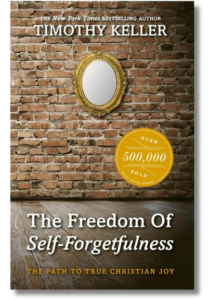 Imagine a life where you don’t feel inadequate, easily offended, desperate to prove yourself, or endlessly preoccupied with how you look to others. Imagine relishing, not resenting, the success of others. Living this way isn’t far-fetched. It’s actually guaranteed to believers, as they learn to receive God’s approval, rather than striving to earn it.
In Tim Keller’s short ebook, The Freedom of Self-Forgetfulness: The Path To True Christian Joy, he explains how to overcome the toxic tendencies of our age一not by diluting biblical truth or denying our differences一but by rooting our identity in Christ.
TGC is offering this Keller resource for free, so you can discover the “blessed rest” that only self-forgetfulness brings.
Michael J. Kruger is the Samuel C. Patterson chancellor’s professor of New Testament and early Christianity at Reformed Theological Seminary. He served as president of the Evangelical Theological Society in 2019. He is the author of Surviving Religion 101: Letters to a Christian Student on Keeping the Faith in College and Christianity at the Crossroads: How the Second Century Shaped the Future of the Church. He blogs regularly at Canon Fodder.
Jen Wilkin is an author and Bible teacher from Dallas, Texas. She has organized and led studies for women in home, church, and parachurch contexts. An advocate for Bible literacy, her passion is to see others become articulate and committed followers of Christ, with a clear understanding of why they believe what they believe, grounded in the Word of God. You can find her at her website.