





I can’t find much agreement between on Christians on COVID-19 and whether or not to re-open our churches and country. But I sense much agreement on one point: We don’t trust institutions. This pandemic may have revealed this change, but it didn’t cause it. Distrust has been building since before millennials were born. Just the drop in Americans’ confidence in organized religion should concern us: from 65 percent expressing a “great deal” or “quite a lot” of confidence in organized religion 40 years ago down to 38 percent in 2018.
Yuval Levin argues that we thrive inside institutions where we develop relationships of commitment, obligation, and responsibility. And he sees a particularly important role for churches. He writes about this in his new book, A Time to Build: From Family and Community to Congress and the Campus, How Recommitting to Our Institutions Can Revive the American Dream.
I previously interviewed Levin on his excellent book The Fractured Republic. He joined me on Gospelbound to discuss a wide range of topics: how populism combines with identity politics to resist restraint, the lure of cynicism and outsider politics, our pervasive culture war, the culture of celebrity as the enemy of integrity, and much more.
“The power of religious institutions in particular, as opposed to all of our other institutions, is that they are inherently formative,” Levin told me. “They begin from that sense that the human person enters the world fallen and unformed and unprepared to be free and in need of formation before we can be free. That is a message that our traditional religions can deliver in a way that no other institution possibly could, and we have that obligation to deliver that message, to convey it, to show people why and how it points toward a better society.”
This episode of Gospelbound is sponsored by Southeastern Seminary, equipping today’s ministry leaders with the Word of God, a philosophical foundation, and care for the lost through their Masters program in Ethics, Theology, and Culture and the PhD in Public Theology. Learn more at sebts.edu.
Transcript
The following is an uncorrected transcript generated by a transcription service. Before quoting in print, please check the corresponding audio for accuracy.
Collin Hansen: We may not agree on much any longer, but this we seem to share in common. We don’t trust institutions. Just to drop in American’s confidence in organized religion should concern us from 65 percent expressing a great deal or quite a lot of confidence in organized religion 40 years ago, down to 38 percent in 2018. Less trust in institutions means fewer close friends.
Collin Hansen: We spend less time with others and feel more disconnected. Through online media we’ve never been exposed to so many competing views and yet somehow we’ve never been so ignorant of what others believe. The old men who used to volunteer with the Lion’s Club now sit at home alone at night watching Fox News. Yuval Levin argues that we thrive inside institutions where we develop relationships of commitment, obligation and responsibility and he sees a particularly important role for churches.
Collin Hansen: He writes this in his new book, A Time to Build: From Family and Community to Congress and the Campus: How Recommitting to Our Institutions Can Revive the American Dream, published by Basic Books. “A recovery of the ethic of community also stands the best chance of beginning in the kinds of communities that first form out of common religious convictions.” Levin is the founder and editor of National Affairs and has written for many prominent publications. I previously interviewed Yuval for his excellent book The Fractured Republic. He joins me now on Gospelbound to discuss a wide range of topics, how populism combines with identity politics to resist restraint, the lure of cynicism, outsider politics a pervasive culture war, the culture of celebrity as the enemy of integrity, and much more.
Collin Hansen: Thank you, Yuval, for joining me on Gospelbound.
Yuval Levin: Thanks very much for having me.
Collin Hansen: Let’s just start with the basics. What’s an institution and what gave institutions such a bad name?
Yuval Levin: Yeah. Actually the term institution turns out not to be so easy to define and as you can imagine, there are a wide variety of academic definitions of it, but where I land in the book is on a broad definition that allows us to think about our contemporary social challenges in terms of institutions, which is that our institutions are the forms of our common life, the structures and shapes of the things we do together. They’re the ways in which we are more than just clumps of individuals out there doing things, but rather are formed into effective wholes of we can be parts. And our different institutions, some of them are more corporate and formal, like a company or a school or a legislature, a unit of the military. Some are less corporate than that, but more significant and fundamental like the family is an institution, the institution of marriage, we might think of the profession as an institution. What’s key to it is that it is a form of common action and in that sense it is also formative of us.
Collin Hansen: And what gave them a bad name? I mean where did this go wrong?
Yuval Levin: Well, at some level Americans have always had some resistance to institutions, because what institutions do is they mediate. They stand between us and what we’re seeking to do. And there’s always been some degree of suspicion of mediation. We Americans have always identified authenticity with directness at some level. But lately, that is in the last few decades, there’s also been a dramatic decline in our confidence in institutions. And I think that has had to do with a more particular kind of institutional deformation or corruption by which people have gone from seeing our institutions at every level of American life as being formative of us to being instead performative for us, being platforms for us to be seen on and to raise our profile and visibility.
Yuval Levin: I think you can see that across the range of American institutions and an institution that functions as a platform is just inherently harder to trust, and so we have been losing our trust in these institutions, in politics, in the academy, in the professions, and also in civic and religious life to a certain degree for decades now.
Collin Hansen: You described institutions as helping us to navigate between freedom and responsibility. How do you see that playing out? How does that work?
Yuval Levin: Well, what institutions ultimately allow us to do is they form liberating constraints. They give us a role, a particular place and function. They tell us this is the responsibility you have. In some ways, of course that’s constraining, but in very important ways it is empowering. It allows us to be part of an effective whole, and ultimately that means that we can find that balance between being an individual, working in pursuit of a goal that matters to us and also being effective by being constrained and being part of something larger than ourselves. It’s not easy to navigate that difference in a free society, and what our institutions do for us is enable us to navigate it precisely by forming us to be more effective.
Collin Hansen: One other thing you described institutions doing as strengthening the strong. Well actually, sorry, let me clarify. Weak institutions, you say they strengthen the strong and weaken the weak. That’s not intuitive for us as Americans, and we’re going to talk more about that, but how is it that sort of an anti-institutionalism actually again, makes the strong stronger, the weak, weaker?
Yuval Levin: Yeah. I think there’s a tendency in our culture to think that institutions serve the elite, that they’re fundamentally good for the people who have power. And of course in some respects institutions do serve, they lead, they empower people with privileges to exercise those privileges, and it’s important that our institution be shaped in ways that constraints some of those privileges. But the trouble is if we respond to that by breaking down these institutions, then we hurt the people who are trying to help, because ultimately the people who are most privileged in our society are going to be fine, whatever happens to our institutions.
Yuval Levin: It’s those people who need their rights protected. It’s those people who need to stand up against genuinely oppressive forces in our society who most need functional institutions. They’re the ones who are most alone and weak out there if these institutions fail. So that the irony of our situation is that although this is a moment that leads us to a kind of populist revolt against institutions, we actually need functional, reliable, trustworthy institutions precisely in order to resist the kind of forces that we now worry about.
Collin Hansen: I have to imagine you have in mind the sociology of our friend Brad Wilcox. They’re talking about marriage in particular. Elaborate a little bit about what that looks like within the institution of marriage.
Yuval Levin: Yeah. Marriage is exactly an institution that constraints and liberates us, right? It constraints in obvious ways. It limits our options. It provides us with responsibilities and yet at the same time, it enables us to lead a flourishing life, to build a family. When we understand it that way, we can come to relate to our constraints as forms of liberation and empowerment, but when we think of marriage only as a mode of expression, as a way of saying that our relationship is recognized, then we fail to see the significance of the structure of the family, the shape of a marriage as a way of forming our souls and ultimately forming our communities. It’s over and over in various institutions from the very personal all the way up to the national that when we mistake their purpose for being fundamentally expressive rather than formative, they lose their ability to provide us with the shape we require to be successful and effective in our lives.
Collin Hansen: And it seems like even people who teach that the institution of marriage does not really matter or has no particular definition, nevertheless into it that it is a formative and necessary institution. Personally, I’ve seen a Wilcox just point out recently some neighborhoods of Hollywood where there are no single-parent-led families there. Even though we see of course such different messages coming from them. You describe our political moment in ways that I think we would all agree with. I wonder though if you could help us to understand how we got there. You described this political moment where all sides have grown mistrustful of authority and cynical about all claims of integrity and I wondered in this lamentable development, do you see a particular turning point where things got off track?
Yuval Levin: Yeah. One way to think about this is as several decades of transformation from a kind of mid century consensus in our politics, I think it’s important to see that that consensus was not a norm in American political life, but was in itself and unusual moment. The America of the post-war era of the 1950s, early ’60s was very unusually cohesive. It had an unusually strong mainstream consensus on a lot of issues. There was a lot of good about this. There are also bad sides to this.
Yuval Levin: It left people excluded, and Americans who live on the margins had much less of a role in our society. Ever since that moment from the early ’60s on, we have been basically liberalizing in one way or another. Economically, we’ve been moving our economy toward a much greater market orientation. And culturally we’ve been liberalizing in the sense that we’ve broken up that mainstream consensus in favor of a great diversity of ways of living.
Yuval Levin: This has had some good effects. It’s been, economically, it’s made us much wealthier. Culturally, it’s made us more inclusive, but it has come at the cost of cohesion and social order and structure, and we’re paying that cost now in a way that requires us to recognize some of the ways this has happened. And what might be done to mitigate it. It doesn’t mean we’ve got to reverse these changes exactly. It doesn’t mean we go back to the America of the ’50s and early ’60s. I don’t think that’s an option whether we want it or not. It’s not how things work.
Yuval Levin: I think what it requires us to do is build up our capacity for solidarity and for social order and for a kind of traditionalism that allows us to find our place in society. One of the reasons people complain now about this as an era of isolation, alienation, all of these are ways of saying that we’ve lost national cohesion. That we’ve lost a sense of belonging to something larger than ourselves, and I think that is ultimately a failure of institutions. Not only a loss of confidence in them, but a loss of their trustworthiness in ways that require us to find ways to reform them and strengthen them, but then also call us to recognize that we have obligations to the institutions we’re part of and we have to recognize those when we make choices in our lives.
Collin Hansen: For me, for people who are interested more in what you’re talking about there, check out The Fractured Republic, especially when you talk a lot about nostalgia. I’m going to be giving a talk pretty soon on politics for a church and your work on nostalgia especially has been really helpful to me in that regard. I was able to kind of identify sort of streams of post millennialism and pre millennialism in terms of American theological eschatological culture overlaid within our progressivism and I even don’t really want to use the term conservatism any longer. I want to say sort of the nostalgia party. There’s a nostalgia party and a progressive party and they kind of overlap into Christian eschatological perspectives there. But-
Yuval Levin: I would say in some ways we, not in our politics at least, we sort of have two nostalgic parties.
Collin Hansen: Yes. Yeah. Well you talk about the ’60s as being nostalgia versus the ’50s isn’t nostalgic, right?
Yuval Levin: Yeah. And, we also live in a time when our leaders in both parties are exceptionally old and the president is in his mid-70s. The Speaker of the House, I believe, is 78. I don’t want to be unfair to her, but I think that’s right. The majority leader of the Senate is 77. That really is an unusual moment in American life, and it presents us with some challenges that very much relate to the institutional question.
Collin Hansen: And the leading challenger is at least as old, if not older themselves. So I mean your book, your previous book especially helped me to understand so much of how the ’50s and ’60s just continued to dominate our politics and how in some sense, we can’t really move past that. Turning back again to A Time to Build, I don’t think I’m wrong to see Protestants as a culprit in your historical analysis. You alluded earlier to our resistance as Americans to mediation and one of the primary ways that we do so there is within a Protestant mill you that rejected the mediation of the priests and of the church there-
Yuval Levin: Well, I’d say that’s not culprits of Protestantism, [inaudible 00:13:30] for what’s great about America. The sense of that authenticity and directness are ways of being free, which I think are really part of what’s great about living in this country. But there is a downside to that. And I think finding ways to take mediation seriously is a challenge for Americans.
Collin Hansen: Yeah. Well no doubt. I mean, I thought though of all that I might’ve, I wouldn’t necessarily say I would disagree, but might push back a little bit on, I was completely on board. When you see the Puritan instinct in today’s campus activists. I don’t understand how that’s not more obvious that the forces that we imagine are so amoral are actually hyper-moral.
Yuval Levin: Yeah.
Collin Hansen: And anti-Puritan are actually extremely Puritan?
Yuval Levin: There’s a tendency for those of us on the right like myself to think about campus activism in terms of relativism. I think that’s just simply not so. Campus activism is highly moralistic. It may be in the service of a misguided morality, and in some ways it is, but it is radically egalitarian and intensely, intensely justice-oriented. It needs a better idea of justice. But the fact that these are folks in search of justice is a good thing. And in any case it’s who they are. I think we need to recognize that this is a moralistic movement, and that speaks for both its positive and its negative implications.
Yuval Levin: And it’s puritanical in some important ways. I mean, American higher education is rooted in Puritanism. Our first two universities, Harvard and Yale, were literally Puritan seminaries, and less has changed than we think. I mean, these are still places that see it as their role to bring the larger society to repent of some kind of sin and also to justify the mores of the elite. And that’s what Harvard does now. They just do it without an appeal to genuine religious foundations that I think leaves them with a very peculiar kind of morality in which they demand repentance but do not offer salvation or forgiveness. That’s a very harsh kind of Puritanism. But I think it ought to be understood as rooted in a certain kind of moral demand.
Collin Hansen: You’ve already alluded a couple times to the differences between the mold rather than a platform when it comes to institutions. But I’m afraid, Yuval, that we may soon reach a point where younger people don’t even know that institutions should mold them, that they haven’t really experienced that before. I mean, I do think to a certain extent, public schools have a bit of that molding effect in different ways, including molding people toward justice like you were talking about right there, but certainly social media has made all the world a stage. And I mean you could look at something like Twitter where institutions have less of a reach than personalities do. It’s a personality-based platform. You could imagine in a Twitter world where Donald Trump is bigger than the presidency because Donald Trump will continue to have a Twitter account with millions of followers even when Donald Trump someday is no longer president.
Collin Hansen: But I wonder why would these folks, including journalists and pastors, a lot of the people that I work with want to go back to the painstaking process of building institutions when they can just build their own brand on Instagram, Twitter, and Medium. I guess I’m wondering, speak to them about why they should want a mold when they certainly don’t assume that that’s the case.
Yuval Levin: Yeah, it’s a great question. I think at some level there is a desire. There is a sense of a dissatisfaction with the status quo and a dissatisfaction that presents itself as a desire to belong to something, to appeal to some set of ideals, a desire to be part of a larger whole that can really only be answered by institutions. So, I agree with you that part of it is not obvious to the people who themselves feel this dissatisfaction. The sense that what they’re seeking is within their reach if they were to understand that they have access to these institutions and that really frankly a form of devotion to them could be enormously satisfying and helpful. I think it is true that there is a rising generation now that is experiencing its role in American society in a fundamentally expressive way.
Yuval Levin: The things that’s done something when it is said it has opinion X about issue Y when in fact to just express that view is not to do anything at all about anything. It seems to me that where there is reason for hope is actually in the fact of dissatisfaction with the way these things were, in the fact that people within our professions find that they’re not respected, that their expertise is not taken seriously, that they themselves don’t know who to trust and what to believe. That’s what our institutions do for us. They allow us to distinguish the reliable from the unreliable, the expert from the layman, the trustworthy from the conspiracy theory.
Yuval Levin: If we don’t have these differences, these distinctions, then it becomes very, very difficult for society to function, and I think we actually are feeling that increasingly in our lives and you see younger people, even though they don’t express it in these ways, seeking some forms of authority. When young men look to Jordan Peterson, they’re actually asking for something else. They’re asking for a morally respectable source of authority. I don’t think Jordan Peterson offers them to that, but that suggests to me that they’re open to something like religious conversion or a moral authority. I think you find that in a lot of institutions where younger Americans congregate now. It hasn’t articulated itself as quite the right kind of desire yet, but I see it as an openness. I see reason for hope there.
Collin Hansen: I grew up in the era of probably the most heightened conservative critiques, or at least how I imagined so, the heightened conservative critiques of mainstream media, and I don’t think I could have imagined a scenario that was worse than all of this mainstream media dominated as in a very formative institutional-type media, but really sort of pushing liberal messages, not even self-consciously or at least not self-admittedly. I’m not sure I could have understood or expected something worse. Well then they fell apart, and now we see something worse. Now it’s just everybody for themselves. It didn’t solve anything. It just now proliferated. It just went all over the place there.
Collin Hansen: Let’s talk about two institutions that, well, one, I deduced this a little bit for meeting your book, so I’m going to try out just a theory on you here. Do you see a connection between high public confidence in the military and the popularity of professional football and the endurance of those institutions as molds?
Yuval Levin: Yeah, absolutely. I think sports and the military are two areas where there really are exceptions to the public’s loss of confidence in institutions, and I think the reason for that has a lot to do with this distinction between the formative and the expressive or the formative and the performative. The military is our one national institution that we really take to be fundamentally formative of human beings that it takes men and women of one sort and produces them. It produces men and women of another sort, a better, more responsible, reliable sort.
Yuval Levin: When someone tells you that they went to Harvard, you think maybe that person is smart, you don’t think Harvard made them smart. You think that the fact that they got in says maybe there smart-
Collin Hansen: Absolutely.
Yuval Levin: When someone tells you they went to the Naval Academy, you think that’s a serious person, and it’s not because they were that before, but precisely because the Naval Academy or the Navy made them so and so. We respect the military because it makes people better. It holds them up to certain standards and ideals, and ultimately it means that we can rely on them more. I think the same is true in some respects of professional sports where for all that there is certainly a celebrity culture. Obviously in professional sports there are also these set of rules and norms that people are held up to and we ultimately respect the team player, the person who sticks to the basics in ways that maybe we don’t quite articulate in these formative terms. But it means this is a person who allows themselves to be subsumed by the larger goal, by the ideals, the integrity that define the whole. And we want more institutions like these.
Yuval Levin: That’s what it really means to trust an institution. It means we believe that it forms trustworthy people and institutions that just become pure platforms for expression don’t form people. They’re not pretending to form people, and therefore they’re not trying to form people and it becomes much harder to trust them.
Collin Hansen: I didn’t grow up in a place where people went to Harvard. I did grow up in a place where a lot of people went into the military, and that seemed to be the whole appeal, especially for people who didn’t necessarily have an intact home, who didn’t necessarily have a great track record in school. There was a sense that which they were pursuing this, especially the Marines, seems to be a pretty big selling point for them. Where that was a place where you really could become something bigger than yourself.
Yuval Levin: Yeah.
Collin Hansen: And that was the whole appeal for a lot of the people that we’re identifying or suffering from the breakdown of institution.
Yuval Levin: Well, it also shows you the appeal of this, because you know the Marines have never once, since the advent of the volunteer military, have never failed to meet their recruiting goals. Even though they tell you that it’s hard. This elective-
Collin Hansen: That’s the selling point. That’s a selling point.
Yuval Levin: Absolutely.
Collin Hansen: Yeah. Let’s go back to universities here. You write this: “Our society does not have to be one big yes or no question over which we are constantly at each other’s throats. It can consist of a diversity events pursued by a diversity of means united by some crucial common ideals.” I think back very fondly to my own university years. I didn’t expect everyone to agree with me. I’m just wondering who is benefiting from this current approach? Like what’s improved by this new climate of fear and performative outrage that you talk about? I just, I don’t understand what’s so scary about a diversity events pursued by a diversity of means united by common ideals, the way you describe it there. And I just, I think especially so many of these challenges don’t come from outside actors on the institution. They come from within, and I think about the professors who fight the institution or the university over their pet agendas and tenure process and turn the entire thing into one mere expression of identity politics.
Yuval Levin: Yeah, no, absolutely. I think the university . . . in some ways the university is really at the core of this book, both because it is where the cultural war that we’re fighting in all of our institutions has come from and because it’s where it’s gone furthest. I mean I think it is really an institution that has been deformed by the reach of the culture or into every crevice and especially by its reaching the university administration. I think in a sense, the answer to the question you’re raising is that the people who benefit from this are the people who run the universities, who now can use identity politics and a certain idea of social justice really as a means of administration of using power. There’s nothing new about student activists. There’s nothing new even about radical professors. That’s been part of the academic world since the beginning of the university in America and well before that in Europe.
Yuval Levin: What is new, I think, is that social activism is now the language of university administration in a way that it has not been true in the past. And that means that the university is simply less committed to the fundamental purpose of teaching and learning and instead becomes a kind of platform for a certain vision of social justice. And look, that vision, you can think it’s good or you can think it’s bad, but it’s not the purpose of the university. And when that purpose is not served, we don’t have an institution that serves this essential goal of pursuing the truth through teaching and learning in various fields and that does enormous harm to our society.
Collin Hansen: We have a couple more questions here with Yuval Levin about his book, A Time to Build From Family and Community to Congress and the Campus: How Recommitting to Our Institutions Can Revive the American Dream. It seems that in the decline of institutions we see the rise of the tribes. I mean we are a collective people. We can pretend we don’t like mediation. We can pretend like we’re all lone wolves, but these wolves tend to desire to run together. That same, whether you’re coming from a religious perspective and evolutionary perspective or what not. That is true of our humanity.
Collin Hansen: So in the decline of institutions, say the political party, the rise of tribes, I’m just wondering, when did we stop debating ideas in politics? I mean, we know there’s some big areas where the parties disagree like abortion. Okay. But just I’m wondering, is there anything . . . one of the diseases is that we just sit there on different sides and say, “Well, I’ll change as soon as the other side changes.” Is there anything either side could do themselves to begin to implement what you’re recommending in the book and to just to break this insidious cycle?
Yuval Levin: Yeah, I mean I think the dysfunction of our politics is really the clearest way in which we see what this deformation of institutions really looks like. So that the institutions of our politics, both the actual infrastructure of our political life in the Congress and the presidency and the courts and some of the institutions around politics like the parties really exist to channel our differences, to compel accommodation, to drive people of different views to reach some compromises and solve problems. When those institutions become purely expressive, then we’re stuck with the places where we start. We don’t move from there. We don’t make progress toward partial solutions, which is ultimately all that’s achievable in our kind of politics and we just stay there. Where members of Congress think that Congress is there as a stage to stand on and express the kind of frustration that got them elected rather than somehow try to mitigate it by changing the law, changing something that has left their voters frustrated.
Yuval Levin: Then we can’t use our politics to address the problems that make us so frustrated. We only use our politics to exacerbate those problems, to state them over and over and over. That’s really what happens in a kind of performative set of institutions. I think, what’s the way forward really in politics and in general requires people to begin by acknowledging that the roles they have in our institutions come with obligations by asking the question that we don’t ask enough now in American life. Given my role here, how should I behave? Given that I am a member of Congress or the president, given that I am a parent or a neighbor or a pastor or a CEO or a worker. Given that, what should I do? I think the people would drive us crazy in American life now where people never asked that question when they should.
Yuval Levin: The people that we respect and regard highly are the people who seem always to ask that question in moments of decision. There’s a lot of institutional reforms that we need to fix these problems, but any of them would have to start by asking that question so that we see the changes necessary.
Collin Hansen: One last question here for speaking on this podcast, Gospelbound, to Christians especially, and I’m wondering as an observer, is there anything you would recommend for Christians in particular, maybe even Protestants that we can uniquely contribute to? Just the changes that you desire for our common society to seek?
Yuval Levin: Well, let me say I’m Jewish, so I am an outside observer of Christian America. Only one, a very friendly one, but I would say the power of religious institutions in particular, as opposed to all of our other institutions, is that they are inherently formative. They begin from that sense that the human person enters the world fallen and unformed and unprepared to be free and in need of formation before we can be free. That is a message that our traditional religions can deliver in a way that no other institution possibly could, and we have that obligation to deliver that message, to convey it, to show people why and how it points toward a better society.
Yuval Levin: I think there’s just no alternative to the Judeo-Christian framework, that anthropology that says that we begin fallen and require formation and that’s what our institutions do. And so when we use our religious institutions as modes of expression, as places to stand and express our political views, we are in some respects failing the larger society because those institutions really are there as formative foundations for the human person. When they fail to perform that role and to show why it matters and how it can help I think what they are failing in their core function. And so they have a very, very important responsibility in the kind of transformation that we need.
Collin Hansen: So helpful Yuval, not only seeing how Christians can contribute beyond our own sort of church walls, but then also to be able to look inside of our churches because so many of the problems that you identify are in endemic to our churches right now and to our religious culture, unfortunately. But it gives us a way to learn and a way to move forward. Yuval Levin has been my guest on Gospelbound. Check out his new book, A Time to Build From Family and Community to Congress and the Campus: How Recommitting to Our Institutions Can Revive the American Dream. Thank you Yuval.
Yuval Levin: Thank you very much.
Free eBook by Tim Keller: ‘The Freedom of Self-Forgetfulness’
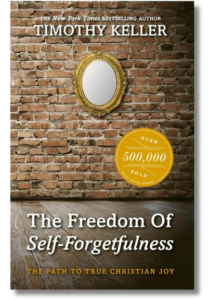 Imagine a life where you don’t feel inadequate, easily offended, desperate to prove yourself, or endlessly preoccupied with how you look to others. Imagine relishing, not resenting, the success of others. Living this way isn’t far-fetched. It’s actually guaranteed to believers, as they learn to receive God’s approval, rather than striving to earn it.
In Tim Keller’s short ebook, The Freedom of Self-Forgetfulness: The Path To True Christian Joy, he explains how to overcome the toxic tendencies of our age一not by diluting biblical truth or denying our differences一but by rooting our identity in Christ.
TGC is offering this Keller resource for free, so you can discover the “blessed rest” that only self-forgetfulness brings.
Collin Hansen serves as vice president for content and editor in chief of The Gospel Coalition, as well as executive director of The Keller Center for Cultural Apologetics. He hosts the Gospelbound podcast, writes the weekly Unseen Things newsletter, and has written and contributed to many books, including Timothy Keller: His Spiritual and Intellectual Formation and Rediscover Church: Why the Body of Christ Is Essential. He has published with the New York Times and the Washington Post and offered commentary for CNN, Fox News, NPR, BBC, ABC News, and PBS NewsHour. He edited the forthcoming The Gospel After Christendom and The New City Catechism Devotional, among other books. He is an adjunct professor at Beeson Divinity School, where he also co-chairs the advisory board.
Yuval Levin is the editor of National Affairs and the Hertog Fellow at the Ethics and Public Policy Center. Levin is the author, most recently, of A Time to Build: From Family and Community to Congress and the Campus, How Recommitting to Our Institutions Can Revive the American Dream.