



There’s a paradox you’ll encounter the longer you walk with Jesus. The more you experience the light of his love, the more clearly you see the remaining spots and stains in your life. Progress seems lacking. Stumbles continue to mark your journey. The more you know the Lord’s love for you, the more you feel your unworthiness and your dependence on his grace.
This doesn’t mean you’re going backward. I call it the paradox of the brightening path.
What the Light Reveals
Proverbs 4:18–19 sets two images side by side.
The path of the righteous is like the light of dawn,
shining brighter and brighter until midday.
But the way of the wicked is like the darkest gloom;
they don’t know what makes them stumble.
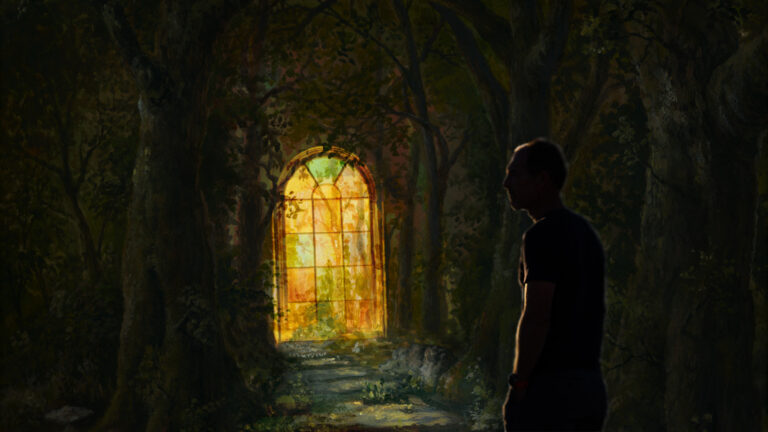
The path of the righteous is one of ever-increasing clarity. On the bright path, you see more of the landscape, more of your surroundings, more of yourself. On the dark path, it’s the other way around. The darkness narrows your vision until you’re stumbling over things you can’t even identify.
Here’s what the paradox looks like in practice. Maybe you’ve made real progress against pornography, but you’re still aware of just how deep the tentacles of lust reach into your heart. Maybe you’ve stopped tearing people down behind their backs, but you notice how easily your first impulse is still to think badly of others. Maybe you look back at a season of fear, and you grieve an opportunity you let slip by.
It’s natural to look at your past regrets or present struggles and think, I must be getting worse. But that’s not what’s happening. You’re finally seeing clearly. The sun is rising. And the sunlight is showing you sins you couldn’t see in the hazy stirrings at the dawn of your salvation.
As Jack Miller used to say, “Cheer up! You’re a worse sinner than you ever dared imagine, and you’re more loved than you ever dared hope.”
So, the closer you get to God, the less you tend to notice your own progress. Perhaps that’s why the righteous in Matthew 25, when Jesus names their acts of kindness, respond with genuine shock: “Lord, when did we do that?” They can’t recall their good deeds—maybe because they weren’t thinking about their good deeds at all. They were focused on the people they were called to serve.
That’s what it looks like to walk toward the light. You put others before yourself, and when you do look at your life, you’re likely to see the remaining stains more than the progress. But the light is still getting brighter.
What the Darkness Conceals
Now, the opposite is also true, and it’s worth pondering. We need to take the warnings in Proverbs seriously.
The dark path is insidious precisely because it blinds gradually. Wickedness doesn’t announce itself. It grows through small compromises, “innocent” indulgences, fleeting moments of lost resolve. As the path darkens, self-deception increases. You lose touch with reality so slowly you don’t notice it happening. You start by choosing the path. But eventually, the path chooses for you.
This is why Proverbs sounds the alarm about staying off the wicked path before it forms your steps—not because God is a killjoy but because he knows how paths work. Every step confirms you in a direction. And the dark path is dangerous because it never feels like a trajectory. “The safest road to hell is the gradual one,” wrote C. S. Lewis, “the gentle slope, soft underfoot, without sudden turnings, without milestones, without signposts.”
What makes the bright path different isn’t that it makes you feel better. It’s that it helps you see more clearly, including the ways you still fall short. The discomfort of that clarity is actually the sign you’re still walking toward the light. Even the apostle Paul still saw himself as the “chief of sinners” in need of the Lord’s mercy.
The Lord Who Is Our Light
When we encounter this paradox, we persevere by deepening our wonder at God’s love for us. We look at Jesus Christ, again and again. Remember, before Christians were even called Christians, the movement was known as “the Way.” That’s not accidental. Christianity involves a way of life. But this path isn’t ultimately a set of principles or practices. The Way is a Person.
Jesus doesn’t give wisdom the way Confucius or Socrates did. He is Wisdom. He’s not like Buddha offering the fourfold path. He is the Path. “I am the Way,” he said. “I am the Truth. I am the Life.” When Proverbs calls us to walk in the light of dawn, it is—across the whole arc of Scripture—calling us toward Christ himself, the Light of the world. The Light that overcame the darkness.
When you fix your eyes on Jesus, when you behold the life-giving love of his cross, everything else comes into focus. Your uncertainty about the future. Your regrets about the past. The stubborn sins you’ve confessed so many times. All of it comes into focus because we live in the light of Christ.
The light of Christ is the light of love. To walk in the light, as he is in the light, may make us feel like we’re getting worse, but that’s only because we’re seeing the depth of our sin better. As our knowledge of our persistent sin increases, so must our gratitude for Jesus’s persevering love toward us. The Lord has “shone in our hearts to give the light of the knowledge of God’s glory in the face of Jesus Christ” (2 Cor. 4:6). So take heart! Embrace the paradox of the brightening path.
If you would like my future articles sent to your email, as well as a curated list of books, podcasts, and helpful links I find online, enter your address.