


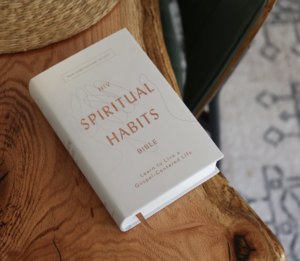
Many of us long to grow in our walk with God, but feel unsure where to begin or how to keep going. The NIV Spiritual Habits Bible offers practical help by guiding readers through Scripture with daily readings focused on forming gospel-centered habits like prayer, gratitude, faithfulness, and rest. Today, I am excited to have my friend and colleague Joe Carter give us a glimpse into how this Bible helps readers establish simple, attainable rhythms to pursue a faithful, sustainable walk with Christ.
The NIV Spiritual Habits Bible is available to order now.
1. Can you tell us a little bit about yourself? What is this season of life like for you and your family?

I’ve spent the last couple of decades writing at the intersection of faith, culture, and everyday Christian life, mostly here at The Gospel Coalition. I’m also blessed to serve as a pastor at McLean Bible Church in Arlington, Virginia.
This has been a particularly full season. Alongside the Spiritual Habits Bible, I’ve been finishing a separate book on AI and the Christian faith, which has me thinking constantly about how technology shapes the way we form our souls. Between those two projects, pastoral ministry, writing at TGC, and trying to be a present husband and father (to an adult daughter), it’s been a lot.
But it’s a season of gratitude. I get to spend my days thinking about what it means to follow Jesus and then helping other people do the same. I can’t imagine a better life.
2. What led you to focus on spiritual habits as the framework for this Bible?
The habits framework came about because of a quote by historian Will Durant: “We are what we repeatedly do. Excellence, then, is not an act, but a habit.” Durant was summarizing Aristotle’s views on virtue and habits, but it’s a wholly biblical concept since the Bible connects our repeated behaviors to our character. For instance, Paul tells the Romans that habits of obedience make us “slaves to righteousness” (Rom. 6:15). And Proverbs is essentially a guidebook for developing wise patterns of living. If we are what we repeatedly do, then spiritual formation is really about asking: What am I repeatedly doing, and is it making me more like Jesus?
Spiritual formation isn’t as mysterious as we make it out to be. It’s mostly about the direction of our life: We either develop habits that draw us toward Christ or habits that pull us away from him. In other words, every day, we’re becoming either more like Jesus or less like him. The framework of habits gave me a concrete, accessible way to talk about a process that can otherwise feel frustratingly abstract.
3. Sometimes habits can feel mechanical or routine. How do habits actually help us live a vibrant, gospel-centered life?
This is probably the most important misconception to address. People hear “habits,” and they think rote, mindless repetition—like brushing your teeth. But the goal isn’t mechanical obedience but helping give us more freedom.
Think about it like a concert pianist who practices scales so relentlessly her fingers know where to go without thinking. That’s a habit. But no one listens to a concert and says, “Oh, how mechanical.” No, they recognize that habits liberated her to make beautiful music. The same principle applies to our spiritual life. When we develop habits of reading Scripture, prayer, gratitude, and service, those practices become the infrastructure of our souls. They free us to respond to God more naturally, more quickly, and with more of our hearts focused on him.
 4. You highlight 30 different spiritual habits, from prayer and gratitude to rest and stewardship. Were there any habits that surprised you as especially important as you worked through the project?
The ones that most people expect—prayer and Bible reading—were obviously central. But two surprised me by how fundamental they turned out to be in my own life.
One category is habits of rest. We live in a culture that treats exhaustion as a badge of honor, and I found that Christians often feel guilty about resting. But Scripture treats sleep as a genuine spiritual discipline. As TGC co-founder D.A. Carson once said, sometimes the godliest thing you can do is get a good night’s sleep. I ended up writing entries on such things as sleep as a spiritual activity and the types of rest we need for spiritual rejuvenation.
Another important group is habits of gratitude. G.K. Chesterton was right when he said gratitude is “happiness doubled by wonder.” Developing the habit of actually paying attention to what God has done—not just vaguely feeling thankful but deliberately counting blessings—has a formative power that’s easy to underestimate.
5. How do you hope this Bible will help readers develop habits that are sustainable over the long term?
The book contains over 1,000 tips and suggestions, and I tell people upfront that no one could or necessarily should attempt to apply them all. My realistic goal is that every reader will find at least eight practices to incorporate into their life—one from each of the eight primary categories of spiritual formation. Eight practices, applied faithfully and guided by the Holy Spirit, is enough to change your life.
I also designed the content around the concept of a “spiritual formation spiral.” Spiritual growth isn’t linear. It’s more like a spiral staircase, where you return to the same categories repeatedly, but each time you come around, you’ve moved a step higher. For instance, you don’t master prayer and then move on to service. You cycle through these disciplines again and again, going deeper each time.
6. In your experience as a pastor and writer, what are some common misunderstandings Christians have about spiritual growth?
There are three that are particularly common.
The first is that the bare minimum is enough. Many believers think that if they just read a chapter a day and say a prayer before bedtime, growth will happen automatically. But we can’t make adequate progress by merely reading a chapter a day and saying a prayer before bed. Becoming like Christ requires intentional effort across multiple dimensions of our lives.
The second is that spiritual formation is something we leave entirely to God. There’s a passivity in some Christian circles that sounds pious but is actually unbiblical. Yes, sanctification is primarily God’s work. But Paul doesn’t tell us to sit back and wait for holiness. He says to “work out your salvation with fear and trembling.” One theologian I quote in the book put it this way: use the means of sanctification as vigorously as if you were to be saved by your own efforts, and yet trust as entirely to the grace of God as if you made use of no means whatsoever. That’s the balance we need to seek.
The third is treating spiritual disciplines as a checklist, as something to complete rather than a way to commune with God. As John Stott said, the essential secret is not mastering certain techniques but being mastered by certain convictions. The habits are a means, not the end. The end is always Christ himself.
7. For a sneak peek, here is an entry from the book: 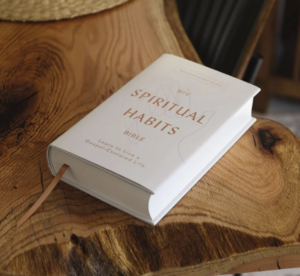
How to Keep a Spiritual Journal (Entry on Psalm 86)
For thousands of years people have read the Psalms and been moved by David’s words as he pleas, prays, and praises God. But as much as these Psalms have blessed generations of readers, the one that likely gained the most benefit was David. Writing down our reflections so that we can examine and ponder over them, as David often did, can be a powerful tool for spiritual growth.
The Bible does not mention spiritual journaling, but there are certain books of the Bible (Psalms, Nehemiah, Jeremiah, etc.) that record prayers, personal life events, reflections on Scripture, and other themes often associated with the practice.
A spiritual journal is a tool for self-reflection that allows us to cooperate with the Spirit to make sense of the deepening work he is doing in our soul. There is nothing in Scripture that requires believers to keep a journal, but throughout the ages Christians have found it to be a useful exercise. If you’re interested in spiritual journaling, consider these tips:
You don’t have to be a writer – Many people avoid journaling because they’re not writers. But a journal is written for an audience of two: you and God. Don’t worry about grammar, spelling, or style. No one has to ever read—or even know about—your journal.
Your way is the right way – Don’t worry about “doing it wrong.” If you find the practice helpful, just do it your way. Choose your own schedule, your own style, and your own topics to write about. Feel free to experiment to discover what works best for you.
Write what you want – There is no wrong way to journal, so write about whatever the Spirit lays on your heart. For instance, you could include in your journal such items as reflections on character formation; successes and struggles in being obedient to Christ; poems or songs you’ve found or written; lessons learned from Scripture reading, etc.
Review your writings – You only get half the benefit from writing in your journal; the other half comes from reading what you’ve written in the past to remember forgotten insights and gauge your spiritual growth. Make a habit of regularly reviewing your journal.
 Joe Carter is a senior writer for The Gospel Coalition, the editor of the NIV Spiritual Habits Bible, author of The Life and Faith Field Guide for Parents, and coauthor of How to Argue Like Jesus: Learning Persuasion from History’s Greatest Communicator. He also serves as an associate pastor at McLean Bible Church in Arlington, Virginia.