




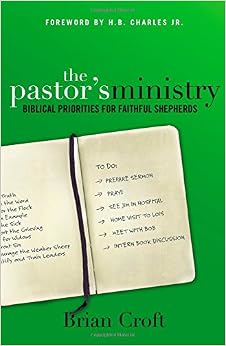
 Brian Croft has proven himself to be a shepherd of shepherds. I can attest to this personally as I’ve benefited from the Practical Shepherding website and seminars, and even phone conversations with him and my elder team. The book The Pastor’s Ministry is like a roundtable discussion with Croft as he instructs on 10 priorities of a pastor. This is a much needed book for us “younger” reformed guys who may know theology like the back of our hand but could definitely benefit from deepening our wells in the practical side of pastoral care. Although I think every pastor should read the classic, The Christian Ministry by Charles Bridges, it’s not necessarily a book I would hand a busy pastor to help him get back to the basics of shepherding. Croft’s book, on the other hand, can be read in a few hours and bring immediate reform.
He breaks the book into 3 parts:
Foundation
1. Guard the Truth
2. Preach the Word
3. Pray for the Flock
Focus
4. Set an Example
5. Visit the Sick
6. Comfort the Grieving
7. Care for Widows
Faithfulness
8. Confront Sin
9. Encourage the Weaker Sheep
10. Identify and Train Leaders
As a pastor I’m always trying to keep my job description at the front of my mind. What do I need to prioritize? What do I need to do? This is what Croft is after,
My hope is that the power of God’s word expounded in these pages will invigorate every pastor to see what God desires for his life and ministry and to better discern what he can do that will please the Chief Shepherd (pg. 18)
Oftentimes you will read books on ministry for the “how to” aspect, but The Pastor’s Ministry is a theologically dense, gospel rich and devotional work. You’ll find biblical, systematic, historical, and pastoral theology interwoven in these pages. It is an edifying read.
At the same time, the book is immensely practical. Croft details personal experiences that some young pastors don’t have experience with until they are blind-sided by them. In particular, he writes about visiting a member in the hospital who’s about to die, funeral preparations, dealing with a divisive man, what questions to ask when you’re sitting in a widow’s living room, how to comfort the grieving, how to encourage the weaker sheep who seem to have besetting sins.
The chapter, Set an Example, has a subsection on spending time with your people. It’s one thing to live out the Christian life but in order to actually serve as “an example” people have to be around you. They have to see you. This means the pastor can’t be in his study 40 hours a week. He must disciple, visit, and fellowship with the rest of the church. This no doubt adds to the challenge of finding adequate time for study but it is essential if we want to be faithful shepherds. The chapter, Preach the Word, will doubtlessly put wind in the sails of any expositor who week after week wrings out the text while trusting in the power of God for fruit.
The book ends with the priority to raise up the next generation of leaders within the church. He helpfully starts with the “how to” of identifying potential leaders. As pastors we want to get on with the training process, but he says it’s just as important to spend time in the identification of potential leaders and lists 3 qualifications:
1. One who is transformed by the Gospel.
2. One who earnestly desires the work
3. One who possesses Biblical character.
It’s easy to get excited when you get guys who want further training, but Croft highlights the value of evaluation on the front end. This is obvious in a scenario where expectations are high and resources are limited. The next process is to Test, Train, Affirm, and Send. While affirming the importance of seminary he does not negate the local church’s role in identifying and training leaders.
There is nothing earth shattering in these pages, but that’s not what Croft is going for. He wants an easily digestible read that reminds pastors to not lose sight of the biblical mandate we have to shepherd the flock among us. With a consumer mindset dominating many in fad-driven churches it’s easy for pastors to be drawn after the shiny wrappers of what is “in” or what is supposed to work. The Pastor’s Ministry is a helpful guide that, if applied well, will certainly encourage and disciple a new generation of godly pastors.