Jesus’s call to take up our cross has implications for the entirety of our lives, including how we read our Bibles. Building on this conviction, Q & A 157 of the Westminster Larger Catechism counsels us to read Scripture with “self-denial.”
Unfortunately, this counsel is often ignored in evangelical Bible reading, preaching, and teaching today.
Instead, many forms of “gospel-centered” biblical interpretation tend to culminate in a kind of baptized “Rogerian self-regard,” as David Powlison puts it. The self is essentially told, Don’t worry; Jesus has got you covered. To which the self responds, Whew! I feel so much better.
In such contexts, the cross of Christ is proclaimed, but taking up our cross is neglected. We are called to faith, but not to repentance.
Not a Zero-Sum Game
Given our fallen nature’s inclinations, it’s easy to ignore the counsel to read with self-denial. The fallen self is curved in on itself, preoccupied with itself, and committed at all costs to preserving and promoting itself. The fallen self therefore will not—indeed cannot—contemplate its own denial.
We also ignore this counsel because we misunderstand it. The fallen self assumes a “zero-sum game” when it comes to God, self, and neighbor: either God and neighbor must orbit around me or I must lose. To deny yourself, on such an understanding, is to obliterate yourself.
Otherwise-helpful Bible preachers and teachers often unwittingly operate on the basis of this misunderstanding when calling us from a self-centered approach to Scripture to a God-centered approach. Reading with self-denial, however, isn’t simply about moving from self-centeredness to God-centeredness. Reading with self-denial is about reorienting the self, not just replacing the self. It’s about the self’s death and resurrection and a new, non-competitive perspective on God, self, and neighbor—a perspective that refuses to play the fallen self’s zero-sum game.
Raising the God-Centered Self
It’s vital that we come to see God not only as the supreme good and center of all things, but also as maker, redeemer, and perfecter of our self in relation to our neighbor. God does not envy the self; he does not view it as his natural competitor. God loves the self. God created it and, when the self exalted itself against God to its own destruction, God gave his beloved Son for it. Moreover, God raised the self, in and with his crucified Son, that it might live a life devoted to his glory and our neighbor’s good.
So while the fallen self assumes that God’s supremacy must entail its own annihilation, the self killed and made alive by the gospel does not. Within the world created, redeemed, and yet to be consummated by God, the self truly finds itself as a child of God, as a sibling of Jesus Christ, and as a member of the household of God.
So a mature Christian reads the Bible with a view, not to the death of the self per se, but with a view to the death of the self-centered self and the resurrection of the God-centered self. This is where the self’s true meaning, fulfillment, and flourishing are found: in rightly ordered relations to God and neighbor.
Thus understood, reading your Bible with self-denial is at once the most God-honoring and humane kind of reading you can pursue.
Author’s note: For further reading, see Augustine’s On Christian Teaching.
Free eBook by Tim Keller: ‘The Freedom of Self-Forgetfulness’
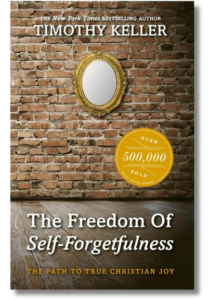 Imagine a life where you don’t feel inadequate, easily offended, desperate to prove yourself, or endlessly preoccupied with how you look to others. Imagine relishing, not resenting, the success of others. Living this way isn’t far-fetched. It’s actually guaranteed to believers, as they learn to receive God’s approval, rather than striving to earn it.
In Tim Keller’s short ebook, The Freedom of Self-Forgetfulness: The Path To True Christian Joy, he explains how to overcome the toxic tendencies of our age一not by diluting biblical truth or denying our differences一but by rooting our identity in Christ.
TGC is offering this Keller resource for free, so you can discover the “blessed rest” that only self-forgetfulness brings.