I doubt many readers will walk away from this book with the flippant thought, Well, wasn’t that nice? You cannot ascribe a mild platitude like “nice” to a message like the one in To Live Is Christ, To Die Is Gain. In fact, many readers will thank God for the bucket of ice water that just got splashed onto their sleepy souls, as was my experience in reading this book.
Written from the perspective of a pastor who loves the Lord Jesus and his church, To Live Is Christ, To Die Is Gain reflects the heartfelt, pastoral concern the apostle Paul had for the church at Philippi. It’s essentially a walk through Paul’s letter to the Philippians, but it’s not just a guided tour. Chandler, lead pastor of The Village Church in Dallas, Texas, states his goal for this book in the introduction: “God wants us to grow from being infants in Christ to being mature in Christ. That’s what this book is about. How are we to mature, and how can we spot any ‘developmental delays’?”
When you think of Philippians, the mind swirls with the vastness of what it covers: costly partnership in the gospel, suffering for the gospel, self-denying humility, having the mind of Christ, working out our salvation with fear and trembling, pressing on into maturity, having omni-circumstantial joy, and learning contentment no matter what. Chandler doesn’t just skim the surface of these eternally significant subjects; he gives you diving equipment so you can swim through the deeps. For the reader unfamiliar with the letter to the Philippians or the context of the Philippian church, Chandler provides ample background information. He shows how we can relate to the church members at Philippi in their struggles by tethering our modern experiences to biblical principles. These literary elements dissuade the reader from disengaging and presuming, “This letter was written to somebody else.”
Where Is This Relationship Going?
Books about Christian maturity tend to fall into one of two categories: the litmus test of what such a life ought to look like or the practical application of how you grow in maturity. Chandler graciously and candidly addresses both kinds of questions. But he also understands he must answer the critical “who” question. That’s why page after page of this book is driven by testimony to the greatness of God. Chandler talks about the explicit goal of Christian maturity: “Clearly, Paul has a lot to teach us about life—by which I mean he has a lot to teach us about Jesus.” In other words, to live is Christ, and to die is gain.
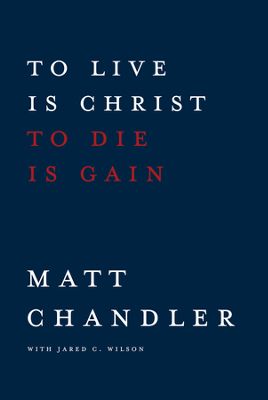
To Live Is Christ, To Die Is Gain
Matt Chandler with Jared C. Wilson
Perhaps at some point you’ve found yourself in an undefined relationship. You’re not sure where it’s headed. We may sometimes wonder the same thing about our relationship with God—where is it going? I’m going to heaven when I die, but how does that help me now? This book offers the direction many of us feel we’re missing. Christians who desire to mature in their faith must apply their lives to the cross of Jesus. “The gospel creates a new reality that deepens our understanding of the world and our place in it,” Chandler writes. “This is where Paul is going in the book of Philippians.” Readers will have little trouble seeing these connections Chandler makes between our daily lives and the reality of life in Christ as described in Philippians. I particularly appreciated how the role of Christian community wasn’t assumed, but was intentionally spelled out.
Not a ‘Bricks’ Book
Sometimes, talk about striving after holiness and spiritual maturity can leave people feeling weighed down for various reasons. But Chandler’s book isn’t about crushing your soul under a pile of bricks. You will be exhorted to take up your cross, which can only be borne by grace. Readers will appreciate the vivid illustrations and both mundane and extraordinary examples of people like you and me living out this cruciform life. The realities of pain, fear, and trepidation about pursuing more of Christ are acknowledged with empathy, and they’re met with more grace because we have an Advocate in heaven: “Face these questions with courage, and press on. Jesus loves you.”
The consequences of readers taking this book seriously are weighty in a different way. If the grace of life is replete with treasuring Christ, then we have a joyful duty to live as unto the Lord with all our might. When we seek joy and contentment anywhere outside of Christ we do so to our own disappointment and destruction, and even to the detriment of others around us. Likewise, in this spiritual economy believers gain Christ through death. We have a hope-filled eternity to look forward to and a gospel of immeasurable value to share with others.
Could there be more important subject matter for us to consider than that which engages our hearts and minds in the “already/not yet” reality of life in Christ? The driving tone of this discussion on Christian maturity isn’t “you can have your holiest life now,” but rather whispers, shouts, and echoes of grace to press us toward inaugurated eternal joy.
I wonder how many of us will be serious about the fact that there will be a day in which the glory of Christ will shine in its fullness and we will be held to account. And on that day we want to be raised with him. On that day, we will want our contentment in him to explode in the infinite joy of heaven.
May it be so. And would God give grace to all who read this book to live in the reality of the life-altering good news of Jesus.