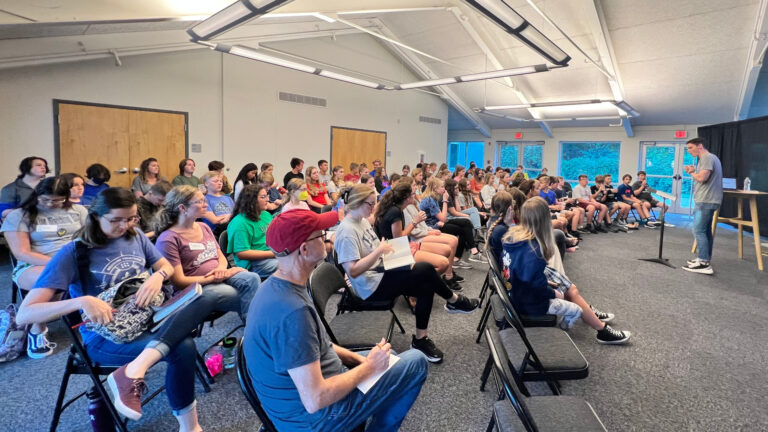



In this thoughtful conversation recorded at TGC25, Matt Boswell, Ligon Duncan, Keith Getty, and Sandy Willson discuss the liturgical practices that have formed American evangelical worship. They talk about the influence of contemporary music and the need for biblically directed worship.
Listen to hear what encourages the panelists about the growth of the global church, as well as what liturgical practices they’d like to see reformed.
In This Episode
00:00 – Introduction and opening prayer
02:26 – Importance of music and liturgy in the church
06:53 – Encouragements and concerns in the American evangelical church
16:06 – The role of the pastor in liturgy and worship
23:07 – Practical tips for effective worship
46:05 – Keys to framing a worshipful liturgy
52:06 – Closing remarks and prayer
Resource Mentioned: The Sing! Hymnal
SIGN UP for one of our newsletters to stay informed about TGC’s latest resources.
Help The Gospel Coalition renew and unify the contemporary church in the ancient gospel: Give today.
Don’t miss an episode of The Gospel Coalition Podcast:
Transcript
The following is an uncorrected transcript generated by a transcription service. Before quoting in print, please check the corresponding audio for accuracy.
Sandy Willson
Well, let’s go ahead and begin the formal part of the panel. Maybe we can have a chance for questions at the end. I don’t know. We have a limited time. Just 45 minutes. I’d like to open with prayer. I’ll introduce who we’ve got here with us, and then I’ve got a few questions for them. Let’s pray together, Father, we do. Thank you for the music that you’ve given our souls because of the revelation of your being and your works, Father, Son and Holy Spirit, as we think in this time together in this room, about the music of your church, the worship of your church, the ways in which we express the praise of your glorious grace. Please give us wisdom in this conversation, that all of us may be an encouragement, one to the other, that our worship may please you in every aspect. So we pray all of this in the blessed name of Jesus, Christ, the head of the church. Amen. Well, let me introduce you know Keith Getty, he and Kristen have been singing and leading us in singing through their hymn writing for years and years, Keith, we’re just so grateful for your ministry and their generosity to continue to give their gifts to so many, Keith, last time I was in your house, you had about 20 musicians in there at Your invitation. You were all just creating together, fellowshipping together and really enjoying a community of worship leaders, and it’s great to have you on this panel. Matt Boswell, who planted the trails church in Saline, Texas some years ago, who is also a prolific hymn and songwriter, wonderful preacher and pastor, more recently named the professor of worship ministry at Midwestern Baptist Theological Seminary. So I know several of you are very happy about that. And I want to thank Keith for providing the third song of Easter Sunday at our church, the power of the cross, and I want to thank Matt for providing the second song that we sang at my church, wondrous mystery. What’s the Yeah, come behold the wondrous mystery. And Charles Wesley’s not here, so I can’t thank him for all all hell. Christ, the Lord, is risen today, but the three of you did a great job for us on Sunday, and Ligon, we didn’t sing one of your songs on Sunday. Sorry about that. Ligand. Duncan is chancellor of Reformed Theological Seminary with its multiple campuses. He’s also professor of systematic and historical theology. He serves on our board and has written a bit, and taught a lot about worship. So lick. Let’s start with you. Tell us why this subject of music and liturgy in the church is important for us to discuss.
Ligon Duncan
Let me specify the question a little bit more. Why is it important that we talk about what we do together on the Lord’s Day week after week. Why is it important that we talk about what the congregation does when it gathers to give God praise on the Lord’s day, and then why is the music that supports the congregation singing of that praise to God important? Why is the structure of what we do in that public gathering important. It’s important for at least four reasons. Number one, it’s important because God is the most important thing in the world, and what we’re coming to do is to publicly confess that God, you are more important than anything, and we need you more than anything. So it’s really important that we think about what we do if God’s the most important thing in the world. So, and I know that’s Matt and Keith’s heart. This is why it matters what we sing. It matters what we what we read, what we say, how we do it, because God is the most important thing in the world. The second thing is, and John Piper actually beautifully pointed to this in the exposition that we just heard. We were created for the praise of God’s glory. So our purpose in existence is to give to God the glory due His name. And that means we really need to think about how we do we want to do that biblically, especially when we get together on the Lord’s Day. So it really matters, because we were created for the praise of God, God’s glory. Paul says that three times in Ephesians, one. So it must be really, really important that we were to the praise of his glory. And so it’s important for that reason. It’s also important because what we do together, congregationally on the Lord’s Day in public worship, will determine who the God is, who we worship. If we do not worship him according to his Word, we. Will maybe not worship Him at all. We may worship a figment of our own imaginations that you know. You ever wondered? How do you worship a spirit? You know, we know. We know that God is a Spirit infinite, eternal and unchangeable in his being, wisdom, power, holiness, justice, goodness and truth. Well, how do you worship a spirit? Westminster, Kenneth, kiss. There you go, number seven, and the Bible’s answer to that question is, however God tells you to. I mean, you only know how to worship a spirit if the Spirit tells you how to do it, and he tells us in His Word. So when one of the issues that the Old Testament prophets deal with all the time is the people are worshiping God according to their own imaginations, not according to the Word, and that’s what the Bible calls idolatry. So we don’t want to come to church on Sunday and do idolatry. We want to worship the one true and living God. In the fourth and final reason that I’ll mention, that there are lot more in Matt and Keith can add to this, but here’s the fourth one, what you do in public worship, gathered together as a congregation, disciples your people in theology. It Keith will say this today. I’m sure Matt will say it as well. If, if, if what you preach is different from how you worship, your people will believe how you worship, not what you preach. Those things better go together. Those things, those things ought to be of the same cloth, because your worship teaches your people theology. And so if we care about discipling our people, we will really care about what we sing, about the music that we use to support the people singing about the order of the service. We’ll care about all those things because we really want the gospel to be in everything that we do, including our public worship.
Sandy Willson
Very well. Said, Thanks, Luke. I’d like for all three of you to answer two questions. One is, I really want you to eventually give us your concerns as you travel the church, the American Evangelical Church, and some of the concerns you have about worship practices that you’ve noticed. But first of all, I’d like for you to make that same survey tell us what you see in the American Evangelical Church that actually encourages you with regard to worship in anywhere you wish to go, whoever’s Ready. Fire away. Everybody’s looking at you, Matt,
Matt Boswell
I am encouraged by particularly young people seeing a deep hunger for expositional preaching, for a recovery of ecclesiology. Honestly, this room is testament to this, this wonderful move of God we’ve seen over the last 20 years, 25 years, of this recovery of the historic gospel and the historic church. And so I’m encouraged by all of those things. I’m encouraged by what I see happening in children and children being discipled and growing up in families. Ligon said it, well, we our lives and our liturgies must be shaped by the word of God, and there’s got to be congruency in that. But I am, I’m certainly encouraged.
Sandy Willson
Thanks. Matt Keith,
Keith Getty
I’ve said encouraged two or three things, as stewards of the hymns and working with this team of wonderful hymn writers as well. You know, we get to travel the world and work with people around the world each each year and to see the speed of growth of the global church, to see that the Bible is in more languages than ever does before, to see that there are increasingly great songs in more languages than ever did before, and that communication, whether it be digital communication or just travel generally, and technology generally, allows us this opportunity to be global Christians. Each one of us in this room and our families have a chance, our churches have a chance to be global Christians in a way previous generations dreamed of, and so it’s an exciting time to be alive. I wouldn’t have wanted to have lived in a previous generation, despite what many of my Presbyterian or choral friends tell me, I should have been born 50 years earlier. I really wish. I really have no desire to have been born 50 years earlier. This is the most exciting age to live in. That’s the first and secondly, you know, every day the encouragement is every day, God’s faithfulness in our lives, isn’t it, the blessings that we see every day. And then, in moving it to the Western Church, I am I am British. I’m Northern Irish, which means I’m Irish and British and European. So I don’t wish to speak. I don’t wish to speak in any way and pass remarkably, towards the American church. So I’ll just speak to the Western Church, because the Western Church, largely, is the one that has seen the least growth on the planet right now. But to see the faithfulness of. See the faithfulness of of believers. You know, is a wonderful thing. We did a concert. One of the most beautiful stories is we did a concert recently in Belfast, and a man after the concert said, Thank you. Thank you for your songs. We have used them to teach theology to a tribe in the island. We mission our missionaries on in Indonesia. So there, and they have a unique dialect there, and they translated the songs and created the six out of out of six of our songs. And I said, Well, I said, How did you, how did you come? How did you discover the songs? And he says, weren’t you born in Plum Park Road? And I said, Yeah, Plum Park Road, Lisbon. He goes, I delivered your coal. So, so he was a coal man who delivered my coal every day for a decade, raising money that one day he could have the privilege of being a missionary, and then he went and did that. And so the faithfulness we see in people every day, in in an old lady in our church who just told me she was praying for us last week, these are, these are the things that we live with every day and feed our souls. So never underestimate, never underestimate, the power of ordinary testimony, ordinary encouragement. And then probably the third thing that comes to mind is the inevitable reckoning of unbalance, you know, the last 50 years, the last 50 years the the Alliance or the the unholy clash between between contemporary Christian music and the church has, has rigged, has while, while it is, I think it’s been really it has been strategic, both evangelistically and in youth movements. It has, as a whole, created, created a chaos that I think we’re now beginning to see a turn on. And, you know, for example, the number one influence on modern what we call, broadly, evangelical churches, and what they sing is called Christian radio, which is not, it’s almost, it’s almost majority Wall Street owned, for a start, but it is basically, it is a business. It is a it is an almost billion dollar business that is built on selling to two women who have names Becky and I think Sarah was called, and one is, one is a lady in her 20s who’s raising kids, and one is a lady going through menopause in her 50s, who represent 75% of your audience. And they basically have built a business trying to, in two minutes, 54 seconds, encourage those two women, and that is what is now deciding the liturgical structure of your church, the songs you will sing into your old age, the way you will ultimately articulate your faith. Articulate your faith. Now we go back to Deuteronomy, these songs, you know that to teach it to their children, less they depart lest the truth departs from you. It’s very clear that, from the very beginning of the Bible, the songs we sing were in significant part instructional. So if you are a pastor and if you’re a worship leader, if you’re an elder, if you are a parent or a grandparent, here you have a holy responsibility that the songs you are singing and leading and planting that people will grow with throughout their life are deep and rich, and anyone who kind of does the Judas Iscariot and washes their hands of what is being sung, to their family, to their churches, to their youth group, is in grave danger of creating A generation of people who either in significant part deconstruct or in the thinking leader group will move towards Catholicism or something else, just for the in desperation to find some kind of liturgical and systematic framework. So we begin to see this. Been able to be with all these guys this week and stage and Laura here and so many others and see what they’re writing. You know, it hasn’t been the biggest quarter of a century for many areas of Christian growth, but to see the growth in what is being sung in churches has been really encouraging.
Sandy Willson
So thanks. Keith LIG, why don’t you take take what you see that’s encouraging, yeah, then go ahead and tell us what concerns you, and we’ll come right back down the line.
Ligon Duncan
I agree with everything that Matt and Keith said, maybe to give an angle on that, and I think the people here at TGC represent only a part of evangelicalism, I would say we represent a part of evangelicalism that’s more concerned about expositional preaching, more concerned about theology, more concerned about how we do church life together, less pragmatic than some parts of evangelicalism, and I do see this in This space in evangelicalism, more and more congregations that come to public worship realizing they are not the audience of public worship. They’re the worshipers. God’s the audience, so and that means that everything that Matt and Keith do is not for us, and so it is. It’s just. Built. It’s to help. It’s to help us give God praise. So God’s the audience. They’re helping us give God praise together. And I do think I see it’s maybe, maybe it’s only the size of a man’s hand, but it’s coming, and that’s a change, because I grew up when the seeker sensitive movement, and when, you know, when the kind of Christian contemporary stuff that was being done in the 70s, you know, the new stuff that is being written by these folks today is so much better than the stuff that was being written in the 70s when I was a teenager. So it’s not only that, it’s that there’s a conception that we’re here actually to give praise to the audience, who is God, and so that’s encouraging me. I still think we probably don’t have enough scripture reading, and we probably don’t have enough prayer in public worship. Is in public worship in our evangelical space, prayer got almost completely squeezed out during the seeker sensitive movement, because the idea was unbelievers don’t understand prayer. It’s going to make them uncomfortable,
Sandy Willson
just a time for transitions come back,
Ligon Duncan
yeah, or onto the stage. And so I think taking prayer and the and the various biblically prescribed subjects of prayer, and making sure that that substantial and biblical in the worship service is one way we will move forward in our time.
Matt Boswell
Well, can I just piggyback on that? Because that was a passing comment, but very significant, prayer has been diminished in many churches to being just that it’s a time where every eye closes so the band can magically disappear. Who knows where they go, and then at the end of the sermon, poof, they’re back there. And we have so much to pray about. Our dependence on the Lord in prayer is or our lack of dependence is shown by our prayerlessness, including in our service. The reason our lives are Prayerless is because our services are Prayerless. We’re not teaching people how to pray. So think about even the prayer movement of a service, even in the in the call to worship, responding with a prayer of adoration for who God is. A prayer of confession of sin, for how we’ve broken God’s law and commands. Prayer of thanksgiving for what the Lord has done in our lives. Prayer of illumination, asking the Lord in the in the public preaching of His Word, by His grace, to speak to us. A prayer of consecration at the end of the Serb at sermon, asking the Lord the things we’ve heard press them in our lives, bear fruit in our lives. For your glory, even the benediction, the glorious prayer, sending the people of God back into the world. Prayer should mark our services, and I think too often it doesn’t. I said I was encouraged. Now I sound discouraged. But here’s another thing is, is perhaps, I think many evangelicals, we, we on paper, believe in the sufficiency of Scripture, but in our gatherings, don’t act like it. This is where our pull to pragmatism, and all kinds of things really shows its itself as well. I think prayer and our actual belief in the sufficiency of scripture for the word to do the work, to believe that. So if you’re in a church where you don’t see much fruit, you may be tempted to not believe that the word does the work, but it does just be faithful, be patient, and in the Lord’s time, His Word will do the work. And so I do think we need to be a great recovery. We need a reformation of worship, and it begins with a reformation of our lives being built on the Word of God.
Sandy Willson
I couldn’t agree with you more. Let’s go back about 140 years you’ve done a lot of study, Matt, on Charles Spurgeon. What age were you 140 years ago? Yeah, I was about 10. Yeah. Let’s go back, Matt, you’ve done a lot of study on Charles Spurgeon and the kind of worship services that he led in the 19th I mean, some of us are Presbyterians, maybe we tend to be a little bit more liturgical than our Baptist and non to Dom friends. But what did you learn about Spurgeon?
Matt Boswell
Well, you just said liturgical. And so with that word, he would say, Where in Scripture meet we, with the bare idea of a liturgy, shall we go down to Egypt when the God of Israel is at our side?
Keith Getty
So he, when he then, he proceeded to do what was quite a liturgical service. That just left out a couple of Antifa. Responses so
Matt Boswell
he wouldn’t like that word, but certainly had a liturgy. I think what I learned from Spurgeon is, as a pastor, how to pastor through the entire gathering that from the call to worship to the benediction that falls under the scope of the pastor’s ministry. And so I studied him, both to learn myself, but then to look many of my brothers who Shepherd local churches, and to say, this really matters. This is really significant. The word worship leader isn’t the best phrase, but as a pastor, you are responsible for the worship of your church, and when you gather to exercise pastoral care and and diligence over everything that happens, over every prayer that’s prayed, every song that’s Sung, everything that happens according to Scripture,
Sandy Willson
Keith learned from Spurgeon from personal conversations.
Sandy Willson
I happen to know Keith from private conversations with you that you you agree with Matt and what he just said about a pastor’s role in liturgy, let me ask you, why you think that so many pastors have seemed to have abdicated their role of chief liturgist, if you will, Chief worship leader in the church. What’s going on?
Keith Getty
Gosh, well, again as a as a Presbyterian, I again genuflect the saying three things. The first one is, I think what Matt said was brilliant. That’s that was that was worth coming to gospel coalition just to hear what boss said there, and and and pastors, pastoring their church by how they put together their Sunday services is so important. Of course, it can’t be in conflict with how you live your life and treat your kids and how you behave when you’re, you know, playing golf and watching football and stuff, but, but and and deal with your staff, you know, it can’t be in conflict with that, but, but that’s brilliant. I think that’s, that’s that is, that is gold. You know, again, I’m the only person on the stage who’s not a, you know Pastor. I’m the only non professional Christian here and the only one with no theology degree. So I So forgive my inferiority complex, but I don’t, I don’t want to say I mind. It’s not mine to prescribe. Just prescribe. Why? Why pastors haven’t done it? We begin now. This is we only have what’s ahead of us in life. Us in life now. So I think you know, at the broadest possible level, at the broadest possible level, the confusion in song, worship and putting together churches, church services has been so great in the church for the last few decades, it is understandable why a lot of pastors have gone okay, I’m going to preach my best possible sermon. I’m going to try and make sure my church is cared for, and I’m going to try and make sure the service isn’t too bad apart from that, and it’s usually done by the operational processes usually be one of what’s called minimalization, where you minimize the amount of songs, you minimize the number of prayers, just so that the rest of it is little messed up as possible, I sure will. Thank you. I wish my kids said that so, so, so I think the general there was one of your kids. But, you know, I think with with every we’ve only got from today on, so there’s no point everybody sitting over coffee afterwards, either making excuses for themselves or feeling bad. I think the issue is, how do we? How do we, you know? Let the word you know grow so. So, just to take the two obvious example, two obvious things you could take away from today. You know, speaking as as the non theologian, just observing the theologians is, number one, you know that you don’t have to sing all classic songs all the time that have four verses that go through the redemption story. We don’t have to do that, but, but you do want a canon of songs like the psalms that your congregation can grow old with. So the question of what are the 50 hymns and psalms that you want your congregation to be singing on their dad a bit well, start tomorrow. Start today over lunch. Start on your way home tomorrow, when you’ve dead time on your flight and in the airports, instead of drinking the awful coffee, just just sit down and go, Okay, let’s start making this list. And let’s go, what are the 50 we want our children when they leave our house at 18? My first one’s leaving in four years, and I can barely believe it. I remember the first gospel coalition we came to. She was six weeks old. She was six weeks old, and at night she’d gone in four years. What? What are the great hymns of it? I want her singing to herself in her dark moments of the soul. Yeah. Our churches. So begin and then begin to gradually bring those songs in and as as with fathers, similarly with pastors in the church, if you’re enthusiastic about it, if you explain why it’s important, and you lead with passion, your people will follow you at whatever speed they will. So that’s one thing, I think, secondly, again, that the comment these two gentlemen to my right made about public prayer is so important. You know, it’s interesting. Dr Martin Lloyd Jones, who was at my side of the Atlantic, usually had guest speakers a number of times in his church’s year, and in almost every case, he still insisted in doing the prayers. Because even though to be speaking in Martin Lloyd Jones’s pulpit was a privilege. He knew. The way he prayed about the Lord, the way he prayed for his congregation’s needs, the way he responded to the sermon and how we will live this week had more influence on how his congregation would live in the next week. I think those things, those are two very practical things and and I think in terms of singing, you know, the church we go to, and some of the staff are here in this reading, they will tell you that, over the years, they have, they have focused on a small number of songs and built a congregationally singing church, and it is just at every Sunday they said earlier about this, they reflected in this, but Chris and I said a couple of weeks ago, every Sunday is the highlight of our week going to church. We don’t go to the biggest church in town or the biggest budget church in time, but our church, every Sunday that they put they put together a beautiful service with thoughtful prayers, where the singing is just epic, and we study God’s Word, and I’d say it is, it is the highlight of our weekend. So I don’t think dependent. I don’t think your church has to have extraordinary talent, and we’re thankful for extraordinary talent, but it doesn’t have to have that. And so I think those things are first. Let me just say, I don’t know how I’m saying all this now, but you know, honestly, right now, that the biggest weakness I have noticed in in confessional churches, in their singing, is this need to constantly do our own songs. And I’m a songwriter, I’m a song publisher, so I believe in doing songs that work. But I mean, I, I probably, I was taught by a guy called Stuart town, and who for eight years. I visited him once a month for eight years, so almost 100 visits I had to pay for most of them as well. It depends an easy jet, an easy jet flight to London to go see him, and we finished. We finished 24 songs in eight years. So I never, I never finished more than three songs a year. So I never did, gentlemen. I probably wrote 500 to 1000 a year, certainly melodies. And I never finished more than three a year. And so you know, if your church are doing more than six new songs a year, three to six more times a year, that’s that is exhausting your congregation. They’re not enjoying singing. They are not singing well.
Sandy Willson
Well, in this list be
Keith Getty
just a little tip, just just, just, just, just, if we’re trying to make Sunday a rich celebration that can absolutely deflate a congregations, because singing, singing is a physical exercise. So it’s based on repetition. It’s based on and on connection. And we’re singing to one another. So if we can’t sing, then there’s a, there’s a there’s a communal
Sandy Willson
blessing that’s lost as well. And to add to what you’re saying, I am not John Piper as a preacher, and some music leaders are not Keith Gettys. And unfortunately, I think so many music leaders in local churches think that they’re not doing their job if they don’t produce their own compositions for their congregations, and that’s a big mistake, because there’s a lot good out there, and to pick up on what you were saying, Keith, Keith, to have 50 hymns that I know by memory that I can sing without my eyeballs and without my ears when I’m Nine years old in my on my bed. That’s worth a lot. Give me the 50 best ones. Man, I think when you planted your church, your first song was holy, holy, holy. I read that somewhere. That was a good start, wasn’t it? LIG you, you’ve said before that your concern is that the church often likes to watch and and hear songs they don’t like to sing them. What is the solution to this problem? And I’d like for you two guys to address that too. How do we re engage the church and actually sing the songs without the help of a PA system projecting four fine, trained voices that makes everybody feel like they’re singing, but they’re not. How do we get congregations to sing again?
Ligon Duncan
Well, again, part of that is, is recognizing that we’re not the audience, that we’re the worshipers, and we’ve had my generation did this, so it’s my generation’s fault where I’m a late. Boomer and the boomers decided the way to attract people to church was to do music that you liked, and so that it definitely conveyed them the idea that our job up here is to make you happy, and that makes you a consumer, and in the way you participate is actually not by singing, but by listening. I’ve been struck by how many mega churches I go to, and four rows back from the front, no one in the room is singing. Everybody has their hands in their pockets and they’re watching and they’re listening. Now the people on the front rows have their hands up. They’re singing loud. They’re moving bodily with the with the band on the stage, but the people in the back are just watching it happen. And so whatever has happened in that culture, we’ve conveyed that music is what you watch and listen and and what, what we need to say is, no, no, that’s there to help you do what you’re supposed to be doing. And this, but interest this hit me as a Presbyterian when I was in Scotland, one of the places that I would worship was a congregation where they only sang psalms and used no musical instruments. That’s a venerable tradition. That’s not the tradition I grew up in, and it’s not the tradition that I’m in now, nor do I commend that. But I learned a lot in that setting. And one of the things I learned is, if any worshiping is going to get done today, I’m going to have to do it, because nobody is up there doing it for me, right? So that was a good and I grew up. I’m the son of a choir director, so I had no choice but from the time of two to sing and to be in the children’s choirs and to be in the adult choir, and that was a part of life. And I loved hearing the piano or the organ, the other instruments that were that were paid, but in that context where there is no instrumentation, I realized, Okay, I’m going to have to do this myself. I’m going to have to be the one making music to the Lord, I’m going to have to be the one singing. And we need to cultivate that attitude using the music that we provide to the congregation. We’re just here to help you do your job, which is to give to God the glory do his praise. So I do think we have a passive sort of attitude and a lot of evangelicalism to worship. I’m going to listen actively when the pastor preaches, but during the time of singing, I’m going to sit back and enjoy what I like, when, in fact, these guys, I mean, they don’t want you to hate it, but they’re there to help you give something to God, and they want to do that as Well as they can, and that means singable tunes, memorable biblical lyrics, things that you can sing on your deathbed or when your child is in the hospital, or when there’s been a terrible situation in your life, but they’re there to help you. They’re not replacing you, and they’re not there just to please you. They’re there to help you give to God glory and praise.
Matt Boswell
Well, let me just if I were to look back just almost seven years ago to when we were planting a new church, you’ve got a lot of decisions in the early days of a church to set the culture Lord willing for a long time, and so some of the things we did was just start with the question was, how do we get the church singing more? And so we started with, like Keith said, a small group of songs that were great, songs that we could sing. Well, from the five year old girl to our oldest church member is my grandmother. She is 89 and so I want a five year old girl and my grandmother both able to sing the songs that we sing second many evangelical Bible preaching churches. Still, you walk in and the lights are very, very low, and the only thing lit is what’s happening on the stage. So even the esthetics of that speak the wrong message we’re saying. What happens up there should be under the lights, and so we’re just very practical ways just to lift the house lights in our worship spaces that will help us recognize well, even practicing. Ephesians, 519, Colossians, three, we’re singing to one another when the lights are so low, you’re just singing into the abyss. And so turning the and this is uncomfortable. I realize what I’m saying right now. This is incredibly shocking, actually. And then also turn the volume down a bit. It’s like, Thank you, ma’am. But you just so if you turn the lights, the lights up and the volume down, it’ll help your churches sing better, because they’ll recognize how much we want good instruments. We want a great we want great musicians helping lead our churches in song, but they’re there to help facilitate the congregation in singing as if you. Just turn the volume down a bit, then the church can hear themselves, and then they begin to recognize how much they enjoy hearing themselves. It’s incredibly life giving. You’re meant to do this together. And so the more the church can sing, the another thing would just be singing. This is very practical, but just singing in keys that normal people can sing in. This is very important. It’s just very important. And then I’ll transition to Keith, because he would add that if you want a singing church that begins with a singing pastor,
Sandy Willson
Matt, would you consider being a professor of Ministry of worship somewhere? I think you’re going to do a really good job at Midwestern seminary. Keith, give us your thoughts on that question. What was the question?
Matt Boswell
Well, it was, it was, how do we make help our churches sing better? And you always talk about the importance of of the pastor.
Sandy Willson
I want to know what you Keith, what were you thinking about while the rest of us, we’re talking,
Keith Getty
you know, I actually don’t know what I was thinking about.
Sandy Willson
Yes, the empty box. Men have a box. Yeah, I turn and when they say they’re thinking of nothing, it’s true. You’re thinking of, actually, nothing.
Keith Getty
I turned 50 in December, explains. And someone, someone said, what’s it? What’s it like turning 50? I said, I don’t know young, young people look younger. Stairs look taller, and I’ve forgotten what the third thing was, but, but, you know, yeah, I think, yeah, I think I kind of, I stole into their answers in the first question. So I don’t push it too far, but they I agree with, but yeah, it’s, you know, it’s, but it’s, it’s, you know, dads who don’t sing, is no good thing. So if a dad doesn’t sing, even money, their sons don’t sing, his sons don’t sing. Most of his kids are apathetic during worship. Do you know what I mean? So, so dads sing. But then that goes up a level. Pastors sing, if you’re a part, you know, people have got asked the question so many times as you’ve traveled around, what churches sing the best? And I want them to say, oh, churches that, you know, agree with me or sing my songs, and, of course, our artistically high standards, because I believe in those things so very much. But it’s not the truth. The truth is, it’s almost always the church is where the churches where the pastor has decided that singing is very important, and he’s inevitably in the front row or on the stage, singing is God out. And you know, if he’s charismatic, his hands go up higher. If he’s conservative, his fists go tighter, and it’s whatever it is, but, but he is singing, he is singing, and he believes in great songs. So the first message is for pastors and for dads. And if you want to extend that, pastors to dads, do not let dads away with it. That’s a great point. Do not let dads away with it. Pastors have the courage and have the integrity to make sure, to make sure that they understand that we are created to sing, that we are commanded to sing, the second most common command in all of Scripture, and that indeed, the beauty of Christ compels us to do nothing else but singing. There’s no greater my wife said. My wife passed me a thing from the ESV Study Bible this morning. See how I dropped in. ESV, yeah, I did. I noticed that elsewhere sponsoring the conference, and they weren’t just on it. Is there? I kind of power visit this morning. There is no greater gift than being able to commune with our Heavenly Father. You know. You know, however, and I’m a sports fanatic, but however well my sports teams do, and however much fun we have, you know, when you know, with hospitality or whatever else you know, the joy of singing to God’s people is the greatest thing. So senior pastors take the lead. Dads take the lead. Senior pastors make sure dads are taking
Sandy Willson
the lead. KEITH And Matt, let me ask you this question, what makes for a really good congregational hymn or song? What are the elements, well, that you look for?
Keith Getty
I was actually going to actually say, that Sandy, if I worked out how to do it, I promise you, I wouldn’t tell you, sure. I mean, if I, I wouldn’t be telling anybody. I would just be doing it. So, I mean, I like you all. You’re good people. You know, very fond of a lot of you. But no, I’ll be, I’ll be keeping it and just working it out myself. But no, I think, I think singing great songs, singing great songs, makes great congregational singing, you know. And so if, if you look at your service, and I’ve just on the way here, changed the order for tomorrow morning because one of the songs didn’t work, and it’s and it’s a tension, you know, I, you know, my pastor’s here in the room, and you know, if your pastor says, This is what we’re doing, this is what we’re doing. And I mean, John wouldn’t mind me saying, you know, John, and I don’t Piper, and I’ve been doing events together for 15 years. He’s spoken almost every year at the same conference, and we’ve had a week of going back and forwards and like closing him because he suggested to hims that he felt really fitted the past. Message. And of course, if John had insisted on it, I would have done it, but I had to very politely text him back. And it was particularly embarrassing because one of them I co wrote, you know, I think I see why you think this about these two songs, but I don’t think they have enough of a response that our emotions need for the end of your sermon, and we ended up going with the City of Light song. Yet not I, which, again, it might have been better to have something which had more of a praise and glorify thing about it, but I thought in the overall and the overall movement of the sermon, to do that was a better response to finish the sermon and would elucidate better singing.
Sandy Willson
But it wasn’t right. There a good example of how a liturgist and a musician work together.
Keith Getty
Yeah, yeah. And to be clear, if John would have said, I want to go for this, I would have said, Okay, John will go for it. But, but they just, they want to. Neither of them, honestly, a lot of it was compositional. Neither of them were just good enough that you guys would have relished singing that last song. And so in the end, we had to, you know, and we finally, last night, he texted me, I just parked at Bloomington in the way here. He texted me and says, I think we should go with your instinct in this. He says, there will be enough in that with the movement of what we’re doing that it would be a good finish. So, so, but so, yeah, I think, I think having a great relationship with your with your pastor or preacher is important, but just the power of a great song. Great songs, you know, great songs, have changed human history at every level, whether it be, whether it be a political history, whether it be, whether it be Christian history. And that’s the power they have. So I think being able to focus on songs that show us, show us God in a fresh way like no other song does, and are just irresistible to sing. We changed another one this morning. We did the third song this morning was was a slightly more up song. We had flipped it because we thought accomplish the guests probably need something, a real, real rocking song on the first set, and boss and our backstage and going. Now we want to, we want to do Christus Victor because it also fits the passage, but it just, it was just a better song, and the table couldn’t backwards. Now it works better. So you do it is a wrestle all the time. I think it’s, I find it very hard to get the right song for every set and to do it well and for services, but I think it’s a battle worth fighting. And if in doubt, if in doubt, go for the song that sings better. Do you know what I mean? Because great song, because it’s not, you know, again, I’m not trying to, I’m not trying to bad mouth movements that have happened but, but some of the movements happened in the last 50 years, became matchy. Matchy, where, if liggin was preaching on five loaves and two fishes, you had to have a song about bread. And it’s bread and a song about fish and a song about fishing or something, I guess. And it was just like, who cares? It’s just stupid. I mean, that’s not what it’s actually about anyway. Don’t be so dumb. Do you know what I mean? And so we’re actually want to sing songs about the greatness of God and the wonder that we get, that we of the good news of this, this incredible and most improbable gospel message that transforms every sinew of our being, you know.
Sandy Willson
So when you think about a great song, obviously sound theology, you know, in the lyrics, it needs to be singable by a congregation.
Keith Getty
I would not use either of those words, and I would not use either of those words,
Sandy Willson
okay, I think. And it needs to be well written. So now, what would you amend? Yeah, I
Keith Getty
think sound theology and Singapore is is too defensive. I think the theology, the theology, the theology, has to make you think. It has to. It has to so fill your mind and being with imagination and praise that it is overwhelming. Of course, it’s signed as well, but, but your friend you mentioned earlier, who contributed to your Sunday morning service became a Christian as an adult at Oxford University called charge Wesley, and he actually wrote a song about becoming a Christian, but he didn’t kind of create this kind of judicial kind of song that that was saying, you know, that just made theological statements. He said, long my imprisoned lay fast sin and nature’s night, thy night diffused a quickening Ray, I will pause the dungeon flame with light. My chains fell off. My heart was Ray arose before. The point is, he wasn’t a beautiful duet. He was never thinking it’ll be available on Spotify Friday morning. But the point is, he’s not trying to be sound. He’s trying to fill your mind with wonder. So that’s that, and that’s what the lyrics have to do. And if you’re a writer here as well, you know, we could send all these songs that are like kind of paraphrases of Romans one or something, and it’s just they’re horrible. Sure. I mean, Romans one is wonderful, but it still could be horrible to sing. Do you know what? I mean? It’s got to be beautiful and to sing and then, and then, I think the melodies have to be just irresistible. You have to be dying to sing them. A great song, a classic song, I guarantee you 90% of the classic songs and hymns you know, you will remember the first place you were when you heard them, even if it was 3040, years ago, because the great songs do that to you. They’re just they’re just in a different league. And that’s why most of the time I recommend on an ordinary run of the mill service. Obviously, they’re wanting us to introduce new songs here, which is a good thing to do as well. But on a run of the mill Sunday, I will choose more traditional hymns than of my hymns, because they’re just better. You know, they just they’re just better.
Sandy Willson
Well, at the same conference, you’re directing orchestra and choir and singing some of the great old hymns, as well as some of the Getty hymns and other hymns. So you you’ve done a marvelous job of blending yesterday and
Keith Getty
today, but I think that framework is helpful for us. Are these songs just just beautiful and glorious to sing? Are we excited about Sunday because we’re singing this?
Sandy Willson
Okay, guys, we got just a few minutes left. Here’s the last question. LIG, starting with you, what are the keys to framing up a worshipful liturgy, an order of service that worships the Lord and enables the people together to come and praise it. What are the keys to liturgy development,
Ligon Duncan
I think you start with the principles of, what are the Bible directed? What is the Bible directed? Content for public worship? And one motto is, read the Bible, preach the Bible, pray the Bible, sing the Bible, see the Bible, because the baptism of the Lord’s Supper are visible words Augustine said. So they’re actually visually depicting to you a promise of God. So what you’re wanting to do is fill up your public worship with Bible. I want, I want people to go out. Man, there was a lot of Bible in that service. Everywhere I turned was Bible, Bible, Bible, Bible, Bible. Now it may have been beautifully it may be beautifully articulated in a Wesley hymn, but man that theology was rich there, and I could tell that truth was biblical, the prayers were biblical, the sermon was a faithful exposition. So I want to think, how am I going to do all of those things? I think the second principle is the truth of the gospel needs to control a Protestant service of worship. Nobody should walk out of a Protestant service of worship thinking that there is any way to commune with God apart from faith in Jesus Christ. So the liturgy should shout that to you from beginning to end that Christ is the only mediator between God and His people, and he is the only way to God. And so that’s why you confess sins. You know, when you know, Matt was talking about adoration at the beginning of the service, but you’re also confessing sin, because Lord, if You should judge, none of us would stand. But there is a man who has stood in our place, and he has taken on our sins, and because he did that, we can come into Your presence now as blood bought sinners who have now been changed into saints to give you praise. And then you can sing and can it be, and then you can sing and can it be. And so you want a gospel logic to the service as well.
Matt Boswell
Matt, I completely agree. I completely agree. I think just to have some sort of order, let me just in the early days of me leading church music, I thought, you know, well how service goes. It’s fast songs to slow songs into the sermon, and then you sing a really slow song at the end. And maybe none of you did that, but that was how I saw church, but thinking through it, through the lens of the gospel, seeing how our liturgy communicates who God is, man’s desperate need to be made right with Him, the glory and truth and beauty of Christ, and then now how to live in response to who he is. So I think that God, man, Christ, response is helpful. I think Robert rayburn’s arc of liturgy is very helpful. We follow something just like that. Are very similar to it. It is, it is still in print. It’s very expensive. You can get it, I think on Amazon.
Sandy Willson
Yeah, I didn’t know we’re still in print, but that’s good to hear. I actually
Matt Boswell
just looked it up the other day, and it’s probably, you know, printed in a back room somewhere, someone’s living room, and you can
Sandy Willson
buy out who cares.
Matt Boswell
I do want for our services to rehearse and renew people in the Gospel of Jesus, to exalt Christ in everything, to make sure that that is the reason we’ve gathered, not to exalt man, but for Christ to be exalted, and for us to leave refreshed and renewed having communed with him and one another. Keith, you.
Sandy Willson
Oh, let me ask you this. He’s asking me what the question is. Again, I don’t know. He’s thinking about baseball or something. I don’t know what it is, cricket. Yeah, cricket. So tell us why you’re publishing the sing hymnal. I think it’s along these lines of music and liturgy.
Keith Getty
Well, we as a group are publishing the singing hymnal, Crossfire, publishing the Singh hymnal, our organization or a partner in that, our organization or a partner in that. And it is really to provide one option for people to help curate what they sing. The history of the Christian church when it has been a singing people, which is probably more of history overall, has been what we’ve sung has always been curated through one, one of four main forms of curation. The most common has been called the Psalms, where we sing the Psalms which are just singing scripture, singing what Jesus said. The second one is litter liturgy, which is again mostly psalms in Scripture, but where you have liturgies and you respond to which have mostly been good throughout history. The third option is called localized singing, which has also been very popular in history. In other words, if you lived, if you lived in a town, most of history, you didn’t have communication with people in other towns, and so the leaders of your group would have told you what the songs were. And the fourth one is post the Gutenberg Printing Press was the hymnal. So you, your your the leadership of your groups provided songs that helped you sing the Bible, sing a big picture of the God of the Bible, and then songs that sort of the like the Psalms, do big picture of God, and then the whole arc of humanity, so that we can be mad and angry and depressed and lament and rejoice and dance and celebrate like all our Baptist friends do, and so the and so we now live. We’re not in a generation that the worship leader in your church you know is likely on a honest less likely on a Tuesday and Wednesday going to something like the CCLI website, that’s not wrong, but it’s over 300,000 songs that you have to choose from, over 300,000 and so that ultimately we feel as a group and crossway as well. I think I can speak on behalf of both. Is, is dangerous for the future of the Christian for of the Christian church, dangerous for the Christian family, dangerous for the Christian individual, and we want to try and help people do that. So it’s really a collection of hymns, hymns and liturgies. When I say liturgies, I mean Bible passages or great prayers from all 20 centuries of Christian history. And it goes through basically the Liturgy of the church service. Then it goes through the Liturgy of the Christian life, from hymns from children, for hymns from suffering and death, then finally, the liturgy of Christ’s life, which is usually known as the church this year, starting with advent and going through that. So it’s a it’s a resource really, really, really, for three different places. It’s a resource for every Christian leader to have alongside their study Bible and their Fox’s Book of Martyrs that can be their reference book for thing, for reference book for if you’re being called to do any kind of service. Secondly, it’s for families to use and learn. And then, thirdly, it’s for churches who would wish to have hymnals available for everybody, or as a reference in their churches, to just have that so well.
Sandy Willson
We thank you and all your buddies for putting that together for us, crossway. And crossway just going to print this out for anything so, oh, wow, and that’ll be available in September, maybe, yeah, okay, ligand, I’m going to ask you to close this in prayer. But before we do that, let’s thank our panelists for this great time to go.
Ligon Duncan
Let’s pray, Heavenly Father, we thank you that by the work of Jesus Christ and through the regenerating power of the Holy Spirit, you have put a song in our hearts to praise to the living God, and that you are worthy of that praise. We ask, Oh God, that You would help us to worship you according to your word and to give unto you the glory do your name. We ask, Heavenly Father that pastors who are here today would be encouraged by this conversation and would go back and serve their congregations with a renewed energy and zeal for the whole public worship of the people of God, not just the preaching, but the totality of what the people of God do when they are together. We pray for a reformation of worship. In our time, we have seen a beautiful recovery of the gospel and a beautiful recovery of the the high view of God that Scripture gives us a beautiful recovery of the theology of Scripture give us a recovery of the rich Christian theology of worship in our time, in our churches. And lead, lead through this, lead us. Us to greater comfort, greater energy, greater zeal for your glory, and get all the glory for yourself. We pray it in Jesus. Name Amen.
Free eBook by Tim Keller: ‘The Freedom of Self-Forgetfulness’
 Imagine a life where you don’t feel inadequate, easily offended, desperate to prove yourself, or endlessly preoccupied with how you look to others. Imagine relishing, not resenting, the success of others. Living this way isn’t far-fetched. It’s actually guaranteed to believers, as they learn to receive God’s approval, rather than striving to earn it.
In Tim Keller’s short ebook, The Freedom of Self-Forgetfulness: The Path To True Christian Joy, he explains how to overcome the toxic tendencies of our age一not by diluting biblical truth or denying our differences一but by rooting our identity in Christ.
TGC is offering this Keller resource for free, so you can discover the “blessed rest” that only self-forgetfulness brings.
Ligon Duncan (PhD, University of Edinburgh) is chancellor and CEO of Reformed Theological Seminary and the John E. Richards professor of systematic and historical theology. He is a Board member of The Gospel Coalition. His new RTS course on the theology of the Westminster Standards is now available via RTS Global, the online program of RTS. He and his wife, Anne, have two adult children.
Keith Getty and his wife, Kristyn, have been at the forefront of the modern hymn movement over the past decade, bridging the gap between the traditional and the contemporary. In 2018, Keith received the Officer of the Order of the British Empire by Her Majesty Queen Elizabeth II, marking the first time the award has been given to an individual in the contemporary church music world.
Sandy Willson (MDiv, Gordon-Conwell Theological Seminary; DD, Crichton College) is pastor emeritus at Second Presbyterian Church, Memphis, Tennessee, where he was senior pastor for 22 years. Most recently, Sandy served as interim president of The Gospel Coalition from 2023 to 2025. Sandy was a member of the original TGC Council and served on its Board of Directors. He was also past vice-chair of the World Relief Board. Sandy and his wife, Allison, have been married for 52 years and have five children, three daughters-in-law, two sons-in-law, and 14 grandchildren.