

It’s tempting to make the obvious joke about a title like Life’s Biggest Questions: What the Bible Says About the Things That Matter Most and its seemingly disproportionate number of pages (176). After all, the sixth chapter, “What is God Like?”, runs 13 pages, four of which contain charts. Entire library rooms and floors are filled with nothing but books on that same topic. Yet that is exactly why this book is so tremendously helpful.
I hope readers will appreciate what a difficult task Erik Thoennes is undertaking in this project. Having taught at Wheaton, Trinity Evangelical Divinity School, and currently teaching as associate professor of biblical and theological studies at Talbot School of Theology, certainly gives him the resume to tackle the tough questions. But it’s quite a different thing to apply that academic pedigree to a book that is meant to explain and introduce the broad scope of Christian teaching to Christians who are young in their faith or theological understanding. An author who takes on this kind of project will constantly feel the tension between writing something relatively brief so that it’s useful while also accurately communicating the depth of Christian faith and its theology. Thoennes resolves that tension by succeeding in writing a book that achieves both of those goals and even includes a number of helpful tools to direct the reader toward further guidance beyond what he has said.
As the title promises, Thoennes does address and tackle the biggest questions, including several relevant Scripture passages on almost every single page. Lest you think that by such inclusion he’s simply proof-texting his own point, let me try to illustrate the feel of the book by highlighting the chapter on revelation, “How Does God Reveal Himself?” Thoennes walks us through the important sub-divisions and implications of what it means that God reveals himself and the specific character of what is revealed. He explains the inspiration of Scripture, the inerrancy of Scripture, the clarity of Scripture, the sufficiency of Scripture, and Jesus’s view of Scripture. At the end of the chapter, as in every chapter, Thoennes includes Scripture memory and meditation to guide biblical reflection on the big question he has just discussed, in this case 2 Timothy 3:16-17, with helpful discussion questions.
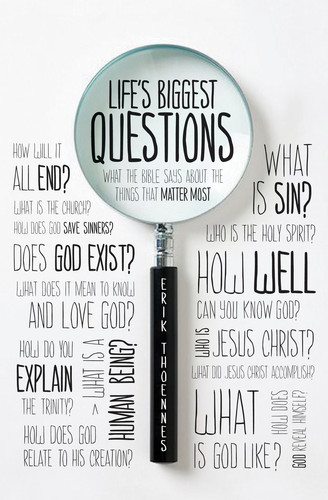
Life’s Biggest Questions: What the Bible Says About the Things That Matter Most
Erik Thoennes
Life’s Biggest Questions: What the Bible Says About the Things That Matter Most
Erik Thoennes
Since the beginning of time, people everywhere have asked the same questions: Does God exist? Is there life after death? What is the meaning of life? The superabundance of these invariable questions, asked over and over, leads us to believe that there just might be answers to be found. Professor Erik Thoennes knows the importance of questioning the fundamental things that we all wonder about. If you aren’t really sure what to believe, or if you’ve been sure of the answers for a long time but want to solidify the foundation of your faith, this concise book takes seriously the inquiries of the ages and leads us all to investigate the truth for ourselves.
So imagine yourself as a small group leader or a Sunday school teacher. You’re looking for a conversational springboard because you have 12 or so weeks to fill. What you’ll find in Thoennes’s work is a biblically faithful and consistent resource. It’s theologically deep, yet it helpfully lacks technical jargon and is carefully divided so as to address the major theological disciplines and categories the church has articulated throughout her history. The charts and figures that help illustrate points throughout the book also give it a nice, readable flow and communicate his intention for readers to really “get it” on a level they can use and apply. Even the progression of topics flow well, from apologetics to theology proper to Christology and right on down the line to eschatology. I wouldn’t say the book’s purpose is exclusively for a kind of group setting, as it could certainly be used for personal study and growth. But it is set up very well to fit a group context in which people are wrestling with these questions, which brings me to the issue of the book’s intended audience.
There are two groups of people I would hesitate to give this book to: unbelievers and brand new Christians just starting out in the church. The book assumes at least a basic knowledge of terms like salvation, sin, and Scripture, which can read like a foreign language to those who have not been exposed to such terms. This in no way takes away from the book at all, and I’m sure there are contexts in which the book is helpful to unbelievers or new Christians if they are being mentored by a pastor or elder.
Where the book will absolutely shine, I believe, is in the hands of Christians who may not have their theological categories and/or priorities down just yet but desire to know how we should think about things like how the world will end, the Trinity, and sin. A person who has been exposed to “church jargon” for years but has never probed deeper than a basic knowledge of the gospel will benefit greatly from this work. Someone who has been in a mainline church and has heard moralistic advice spoken at the expense of the true gospel may also be greatly helped by this book, thanks to its content and easily readable form.
This book is meant to be both read and used—thought through, meditated on, wrestled with. Thoennes has given the church a tremendously helpful resource that is biblically based and dependable with the potential to help a great many people direct their life’s biggest questions to the gospel and all its life-changing implications.