

It can be assured that if you were to go into any theological library 50 years ago, you would not find a quarter of the biblical commentaries there are today, not to mention the growing number of kinds of commentaries—from expository to socio-rhetorical. Yet, despite this surge, the level of biblical illiteracy in our Western Culture (even in our churches) is remarkable and far-reaching. Somehow, these two movements have been able to grow rapidly side-by-side. The question, then, is raised for Christians, how do you explain the Christian message to a largely biblically illiterate culture? Enter D. A. Carson’s book The God Who Is There: Finding Your Place in God’s Story. Carson’s book assumes no knowledge of the Bible and is a basic introduction to biblical faith and the big story of Scripture.
Somewhere else, Carson has observed that 20 or 30 years ago, when you were talking to an atheist, he was usually a Christian atheist, that is, the God who the atheist disbelieved in was the Christian God. One could explain the significance of the death and resurrection of Jesus and the need for repentance and it would be fairly well understood. That is not the case today and Carson, in The God Who is There, doesn’t make this assumption. Like Paul at Mars Hill in Acts 17, Carson orients his readers with the God of the Bible by explaining the contents of the Bible.
Of course, Carson begins at the beginning. The Christian worldview begins with the God who creates. The rest of the storyline of the Bible depends much upon the reality of Genesis, so it’s no surprise that Carson spends almost a quarter of the book there. A biblical understanding of sin and God’s promises are dependent upon its beginnings. Yet, Carson never loses the storyline in the details. For example, after describing the narrative of Abraham and the sacrifice of Isaac (Genesis 22), Carson explains, “The stories and the account begin to multiply through Old Testament pages in anticipation of the time when God would provide a sacrifice that far exceeds the value of some ram caught in a thicket” (55).
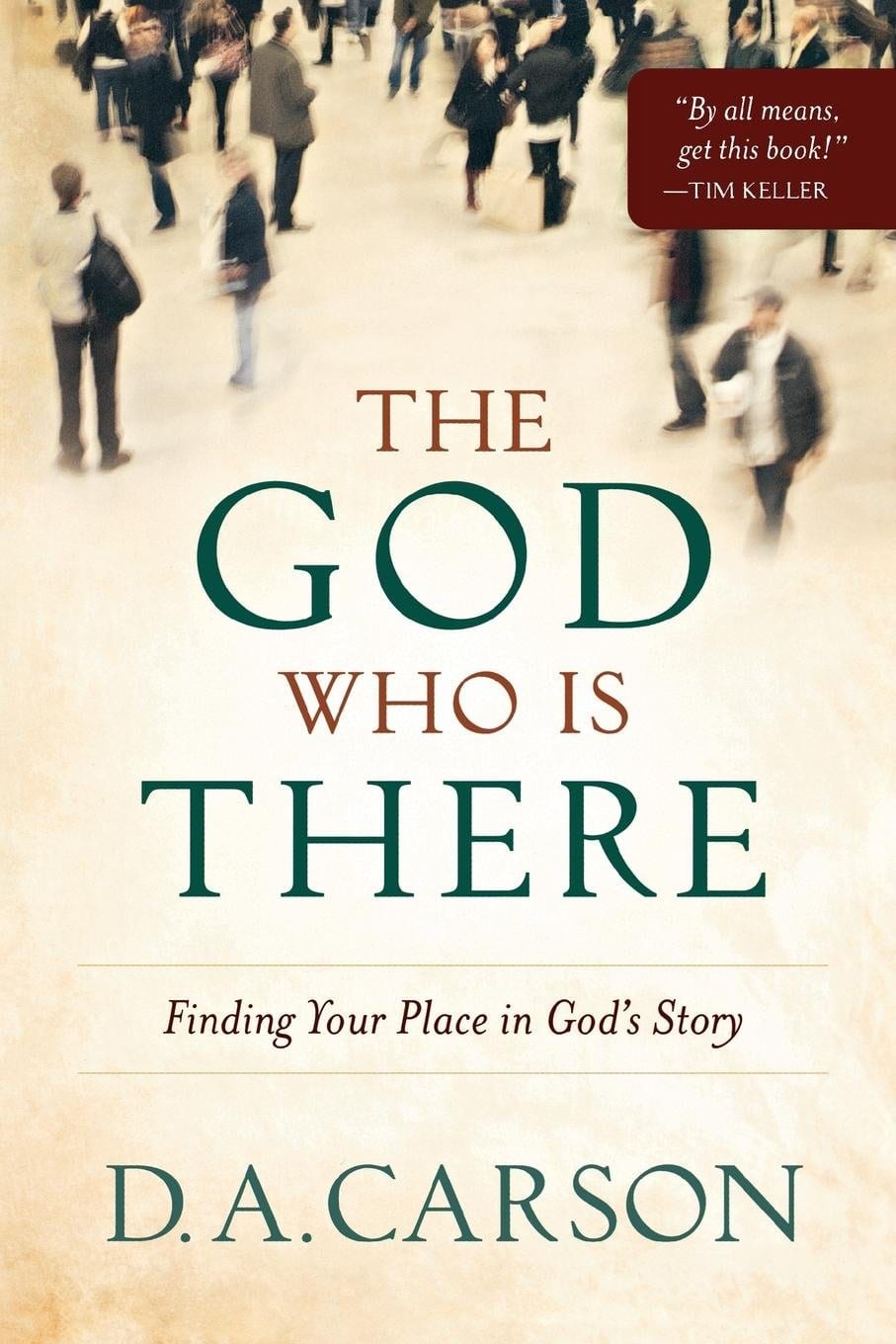
The God Who Is There: Finding Your Place in God's Story
D. A. Carson
t can no longer be assumed that most people–or even most Christians–have a basic understanding of the Bible. Many don’t know the difference between the Old and New Testament, and even the more well-known biblical figures are often misunderstood. It is getting harder to talk about Jesus accurately and compellingly because listeners have no proper context with which to understand God’s story of redemption.
In this basic introduction to faith, D. A. Carson takes seekers, new Christians, and small groups through the big story of Scripture. He helps readers to know what they believe and why they believe it.
The anticipation of this sacrifice is found in the storyline of God’s people, Israel—the rise and fall of the nation and her kings. From this history comes literature that reflects upon the nation’s rebellion, exile, and the need for God to act on their behalf. Carson explains the incarnation through John’s prologue (1:1–18) and the new birth through John 3. Following his classic book The Difficult Doctrine of Love, his chapter “The God Who Loves” redirects the popular, worldly confusion of divine love to God’s love in Christ that recognizes God’s holiness, our sin, impending judgment, and a substituting Savior.
The remaining chapters of The God Who Is There works out the explicit gospel message of the New Testament: The cross and its ironies (Matt. 27:27–51), the message of saving righteousness and justified sinners (Rom. 3:21–26), the gathering and transformation of God’s people (Eph. 2:1–22; 4:5–10; Gal. 5:13–26), the coming judgment against sin, the need for repentance and Christ’s return (Revelation).
There are a slew of biblical theologies, working out any one issue through the storyline of the Bible (see Carson’s edited series “New Studies in Bible Theology”). However, few, if any, accomplish what Carson has through The God Who Is There. This book is the fruit from decades of campus evangelism. Undoubtedly, he has countless objections and questions in mind within these pages, making it an ideal give-away book for skeptics and new believers. Let me highlight a few things to account for its value:
1. The God Who Is There is an apologetic of coherence. Very early on, it becomes clear that Carson is making the case for the reliability and truthfulness of the Bible based upon its one coherent message, its storyline, which spans thousands of years and dozens of authors. In an age of skepticism, demonstrating the Bible’s unity over centuries of history is compelling and Carson does it preeminently.
2. Carson clearly and plainly explains difficult biblical concepts. I’ve already mentioned his chapters on incarnation, the new birth, and God’s love. Even in explaining the “already/not yet” complexion of the New Testament, he clarifies the difficulties and preserves the profundity. The God Who Is There has obvious usefulness for small group or Sunday school settings.
3. From the Bible, Carson makes sense of reality. The message of the Bible is not an ethereal concept separate from true life. No, its earthy and is concerned with sin, human nature, death, and redemption. Yet, the message of the Bible, as Carson demonstrates, displays our need for help from outside ourselves, namely the incarnate Son of God and a substitutionary death.
4. Sadly, very few Christians have a grasp of the storyline of the Bible and its unifying message. It would be difficult to find a better book to hand young Christians. A grasp of the over-arching story of Scripture gives teeth to theology and The God Who Is There is the ideal place to begin.
It is difficult to comment on the importance of a book when it has only been out for less than a month. These days, too many book reviewers are zealous to exclaim the immortality of their book in review. So, let me give this tempered recommendation: Buy the book; read it and then buy a box of them in order to hand them out to as many people as you can afford. It may be one of the most important books you or those whom you give it to read.