







It’s impossible to read every book, let alone review each one. But in addition to our steady line of reviews, we want to highlight other books that have recently released. Here are some recent releases that have caught my attention.
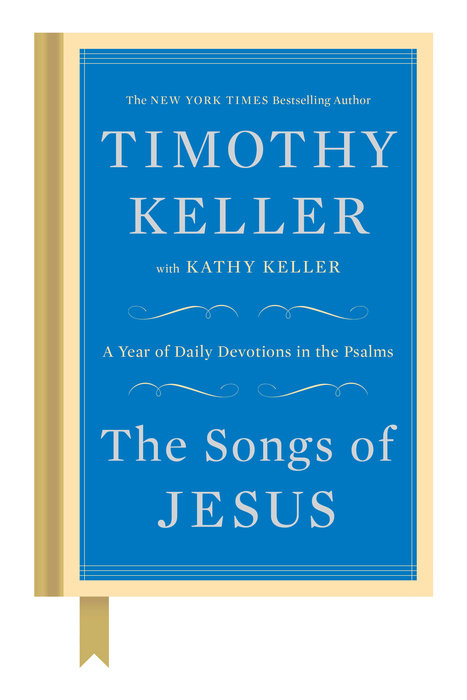 Tim Keller, The Songs of Jesus: A Year of Daily Devotions in the Psalms (Viking)
This book is a daily devotional that takes the reader through every verse of the book of Psalms in 365 days. In one sense the psalms do not need to be made into a daily devotional—they are the divinely inspired devotional book.
Many find modern devotionals to be either too upbeat or too sentimental or too doctrinal or too mystical because they reflect the perspective and experience of just one human author. The psalms, by contrast, give us a range of divinely inspired voices of different temperaments and experiences. No other book, even of the Bible, can compete with it as a basis for daily prayer. . . .
Each devotional provides you with your daily readering from a psalm. It then gives a brief meditation on the meaning of the psalm and a prayer to help you actually use it in your heart and as a way to approach God. The prayers should be seen as “on-ramps,” not as complete prayers. The reader should follow the trajectory of the prayers and keep going, filling each prayer out with personal partciulars, as well as always praying in Jesus’s name (John 14:13). (From the Introduction)
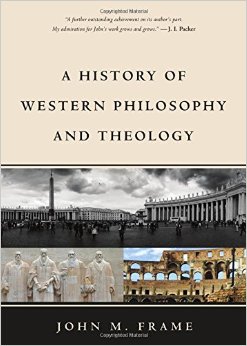
John Frame, A History of Western Philosophy and Theology (P&R)
Christians should evaluate philosophy by biblical criteria. This will shed greater light on the developments in the history of philosophy and better prepare us for the intellectual challenges of our time. The fall of Adam brought intellectual as well as moral corruption on the human race, and the effects of the fall can be seen in the work of philosophers, most of whom try to understand the world autonomously—through reasoning apart from God’s revelation. Some philosophers have appealed to God’s revelation, but their work has often been compromised with the wisdom of the world. Revelation should inform reason, and not the other way round. In the past, even Christian theology was corrupted by the movement toward intellectual autonomy, creating the tradition of liberalism, which has unhappily dominated academic theology down to the present day. But there is hope—a new generation of Christian thinkers take God’s Word seriously. Frame’s unique new contribution augments that process. (From publisher) [See Justin Taylor’s compilation of endorsements.]
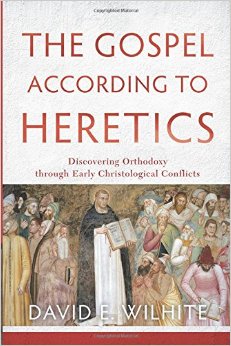 David Wilhite, The Gospel According to Heretics: Discovering Orthodoxy through Early Christological Conflicts (Baker Academic).
Since what Christian doctrine denies can be as important as what it affirms, it is important to understand teachings about Jesus that the early church rejected. Historians now acknowledge that proponents of alternative teachings were not so much malicious malcontents as they were misguided or even misunderstood. Here a recognized expert in early Christian theology teaches orthodox Christology by explaining the false starts (heresies), making the history of theology relevant for today’s church. This engaging introduction to the christological heresies is suitable for beginning students. In addition, pastors and laypeople will find it useful for apologetic purposes. (From publisher)
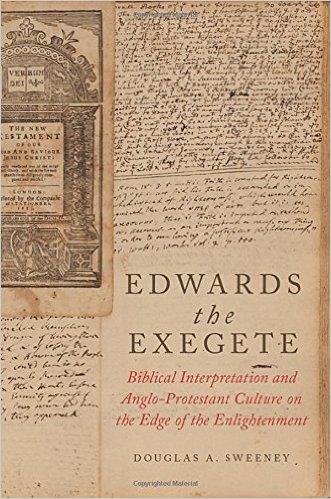
Douglas Sweeney, Edwards the Exegete: Biblical Interpretation and Anglo-Protestant Culture on the Edge of the Enlightenment (Oxford University Press).
Scholars have long recognized that Jonathan Edwards loved the Bible, but preoccupation with his roles in Western “public” life and letters has eclipsed the significance of his biblical exegesis.
In Edwards the Exegete, Sweeney fills this lacuna, exploring Edwards’ exegesis and its significance for Christian thought and intellectual history. As Sweeney shows, throughout Edwards’ life the lion’s share of his time was spent wrestling with the words of holy writ. After reconstructing Edwards’ lost exegetical world and describing his place within it, Sweeney summarizes his four main approaches to the Bible-canonical, Christological, redemptive-historical, and pedagogical-and analyzes his work on selected biblical themes that illustrate these four approaches, focusing on material emblematic of Edwards’ larger interests as a scholar. Sweeney compares Edwards’ work to that of his most frequent interlocutors and places it in the context of the history of exegesis, challenging commonly held notions about the state of Christianity in the age of the Enlightenment. (From publisher)
 ESV Men’s Devotional Bible (Crossway).
Our world presents daily distractions that can easily displace Christ as the center of a man’s heart and life. The goal of the ESV Men’s Devotional Bible is to strengthen and encourage men through the life-giving Word of God and sound devotional content aimed at nurturing godliness. . . . Introductions orient men to each book of the Bible, exploring its unique contribution to a man’s walk with God. Thoughtful and instructive articles address the importance of sound doctrine, life in the local church, leadership, the heart, calling, and a host of other relevant issues for today. (From publisher)
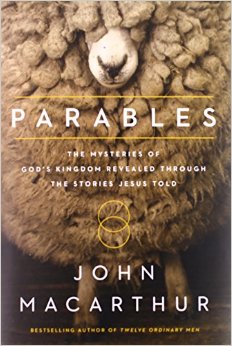 John MacArthur, Parables: The Mysteries of God’s Kingdom Revealed Through the Stories Jesus Told (Thomas Nelson)
John MacArthur helps readers understand Jesus’ parables and how they relate to the whole of His message. Jesus was a master storyteller, and the parables he told were ingeniously simple word pictures with profound spiritual lessons. Understanding the parables is a crucial matter for followers of Jesus. Jesus told parables so his people might comprehend his message about the kingdom of God clearly. . . .
In Parables [MacArthur] helps Christians understand the essential lessons contained in the most famous and influential short stories the world has ever known. (From publisher)
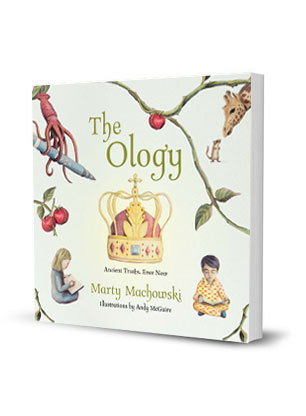
Marty Machowski, The Ology: Ancient Truths Ever New (New Growth Press).
In the cellar of the old stone cathedral, Carla and Timothy uncover a life-changing treasure, a carefully wrapped ancient book known as The Ology. What adults might describe as a beautifully illustrated storybook of systematic theology, the kids discover to be a story of adventure, mystery, and wonder that leads them to the truth about God, themselves, and the world around them. . . .
The Ology takes abstract theological concepts and makes them easier to understand with the use of creative examples, illustrations, and analogies. The goal is not to say everything that could be said about a theological topic, but rather to share the key thoughts behind a theological concept. The Ology is a starting point to learning theology and aims to create a hunger and desire in children to learn more as they grow older. (From publisher)
 Sven Birkerts, Changing the Subject: Art and Attention in the Internet Age (Graywolf Press).
In 1994, Sven Birkerts published The Gutenberg Elegies, his celebrated rallying cry to resist the oncoming digital advances, especially those that might affect the way we read literature and experience art―the very cultural activities that make us human. After two decades of rampant change, Birkerts has allowed a degree of everyday digital technology into his life. He refuses to use a smartphone, but communicates via e-mail and spends some time reading online. In Changing the Subject, he examines the changes that he observes in himself and others―the distraction when reading on the screen; the loss of personal agency through reliance on GPS and one-stop information resources; an increasing acceptance of “hive” behaviors. . . .
He finds solace in engagement with art, particularly literature, and he brilliantly describes the countering energy available to us through acts of sustained attention, even as he worries that our increasingly mediated existences are not conducive to creativity. (From publisher)
 Robin Lane Fox, Augustine: Conversions to Confessions (Basic)
Saint Augustine is one of the most influential figures in all of Christianity, yet his path to sainthood was by no means assured. Born in AD 354 to a pagan father and a Christian mother, Augustine spent the first thirty years of his life struggling to understand the nature of God and his world. He learned about Christianity as a child but was never baptized, choosing instead to immerse himself in the study of rhetoric, Manicheanism, and then Neoplatonism—all the while indulging in a life of lust and greed.
In Augustine, the acclaimed historian Robin Lane Fox re-creates Augustine’s early life with unparalleled insight, showing how Augustine’s quest for knowledge and faith finally brought him to Christianity and a life of celibacy. Augustine’s Confessions, a vivid description of his journey toward conversion and baptism, still serves as a model of spirituality for Christians around the world. (From publisher)