In spite of the prevalence of dispensational and premillennial interpretations of biblical eschatology, there has been a spate of books in recent years that argue extensively for the amillennial perspective. Of course, there have always been advocates of the latter view, the more substantive being: Oswald T. Allis, Prophecy and the Church (1945); Anthony Hoekema, The Bible and the Future (1979); Cornelis Venema, The Promise of the Future (2000); Kim Riddlebarger, A Case for Amillennialism: Understanding the End Times (2003); Samuel Waldron, The End Times Made Simple (2003); my own Kingdom Come: The Amillennial Alternative (2013); as well as the forthcoming book by Dean Davis, The High King of Heaven (2014).
To these works must now be added the nearly exhaustive treatment by Jonathan Menn, Biblical Eschatology. He is a practicing lawyer who received his MDiv from Trinity Evangelical Divinity School in 2007 and is currently the director of Equipping Church Leaders–East Africa. More so than any of the previously noted books on amillennialism, Menn casts his in the form of a textbook that is highly structured and often overburdened by excessive citation of secondary sources. But that is not necessarily a liability, if one makes use of the book for scholarly purposes.
Menn provides extensive data on the strengths and weaknesses of virtually every eschatological system and is especially critical of classical dispensational and premillennial schemes. It would be impossible in a short review to account for his own perspective on every issue, so I will limit myself to several of the more important points he makes.
Primary Problem
As for his hermeneutical approach to the Old Testament, Menn rightly emphasizes what he calls “prophetic idiom,” by which he means that “the OT prophets spoke within the framework, and used terms, they were familiar with and that made sense to their hearers” (9). That is to say, “the OT prophets spoke of Messiah’s eternal kingdom using the language and limited frame of reference of their own physical, Israelite context” (9). As a result “the form in which OT prophecies are fulfilled in the New Covenant era are likely to be different from the Old Covenant form in which the prophecies themselves were originally given” (13). One example is the way in which “the new Zion, the restored Israel, is not identified with a place or a nation but with the person of Christ and his people” (27).
Menn’s treatment of the broader hermeneutical issues is quite good, and he also interacts at some length with the development of the various points of view in church history. To the chagrin of many today, Menn agrees with the conclusions of Alan Boyd and his ThM thesis at Dallas Theological Seminary that “none of the distinctive beliefs of dispensational premillennialism were present in the apostolic and post-apostolic era” (63).
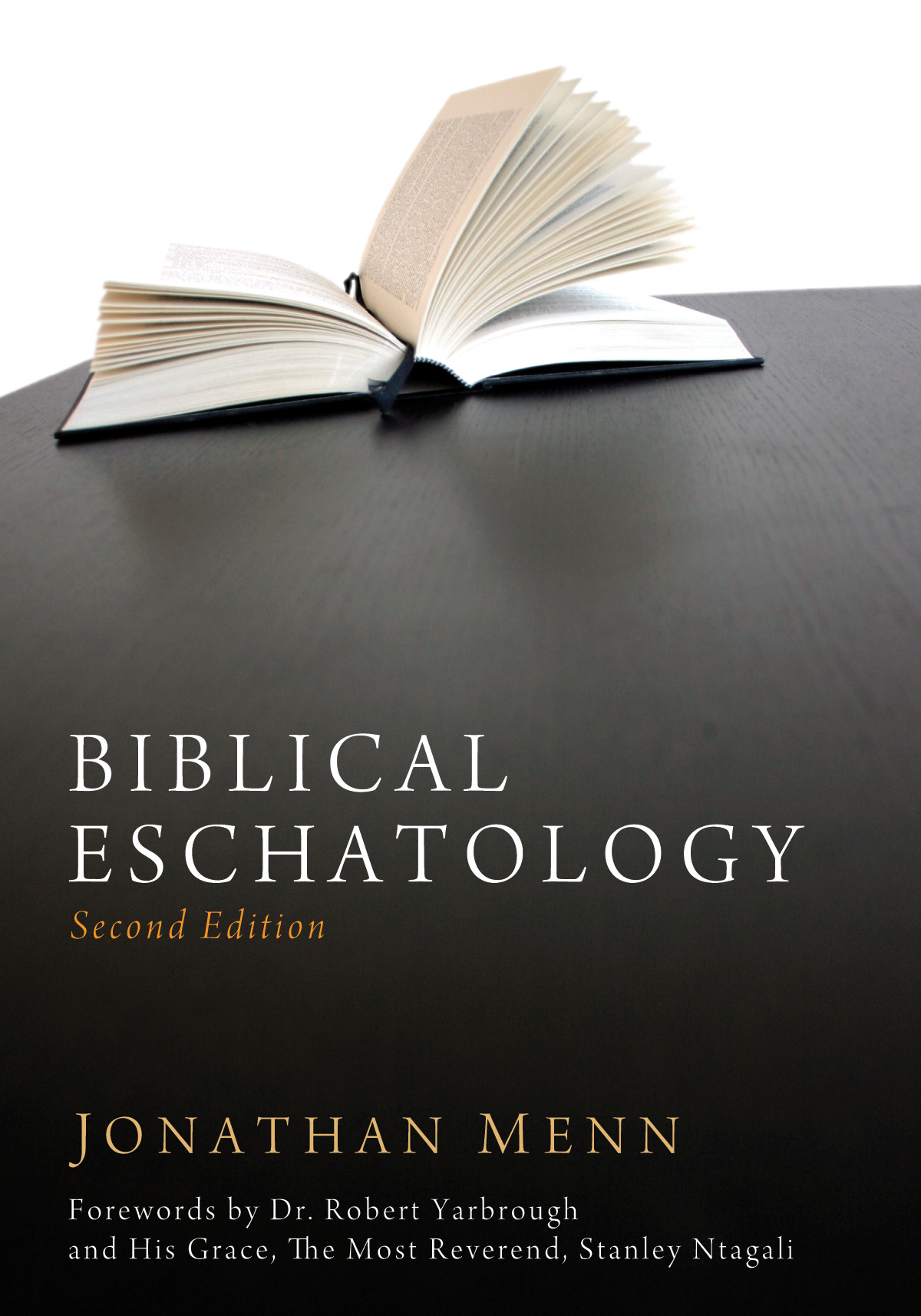
Biblical Eschatology
Jonathan Menn
In his lengthy chapter on the various millennial views Menn identifies the primary problem with premillennialism: its failure to reckon sufficiently with the finality that comes with the second coming of Christ: in terms of a single final judgment, a single final resurrection, the end of all physical death, the removal of the curse from the natural creation, the termination of all hope for personal conversion, and so on. Amillennialists, on the other hand, with whom Menn identifies himself,
look for one cluster of end-time events: the second coming entails a complex of events involving the resurrection of the righteous and the unrighteous, the judgment of the righteous and the unrighteous, the renewal of the earth and the cosmos, and the inauguration of the eternal state. There will be no thousand year interregnum of Christ between the second coming and the eternal state. The basic amillennial view of the “first resurrection” (Rev. 20:6) is that it is a symbolic term for the believers’ regeneration and new life on earth (i.e., their spiritual resurrection in Christ) or [Menn’s personal view] the death of the believer which translates him to the intermediate state to “live and reign with Christ” (Rev. 20:4). (87)
Menn understands the Olivet Discourse to describe both the events surrounding the destruction of Jerusalem and its temple (AD 66–70) and also the second coming of Christ at the close of history. As for particular points of interpretation: “this generation” (Matt. 24:34) must refer to the contemporaries of Jesus; “the parable of the fig tree is related to the signs which culminated in the destruction of Jerusalem in AD 70 and has nothing to do with the founding of the modern nation of Israel in 1948, as some dispensationalists allege” (125); and “the tribulation of those days” (Matt. 24:29) not only includes the events of AD 70 but also “must at least include the tribulation the church will face throughout the inter-advent period from AD 70 until the parousia” (120). Central to Menn’s reading of the discourse is his belief that the events of AD 70 are in some sense a type, adumbration, or foreshadowing of events that will occur in conjunction with the parousia at the end of history.
Eclectic Approach
He devotes an entire chapter to demonstrating that “the rapture and the second coming are not two events separated in time. The rapture occurs as part of the second coming which is after, not before, the tribulation” (a period of time, however, that he insists is never described in the Bible as specifically seven years in length).
As for 2 Thessalonians 2, the “temple of God” refers to the church of Jesus Christ, although Menn does leave room for the possibility that the end-time Antichrist is an individual and not merely (but certainly inclusive of) a personification of all the anti-kingdom forces of Satan and evil (whether political, cultural, philosophical, educational, or social) that have exerted their influence from the first coming of Christ to his second. On the book of Revelation (this chapter is easily the longest in the book, coming out at some 128 pages), Menn generally follows the scheme outlined in G. K. Beale’s New International Greek Testament Commentary. Thus, he endorses progressive parallelism as the only way to properly read the book and generally embraces Beale’s eclectic (idealistic-futuristic) approach to its interpretation. He explains:
The themes and imagery of Revelation are not merely references to particular events but have ongoing relevance for the church. The principles of idealism, utilized in the eclectic approach, provide practicality for the faith and life of the church from the first century to the parousia. On the other hand, the eclectic approach recognizes that Revelation does more than set forth ongoing principles. The book not only describes first-century events but also the consummation of the ages. Consequently, this approach provides ultimate hope for believers, whatever trials they may be experiencing now. (196)
There are several other helpful chapters and appendices on such themes as: the practical and moral relevance of eschatology; the vision of a restored temple in Ezekiel 40–48 (which Menn understands as a symbolic portrait of Jesus, the church, and ultimately the New Jerusalem of Revelation 21–22); Daniel 9:24–27 and the “Seventy Weeks” prophecy; Zechariah 14; and Romans 11. As for Romans 11, he does not believe it teaches that a mass conversion among ethnic Jews will occur in conjunction with the second coming of Christ, but he does not rule out the possibility that other texts might support such an expectation. Following Hoekema, he is open to the possibility that large numbers of Jews might convert to Christ at the end. He simply doesn’t believe that is what Romans 11 is asserting.
Menn has made an excellent contribution to the study of eschatology. As noted earlier, its textbook format and style make it less readable for the average Christian. But its near exhaustive treatment of every issue imaginable, and his fair-handed and always biblically grounded interaction with views that he ultimately rejects, make it an extremely valuable resource for anyone wanting to dig deeply into debate regarding the end times.