
Where I grew up, the front porch wasn’t just a feature of the home but a cornerstone of the community. On Sunday afternoons, friends or family gathered to share news, tell stories, and enjoy unhurried conversation.
That sort of socializing is rare these days, as Sherry Turkle argues in her 2016 book, Reclaiming Conversation: The Power of Talk in a Digital Age. As we’ve grown more connected digitally, we’ve become more isolated socially. According to Pew Research, around one in six Americans feels lonely or isolated all or most of the time. Part of the reason for that isolation is that we’ve forgotten how to talk to one another about important things—a problem that’s hampering our evangelism.
Louis Markos, professor of English and scholar in residence at Houston Christian University, is here to help with his book My Apologetics Dinner Party: A Real-Life Socratic Dialogue. Markos teaches by example as he presents a dialogue based on a lively conversation he experienced over Thanksgiving dinner with guests of various faiths. Through stories and conversations, he helped people wrestle with their objections to Christianity. More significantly, he shows us how we can do that too.
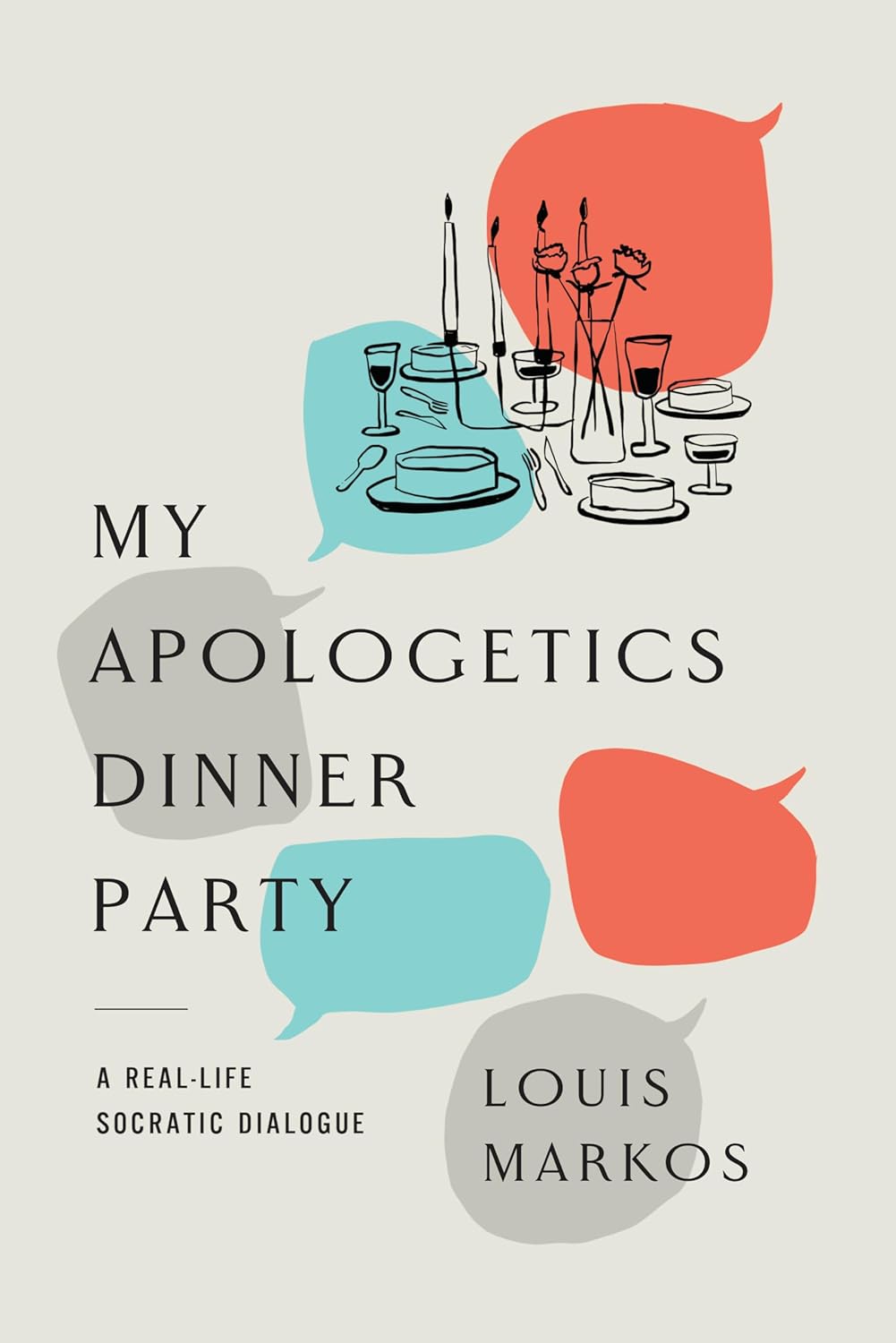
My Apologetics Dinner Party: A Real-Life Socratic Dialogue
Louis Markos
My Apologetics Dinner Party presents a method of talking about Christian faith that is not based primarily on propositional logic or the defense of truth claims (though these features do show up). Instead, he aims to clarify what Christians actually believe through a winsome and engrossing narrative in the tradition of Socratic dialogue. The conversations in this book are rooted in real-life interactions Markos has had with skeptics, seekers, and adherents of other faiths throughout a lifetime as a professional apologist for Christianity.
Dialogue Without Togas
The term “Socratic Dialogue” isn’t going to ignite excitement in most circles. It brings to mind classical philosophers in togas, like we see in Raphael’s painting The School of Athens. To many, that image will seem stuffy and dated—more often featured in satire by college sophomores than emulated by saints.
Yet the painting is beautiful, both in how it depicts the imagined scene and in the action it represents. I long for this sort of conversation among my friends about big questions of life. I imagine that Paul’s experience in the Areopagus might have looked similar to the scene Raphael painted (Acts 17).
Markos shows us how we can have something like this vision (probably without the togas) in our modern world. He also shows how we can become much more effective apologists by becoming better communicators. People have access to unending information in their pockets; they don’t need us to inform as much as to help them sift through the overflowing mound of data with them as they search for truth.
We can become much more effective apologists by becoming better communicators.
As Markos reflects on the purpose of his dinner party, he observes, “My job that day was not so much to answer every question with airtight logic and irrefutable proofs as to clarify what Christians actually do believe—to distinguish the myth from the history, the rumors from the facts, the urban legends from the true stories” (ix). Topics like the virgin birth, miracles, Christ’s exclusivity, and the resurrection are often shrouded in confusion.
It’s helpful to ask questions and clarify answers through dialogue, rather than dominating the room by answering questions no one is asking. That error flows from a desire for efficiency that results in overwhelming others with information rather than attentively listening and answering thoughtfully. It’s an error that can occur in conversations with Christians or skeptics.
Apologetics Beyond Debate
Kindness, respect, and genuine curiosity are necessary for using dialogue for apologetic engagement. Markos argues,
We must avoid gotcha arguments that lure people into apologetical traps. Such tactics may allow us to win the argument, but we will lose the soul in the process. Apologetics is not a game. It is not about winning; it is about sharing Christ, clarifying the claims of the Bible, and building relationships. (181)
In an era where meme-length quotes form much of the substance of public discourse, real dialogue looks strangely appealing.
There’s no loss of propositional punch in this sort of personal dialogue. Incisive questions are fair game in casual conversations. In fact, Markos argues, “We must ask questions that draw them out and help them to clarify their concerns” (180). That’s simply part of treating our conversation partners as intelligent members of the human race.
Our shared humanity is vital for dialogue. Many cultures share the same basic questions. For example, one of Markos’s guests argues, “It is my belief . . . that all religion rises out of man’s fear of death” (103).
Our shared humanity is vital for dialogue.
Rather than dismissing that statement, Markos sees it as an opening. He concedes the universality of that fear, “but it raises the question of why the thought of our own demise should fill us with such horror and dismay.” Handled well, a prickly question can point beyond itself toward the transcendent.
This kind of patient, humble exchange stands in sharp contrast to the shallow clashes that dominate much of today’s discourse.
Dialogue Outside the Classroom
Recent interest in recovering the Socratic method as a pedagogical approach hasn’t been limited to classical educators. People are waking up to our need to relearn how to have meaningful conversations outside the classroom too. In a fast-moving information culture, where arguments are often confused with influence, we need to rediscover how to talk about big ideas together and disagree with integrity.
Though few of us are likely to be as eloquent in casual conversation as the speakers in My Apologetics Dinner Party, Markos demonstrates that such dialogue doesn’t belong only to the great men or within the classroom. Ordinary people can have “conversations in the den, around the dinner table, and on the deck” that range “from miracles to pain, philosophy to theology, literature to history” (169).
We, too, can wrestle with the biggest questions of life. Respectfully engaging others’ ideas doesn’t keep us from arguing toward truth with clarity. Indeed, if our evangelism is going to be effective in an increasingly post-Christian world, we need to learn to dialogue with those who disagree.
Above all, My Apologetics Dinner Party demonstrates that speaking the truth is a powerful apologetic because it flows from a life transformed by Christ’s power.