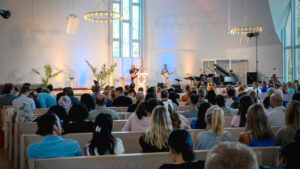





Loving Jesus means loving our neighbors as well. But our culture is increasingly post-Christian, post-church, and post-reached. Our neighbors feel further away than they’ve ever been. So what shifts are needed to speak Jesus in this culture? In this talk from TGC25, followed by a Q&A, Sam Chan teaches how to speak about Jesus more effectively.
In This Episode
0:00 – Introduction and personal background
2:11 – Challenges in evangelism today
4:01 – Concept of plausibility structures
8:54 – Merging universes of friends
15:10 – Disciple-making evangelism vs. event-based evangelism
15:32 – The power of conversation in evangelism
24:01 – Becoming an unofficial, de facto chaplain
30:53 – Role of wisdom and calm presence
34:18 – Resources and final thoughts
Resources Mentioned:
- How to Talk About Jesus (Without Being That Guy): Personal Evangelism in a Skeptical World by Sam Chan
- Evangelism in a Skeptical World: How to Make the Unbelievable News About Jesus More Believable by Sam Chan
- The Great Dechurching: Who’s Leaving, Why Are They Going, and What Will It Take to Bring Them Back? by Jim Davis and Michael Graham
- The Missing Peace: How Christmas Brings the Calm We Crave by Sam Chan
- 321: online resources from Glen Scrivener
SIGN UP for one of our newsletters to stay informed about TGC’s latest resources.
Help The Gospel Coalition renew and unify the contemporary church in the ancient gospel: Give today.
Don’t miss an episode of The Gospel Coalition Podcast:
Transcript
The following is an uncorrected transcript generated by a transcription service. Before quoting in print, please check the corresponding audio for accuracy.
Sam Chan
So just a few words of introduction. My name is Sam. Sam chan Yes, I’m Asian, yes, I’m Australian, and yes, I’m short. That’s why I’m standing on this. They built this just in time for me to be here. And I’m married to my wife, Steph. We got into, I don’t know, USA yesterday, day before, Stephanie’s trying to hide. She hates being seen, but she’s sitting right in the middle next to the camera. There also we have three boys. So I’ve told them, boys, when you grow up, chances are you be just like me, not very good, looking very, very short, so no girl is ever going to like you. Your only chance in life is to study hard and make a lot of money. Now, of course, I’m joking. I’m not saying I’d never have said that, but every Asian in the room is thinking, Hang on, I’ve said that, or my dad has said that to me. No, I’ve never said that to my boys. But anyway, it’s so good to be here. Just a few other words of introduction. What can I say? So shout out to my publisher, Zondervan. So I was an unknown Aussie, and a few years ago, they took a chance on me, and we put out evangelism in a skeptical world, and it did way better than we thought it would do. It won Book of the Year by Christianity today, I think. But it’s only problem is it’s a big book. It’s over 200 pages long. So then we thought we’d put out a much easier, easier version, only a few much, only a few pages how to talk about Jesus without being that guy. And we presented some of the points here at TGC in 2019 and so we’ll present some more content from this book, but much more content. Also, there’s a lot of stuff from me on YouTube, so chances are you may have heard some of this stuff before. Don’t worry, there’ll be other stuff you haven’t heard. But also, if there’s stuff you’ve heard before, just laugh as if it’s your very first time hearing that joke, for the benefit of the others who have not heard yet. So we’re talking about shifts in talking about Jesus, hands up here. Who hands up here? Who has heard of the rock band you two? Wow. Okay, hands down. Majority, right. So a few years ago, you two came to Australia, came to Sydney. I went to the concert. It felt good. I thought, hey, look at me, young still rocking it at a big open air rock concert. Then I looked around and I realized everyone is really old. Everyone here is really old. I don’t see any young people here. And I suddenly realized, wow, young people don’t listen to you too. They’ve never heard of you too. Our world has changed. I also work part time as a medical doctor. I was working with a young surgeon. Surgeon says to me, oh, Sam, do you like listening to Billy Idol? I say, Yes, I love Billy Idol. He looks at me, who’s Billy eidl? I said, Billie Eilish. I said, Who’s Billie Eilish and Sally rides? The world has changed. They’re not listening to the music we grew up with, and chances are the ways we’ve been talking about Jesus, let’s say 20 years ago, are not the ways people talk about Jesus. Now we’re not just post Christian. Now they’re saying we’re post post Christian. So what are some things we can do to shift in the way we talk about Jesus to our friends and family? Now if I’m talking really fast, it’s because I’m talking really fast because I’m hoping to leave some time for question and answer time afterwards. So as I’m talking, think of whatever questions you might want to ask. I’ll do my best to try to answer those questions. All right, what are some random tips on how we can talk about Jesus to our friends and family? The first tip you may have heard before, and I call it the shift from rather than something we do as a once off evangelism now has to be a lifestyle. It’s actually a lifestyle change to be evangelistic, we it’s a lifestyle change. And I’m sure you’ve probably heard this story before, but if I said to you, you won’t believe what happened. Just last week, my wife and I were watching TV and a UFO land in our backyard, and a little alien got out, invited us into the UFO, so my wife and I jumped in, and he took us to his home planet, Jupiter. We got out, he showed us around. We had a meal with him. We jumped back into the UFO, and because of the time portal, space time continuum thing, we arrived back in earth, and only one second of Earth time had gone by hands up here. Who believes me? Okay, one or two. It’s a minority belief. Let me tell you another. Story. 2000 years ago, God sent us His Son, Jesus, born of a virgin, 100% God, 100% human. At the same time, dies on a cross. If you believe this, God washes away all your sin, guilt and shame. More than this, three days later, he rose from the grave, and now he’s in heaven. And one day, depending on which denomination you belong to, he will come back and he’ll set up a physical kingdom here on earth. Hands up here, who believes me? Whoa, okay, hands down, majority belief. Now you’ve got to think, why am I happy to believe the Jesus story, but not the Jupiter story? Because, let’s face it, they both sound pretty unbelievable. And if we’re honest, the Jesus story is more unbelievable than the Jupiter story. Why do we believe Jesus and not the Jupiter story? Because as I’m talking to you and as you’re listening, you have what philosophers sociologists call plausibility structures. And plausibility structures are pre programmed, predetermined structures that we have that pre judge a story as bling believable or bumper unbelievable. So as I’m telling you the Jupiter story, I say, hey, a UFO Jupiter time portal, you’re pre programmed, pre determined plausibility structures are pre judging the stories. Bah, unbelievable. But as I tell you the Jesus story, Jesus, born of a virgin, dies on a cross, rises from the dead, and one day you two will rise from the dead. You’re thinking bling, bling, bling. Believable. Believable, believable. Why? Where do we get these plausibility structures from? Well, they come from three main sources, our community, people that we know, love and trust. They come from our experiences, and they come from facts, evidence and data. So as I tell you the Jupiter story, none of us live in a community of people who believe in UFOs. None of us have had a personal experience of UFOs, and none of us believe there any facts, evidence or data to support my UFO story. But as I tell you about Jesus, most of us live in a community of friends and family that also believe in Jesus. We’ve had a personal experience of Jesus, and we believe there are enough facts, evidence and data to support the Jesus story. Now out of these three, which one is the most powerful for determining belief. Now me, we may think it’s facts, evidence and data, we may want it to be facts, evidence and data, but it’s not. It’s the least powerful one in determining belief. So let’s see how facts, evidence and data works. If I said to you, the UFO facts, evidence and data. It’s in my backyard still right now. Who here in this room of 700 people could be bothered flying to Australia to check out the UFO? No one, so you could not be bothered to check it out. And even if you did come, you’d be thinking, aha. Now there’s another explanation. You explain away the facts, evidence and data. So the most powerful one for determining belief is community, friends and family that we know, love and trust. So as I tell you the Jupiter story, I’m unbelievable. I’m the only Bozo in this room that believes in the Jupiter story. But as I’m telling you the Jupiter story. Imagine if this half the room went, Oh, me too. Last week, I also went in a UFO to Jupiter. I thought that was you I saw, but I just didn’t want to raise my hand. Now, this half the room. You’re thinking, this is more believable. And imagine if the whole room said, Me too, and you’re the one Bozo who doesn’t believe it. This is way more believable. That’s why Paul says, Hey, I saw Jesus risen from the dead. Oh, wait, not just me, but 500 people that you know love and trust, they also saw Jesus risen from the dead. Now it’s believable. It’s true whether you like it or not. It’s true whether 500 people saw Jesus or not, but it’s more believable because 500 other people saw Jesus risen from the dead. So why am I saying this? Because usually when we think about telling our friends and family about Jesus,
Sam Chan
we go solo, we think, Oh, okay, I’m going to be bold, and I’m going to sign up for a flag football team, a book club, and I’m going to tell everyone there about Jesus, which is good, it’s noble, it’s bold, but we’re going to be unbelievable, because we’re the one Bozo in the room that believes the story. It’s true, but it’s unbelievable. So what we need to do is merge our universes of friends. So we have to merge our universes, because typically, as Christians, we have a universe of Christian friends and a universe of non Christian friends. And so when our Christian friends have a barbecue, we go with them. When our non Christian friends go to the movies, we go with them, but we keep the universes separate. But what we need to do is merge our universes. So when our Christian friends have a barbecue, invite our non Christian friends along. When our non Christian friends go to the movies, invite our Christian friends along. So bit by bit, we won’t be the one Bozo who believes in the Jesus story, but they’ll be thinking, hang on, a lot more people who I know, love and trust, also believe in the Jesus story, so it becomes more believable. So what this means is it’s a lifestyle change, because it takes years to build up a new network of friends, one or two years. It’s a lifestyle change. It’s like getting fit every year. For New Years, we always think, oh, this year, this year, this year. For sure, I’m going to get fit. I’ll eat less, drink less, exercise more. And it lasts about a week. We get up at five in the morning, we go to go for a run, go the gym last week, because it’s unsustainable, because it was one extra event that we shoehorned into our busy calendar. When we shoot when, when fitness should be a lifestyle change, we become fit. Evangelism is the same. It’s not one extra thing we try to do in our calendar. Now we become evangelistic by deliberately merging our universes of friends, and that means we can match make our friends. See, this used to happen to me all the time. When I was single, My friends would invite me to a dinner party. I would turn up and think, Ah, it’s happened again. They’re trying to match me up, married couple, married couple, a girl all by herself. I see what’s happening. But so my wife and I, we’re trying to match make our non Christian friends with our Christian friends, not romantically, but socially. So we have a barbecue. We think, hang on. This set of friends will get on really well with this set of friends. Let’s introduce them to each other. It’s called Getting our friends to become friends with their friends. So now in Australia, a lot of churches now have merge days in their church calendar. This is a deliberate day where we merge our universes of friends. When I was a junior doctor, I lived in hospital accommodation with three other non Christian doctors, but that meant whenever my Christian friends came and we went out, we would invite them along, and whenever they went somewhere to do something, I’d invite my church friends along. And bit by bit, we merged our universes of friends, and bit by bit, after two years, they also came to know, love and worship Jesus. But it takes about one or two years. It’s a lifestyle change. That’s one shift in how we talk about Jesus. So that’s shift number one. It’s a lifestyle change. Let’s merge our universes. Shift. Number two is we pivot. We shift from what’s called event based evangelism to what they call disciple making evangelism. So event based evangelism is where our Church invites a very gifted speaker to come to give a talk, and our non Christian friends come and they hear and they believe disciple making evangelism is where we train just the normal, ordinary Christian to tell their friends about Jesus. Now, once upon a time, this was the main way of doing evangelism, Billy Graham, for example. And long may this continue, I’m employed by city Bible forum in Australia to be that guy who gives a talk at the event. So long may this continue, it pays the bills for me. But the shift is this, this is only going to be 1% of how evangelism works. 99% is going to happen through just normal, non trained people who have not been a seminary Christians telling their friends and family about Jesus. See, this is the pointy end of the funnel, but all the action is going to happen over here, by the time someone turns up to hear me speak, this has had to happen over on this side, and this is good news. This isn’t an opportunity. It’s not a threat. So barna.com in the USA, they have worked out, they’ve surveyed non believers, and they said, if I was to hear about Jesus, I’d want to hear it from a Christian friend. And they’ve also surveyed non believers, and they found that the average non believer, yes, they’ve got a problem with the idea of Christianity, but they don’t have a problem with the Christian friend that they know. Surveying the. UK found exactly the same thing. Non believers are favorably disposed to the Christian friend they have in their life. They have a high view of the Christian friend in their life. An easy way then of doing this is just show people. I don’t work for alpha, but for example, they have online stuff. Glen Scrivener has something called 321, you can send them there online. Hey, check out this link. And you know, we all think I reckon so. This is a quick aside. People discover Jesus I find in three ways. And you sort of need all three to operate. One way is they meet a Christian friend. Second way and all three happen concurrently, like you need all three it seems. Second thing is they get invited to go to church, and they experience church. Third thing is they Google Jesus. They’re discovering Jesus online. People want to check out Jesus in the privacy of their own home. It’s like when you try to book accommodation in a hotel or you try to book a plane ticket and suddenly a pop up window says, Do you need help? And you go, no, no, no, no, no, no, because you just want to do it yourself. And people are doing the same thing. They’re Googling Jesus. They want finding about Jesus. So we can send them to good links, rather than unhelpful links. That will be very good. Also, Mark Green UK.
Sam Chan
He did some there’s no E there. I know they’re UK, but they misspell everything in the UK, don’t they, all right. Mark Green. He looked at when people went to hear Billy Graham speak in the London crusade. By the time they heard Billy Graham speak, and they prayed the prayer. They ticked the box, they walked down the front. They gave their lives to Jesus for that to happen, that person had 32 prior gospel encounters for that to happen. So it’s always been the pointy end of the funnel. We just weren’t seeing it. So what all what we’re trying to do is just trying to be one of those 32 prior gospel encounters. So don’t be discouraged when they don’t believe. No, it takes time. It’s a lifestyle change. So that’s a second pivot, the third shift, the third pivot in talking about Jesus, is shifting to think from a monolog to a conversation or dialog 1020, years ago, if you went to seminary, if you took the class on evangelism, chances are you were trained in evangelism by a preacher, because that’s what evangelism was. It was a non stop monolog where you control the conversation or and long may continue, you got to walk up to a stranger, maybe read from a tract, 4.6 points, and again, it’s a monolog. You’re controlling the conversation, but with friends and family, it’s going to be a conversation. So we need to pivot from thinking of evangelism, from evangelizing like a preacher, to evangelizing like a counselor. And how do counselors counsel you? If you’ve ever seen a counselor, what do counselors do? They ask questions. They don’t monolog. They let you do all the talking. They ask questions. And I remember when I was going through a crossroads moment in my life, many years ago, where I had to decide, am I going to stay in full time medicine, or am I going to a full time Christian ministry? And I lined up eight wise, mature Christians for advice, and they monologued at me for half an hour to an hour, and I walked away from each session. Huh, underwhelmed, disappointed, and I couldn’t work out why, because I had asked for advice. They gave me advice, but I was unhappy. But then I met a friend who was a trained counselor, and I said to him, Hey, I could stay in full time Christian, and I could stay in full time medicine. He just said, you could, couldn’t you? And he unlocked me with one question. Because what questions do is they just you. You Now find your own pain point and you discover the answer for yourself. You. Now showing in evangelism studies that Jesus, in the New Testament, asked about 300 questions. Jesus himself was asked 200 questions, but he only directly answered that question eight times. The rest of the time he responded with a question. And so what we can do is learn the power of what are called nudge questions. Nudge questions that just nudge the conversation from interest. What did you do in the weekend to values? Oh, what do you like about that? To world views? Nudge questions that nudge the conversation along, and eventually we can get to questions like, what religion did your parents have? Because that’s still descriptive, but now we’ve nudged the question into the world views, layer because, remember, there are three layers to a conversation, interests, what did you do on the weekend? What books are you reading? Middle layer values, what’s good about that to central layer, world views, we can also ask them, what was church like for you growing up and again, that’s descriptive, but that’s going to say a lot about where they are in their faith, and it gives them permission now to talk faith conversations, or even more directly, we can say, Do You have a faith Tell me about your faith journey, and if they say I have no faith, or I have a faith, or I’m a Buddhist or I’m a Muslim, what we do is then ask The power of the second question. As doctors, we make fun of our psychiatry colleagues and our counselor colleagues by saying, it doesn’t take much to be a psychiatrist. You only have to ask two questions, how are you doing? How are you really doing? And it’s that power the second question. Now we ask them, How you doing, how you really doing, and it gives them permission to open up and be vulnerable. We and then all we do is keep asking questions. Tell me more. Why is that important? Tell me more. How do you feel about it. Tell me more. Why is that important? Tell me more. How do you feel about it? If you do that, you can listen for the next one hour. I remember, I was working as a doctor. This young nurse came to me and she said, What books should I read? And she was young. She was from China, so that was my chance now to be the doctor play the power game. Mansplain to her. Okay, let me tell you about the canon of Western literature. Instead, I said, Huh? Why do you ask? And she said, because I feel so naive and young, I want wisdom. And I said, Well, I work for city Bible forum, and I we have a female chaplain who was trained as a lawyer, and she’s very wise, and she speaks Chinese. Would you like to talk to her? And she said yes. And so often, people sound like they’re looking for advice, when really they’re wanting permission to talk and open up. So that’s another shift now, learning the art of conversation. Evangelizing, not so much like preachers, but like counselors.
Sam Chan
Number four, what we’re trying to do now is position ourselves in our friends’ life, in our family’s Life as the as the unofficial de facto chaplain. You Yeah, I have a friend called Craig. He was a military chaplain. Saw a few tours in the Middle East. Lot of tragic stuff would happen, so the military would come to him for prayer, for counseling, for advice. Yes, but the commanding officer he was, he was a strict atheist. He didn’t have any time for this religious mumbo jumbo. But after a while, enough tragic stuff happened that the commanding officer, one day, said to Craig, hey, please come into my office. Close it all behind you. Can you pray for me and my Chaplain friends say this is how it works. As a chaplain, people have the doors closed, doors closed, but in a time of crisis, they come to you, they open up. They want you to speak on behalf of God. They want you to connect them with the sacred. They want you to bring meaning into a tragic situation. I remember once on our street, tragedy happened. Gorgeous young boy died suddenly, unexpectedly. The whole street loved him. The whole street grieved, but there was a wise Christian man on our street, so they got him to run the funeral. We got him to do the prayers. Also, people knew that my wife and I were Christians. They came to into our house to speak meaning into this tragedy. I know of a friend called Pierre one time he and his wife had been investing blessing, loving non believers in their workplace, and they’ve done everything that you know we’ve been saying in the in other evangelism courses in that book, How to talk about Jesus without being that guy. Merge your universes. Go to their things, listen, and then one day, a grandma, the workers, mother, grandmother died, and then they get a phone call out of the blue saying, hey, the little grandson wants to know where his grandmother is right now, can you talk to him? And then Pierre and his wife then had an open telephone call to like, 20 relatives in one go see at that moment they had earned the right to be the unofficial de facto chaplain in that family’s life. So how can we become the unofficial de facto chaplain? Well, my chaplain’s friends say, begins with genuine curiosity. So yes, we asked them what they did on the weekend, but we’re genuinely curious about what they did on the weekend. We do want to know we asked our second question, how did that go? Tell me more. I love to ask people like at work, so many of the nurses have tattoos. So I asked them to tell me about their tattoos. They must have a meaning. Which was their first tattoo. What’s the next tattoo they have planned? If they have children? I ask them for the names of their children, what’s the meaning behind their names? I show genuine curiosity. Wow. Tell me more. Chaplains also understand, I’ve heard the saying, it’s not original to me, home is where you’re understood. So we can be that second home away from home, where they’re understood. And we know how when we listen to counselors, if we’ve ever been to a counselor, there’s that moment where we feel like you understand, and that’s usually when we break down and cry. It’s so good to finally find a home where someone understands you, and this means we listen to understand. And so there are three sorts of listening, where we hear, where we understand and we feel so guys, it’s everything you were taught in your pre marriage counseling. Remember to remember conflict resolution. 101, your wife says to you, you’re not doing your share of the housework easy. All you have to do is repeat her words back at her, Oh, from what I hear, I’m not doing my share of the housework winner. And then you summarize and identify the issue behind the issue. So do you show you’re not just parroting her words back at her. So you say, Oh, I understand I’m not doing my share of the housework. Really good. And she would say, yes. Now you have to say that must make you feel blank, and you have to guess the emotion and ah, but it’s always going to be anger, right? So that must make you feel so angry and ticked, just like that conflict resolved. So my wife heard me give this advice to my guy friends, and she said, Oh, if I. Ever catch you doing that to me? And I said, Oh, from what I hear you say, so will our friends and family listen to understand? So I remember one time asking a nurse at work, how are your children doing at school? And you know, the answer is always, good, good, good, good, good, good. But after a while, if you show you’re genuinely curious, she finally opened up and said, Ah, they’re not doing well. They’re getting bullied. They’ve got learning difficulties. And I said, Oh, you’re worried they’re going to fall behind. And she said, Yes, you’ve identified the issue and the emotion she feels understood at that moment. Also. We don’t know it, but we actually have wisdom, because we’re filled with the Spirit of God. You know, there’s a general wisdom that we all get to enjoy, but somehow the fear of the Lord is the beginning of wisdom. So we can’t, you know, like dog owners can’t smell the smell of dog in their house. They’re so used to we actually can’t smell the wisdom we enjoy by knowing Jesus, we have a wisdom that radiates, and sooner or later, people will come to us for advice. Also, chaplains have this calm, non anxious presence. And obviously I’m not talking about medical anxiety. Christians can go through anxiety as well, but that’s this non anxious presence we enjoy by knowing that there’s a God of the universe who has everything in control, so I don’t have to be in control of everything. So we have this calm, non anxious presence. And I know I was at work once, and I said to a nurse, I said, Hey, in this operating room with a surgeon, the anestiologist, the scrub nurse, the scout nurse, the anesthesiology nurse, I’m the least important person in this room. If anyone else did not turn up, we would have to cancel with the operation. If I didn’t turn up, you could still do the operation. It would go even better without me turning up. So that’s why I turn up, so you don’t find out how better It goes without me. And she said, No, you’re the one who brings peace. And I did not know that. She said, You’re the peacemaker in the room. So once we show genuine curiosity. We listen to understand and feel the emotion we have, wisdom which we can’t smell, but others can, where the calm, non anxious presence, we can now offer to pray. So when my work colleague says, Oh, my children are falling behind, I can say, hey, my wife, my kids, we pray every night for our friends. Can we pray for you tonight? And if you’ve earned the capital 100% of the time, the answer is yes, and I like to text our prayer that night, just hey, just prayed for you, or record it on your phone and then send it to them, and then I check in a week or two later, I say, How are things going? Whatever we pray for, and then they will say, Yeah, you know what? I think things are better, and that’s why I say it’s a miracle. And now I’ve introduced a language of Providence and supernatural. So we’re gradually blurring the lines between the secular and the sacred, and now we’re given permission to talk about our worldview. So
Sam Chan
so I’ve got so many more things I want to talk about, but I’m out of time. So what I’ll do is I’ll trust question and answer time to bring those things out. But there are three things we can do before we go to question and answer time. Number one is, I work for city Bible forum, and we have this thing called EV Q school of evangelism. So the website is there, and at the top of the website, you can click on a link that measures your EV Q, because we’ve heard of IQ EQ, but EV Q and it would identify, I think there are five or six dimensions that we will be strong at in evangelism, and then somewhere we’re not so strong. So what are the roadblocks we look at community like, how many non Christian friends do we have? We look at character like, who are we like inside? What’s my walk with Jesus? Jesus like before we look at things like skills, experience, confidence, competence, stuff like that, but go to that you will help unlock your evangelism. Number two, those books I talked about how to talk about Jesus without being that guy. Today, I only had chance to share a handful of tips from there, there are like nine tips in that yellow book, How to talk about Jesus without being that guy. But number three, I’ve got a Christmas book coming out with the Good Book Company, and it’s designed to give to non believers at Christmas time. And it’s going to be called the missing piece, how Christmas brings the calm we crave the missing piece, how Christmas brings the calm we crave? Because Christmas is chaos, let’s face it, so we want calm. So this is and good book coming in. It’s deliberately made it super cheap, so we can give it out as tracks and we can give it as Christmas presents to friends and family. And family. But also we’re pastors, this is what we have at the back of the church to hand out to all the newcomers who just came for Christmas day. Anyway, I have a Christmas book coming out, coming out in September, but you can pre order it as well. All right, we have, I think, 10 minutes for question time, 10 minutes, yeah, there’s no microphone, so I don’t know how this is going to work. Just wait, put a hand up, yell the question now, okay,
Speaker 1
you mentioned having an event day at church. I’m assuming that means people bring friends, and you all do something together. My question is, how do you get your church to follow this? Begin
Sam Chan
with? Yeah, oh, wow. So how did yeah, it’s suddenly you realize it’s, it’s a lifestyle change, and the church itself has to think in terms of a lifestyle change. So what we usually do in August, we run seminars on evangelism, just like one here. So imagine this was a seminar that we ran at church in August, and we’re telling everyone there to do everything that my yellow book says, start merging your universes. Go to their things so they will come to your things. Do hospitality, so coffee, dinner, gospel, listen to understand, and now and be the unofficial de facto chaplain. And now, in October, if they’re families, we run a family service designed where kids can sit in the service for the whole time, and then we say, Hey, if you like that, around December, we’re going to have a big open air Carols event. And hey, if you like that, come, come for Christmas Day. And then everyone goes away for Christmas holidays in Australia, but we say, Hey, if you like that in February, me the event speaker. We’re going to do a thing we call Feb talks. I have Ted Talks. We have Feb talks now, one on each Sunday. Hey, if you like that, there’s three avenues there. You can join a life course, and that’s the baptism course. But then now your non believers are mixing with believers who want to get baptized. Or there’s in Australia, there’s an olive tree media that has something called the encounters series. So come, come watch the videos called encounters. Or we run a group for newish. If you’re newish to church or Christianity, we have a newish group. And then from there, we say, hey, come to Easter. So we have this cycle just knowing people don’t magically turn up in a vent. So for this to happen, this has to happen. And then I work for city Bible forum, where I actually speak in secular spaces to secular people like in the workplace, I come in under the DEI umbrella as a person of faith, speaking about what it’s like to be a person of faith, I we speak in things like this, for Easter, Christmas, in workplaces, but for that to happen like if I turn up in a workplace, I’m not going to get anyone turn up unless there’s been a lot of bottom up work happening with Sydney Bible forum, where we network Christian workers with each other to pray for their non Christian friends, and then to do all this for their non Christian friends, so that when the event happens, I will turn up, and this is what I see in the workplace. So that’s my specialty, speaking secular spaces to secular people. Thanks. It, yeah. Question, what was the website
Sam Chan
that you had up earlier? Ba, something. I was either barna.com the USA stat thing, and the my one was evq.org.au, and click on that link at the top of the page. Take the barometer test. All right, any other questions? Yes, you talked about,
Speaker 2
like, the importance of learning to be a good question asker and listener. Like, what are the best resources to help people to grow in learning how to be a good
Sam Chan
listener? Yeah, the question is, I said, talked a lot about questions and listening. What a great resources, I think those counseling books that they so whenever you’re training in counseling in Bible colleges or seminaries, find those counseling books, and they actually have categories of questions. So what I’ve just done today is give you know, like in medicine, we do CPR, and it’s actually very complicated, but we teach everyone this very easy version of CPR. And I think there’s a very easy version of asking questions that doesn’t necessarily be as complicated as whether councilors have but I think that councilors know how to ask really good questions, and they have categories for them as well. Yes question,
Speaker 3
yes sometimes, as Christians, we know we have the answers, and we just want to dump it on them so fast, and it just takes extra time to just hold our tongues and actually hear from them, because they don’t want to be dumped on and it’s just hard to reframe. We just need
Sam Chan
to be quick to listen correct. So the question comment is we need to be quick to listen. We know we should ask questions and listen, but we don’t, because we’re just so much in a rush of want to dump information. I’ll give you an example. In an operation, surgeon asked me what my view is on same sex marriage, because it was March. We were going to have the pride game March going through Sydney, and I used to teach in a seminary, so I gave him like the 20 minute answer, nuanced, informed, sensitive, and I only found out later that this surgeon’s, I think, wife’s brother is gay. And so all I had to do was, Why do you ask the question? That’s what I should have said, and it would have been a very different conversation. Yes, how do you approach those who say
Unknown Speaker
they’re confirmed atheists?
Sam Chan
How do you approach those who say they’re confirmed atheists, I think, treat it as a worldview, and just say, Wow, tell me more. What’s what’s the best thing about being an atheist? How did you become an atheist? And I think just recently. And then look for that, because in God’s common grace, there’s always be something true, good and beautiful in every worldview. So genuine curiosity, where we aim to discover what is true, what is good, what is beautiful, and that person’s position.
Speaker 4
Yes, if you have a non Christian friend, ask you, why do you believe in Jesus? What would be like your short
Sam Chan
answer? Yeah, save a non Christian say, why do you believe in Jesus? What would be your your short answer? I think we could say, I could tell you about the facts, evidence and data. I could send you to the Bible. I can send you all these websites, so get that all out the way. But I think for me, I say, something came from nothing. Something came from nothing. Life came from non life, and we believe in love. We believe in forgiveness. In other words, we live as if Jesus is true. Everything that we hold to be true, good and beautiful can only be true. Good and beautiful because Jesus is true, we live as if he’s true. I think that’s how I’d go. Yes. Yeah, we got time. So last question,
Unknown Speaker
how do you share the gospel with people who have been hurt
Sam Chan
by the church before? Yeah, how do we share the gospel with people who’ve been hurt by the church before? So we know there’s a great book called The Great D churching by Michael Graham and Ryan Burge, I want to say so we talked about the casually D church. They stopped going church because just life got busy. But there’s a D church casual tea, and I think they can only be loved back into the church, and people have to be willing to say sorry for what happened. Like a wrong is a wrong we have to call wrongs wrong, all right. Give yourselves a hand. You guys did really well to get through that. Thank you for coming. Thanks so much. Thank you.
Download your free Christmas playlist by TGC editor Brett McCracken!
 It’s that time of year, when the world falls in love—with Christmas music! If you’re ready to immerse yourself in the sounds of the season, we’ve got a brand-new playlist for you. The Gospel Coalition’s free 2025 Christmas playlist is full of joyful, festive, and nostalgic songs to help you celebrate the sweetness of this sacred season.
The 75 songs on this playlist are all recordings from at least 20 years ago—most of them from further back in the 1950s and 1960s. Each song has been thoughtfully selected by TGC Arts & Culture Editor Brett McCracken to cultivate a fun but meaningful mix of vintage Christmas vibes.
To start listening to this free resource, simply click below to receive your link to the private playlist on Spotify or Apple Music.
Sam Chan (PhD, Trinity Evangelical Divinity School) is the lead mentor and trainer at EvQ School of Evangelism, a ministry of City Bible Forum. Based in Australia, he’s the author of several books including Evangelism in a Skeptical World and How to Talk About Jesus (Without Being That Guy). Sam speaks at conferences around the world on storytelling, apologetics, and the practice of evangelism in a post-Christian culture, and he blogs at Espresso Theology.