



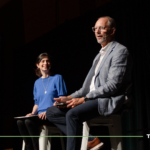




At TGCW26, Mark Vroegop teaches us from Psalm 102 in his keynote talk, Turn to God in Suffering.
Transcript
The following is an uncorrected transcript generated by a transcription service. Before quoting in print, please check the corresponding audio for accuracy.
Mark Vroegop
Let me invite you to take your Bibles and open them to Psalm 102 Psalm 102 as you’re turning there, let’s pray. Oh, Lord Jesus, we want your name to be exalted, we want your glory to be seen, we want your comfort to be felt, and so we pray that you will meet with us, pray that you will speak to us, and pray that you will help us. We ask this in your name, King Jesus. Amen. It, please, Lord, not this on my knees next to our bed in the early morning hours, that’s the prayer that I prayed, please, Lord, not this. My wife had just woken me up, and with a panicked sound in her voice, said, Mark, something’s wrong with the pregnancy. We were just a few days away from our delivery date of what would have been our fourth baby. She said, I’ve been up all night, been shifting, and there’s just no movement, and I’m really scared. She left the bedroom. I pulled back the covers, dropped to my knees, and prayed, God, please, please, not this. A number of hours later, we went to the doctor’s office, and he took the stethoscope, and he put it on my wife’s womb, and we were waiting to hear the sound that we had heard so many times before of that. As the doctor moved over her womb, there was a silence that was frightening. We then moved into the ultrasound room, and he took the wand and put it on her womb again, and I could see the grainy outline of our daughter’s body, and he put the wand right where her heart was, and he said, “I don’t know how to tell you this, but your baby has died. That moment 22 years ago rocked us, and yet I am here today to tell you it didn’t ruin us. That journey was long and hard, and throughout the course of a number of years we tried to pour out our hearts in desperation, trying to process the pain of what was happening inside of us. The sadness that I felt, and my wife felt in that moment, was like nothing we had experienced before. Its presence was frightening, and the anticipation that our lives would never change was almost at times a feeling like it would be too much to bear, and following the stillbirth of our daughter, we began to pour out our hearts in desperate candor. I found words and phrases in the Bible that had been there before, but now I saw them, and I heard them differently. It’s as though grief had tuned my heart to hear things and see things that I had never seen before, and in that journey I discovered the minor key language of lament. I’ve been a pastor for years. I went to a good seminary, and I don’t know if I was sleeping when the Psalms were taught, but I missed it. To this day, I don’t know how, and through this journey, and over a number of years, I began trying to voice my fears and my struggles, I was trying to hold two things together at the same time. God is good. This is really hard, and the Lord brought us on a long journey in lament. So, when I come to Psalm 102 and I see the title in the ESV, which says this: A prayer of one afflicted when he is faint and pours out his complaint before the Lord, I see that, and my heart goes, Thank you for putting this in the Bible, because this psalm sounds like me, and what I want to do is help you understand how psalms of lament, in general, and this particular psalm speaks the language that you speak, and I want you to have permission. Mission to talk to God to process your pain, so that you can come through your sorrows and pray through your griefs, and come to the conclusion, my life is hard and God is still good. To come to the conclusion, I don’t know why, but I know who, and He’s in charge and in control, and somehow someway God’s going to help us. In the text today, we’re going to look at three things. Number one, I’m going to invite you to turn to Jesus in your pain.
Mark Vroegop
I’m going to invite you to two, to tell Jesus about your pain, and three to trust Jesus through your pain, so turn to Jesus, tell Jesus, and trust in Jesus. And my hope is that you’ll come to embrace this biblical language of lament, that you’ll make it your own, and you’ll find comfort by turning to the man of sorrows who is acquainted with grief. I want to invite you to do what Jeremiah says in Lamentations three, and how the New Living Translation renders it. When he says this: I will never forget this awful time, and yet I will dare to hope. So, first turn to Jesus in your pain. Look at verses one and two as I read them. Hear my prayer, O Lord, let my cry come to you. Do not hide your face from me in the day of my distress. Incline your ear to me and answer me speedily in the day when I call. Let me start with a definition of what a lament is. A lament is a prayer in pain that leads to trust. Again, a prayer in pain. So, these are psalms, in particular, that were sung, and they are prayers. They’re prayers that we offer in pain, and it might surprise some of you to know that 1/3 of the sacred songbook in your Bible are laments, one out of every three, and you know why that’s really helpful, because it means that if you have a bad day about one out of every three days, you’re biblical, like you’re right there, that’s helpful for me, like I’ve had them a bad day, but it’s day four, I’m ahead of the curve of the Psalms, one out of every three. It’s a prayer and pain that leads to trust. Laments give voice and words to emotions that we feel because of suffering and the questions that are implicit. Listen, I trust that you know that suffering is a central part of what it means to be a Christian. There are so many hardships in life. If I, if I run into a young person who says, “I haven’t really suffered, my answer is, “Well, I don’t want to be depressing, but you just haven’t lived long enough, and yet that’s not a depressive dark cloud sort of statement, that’s that’s the real world, life is full of struggles, and maybe you’re here and you’ve recently said something like this, I don’t know why this is happening, or I cannot see the point in this, or I’m not sure I can handle this, or I don’t see how this fits into anything that’s going to be good. Listen, the human heart always longs for that answer to the question of why, and yet most of our lives, the why question is not fully answered. Most suffering is unexplained. However, that does not mean that suffering is meaningless. Lee Duncan writes this for the believer, there is no such thing as meaningless suffering, nor is this psalm, Psalm 102 about inexplicable or unexplainable suffering. All suffering is ultimately explainable. It’s just that in the most of our lives, as in the most of the lives of believers from the days of the Bible, it is not in God’s inscrutable plan to explain to us the reasons for our suffering, for our afflictions, for our tribulations. In the end, He writes, all will be clear, but for now, much of what we do and experience is unexplained, so what do you do with that? My answer, well, you better learn how to lament, because lament is the means by which you can live with un. Inexplicable or inexplicable suffering. Can I just encourage you that perplexing suffering doesn’t mean pointless suffering. You may not know why, but it doesn’t mean there is no point to it. So, how do we live with unexplained suffering, and you know we do. We talk to Jesus about it. The Bible invites us to turn to God in prayer to pray. The language of lament gives us a pathway for processing the tensions of believing that God is good, while we live in a world that is filled with all kinds of pain. There are over 50 psalms that invite us to turn to Jesus, to talk to him, to tell him, and this is why the psalmist begins this way.
Mark Vroegop
He says, Hear my prayer, O Lord, let my cry come before you. It’s the psalmist saying to God, please listen to me. This is similar to what we read in Psalm 3912 hear my prayer, O Lord, give ear to my cry. Hold not your peace from my tears. Listen, you know this to be true. It is one thing to be suffering, and for it to be confusing, it is another for you to be ignored when you’re in pain. It is one thing to have suffering be invasive, it’s another to have people avoid the very topic, and what happens is that suffering creates a paradox where there’s a longing to have your suffering recognized, and yet it’s so hard to know what to say when somebody says, How are you? And so, what do we do with this? Well, we learn to lament, because we can do all of this before the King of Kings and the Lord of Lords. He gives us permission to pray through our tears, the confusion and the loneliness, and that’s why verse one pleads with the Lord to hear His cry. He says, ‘Hear my prayer, hear my cry. There’s a, there’s an escalation in it, and in verse two he says, ‘Do not hide your face from me in the day of my distress. The idea is he is fearful that God would somehow ignore him or reject him. Eugene Peterson says it this way: Do not turn your back on me just when I need you so desperately. Suffering has a weird way of showing you who really cares for your soul. Suffering often doesn’t even feel survivable, and then if you add isolation and abandonment in it, it’s just absolutely terrible, which is why the psalmist is inviting God to lean into his pain. He says, “Incline your ear to me, answer me speedily in the day that I call. So the psalmist here is reaching out to God in the midst of his pain, and we’ll see more about how he describes it. We don’t know the exact circumstances, but what we do see, and what we need to learn from the outset, is that lament is a prayer, a prayer in pain that leads to trust. We talk to God about our sorrows. To be a lamenter is not to be faithless. No, on the contrary, given the prominence of the Psalms and the laments within them, to lament well is an act of faith, to struggle, to question, to talk to God about our emotions is part of what it means to be a Christian. After all, it’s the martyrs in Revelation six who say, How long, O Lord? And it is our Savior who on the cross said, My God, my God, why have you forsaken me? He quoted a lament, Psalm 22 Michael Card says that lament is one of the most deepest and most costly demonstrations of belief in God. Stacy Smith writes this: a lament, honestly and specifically, names a situation or a circumstance that is painful or wrong or unjust. In other words, a situation or circumstance that doesn’t line up with what you know about God’s character, and therefore doesn’t make sense in His kingdom. Lament is the cry of a hurting, confused, and yet faith-filled believing heart. It’s an act of faith where we resist the temptation to stop talking to God because we are in pain, or because we are sinfully angry, or because we are disenchanted, or disillusioned, laments express what God already knows to be true about our hearts, and it’s the way that we process our sorrow. It means we stop giving Jesus the silent treatment. Is there anything that you’ve stopped talking to God about? Any questions that you’ve not asked? Maybe part of the. Reason that you’ve given him the silent treatment is it’s just exhausting. I get it. Just start with Psalm 13 and read it out loud as your prayer, or 49 of the other psalms. Or maybe the reason you give him the silent treatment is you don’t know exactly what to say, you can pray the Bible. Maybe you didn’t know that you had permission to talk to God about the sorrows of your heart, or maybe you’ve been burned. One of the things that we experienced is that people in the church, myself included, aren’t really good at helping grieving people.
Mark Vroegop
We say really unhelpful things. We don’t, we don’t know how to help people who are grieving. We, we jump in when we need to wait. When my wife and I were newly married, there was a day when I came home from the church, and she was sitting on the couch, and she was quite sad. This was way before the stillbirth of our daughter, and I learned an important lesson in this moment. I sat next to her and I said, Sarah, clearly your burden, tell me what’s going on. So she started to unpack just the troubles of the day, and before she got, I don’t know, like two and a half minutes in, I was like, oh, I know what we need to do here, and so I interrupted her, and I said, wait, wait, wait, here’s what you need to do, and then she looked at me, and I had this sinking feeling like oh no, and I said, wait, what’s wrong? And then she said, this, Who are you right now? And I was like, I’m your husband, she said, No, who are you right now? And then I knew, oh, this is not going well. And I, and I said, who would you like me to be? And she said the other husband. And then I realized, all right, so if he was here, what would he be doing right now? And she said, well, he wouldn’t be talking, and I said, this is true story. I said, let me go get him. And so I walked out, and I came back, and we literally replayed the conversation over. I’ve only done that once. No, that was many times. If I was to write a follow-up book to Dark Clouds, Deep Mercy, about how to help your friends when they’re grieving, the title of my book would be Stop Talking, Just Be There, I I have no doubt that there are several of you who have stopped talking to God, and I want to invite you to dare to hope again and start opening your heart to the possibility that Jesus can help you if you’ll start talking to him. He invites you through the laments. I hope you’ll be encouraged to start talking to him again about the sorrows of your soul. I hope you’ll read the lament psalms and realize how much your words are there right in the Bible and I think of the hymn writer who said, I must tell Jesus all of my trials, I cannot bear these burdens alone. In my distress, He kindly will help me. He ever loves me and cares for His own. I must tell Jesus, I must tell Jesus, I cannot bear my burdens alone, so the first thing we see in this text is that we, we talk to Jesus, we turn to him in our sorrow and in our pain, we don’t allow it to give him the silent treatment, instead we, we open our hearts to him, and then the question now is, okay, so secondly, what do we do, and the answer is, we tell Jesus about our pain. This is the longest portion of the psalm, verses three through 11. It’s a vivid description of the pain that the psalmist is experiencing, and 10 verses out of the 28 capture the anguish of his soul. He pours out his complaint before the Lord. So we’re going to hear a lot of pain now. Before we get into this, there’s biblical complaint, and there’s sinful complaint. Sinful complaint is when you come to God with a demand. Ending attitude, like, how dare you hurt me? You owed me a good life. This wasn’t the deal. You better fix this. That’s not lament, that’s sin. And it should be repented of quickly. Biblical complaint is different. Biblical complaint is simply laying before the Lord the reality of living in a broken world and acknowledging how hard and painful it can be. Honest, humble, pain-filled complaints offered to God are part of what it means to be a follower of Jesus, and the book of Psalms, in particular, is full of them. Look at verse three, where it begins, for my days pass away like smoke, and my bones like they burn like a furnace. It feels like his life is fleeting, like it passes away like smoke.
Mark Vroegop
I remember driving home, learning that our daughter in utero had passed away, and realizing everything has changed right now, everything and life can pivot so quickly. Life feels like passing smoke. He’s his body is burning, perhaps a fever or just some raging sense of uncomfortability. In verse four, he’s discouraged. My heart is struck down like grass and has withered. I forget to eat my bread. He’s not eating, he’s not hungry. And those of you who’ve experienced grief, you know, yeah, this is what it feels like. There’s no appetite. Verse five, because of my loud groaning, my bones cling to my flesh. He’s losing weight. There’s physiologic physiological effects of grief in verse six. I am like a desert owl of the wilderness, like an owl of the waste places. So, in Indiana, we have mourning doves, and they sit on top of houses, and in the morning they have this sound that they make, and they’re always there by themselves, and the psalmist is saying, I’m like this bird on a housetop, and I feel isolated. Some of you know what this is like, not to be all by yourself, but to be in a large room, maybe Sunday morning services, or maybe in this room, and one of the loneliest places you can be is in a crowd of people with a deep burden, and you just feel like nobody understands, or as the people around you are singing and worshiping and experiencing the beautiful triumph of Jesus. All of what you believe in that moment, it’s hard for you to engage in worship because your heart is just wrestling with how do I make it. This grief doesn’t feel sustainable, it’s isolating. Verse seven, I’d lie awake again, I’m like a lonely sparrow on the housetop, so he can’t sleep. Can you relate to this? For some of you, this is the first time you’ve ever seen this kind of language in the Bible, and it’s like God is just describing your world. I just want you to know, God sees you, He loves you, He knows you, and your experience is not just isolated to you. There are all kinds of people who know exactly what it’s like to walk that hard path, and there are inspired words in your Bible to help you know you can talk to Jesus about this. The trouble is, is the culture of so many of our churches is that grieving people don’t really have a space. As a result, I’ve seen so many people who fall into the ditch of denial or despair that they come to church and people ask them, How are you, and they think real Christians just deny the reality of how hard it is, they, they slap a Bible verse on their pain, and they, they kind of paper over it, because they think that real Christians just fake it till they make it. Or, on the other hand, there is this ditch of despair, where someone who’s struggling with these questions and wrestling with the contours of grief, feeling so alone and isolated, they begin to wonder, if I think like this, and I’m struggling like this. Am I even really a Christian? And yet, the book of Psalms have words that sound just like you. And so, lament is this beautiful language that invites us to talk to God about our sorrows. Now, some of you are thinking in the back of your head, wait a minute, doesn’t the Bible say we are to rejoice always? Yes, it does, and I’m not arguing that the Bible calls us to rejoice always, but what I’m suggesting is, how do you get there? Lament is the means by which you get to a point that you can confess the goodness of the Lord. Again, a prayer in pain that leads to trust. Look at verse eight, there’s more. All the day my enemies taunt me, those who deride me use my name for a curse. Other people are making it worse. Verse nine, for I eat ashes like bread and mingle tears with my drink. He’s literally eating, and it feels like he’s. Eating ashes and sorrow just comes out of nowhere, and suddenly he’s crying. Man, that sounds like my world. Sounds like a lot of grieving people that I know. Verse 10, because of your indignation and anger, you have taken me up and thrown me down.
Mark Vroegop
He’s worried that there’s a barrier between him and his God, and the roller coaster ride of grief has been so real and traumatic. And verse 11, my days are like an evening shadow, and I wither away like grass. Wow, skip ahead to verses 23 and 24 because here’s the other aspect of talking to Jesus about our pain. He has broken my strength in mid course. He has shortened my days. Oh my God, I say, take me not away in the midst of my days, you whose years endure throughout all generations. I remembered saying to my wife one time, I don’t know, this doesn’t feel survivable, like this level of pain, and that’s what’s so frightening about sorrow or grief, whether it’s intense or long term. It’s a frightening reality of how in the world are we going to make it. And I’m here to tell you one of the ways that you make it is by understanding and practicing the language of lament. What I want you to know, ladies, is that to lament is one of the most theologically informed things that you can do. Why do I say that? Well, listen to what Todd Billings writes. If a person did not believe that God was sovereign, there would be no cause for lament. Let me read that again. If a person did not believe that God was sovereign, there would be no cause for lament. It is precisely out of a trust that God is sovereign that the psalmist repeatedly brings his lament and petitions to the Lord. If the psalmist had already decided the verdict that God is indeed unfaithful, there would be no reason to lament. It’s because I believe God is sovereign. It’s because I believe that He’s good, but I come to Him and say, God, I know You’re trustworthy, I know You’re good, I know You’re righteous. How do I do this? God, help me hold these two things in tension instead of trying to reconcile them or paper over them or give them explanations that don’t hold weight, just help me to hold the tension of God. Hard is not bad, according to Romans eight, but hard is hard, and lament helps you to hold those two things in tension in our life. I wish the stillbirth was the end of the story in terms of our pain, but there were multiple miscarriages after that. It just felt like our sorrow kept going over, going on and on, and repeated over and over and over. And then finally, there was a moment where we got a positive pregnancy report, an initial blood work that said the numbers were going up, so we went to our doctor’s office to have this whole season of our life concluded, like it was going to be over, book ended, we’re done, and we were going to hear that heartbeat, we were going to see the image on the ultrasound. We go into the same doctor’s office, same ultrasound room, puts the same wand on my wife’s womb, and an ashen look comes over his face, and my wife said to him, “What? And he said, “I don’t.. I don’t know how to tell you this, but you have a blighted ovum. What’s that? He said, “You have a home for a baby, but there’s no baby. Basically, you caught a miscarriage early. I’m like, God, are you serious? I mean, a stillbirth, a funeral, our kids, the highs and lows. We just started hoping, and how this go out to the parking lot, we get in the car, we close the door. I looked at my wife, and I said, “Honey, do you, do you think you can pray? And she said, “I’ll try. I’ll never forget what she prayed. God, I know you’re not mean, but it feels like it today. What is she doing in that moment? She’s holding two things at the same time. I know, I know, I know, I know, I know. You’re not mean, you are not mean, you are not mean, you are not mean. But a blighted ovum after multiple miscarriages and a stillbirth. Are you serious? God, how do we, how do we, how do we do this? How do we do this? I It’s because we believe in God’s sovereignty. It’s because we believe in His goodness that there are tensions and struggles in the context of our lives.
Mark Vroegop
In that moment, my wife is trying to hold two things together: what she believes and how life is hard, and you will find that all over. Psalms. I trust that you know that there are things that you know aren’t true, but they feel true. What do you do with those? You lament them, you talk to God about them, you put them through the process, the rigor of a prayer in pain that leads to trust. I love William Cooper’s hymn. He says this: God moves in a mysterious way, his wonders to perform. He plants his footsteps on the sea and rides upon the storm, deep in unfathomable mines of never failing skill. He fashions up his bright designs and works his sovereign will. Ye fearful saints, fresh courage take the clouds you so much dread are big with mercy and will break with blessing on your head. I love that, because he acknowledges the clouds are real and they’re also big with mercy. 20-two years later, from that moment, I can tell you that God has proven Himself to be faithful over and over and over. There is a 20 year old daughter who will be here tomorrow, who God kindly gave us after the loss of our stillborn daughter, and it is remarkable to be able to trace the handiwork of God after two decades, but I will tell you that journey was hard and long and good and glorious. So we are to turn to Jesus in our pain, we are to trust, we are to tell Jesus our pain. Third, we are to trust Jesus in our pain. I want to be clear about something. Laments are not meant to be cul-de-sacs for pain, they’re not meant to be cul-de-sacs. Laments are meant to be conduits, they’re meant to move you through something. Let me caution you, you can have something bad happen to you, and that thing becomes your the thing. You know what I mean by that? Like, it doesn’t just become something bad that happens, it becomes your identity. Everything about your life now circles around this pain, and in our present cultural moment, you can get a lot of cultural cachet and power and authority by just staying in that pain forever, and it is not what God intends. He intends lament to be the means by which you move through that pain, not a cul-de-sac, but a conduit for pain, because laments are designed to lead us to trust. If you don’t get to trust, you haven’t actually lamented. Laments are the means by which we process the hardships of life, and then we recommit. I know he’s good, I know he’s good, and we see this big pivot in verse 12. Notice the first verse, the first word, rather, of verse 12 is, but you, Lord, are enthroned forever. So all of this hardship is true. I’ve got tears over my drink. My bread feels like ashes. I’m like withered grass. I feel like a lonely sparrow. I’m an isolated owl. All of that is true, but you are enthroned forever. Do you know that the Bible is filled with that kind of pivot? Joseph in Genesis 50, you meant it for evil, but God meant it for good. Asaph in Psalm 73 my heart and my flesh fail, but God is the strength of my heart and my portion, David in Psalm 30, weeping may tarry for the night, but joy comes in the morning, Lamentations three. I will never forget this awful time as I grieve my loss, but I will still dare to hope when I remember this. The faithful love of the Lord never ceases, his mercies never come to an end. Great is his faithfulness. It’s Jesus in John 16 saying, in this world you will have tribulation, but take heart, I have overcome the world. It is Paul in Ephesians who says, but God, being rich in his mercy, because of his great love with which he loved us, even when we were dead in our trespasses, made us alive together with Christ. And it is the Apostle Paul in Second Corinthians four who just strings together a list of pains and beautiful promises when he says this: We are afflicted in every way, but not crushed; we are perplexed, but not driven to spare; we are persecuted, but not forsaken. We are struck down, but not destroyed.
Mark Vroegop
Can I just tell you that through Christ, God has made it possible for us to realize the pivot that exists. I trust you know that God is a mere. Worker on these pivot moments, and I hope that you know this day, no matter what’s happened to you, that just because you can’t see the plan doesn’t mean there isn’t a plan. Just because you don’t know the plan doesn’t mean that it’s not a perfect plan, and the Psalms and the entire New Testament help us to see this verse 13. He says, ‘You will arise and have pity on Zion. Verse 14, your servants hold her stones dear and have pity on her dust. Verse 15: nations will fear the name of the Lord, and all the kings of the earth will fear your glory. There’s even an eschatological perspective happening here, for the Lord will build up Zion. He appears in His glory. Look at verse 17. There’s so much hope here. He regards the prayer of the destitute, and He does not despise their prayer. He’s open-armed to people who come to Him with hurts and difficulties and hardships. And then he says in verse 18, let this be recorded for a generation to come, so that a people yet to be created may praise the Lord. In other words, we’re laying anchors for the future, for people to realize that God is trustworthy. In fact, for those of you who are a little older, you got more water under the bridge, you may wonder, what do I have to offer? You know what you have to offer, you have to offer the fact that God proved Himself in your lifetime, and you got all kinds of stories, and you need to share those stories in the appropriate manner, in the right time, with people who are in their sorrows and their struggles. We see that the psalmist continues, and it says, verse 19, He looked down from His holy height, from heaven, the Lord looked down to hear the groans of the prisoners to set free those who were doomed to die, that they may declare in Zion the name of the Lord and Jerusalem His praise. When peoples gather together in kingdoms to worship the Lord. Skip to verse 25 of old, you laid the foundation of the earth, the heavens are the work of your hands. Notice all of this God-centeredness. He’s taking his pain. We’re a long ways from God. Do you hear me? God, do you listen to me? Are you going to incline your ear? We’re a long ways from.. I’m losing weight. I feel all isolated. The psalmist has intentionally anchored his soul in what he knows to be true about God when he doesn’t know what’s true about his life, and he’s rehearsing, he’s preaching to his own soul through the means of prayer, and this means of this language of lament. Verse 26 he says, They will perish, but you will remain, they will all wear out like a garment, you will change them like a robe, and they will pass away, but you are the same, and your years have no end. Here’s the thing, the writer of Hebrews uses this exact text to talk about Jesus. He takes this text and he says this is about Jesus, how he’s better than angels, that Jesus is the one who is the same, and that his years have no end. So, how does all this connect to the cross? Oh, how it connects to the cross, because it is in the cross of Jesus Christ and the empty tomb, we see that God specializes as taking the worst and causing it to turn out for the best. He takes something that looks like an absolute disaster, the crucifixion, the shame of the Son of God, and in three days flip the script, so that that then becomes the means, the backdrop by which now the resurrected Christ proclaims, I have defeated death. So, ladies, where do you take your pain when you’ve got little gas in the tank? Where do you bring your sorrows? You bring it to the foot of the cross, and you remind yourself of what Paul said in Romans eight. What shall we say to these things? If God is for us, who can be against us?
Mark Vroegop
He who did not spare His own son, but gave Him up for us all, how will He not also with Him graciously give us all things? In other words, if He did this, He do you think he can’t handle your wayward kids? If he did this, you don’t think he can handle your illness. You don’t think he can handle your failed marriage. You don’t think he can handle the worst things that are taking place in your life. Listen, your suffering may be perplexing, but it’s never pointless. And Jesus bought the right to make that right. There is coming a day, oh, I can’t wait, when there will be no more tears, when God will wipe away all of them from our eyes. There will be no more sorrow, no more sadness, no more injustice, no more loss. Our faith will be sight. There will be no more pain to talk to Jesus about until that day. Lament is our language. It’s the way we process our pain right now. It’s a prayer in pain that leads to trust. You can talk to Jesus about your sorrows, talk to him about your struggles. I don’t know what songs we’re going to sing in the new heavens and the new earth. I think it’d be pretty cool if we sang some Shane and Shane songs in the new heavens, new earth. That’d be, that’d be cool. I’d be like, I knew those guys down there, like that was the awesome. I don’t know all the psalms that we’re going to read, but I know a bunch that we’re not going to read anymore. A third of the psalms will no longer be relevant. Wow, a third, a third of the psalms are no longer relevant. Why? Because the ark of God’s redemption is complete. The end goal has been accomplished. Our faith has been sight, our sorrows have been finally healed, and Jesus reigns in all of His glory. So, again, William Cooper. So, ladies, judge not the Lord by feeble sins, but trust him for his grace behind a frowning providence. He hides a smiling face. His purposes will ripen fast, unfolding every hour. The bud may have a bitter taste, but sweet, I can tell you, sweet will be the flower, and then listen to this blind unbelief is sure to err and scan his works in vain. God is his own interpreter, and he will make it plain. So, what do we do? We do this while we’re here. We turn our eyes upon Jesus, look full in His wonderful face. face, and the things of earth will grow strangely dim in the light of His glory and grace, sing that again, ladies only.
Crowd
Turn your eyes upon Jesus, look full in His wonderful face. And the things of earth will grow strangely dim in the light of His glory and grace.
Mark Vroegop (BA, Cedarville University; MDiv, Cornerstone Seminary) is the president of The Gospel Coalition. He served in pastoral ministry leadership for nearly 30 years, most recently as the lead pastor of College Park Church in Indianapolis. An award-winning author, Mark has written several books, including Dark Clouds, Deep Mercy: Discovering the Grace of Lament and Waiting Isn’t a Waste: The Surprising Comfort of Trusting God in the Uncertainties of Life. Mark is married to Sarah, and they have three married sons, a college-aged daughter, and five grandchildren. You can find Mark on Facebook, Instagram, and X.