



Are evangelicals obsessed with angels and demons? Or do evangelicals not give enough attention to the unseen realm?
How you respond to this question will likely be driven, at least in part, by your background and church experiences, and perhaps your faith tradition.
Some evangelicals have grown up among Christians who see spiritual forces at work everywhere, with territorial spirits causing chaos and invisible angelic battles happening above us—with real-world consequences in society. It’s the world of Frank Peretti’s This Present Darkness. It’s no surprise that these believers grow weary of constant speculation and begin to question pastors and church leaders who extrapolate all manner of angelic and demonic activities from apocalyptic passages in Scripture. At the mere mention of the spiritual world, these Christians may think it best to shut the door to anything that goes beyond the bare affirmations we find in Scripture.
But what do we do with the Christians who came before us? Thomas Aquinas gave a lot of attention to angels in his Summa Theologiae, and he reflected on the question of their nature and activity in multiple disputations. Building on the work of Pseudo-Dionysius from the fifth century, he argued for three hierarchies, made up of three choirs each, thus giving us nine categories of angels in descending order from God.
And the stubborn witness of the church through the ages is that this world is indeed teeming with powers and principalities all around us—perhaps not exactly in line with the charismatic inflection of ’90s Christian fiction but closer to that than to a worldview that minimizes or ignores the unseen.
We must also reckon with the global church, especially the continents where Christianity is growing by leaps and bounds. In societies less secularized than ours, Christians don’t see spiritual forces as peripheral but as central to Christian life and witness.
Esther Acolatse’s Powers, Principalities, and the Spirit surveys the scholarship from around the world and considers the disparity in treatment of angels and demons. She acknowledges the Global South’s tendency toward overinvolvement with the spirit world, due in part to syncretism with primal religions. But she warns Christians in the North and West against another kind of syncretism—Enlightenment-based assumptions that lead us to undervalue or dismiss these powers and their ability to permeate and affect the material world.
Two Books with Different Outlooks
So, which is it? Are Christians prone to reading too much into the biblical text or through the lens of their own experiences, thereby focusing on the spirit world more than is appropriate? Or are Christians giving short shrift to angels and demons, thereby missing the backdrop and influence of the unseen realm in our world today?
Let me point you to two recent books that offer an overview of angels from an evangelical perspective. Both are from excellent scholars with whom I’ve had wonderful interactions over the years. One leans heavily toward the “let’s not speculate” side of the spectrum (aptly describing himself as a “killjoy” for the student overly excited to explore angelology). The other believes biblically based speculation, in conversation with the great Christian tradition and with believers from other parts of the world, can be fruitful.
Minimalist Approach
The minimalist approach is on display in the work of John R. Gilhooly, a professor at Cedarville University, whose 2024 book Angels and Demons: What the Bible Says About Spiritual Creatures does exactly what the title promises. Gilhooly is a “reluctant angelologist”—intrigued by what the Scriptures say about angels, yet finding the Scriptures lead to this unexciting conclusion: “I just don’t think angels are that important.”
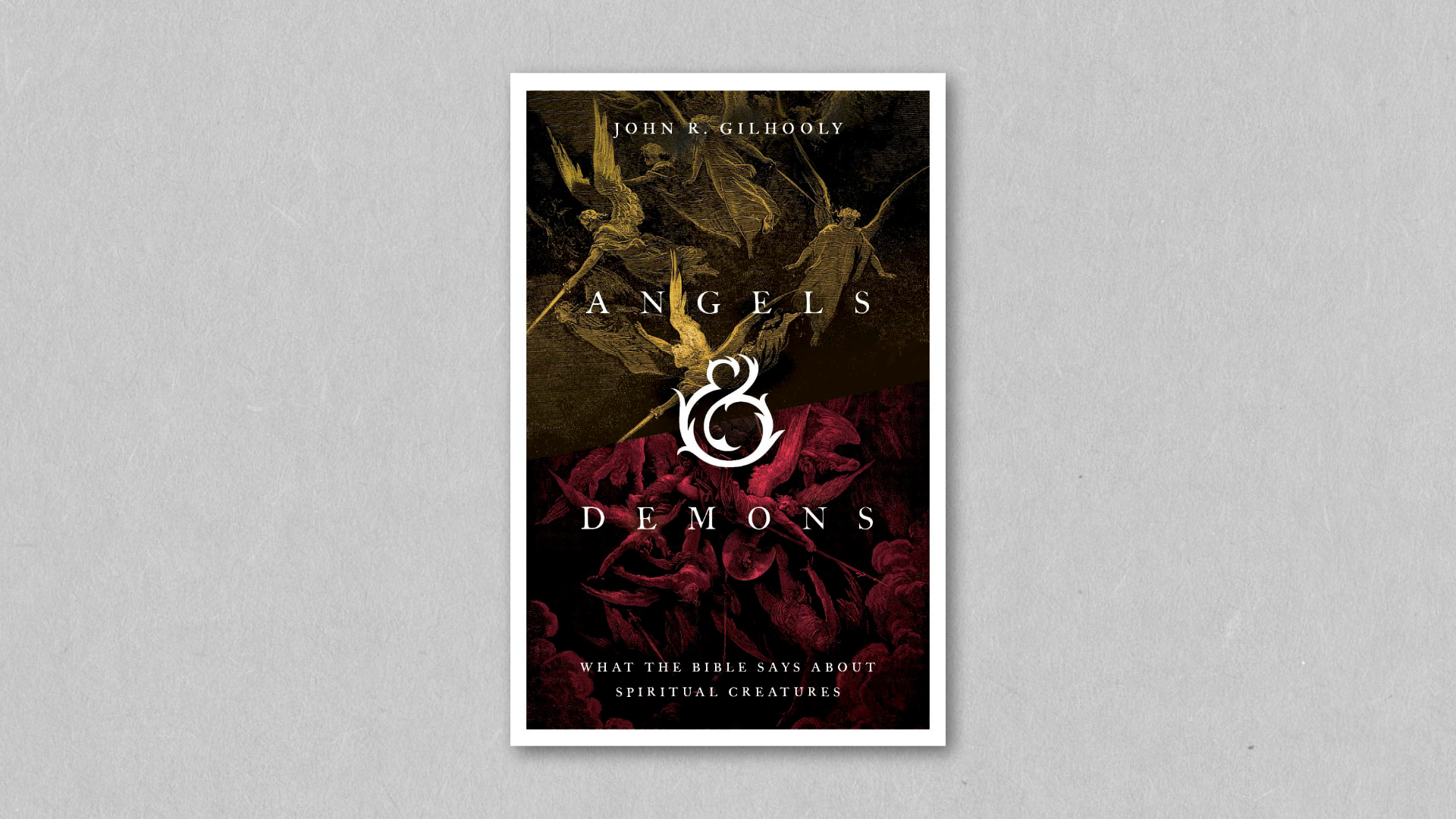
Angels and Demons is a splash of cold water for the person prone to the excesses of popular-level treatments of angels in culture, fiction, and charismatic Christian books. Gilhooly doesn’t see the unseen realm of angels and demons as occupying a space anywhere near the center of the Christian faith, and so he pushes back against unhealthy fascination and the downright misleading speculation that results.
The Holy Scriptures do not say much about angels. They are depicted doing only a handful of things, and they stay largely behind the scenes. The occasional glimpse behind the curtain is not an invitation to go backstage.
For Gilhooly, what’s central in Scripture should be central for us. A never-ending list of questions about angels can become a distraction. Angels are mentioned, yes, but they’re rarely described in detail and their nature hardly discussed. That’s the cue we should take. “If the Bible doesn’t say much about angels, then maybe we should not try to say too much either,” he concludes.
Gilhooly may be a reluctant angelologist, but he has a high view of Scripture’s inspiration and authority. He’s no modernist or antisupernaturalist, which becomes clear as he walks through the important biblical passages about angels, showing us what these beings say and do and what role they play in God’s redemptive purposes.
The book includes a chapter on demonology and then addresses common questions that arise. A sampling: Do I have a guardian angel? No. Are there territorial spirits? No. Do people become angels when they die? No. Who were the the Nephilim? Whatever the answer, it’s got nothing to do with angels or demons. Gilhooly closes the book by quoting every time the word “angel” appears in Scripture.
Angels and Demons comes across as a tonic from a friendly professor a bit wearied by a barrage of questions from wide-eyed students about angels or supernatural encounters and feels compelled to say, I hate to rain on your parade, but it’s not proper to speculate about things the Scriptures aren’t clear on, so you’d do well to keep your focus on the main thing and get on with the Christian life. If it’s not spelled out in Holy Scripture, it’s best not to speculate further.
More Expansive Approach
The second book is Ultimate Guide to Angels and Demons by R. Lucas Stamps at Anderson University. Don’t let the snazzy cover and overstated title, designed for the rack at Walmart, throw you off. This is a work of serious scholarship, filling nearly 400 pages with careful consideration. It’s encyclopedic in its scope, and gorgeous artwork is interspersed throughout.
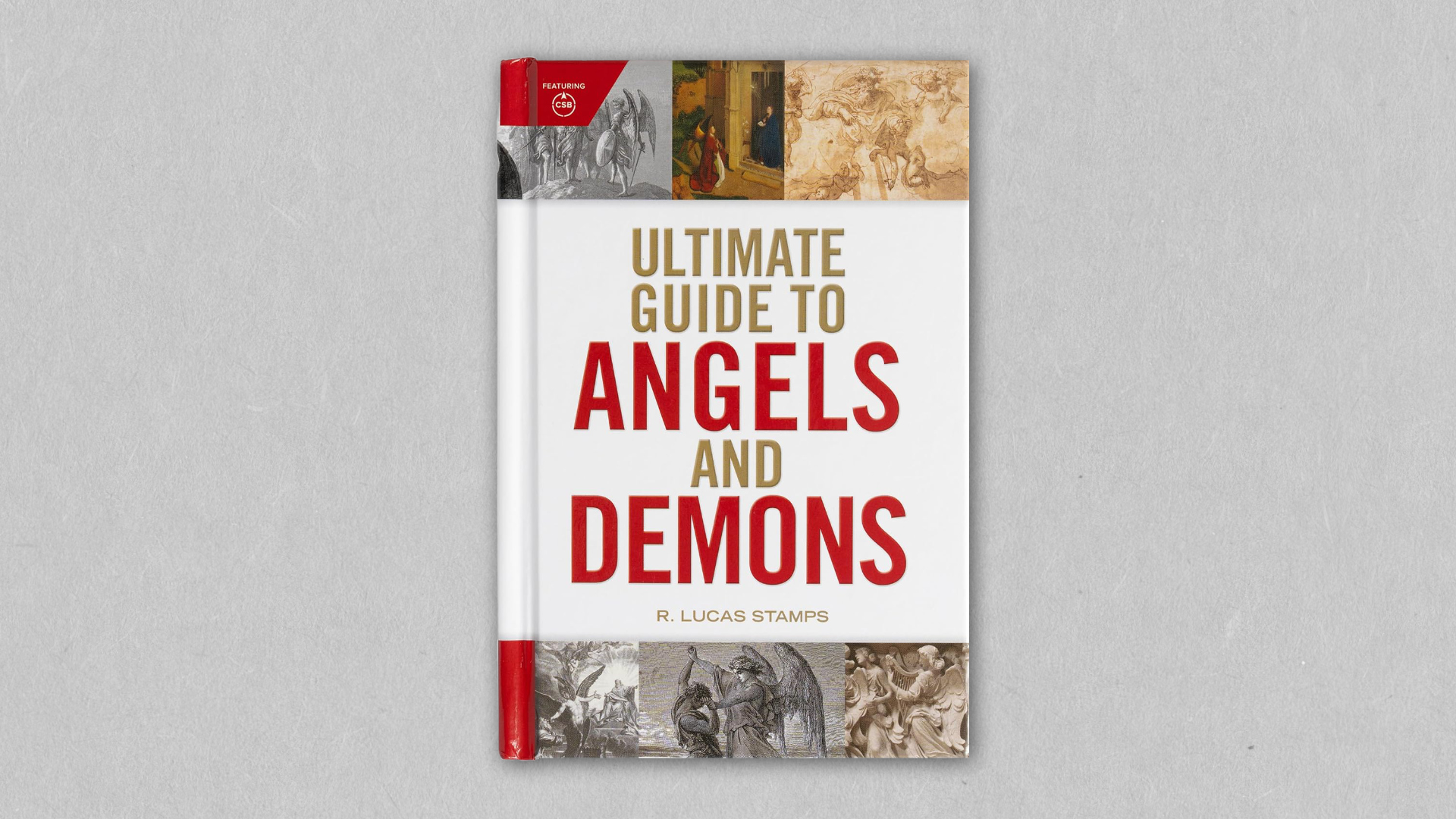
What differentiates these books isn’t only the length (Gilhooly’s comes in right at 200 pages) but the choice of conversation partners. Like Gilhooly, Stamps devotes attention to angels and demons as described in the Old Testament and then the New, but all throughout his biblical survey, he’s listening to the broader Christian tradition as he engages in interpretation. Then he ventures into the view of angels we find in church history: the patristic era, the medieval era, the Reformation era, and the modern era. The latter part of the book includes a summary of all the biblical and historical material, with Stamps offering his theological and practical reflections on these supernatural beings, before closing with a critique of contemporary approaches and what we see in popular culture.
Like Gilhooly, Stamps is happy to rain on the parade of popular-level imagination about angels. The difference comes from Stamps taking in the full scope of Christian history and theology, leading to a more favorable assessment of the whole enterprise of angelology.
The great need, Stamps believes, in our “desacralized, despiritualized, disenchanted” Western world is the “remystification of the contemporary church.” Stamps commends further reflection on angels for several reasons: (1) because it’s delightful to do so, (2) because the Bible says a lot about them and showcases them in every phase of the biblical storyline, and (3) because such study is theologically and practically beneficial.
Gilhooly sees angels as peripheral, but Stamps sees these beings intersecting with virtually every topic of Christian theology (creation, providence, Christology, ecclesiology, and eschatology). If we care about Christian doctrine, he says, we have to care about angels. And in everyday Christian life, “studying angels and demons enriches our worship, our prayers, our battle against sin, our thanksgiving for the saving work of the triune God, and our hope in the future redemption.”
Two Treatments, Two Worlds
In reading these two books together, even with their different approaches, it’s fascinating to see how often Stamps and Gilhooly agree on their conclusions. Both authors believe the “sons of God” in Genesis 6 are humans, not angels. Both deny that believers can be possessed by demons. Both caution against elaborate exorcism rites. Both show admirable caution regarding extrabiblical speculation.
On occasion, they differ—Stamps is open to the possibility of guardian angels, while Gilhooly gives a categorical no. The biggest difference isn’t in their answers to specific questions but in the world we’re left with as readers. I’d love to get the two of them in a room and host a conversation about this, because it’s here—the question of what kind of world we live in and how it shapes our belief and practice—that I find the point of departure.
For Gilhooly, the unseen realm is whatever is happening behind the curtain. It isn’t intended to be the focal point. We can only know for sure whatever Scripture tells us explicitly, and truth be told, the presence and power of God’s special messengers doesn’t merit the massive speculation it has generated among theologians over the centuries. Of course, there are angels in Scripture, but what matters most is their message. Fascination with the spiritual realm can distract us from directing our gaze to the God who is over all of this world, seen and unseen. Even if the world is teeming with spiritual forces, these mysteries are ultimately unknowable, so the everyday Christian should stay focused on the gospel.
For Stamps, a more robust approach is to be commended. We’d do well to give more attention to the unseen realm, not less, because by doing so we line up with the majority of Christians through the ages (though he acknowledges their excesses at points), and because angelology gives us another way to counter the flattened-out materialist world bequeathed to us by secularism. Yet even more important than these reasons, Stamps believes the Bible itself describes a world in which angelic activity is ever-present.
To this, I think Gilhooly would point out how the Bible mentions angels casually, refraining from detailed description or discussion. In response, I suspect Stamps would say the lack of scriptural explanation itself indicates the sheer normality of the unseen world impinging on the world we can see. Yes, we note throughout the Bible the role of “signs and wonders,” but as Peter Harrison’s Some New World has argued, it would be hard to explain the difference between “supernatural” and “natural” to a premodern Christian because they saw all creation as permeated with God’s presence.
My Two Cents on the Big Question
So, do we make too much or too little of angels? There’s no easy answer, for it’s possible for someone to become obsessed with angels or demonic encounters, or to go overboard in attributing too many circumstances and trials to powers and principalities. In some charismatic circles today, we can find aberrant applications and strange doctrines untethered both from Scripture and church history.
But in the circles I run in, I think we make too little of angels. I’d like to see more exploration, especially in connection with theodicy and the angelic fall. I think even fantasy writers like C. S. Lewis and J. R. R. Tolkien, who understood something of the ancient mind and the medieval conception of the cosmos, have insights to offer in how we think about the primeval world. I believe we have solid scriptural reasons, backed up by theologians and scholars throughout history, to see angels as active stewards and guardians in the world, and we find clues to help us guess at how their oversight is implemented and hierarchy arranged.
What’s more, in everyday Christian practice, I’m brought face to face with unseen spiritual realities whenever I pray the Lord’s Prayer. To pray for the name of the Lord to be hallowed surely calls for praise not only to ascend from humanity but also to join the chorus of angels around God’s throne. To pray for deliverance from evil (specifically, the Evil One) not only names the fallen angel who is our Enemy but also recognizes that God may answer our plea for help by assisting us with angels unaware.
When I pray against the schemes of the Evil One and his minions, and when, at night, I pray for the protection of holy angels over my house and family, I acknowledge the mysterious nature of the world I cannot see, and I entrust myself to Jesus, King of angels.
Something I often ask myself: If my view of the world seems at odds with the majority of Christians throughout history, why is that the case? Is it because Christians in the past succumbed to unhelpful and unbiblical speculation? Sometimes, for sure. Or is it because I’m more influenced than I realize by the materialist, secular world I inhabit? Surely that’s more often the case.
Look for yourself at the Scriptures. Engage with church history. Talk with Christians in other parts of the world. How much we do we make of angels? I suspect for most of my readers, it’s too little, not too much.
If you would like my future articles sent to your email, as well as a curated list of books, podcasts, and helpful links I find online, enter your address.