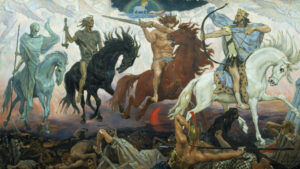
In his 2005 book, The Singularity Is Near, Ray Kurzweil predicted that within a century, we’d achieve what he called “resurrection,” not through divine salvation but through technological progress. The singularity, the moment when artificial intelligence achieves equivalence with human intelligence, will allow, he predicted, human minds to exist within a digital substrate.
Once this is possible, digitally preserved minds will simply await embodiment in superior physical vessels designed to transcend our corruptible flesh’s limits. Death, in this view, isn’t an end but a technical problem that can be solved by consciousness transfer and a bodily upgrade.
What I’m describing isn’t merely science fiction but the earnest hope of a growing movement—transhumanism. Transhumanists from Silicon Valley to philosophy departments in major universities are seriously pursuing a technological conquest of mortality.
Yet this vision isn’t novel. Strip away transhumanism’s digital vocabulary, and you’ll find a narrative familiar to any student of Christian eschatology: the soul’s departure from a failing body, a disembodied intermediate state, and finally resurrection into a glorified form designed for eternal life.
What Drives Transhumanism
What drives transhumanism is what drives nearly all life philosophies. We’re all aware of our finitude; with fear, we know that our bodies age, get sick, and die. We also experience what C. S. Lewis describes as a longing for “another world.” We have an inkling that life is more than mere physical existence, more than the sum of our biochemical processes.
We live with a tension: We’re material beings, but we also understand ourselves as having a supermaterial existence. We recognize that humans are more than our bodies.
Strip away transhumanism’s digital vocabulary, and you’ll find a narrative familiar to any student of Christian eschatology.
Traditional materialism resolves this tension by downplaying humanity’s ontological significance. For the naturalist, our sense of being more than matter is ultimately a survival mechanism granted to us through evolution. We’re not “shining human creatures” made in God’s image but meat computers, or as Daniel Dennett put it, “moist robots.”
Contemporary transhumanism pushes on this materialist move, not by rejecting the ontology but by trying to accommodate our longings for more. If we mere meat computers long to transcend our material bodies, perhaps digital technology can help us fulfill that desire.
Transhumanist Resurrection
The predominant transhumanist theory of personal identity holds that each person’s mind comprises the patterns—thoughts, beliefs, desires, habits, and memories—unique to that individual. Most, perhaps all, transhumanists suggest these patterns can be attributed to electrochemistry in the brain, but many admit the patterns aren’t merely electrochemistry.
However the patterns are understood, the key truth of transhumanist doctrine is that they can be preserved beyond death. Wherever the patterns go—whether the digital substrate is a server, hard drive, a new robot body—that’s where the person is.
The transhumanist vision, then, entails that prior to our death, our patterns will be uploaded to a computer. Then we’ll exist for some time as digital code before our patterns are downloaded into new, better bodies.
The parallels to Christian eschatology are striking. Both frameworks recognize that human life as currently constituted is unsatisfactory because it’s marked by suffering, limitation, and death. Both also refuse to accept death as final, envision the preservation of personal identity through and beyond bodily death, expect a waiting period between death and final embodiment, and anticipate a superior form of bodily existence.
Better Metaphysic
Transhumanists think technology can help human minds transcend their bodies, and when they talk about this goal, they smuggle a nonmaterialist metaphysical vocabulary into their materialism. Prominent transhumanist thinkers such as Kurzweil and Max More admit that their discussions of mind uploading, digitally disembodied existence, and consciousness transfer into new bodies all sound similar to Christian teaching about bodies and souls.
But the difference between transhumanists’ “grammar of redemption” and the Christian vision is God. In Confessions, Augustine describes the human heart as “restless until it rests in [God].” With those words, he recognizes our present existence points beyond itself toward greater fulfillment in Christ. But his words point to a means of salvation that’s different from what the transhumanists anticipate too. Augustine sees human restlessness as evidence we’re made for a relationship with the Lord; the transhumanist sees our restlessness as a reason to create ourselves anew through technology, as a reason to play God.
The transhumanists’ error isn’t in the longing for transcendence but in the proposed means. They rightly see our need for redemption, but they want to attempt it by a wholly inadequate means; they’ve located salvation in human achievement rather than divine gift.
Better Hope
Before we congratulate ourselves for not being transhumanists, we should realize that the same impulse to replace God with achievement also lurks in our hearts. It’s far too easy to think a promotion, an accomplishment, or the arrival of a new stage in life—perhaps finding a spouse or having a child—will magically make us whole. Our world is full of counterfeit redemption stories, and our sinful hearts constantly point us away from Christ to these artificial substitutes.
Augustine’s “restless heart” is a diagnosis for all of us, not just materialists and transhumanists. Whether we recognize it or not, we all regularly create new grammars of redemption for our idols. We’re all seeking paths to transcendence. The question is whether we’ll be honest enough to admit that these paths don’t save, that we can’t engineer salvation ourselves.
History gives us little reason to trust human achievement as a foundation for hope. Babel’s builders reached for heaven but were scattered across the earth (Gen. 11:1–9). Isaiah watched Judah court Egypt’s armies, trusting chariots over covenant, and warned them plainly that flesh-and-blood help built on human muscle alone never holds (Isa. 31:1–3). The pattern is consistent: The higher the tower we build to transcend our limits, the more spectacular the collapse. Transhumanism is just one pending example.
Whether we recognize it or not, we all regularly create new grammars of redemption for our idols.
Thankfully, Christian eschatology offers what the counterfeits can’t—a resurrection that rests on Christ’s finished work. We can’t achieve redemption for ourselves, but our redemption has surely been achieved.
This doesn’t mean we should stop striving for our goals. The promotion, the completion of a project, getting married and having kids, or even improving technology can all be good things. But hope in Christ helps us to reorient those goals away from achieving salvation for ourselves and center them instead on God’s kingdom and glory.
Free eBook by Tim Keller: ‘The Freedom of Self-Forgetfulness’
 Imagine a life where you don’t feel inadequate, easily offended, desperate to prove yourself, or endlessly preoccupied with how you look to others. Imagine relishing, not resenting, the success of others. Living this way isn’t far-fetched. It’s actually guaranteed to believers, as they learn to receive God’s approval, rather than striving to earn it.
In Tim Keller’s short ebook, The Freedom of Self-Forgetfulness: The Path To True Christian Joy, he explains how to overcome the toxic tendencies of our age一not by diluting biblical truth or denying our differences一but by rooting our identity in Christ.
TGC is offering this Keller resource for free, so you can discover the “blessed rest” that only self-forgetfulness brings.