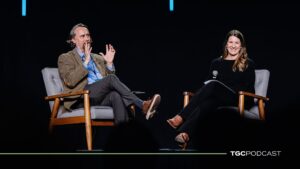
Don Carson highlights the complexities of conveying theological themes in different cultural contexts. He discusses historical uses of apocalyptic writing, the symbolism in biblical prophecy, and the challenge of explaining divine visions. Carson emphasizes the importance of diverse literary forms in scripture to convey the transcendent nature of God and the spiritual realities beyond human experience.
There was a time in Western history when Christians fought a great deal over eschatology, the doctrine of last things. Since then many have felt so burned out by the debate that they are inclined to give those passages of Scripture dealing with such matters a wide berth. The result is the various sectors of evangelicalism including Reformed theology have sometimes in the last 20 years or so focused so much on God’s blessings for the present that we sometimes overlook any hope for the future except in brief asides now and then.
This evening I am going to begin by expounding Revelation 4. Revelation 4 and 5 together constitute one vision. Chapter 4 is to chapter 5 what a setting is to a drama. That is to say, chapter 4 has no action, no plot, no developing story, but it sets the scene in heaven. Then with the scene set, something takes place in chapter 5 which we shall look at tomorrow night.
Before beginning this chapter, I want to say something about the interpretation of the book as a whole. Anyone with a most cursory knowledge of the New Testament recognizes the book of Revelation is the most difficult book to interpret, and I want to outline three or four reasons why this is so.
First, there is an inherent difficulty in talking about God the closer you get to him. For a while, my sister and her husband served as missionaries in Papua New Guinea in a tribe that was pre-Stone Age in its technology. That is to say, they did not even use stone on their arrowheads; they used a hard wood like ebony or teak on bamboo shafts, so from a technological point of view this was a very primitive people.
Suppose for argument’s sake, one of those people came out, one of those tribe’s people came to your hometown and you buckled down with that tribal person and learned the language. You spent five years at it, and you learned to speak the language fluently. Now let us suppose you have the assignment to go back into that tribal area and without using any visual aids explain to the tribe exactly what electricity is using only their language and no visual aids. How will you proceed?
You will begin in their language by saying something like, “I am here to tell you about … You don’t have a word for it. We’ll make one up. In your language we shall call it electricity. Electricity is like a powerful spirit that runs along hard things like vines. Only these vines are not something that grows; they’re something we make. We string them from tree to tree. Actually, we cut down the trees and take off all the branches and plant them in the ground again, but we string these vine-like things and we pump in a whole lot of this powerful spirit at one end.
Then this vine comes into our mud huts and it goes into square things we also make with round bits on top. This spirit-like thing, electricity, goes around so fast it makes something like a fire so you can boil water without actually having any smoke in your mud hut. Then it goes into other round things near the top of your thatched roof that makes many suns so that you can stay up late at night if you wanted to.”
How am I doing in my explanation of electricity? So far, I have not mentioned the molecular nature of matter. I have certainly not introduced anything about atomic weights. I haven’t introduced alternating and direct current. I haven’t introduced microchips. I haven’t introduced storage facilities or generating capacity. I haven’t introduced measures, ohms, watts, volts, and so forth.
What’s the trouble? Are these people stupid? No, of course not. If they immigrate to Canada, their children will probably beat ours. They’re not stupid. The children of immigrants often beat the westerners for a while. It takes us two or three generations to slow them down. Immigrants often try harder. What’s the problem then? The problem is their complete want of experience. They have no categories to understand these things.
How, then, shall we speak about God? How shall we talk about the throne room of God? Even the favored few in Scripture who are caught up like Paul into the third heaven or like Isaiah to see something of the trailing edge of the garment of him who stands in the temple use metaphors and symbols to get across what they see. Do you recall how Ezekiel ends up? “This was the appearance of the likeness of the glory of the Lord.”
Apocalyptic, then, precisely because it is so full of symbols is one of the tools God in his wisdom has used to give us an insight into the throne room of God because our experience of him is so benighted we do not have categories to understand it any other way. One day we shall but not yet.
There is another advantage to apocalyptic. Apocalyptic, this genre of writing, was, in fact, well known from about 200 BC to about AD 200. At that time, there were many books with this kind of symbolism written, some by Jews and some by Christians, but today nobody reads them. Nobody writes them.
A friend of a friend was passing out free New Testaments in a British university a few years ago, and his condition in giving them out was always that the person who received one would promise to read it. A few weeks passed and he bumped into this particular student and said, “Did you read that book I gave you?”
“Well, yes. In fact, as a matter of fact I did.”
“What did you think of it?”
“Well, it’s a very interesting book. A bit repetitious at the front end where it sort of goes over the same story several times, but I sure liked that science fiction at the end.” What is the student doing by commenting like this? The student is trying to find a modern genre, a modern category of literature, to make sense of the book, and of course, science fiction is entirely the wrong category, but you can understand what is going on.
One of the wonderful things about the Bible is that God in his wisdom has used so many different kinds of writing to get across his truth. Is that not so? There is history. There is parable. There are genealogies. There are laments. There are dirges. In 1 Kings there is even one fable told by Jotham. On top of all of this, there are letters, and there are metaphors and wisdom sayings and now apocalyptic.
One of the reasons for the diversity, of course, is that the sheer diversity also enables us to get some small insight into the diversity and richness of the mind of God himself. There is another element and it is extremely important, one we’ll see again and again. Not only does this belong to a certain kind of writing where the symbols are, by and large, well known in the first century, but also this kind of writing enables you to mix your metaphors.
This book rarely quotes the Old Testament in any extensive way, but there is scarcely a paragraph that does not allude to the Old Testament again and again and again. In some ways, the Apocalypse is the richest book in the New Testament for alluding to the Old Testament, and the more you know about the Old Testament the more the pieces come together in this book.
We shall see again and again and again the author inspired by the Spirit of God picks pieces from the Old Testament and puts them together enabling us to understand a little better what otherwise we would not understand at all. Let us turn to the text itself. John writes, “After this I looked …” That is, after the inaugural vision of chapter 1 and the messages to the churches in chapters 2 and 3. After this there is yet another vision.
We are not to understand that John’s call up into heaven here refers to some secret rapture of the church or the like. It is standard in this kind of writing for the seer to be called toward heaven to see something. There is no suggestion whatsoever this John represents the whole church so that this is a symbol for the church raptured out of the way. No. John is called into heaven.
He says, “There before me was a door standing open in heaven. And the voice I had first heard speaking to me like a trumpet …” That is the voice of the exalted Christ. In chapter 1, verses 12 and following, it is the exalted resurrected Christ who calls John up into heaven, and his voice was shrill and sharp and piercing like that of a trumpet.
John says, “The voice that had first spoken to me like a trumpet speaks to me again, and he says, ‘Come up here, and I will show you what must take place after this.’ ” After this may mean after our present situation in history (“I will show you what will take place next”), or it could simply mean, as I think it does, “I will show you what must take place in the sequence of visions after the visions you’ve already received. The next vision now takes place. After this you have received comes this next vision.”
You can only determine that on the basis of the vision itself. What, then, does John see? He says, “At once I was in the Spirit.” In chapter 1, verse 10, he has already declared when the first voice called him heavenward he was in the Spirit on the Lord’s day, called perhaps into some trance or perhaps called like Paul in 2 Corinthians, chapter 12, whether in the body or out of the body, he doesn’t know, called into heaven. But he is in the Spirit, and now he tells us what he sees.
1. John sees the centrality and indescribable majesty of the Almighty.
He says, “At once I was in the Spirit, and there before me was a throne in heaven with someone sitting on it. And the one who sat there had the appearance of jasper and carnelian. A rainbow, resembling an emerald, encircled the throne.”
John does not let his persecuted readers forget there are thrones above thrones. His readers either have been persecuted recently or are threatened with it in the near future. In either case, it is extremely important for them to remember the highest throne is not Caesar’s in Rome. Above the throne of the local governor or of the local magistrates or of the emperor himself is God’s throne, and it is important for us in our place in Western history when much of our culture is in declension and decay to remember God is still on his throne.
Yes, there are many things of which to repent. Yes, there are many things to concern us, but that does not mean God’s arm is shortened that he cannot save. It does not mean God has gone to sleep or has abandoned all his own blood-bought people. No. We need to be reminded as John reminded his people that above all earthly thrones, all the pressures and developments in Western society as in first-century society, there still stands over all of them one throne.
That is something Isaiah learned, of course, in his vision. It was in the year King Uzziah died that he saw the Lord. Once the earthly king was taken out of the way, he saw the Lord. Psalm 47 reminds us God reigns over the nations. God sits on a holy throne. When you come to the details of these verses, it is almost impossible to imagine exactly what John saw.
One of the problems is the ancients did not employ our contemporary terminology in their classification of precious gems. The jasper almost certainly was white, either an opal or a diamond. The ancients had not yet learned how to cut diamonds with perfect symmetry so they were not clear. They were clouded in appearance, whitish. The next stone, which the Authorized Version calls the sardine or the sardius, the carnelian, is a scarlet red gem named after Sardis where it was mined.
The emerald, almost certainly like ours, is green. The rainbow encircling the throne … The term is the term from which we get the lady’s name Iris. When cast vertically, it is a rainbow. Cast horizontally, it is some sort of shimmering light that generates all those medieval pictures of halos. Have you ever wondered where halos in Christian iconography came from? It came from passages like this with an edis, an iris of light, circling the throne.
What does this mean? The best analogy I can think of are the Crown Jewels in the Tower of London. Some of you may have seen them. I’m told they have recast their setting recently, and I have not seen them in the last couple of years. Up until that point, if you went to the Tower of London, you entered a long passage that finally wound you down underground into a chamber where the Crown Jewels were set forth.
They were in boxed security covered with glass with wonderful spotlights on them. There were two walkways. The closer walkway that went very close to all of these cages you were not supposed to stop on and there were security guards everywhere saying, “Keep walking. Keep walking. Keep walking.”
Three feet back is another walkway, and there you are allowed to stop and just stare at these jewels. Crowns that must weigh 75 pounds. Swords with jeweled handles that are scintillatingly beautiful. The wealth is meaningless. The beauty of their glory is spectacular. If you stop and stand still and stare at one of these jeweled handles, the light refracts and you see this spectacular glory.
You stand perfectly still and move your head a couple of millimeters to the right. Then a centimeter to the left. Then three or four centimeters to the right and back to the left and back and forth. The light dances and shimmers. It’s full of glory, spectacular beauty, like the most amazing kaleidoscope of sheer glory.
In other words, what John sees is some being on the throne surrounded by shimmering, spectacular glory. God’s character and description lie utterly beyond the word pictures of mere mortals. He is warmer than the hottest fire. He is whiter and purer than driven snow. He is more magnificent than the most entrancing sunset and more stunning than a million twinkling stars on a clear, cold night, more nourishing than the best of foods, more loving than the ideal parent, more awesome than all the forces of nature unleashed.
How do you describe a God like that? Indeed, the most important thing about this description is that, strictly speaking, God is not described except in these symbolic and metaphorical ways. Every shade of anthropomorphism is cast off. He is now not just like us. No mention of his mighty arm.
We remember the Psalms. God crowns himself with light as with a garment. There is no possibility here of image-making. No possibility of reducing God to our size so he’s more or less like us, only more so. We remember, then, Ezekiel 1:28. “As the appearance of the bow that is in the cloud in the day of rain, so is the appearance of the brightness round about.” This was the appearance of the likeness of the glory of the Lord.
Brothers and sisters in Christ, it is important that our God not be too small in our eyes. I must say it is not only the peculiar sin of Arminians to make God small. They make God small in a particular way. We may make God small in another way. He is so structured in our minds. The truth he teaches, which we do understand, is so well-taped (19:55) by us that somehow he himself is diminished, and there is not enough place leftover for awe. The first thing John sees, then, is the centrality and indescribable majesty of the Almighty.
2. John sees the divine throne enhanced by spectacular heavenly beings.
Verse 4: “Surrounding the throne were twenty-four other thrones, and seated on them were twenty-four elders. They were dressed in white and had crowns of gold on their heads.” Various groups in the history of the church have interpreted these elders as representing the church.
Dispensationalists take it that way, but others do as well. They argue the white raiment they are wearing and the crowns on their heads are nothing other than the rewards of overcomers (chapter 3, verse 4). The 24 represent 12 plus 12, the 12 tribes of the old covenant people and the 12 apostles of the new.
Moreover, this interpretation is based in part on a mistranslation in the Authorized Version in chapter 5, verse 9. In chapter 5, verse 9, the elders cry, “Thou hast redeemed us to God by thy blood.” If that were the correct rendering, that would settle the issue. These elders then are the redeemed. Has it ever struck you that there has arisen a Redeemer for fallen human beings but not for fallen angels?
If the elders do say, “Thou hast redeemed us to God by thy blood,” in addressing Christ, that settles it (they represent the people of God), but in fact, the NIV has it right. There the text says in chapter 5, verse 9, “You are worthy to take the scroll and to open its seals, because you were slain, and with your blood you purchased men for God from every tribe and language and people and nation.” In other words, they make a distinction between themselves and those who are purchased for God.
With respect, then, to those who disagree with me on this matter, I shall argue these elders are a high order of angels. This is extremely important. For a start, they offer the prayers of God’s saints to God (chapter 5, verse 8) in a passage we shall look at tomorrow night. This is an angelic function in chapter 8, verse 3.
Moreover, in chapter 14, verse 3, believers (Christians) appear to be singing a new song which even the elders cannot learn. More importantly yet, in chapter 7, verses 9 to 11, in the vision of these verses there was a great multitude around the throne. First, the great multitude of the saved, the redeemed. Then, in concentric circles, angels, elders, and the four living creatures, the cherubim, the highest order of angels. Angels, the elders, and then the cherubim, with a great mass of the redeemed farther out. There is a similar ordering in chapter 19, verses 1 to 4.
I could give many other arguments in defense of this view, but it becomes rather important later, for in chapter 5, and later on in 12, 13, and 14, elders come and explain to John what is going on in the vision. In this kind of writing, generally that’s an angelic function. In apocalyptic literature, angels explain to the seer what is going on. These elders, then, I take it are a high order of angelic heavenly beings whose function it is to enhance the throne and, as we shall see, to offer praise to God down in verse 10.
We can understand something of what is going on by another contemporary analogy. If you were to drop in on my home in Libertyville, Illinois, some Saturday morning unannounced, you might find me in blue jeans and a tattered plaid shirt about to begin the chores of the weekend. I might say to you, “Well, come in. My wife’s about to make pancakes for the children. Would you like some?”
Suppose instead you dropped in at the White House unannounced. Whatever their equivalent is of a doorbell, if you can get close enough, do you really expect Bill to open up and say, “Oh, I didn’t expect you! Come on in. Hillary is about to make pancakes.” No. Even my active imagination won’t stretch quite that far. Similarly, if you went to Buckingham Palace, you really do not expect Her Majesty the Queen to come and answer the doorbell in exactly that way.
In other words, the higher up the pecking order you are, the more you are likely to be surrounded by minions of one sort or another. For a recent publication, I tried to get hold of Charles Colson to contribute something or other. Do you have any idea how hard it is to get hold of Chuck Colson? In point of fact, because I knew people who knew people who knew how to get hold of him, I got hold of him, but he is surrounded by minions precisely because there are so many demands made on his time that he has to have various people to stave off these demands and filter them for him.
As this vision in chapter 4 progresses, what we discover is God is pictured as distant. You do not simply saunter into his presence, and the various visions in the book of Revelation conspire toward that end constantly. God’s throne is terrifying. Around it are the cherubim, as we shall see; and these elders, who themselves sit on thrones (they have some derived right of rule); in later visions, angels; and, we shall see in a moment, other terrifying phenomena.
It is extremely important to recognize the effect of all of this is to enhance God’s throne. The result is God is not pictured as a kind of big buddy, a kind of super friend who is sort of waiting there to pop another blessing into your lap. Which brings me to the third thing John sees.
3. John sees the holy separateness of the Almighty.
Verses 5 and 6: “From the throne came flashes of lightning, rumblings and peals of thunder. Before the throne, seven lamps were blazing. These are the seven spirits of God. Also before the throne there was what looked like a sea of glass, clear as crystal.” There are three elements here: first, the lightning and thunder; second, the seven lamps; and third, the sea of glass. All three of them conspire to teach the same lesson.
A) The lightning and thunder
I gather you had a real humdinger of a thunderstorm this morning. Is that right? There are parts of the world, of course, who don’t know anything about really decent thunderstorms. I was in northern California recently. They know all about earthquakes but they don’t have any decent thunderstorms, so I had to explain.
I was brought up in the Saint Lawrence Valley, a little further downstream, just east of Montreal. There, as you know, many of the weather systems of North America funnel out and bring spectacular storms. My father was planting a church in French Canada in Drummondville. I can remember standing on the porch of the house as a boy watching the sky get dark in the west and southwest.
We had a lot of poplars on the property, and they began to sway back and forth in the wind. The wind came up, and those soft-tree poplars began to bend and bend and bend. Pretty soon, it was so dark in the southwest you couldn’t see where the horizon ended and where the sky began. Then the whole sky was relatively dark, but it was really black over there. The streetlights popped on. Then way off to the southwest you would see a kind of illumination in the darkness.
You’d start to count. “One … two … three … four … five … six … seven … eight …” You knew perfectly well that sound takes about five of those to travel a mile in that kind of density. You’d get to 27 or 28 and then you’d hear some thunder. By this time, the trees are bending a little more and the first raindrops come. Not your fine English mist but raindrops the size of a small fist. Splat! Splat! Splat! Splat! Gradually, the sky got darker and the wind came up. Then you’d see off to the southwest the occasional, actual flash of lightning, a fork from cloud to cloud.
“One … two … three … four …” You’d get to 15 or 16 or even 18, and then the thunder. It would roll and roll and roll. If it were a really good one, pretty soon the heavens would open up, and if you stepped out and back just for a moment, you would be drenched through. Then you might actually see a bolt of lightning hit a tree and split it! I’ve seen it! It is absolutely terrifying. It cracks and immediately there’s thunder everywhere. Then a scared little boy goes in from the porch and hides inside the house.
Before the age of nuclear power, there was no display of sheer energy known to human beings greater than all the forces of nature unleashed. None. That is what surrounds the throne. For people, of course, who know their Bibles, they remember when God gave the Law that was precisely the lesson the people had to learn. The people were not allowed to get too close to Sinai.
Immediately after the giving of the Decalogue, the Ten Commandments, in Exodus, chapter 20, with all of this thunder and lightning and terrifying display of sheer energy, the people cry to Moses, “We cannot approach this God and live. You stand in God’s place for us. You represent us to God for we do not dare come any closer.” Isn’t that what Exodus 19:16 says? “It came to pass on the third day in the morning, there were thunders and lightnings and a thick cloud upon the mount so that all the people in the camp trembled.”
B) The seven lamps
What shall we make of the seven lamps? They are identified as the seven spirits of God. Historically, there have been two interpretations of this expression. To this day, I’m not quite certain which one is right. I will tell you what I think. Some hold these seven spirits represent seven archangels, seven superior angels. It is possible.
However, although you find that common nomenclature even with their names in intertestamental Jewish literature, you do not find this kind of nomenclature in the Bible itself. I’m suspicious of it. It could be the Apocalypse has taken it over, but I do not see convincing grounds of it.
I suspect, instead, this is picking up on something from Isaiah, chapter 11. Isaiah, chapter 11, is in fact, quoted several times in the book of Revelation, so we know the author had the chapter in mind. We shall come to such quotations a little later in the series. Already, at the beginning of chapter 11 of Isaiah, we read these words: “A shoot will come up from the stump of Jesse; from his roots a Branch will bear fruit.”
Then we read, “The Spirit of the Lord will rest on him—the Spirit of wisdom and of understanding, the Spirit of counsel and of power, the Spirit of knowledge and of the fear of the Lord—and he will delight in the fear of the Lord.” The ultimate referent there, of course, is Jesus himself.
If you go through the Spirit phrases in that second verse, there are seven of them: the Spirit of the Lord, the Spirit of wisdom, the Spirit of understanding, the Spirit of counsel, the Spirit of power, the Spirit of knowledge, and the Spirit of the fear of the Lord. So it has been a commonplace in the interpretation of this expression that the seven Spirits of God here is a way of referring to the seven-fold Spirit of God as described in Isaiah, chapter 11.
The expression occurs four times in the book of Revelation, and I think that is the meaning each time. It is first introduced in chapter 1, verse 4. If that is the case, why is it introduced here? What is on John’s mind? We sometimes need to remember, although the Spirit of God is the one who mediates God’s presence to us this side of the resurrection and exaltation of Christ and before the final consummation, in that sense the Spirit of God brings God near to us.
By the same token, the Spirit’s presence is, thus, telling us the consummation is not yet. At the consummation, the Spirit of God will not be the one who stands in for Jesus as his successor, to use the language of the Farewell Discourse (the Upper Room Discourse of John 14 through 16). “We shall see Jesus as he is.”
In the new heaven and the new earth, the home of righteousness, the triune God will be present to us in all his unshielded radiance, but for right now, the Father and the Son make their presence known in the life of the believer through the Spirit. Thus, as great and glorious a gift as the Spirit himself is, his very presence is also, in one sense, an announcement that the end is not yet.
Thus, we have before us a picture of the throne surrounded by thunder and lightning and by these lamps which represent the seven-fold Spirit of God which has the effect of saying, “Yes, God is connected with us but he is distanced from us, too.” That brings you to the third symbol.
C) The sea of glass
There have been many wonderful interpretations of this passage, many highly speculative ones. Some people have said it’s a sea of glass. You see, it’s crystal clear. That means God can see through it, sort of like the bottom of heaven. He can see everything down below, so it’s a kind of a symbol of his omniscience. It won’t do.
The symbol of omniscience in apocalyptic literature is eyes. Eyes everywhere. We’ll see them in a moment. No. This is a sea of glass, but we must remember in the ancient world, glass was not like our glass. Modern glass, unless it’s tinted, is perfectly clear, and when we hear the expression a sea of glass, we think of a wonderful sea that is perfectly becalmed, wonderfully smooth, such that when you look down into it it’s really clear.
That’s not what is meant. For a start, it doesn’t fit at all with storms and winds everywhere. No. The sea of glass is a sea that shimmers, that reflects light like glass does whether the ancient glass or modern glass. The ancient glass was clouded but it reflected light in all directions. It was bright and sparkly, but it wasn’t clear.
In fact, the word clear rendered in many of our modern versions equally means shiny or sparkly. This is a sea of sparkle, of fire if you like, of light reflecting off it. It is chopped and rough, and John cannot get to the throne of God because the sea is in the way. What’s the symbolism? Remember that John is steeped in the Old Testament. He’s referring to the Old Testament again and again and again. How does this book end up at the closing vision? Chapter 21: “I saw a new heaven and a new earth, and there was no more sea.”
The ancient Jews were not a sea-faring people. When Solomon had his fleet of ships, he hired sailors. They’re not like the Brits born with saltwater in their veins. Thus, in the Old Testament the sea, when it is used symbolically, is regularly used of chaos, of confusion, and of danger. We shall see this symbolism a little later in the book. The sea is not a happy place for ancient Israel. Thus, the symbolism of the seas is always bound up with the old order of fallenness, of danger, but in the new heaven and the new earth there is no more sea.
Now John is saying, in effect, by his vision that between him and the throne of God there is the whole fallen order. He can’t saunter into God’s presence. Thus, John finds himself distanced from God. He finds himself distanced from God by the sheer spectacular energy of the thunderstorm, by the mediating presence of the Spirit, by the whole fallen order. John couldn’t have ventured much closer. This is part of the setting that enables us to understand the next chapters we’ll see. This is not a domesticated God.
Brothers and sisters in Christ, it is important we remember God is a God of love (I shall say a great deal about that tomorrow night), but that is almost an incoherent notion until we understand God is a God of transcendence. God is a God of power. God is, quite frankly, a frightening God. It is appalling to sing choruses of the type, “He’s a great, big, wonderful God,” which sounds roughly like a teddy bear.
In the Middle Ages, they sang this hymn. The language is a bit old. It was translated from the Latin at the beginning of the seventeenth century, so you will have to listen to the Elizabethan English rather closely.
Thou wast, O God, and Thou wast blest,
Before the World began,
Of thine eternity possessed,
Before time’s hourglass ran.
Thou needest none Thy praise to sing,
As if thy joy could fade;
Could’st Thou have needed anything,
Thou could’st have nothing made.
Do you hear that? If you were the sort of being that needed our praise, you wouldn’t have been the kind of being that could have made us. If God’s happiness is somehow directly dependent on what we can give him, he wouldn’t be the sort of God that could have made us. “Could’st Thou have needed anything Thou could’st have nothing made.”
That is what an older generation of theologians referred to as the Aseity of God. That is, God’s independence. He doesn’t need us. He’s not a big, wonderful teddy bear. He’s independent. Before the world began, before the universe began God was a God of aseity. He was happy with himself, and the Father loved the Son, and the Son loved the Father.
Great and good God it pleased Thee
Thy Godhead to declare;
And what Thy goodness did decree
Thy greatness did prepare
Thou spak’st and heav’n and earth appeared,
And answered to Thy call;
As if their maker’s voice they heard,
which is the creature’s all.
To whom, Lord, should I sing, but Thee,
The maker of my tongue?
Lord, other lords would seize on me,
But I to Thee belong,
As waters haste into the sea,
And earth into its earth,
So let my soul return to Thee,
From whom it had its birth.
What John sees, then, in this passage is the holy separateness of the Almighty.
4. John sees the four living creatures.
What the Authorized Version calls the beasts. It becomes very clear they are the highest angelic beings, and they orchestrate the praise of the Almighty, and they reflect the transcendent administration of the Almighty. Some thrones of ancient monarchs were fastened on the backs of stone lions with a lion’s head sticking out, one in each direction to indicate royalty or the like.
Here, if I mistake not, the four heads are very important. The language here is drawn, on the one hand, from Ezekiel 1 and Ezekiel 10 and the picture of the cherubim, the high order of angels in Ezekiel’s vision. On the other hand, it’s drawn from Isaiah 6. The seraphim, the flames of fire, the angelic beings Isaiah sees in his vision. John takes elements from both visions and puts them together in his. What does he see? The four heads that stick out are …
First, the lion … then, as now, the king of the beasts. God’s throne is a sovereign throne. There is nobility and sovereignty. Secondly, the bullock. In the Egyptian world, their god Apis was pictured as a bullock. The idea is God’s throne is characterized by endurance, stability, and strength.
Thirdly, a human face to indicate intelligence. God’s government through his angels here does not operate on principles of blind chance or whim. Fourth, the flying eagle. Either speed to execute God’s commands or, more likely, drawn from Exodus 19:4, God’s protecting care. “You have seen how I have borne you up on eagles’ wings.”
Some species of eagles find the mother eagle pushing the young eaglets out of the nest to force them to fly. Occasionally she makes a mistake, and one of these eaglets starts plummeting downward, but the father eagle is circling and he plunges down and lifts the young eaglet up. “You have seen how I have borne you on eagles’ wings.” Watch-care over the people of God.
At the same time, you cannot picture this throne literally because inside and out, everywhere, are these eyes. Ceaseless vigilance and limitless intelligence, a constant symbol in apocalyptic literature for God’s all-knowingness. These six wings … That’s drawn from Isaiah, chapter 6, where we were told the seraphim, the flying angels there, have two wings to cover their faces (reverence and humility), two wings to cover their lower parts (modesty), and two wings to fly (speed to execute God’s commands). All this around the throne as well.
In other words, what we see is the highest order of angelic beings orchestrating the praise of the Almighty in the verses that follow and reflecting the transcendent administration of the Almighty.
5. We overhear something of the worship and the praise of heaven.
Halfway through verse 8, we read, “Day and night they never stop saying: ‘Holy, holy, holy is the Lord God Almighty, who was, and is, and is to come.’ ” What does that mean? What does holy mean? Some want it to mean simply separate, but this is not saying, “Separate, separate, separate is the Almighty.” Some want it to mean moral, but this is not simply saying, “Moral, moral, moral is the Almighty.”
In the first instance, holy in the Bible is almost an adjective for God. Whatever else God is he’s God. He’s holy. This so-called Trisagion, this thrice holy, occurs in only two passages. One is the vision of Isaiah in Isaiah 6 and the other is here. We do not read anywhere in the Bible, “Love, love, love is the Almighty.” We do read, “Holy, holy, holy is the Almighty.” There is but one God. He is God. That is, he is holy.
In that sense, he is different from us. He is different from everything he has made. He is transcendent. That is, he is above space and time. He is holy. In that sense, he is separate from us. That’s where the notion of separation comes in. He is separate from us, and he demands, if you please in an extension of the term, that we be holy. He says, “Be holy, for I am holy.”
He doesn’t at that point mean, “Be God, for I am God.” No. He means in certain respects we’re to be like him. We’re not to be like him in every respect, but in certain respects we are to be like him. We are to be holy, as he is holy. According to the Beatitudes, for example, we’re to be peacemakers, for he’s the peacemaker.
By further extension, it can refer generally to the realm of the sacred so that a pan that is used for taking out the ashes from the altar in the Old Testament can be called holy because it’s used only for God. It’s not moral. It’s still using ash, but by extension, it’s only for the God realm, so it’s holy.
By further extension, it is used sometimes of pagan holy men, pagan priests, because they deal with the realm of the sacred, but in its heart, in its core meaning, as something that is predicated of God, to say that God is holy is very close to saying God is God. There is no other. He’s different from us. He is pure. God is God, and he has always been so and always will be so. He was, and he is, and he is to come. He has come from nowhere. He is not going to decay and disappear and perish. He always has been. He is now and always will be. Thrice holy.
Day and night, the highest order of angelic beings orchestrate the praise of heaven and cry, “ ‘Holy, holy, holy, is the Lord God Almighty, who was, and is, and is to come.’ Whenever the living creatures give glory, honor and thanks to him who sits on the throne …” And we’ve just been told they do it day and night incessantly. Whenever they do it, “The twenty-four elders fall down before him who sits on the throne, and worship him who lives for ever and ever. They lay their crowns before the throne.”
That is, they acknowledge whatever authority they have is derived. “And they say, ‘You are worthy, our Lord and God, to receive glory and honor and power, for …” This is the ground of their praise. “… for you created all things, and by your will they were created and have their being.’ ” What does that mean?
Have you ever talked to someone about your faith with a conversation running something like this? You explain what Christ has done for you, you talk about the forgiveness of sin, the gift of the Spirit in your life, the fellowship of saints, the anticipation of a new heaven and a new earth, and your friend says to you, “Charlie, I’m happy for you. If you find this is helpful, bully for you. I’m pleased, but quite frankly, I don’t need it, and I do like your friendship, but back off on this religious stuff, will you? Just give me a bit of space. I’m not interested.”
What do you say? Have you ever talked to someone about your faith and had that as a response? How do you begin to reply? There are a lot of things that could be said, but one of the things that must be said sooner or later in the nicest possible way is, “I can’t possibly back off because, don’t you see, this God made you. You owe him. It is the height of rebellion for you to think you don’t need him. The fact that you can think the way you do is already a mark of how desperate your circumstances are.”
The ground of all human accountability is the doctrine of creation. Do you hear that? The ground of all human accountability is the doctrine of creation. God made us for himself. Jesus as the agent of God in creation made us for himself. Paul writes, “All things were made by him and for him.” So also here. Do you read this? “You are worthy, our Lord and God, to receive glory and honor and power, for you created all things, and by your will they were created and have their being.”
God is worthy of all praise precisely because he is the Creator. My dear friend, I can’t pretend religion is a privatized thing, so I have my opinion and somebody else has another opinion. If God be God, if God is a thrice holy God, if God made us then the fact of the matter is we owe him and not to see it is already a terrible mark of our lostness. Here the worship and praise of heaven is bound up with God’s transcendence and his creative power.
I want to close this way. Tomorrow night we’ll see there are other grounds for praise. Tomorrow night we’ll see God brought close, but it is important to begin with this vision of a transcendent God before we see the triumph of the Lamb in chapter 5. In closing, I want to say something about worship.
How shall we improve our worship? Do you ever ask that question in your church? Maybe your local church is so safely conservative you don’t struggle with whether you use any hymn after 1860. Other churches struggle with not only the dates of hymns but the instruments you use. Is there more worship when you have an organ? More worship still if you can get rid of the electronic organ and put in a pipe organ? Is there less worship if you have guitars? Some think there’s more.
How do you make these sorts of decisions? Is there a theology of worship that helps us sort out? Others say, “We don’t come to church for sermons; we come to church for worship.” A colleague of mine at another school wrote a book called Worship is a Verb. “To worship. If you’re just sitting there, you’re not doing anything. In real worship you have to participate by singing and by responses, liturgy. To worship. Worship is a verb.”
How do we respond to this? The most important thing to understand is there is a biblical theology of worship with a shift that takes place from the old covenant to the new that is very important to understand. If under the old covenant you examine the worship terminology (the language of sacrifice, of priests, of offering things to God, of corporate prayer), you discover the overwhelming majority of such usage is bound up with the temple, with sacrifices, with priestly offerings, with oblations.
There is some language of worship reserved for private prayer in the Psalms and elsewhere but the overwhelming majority of old covenant worship language is bound up with the temple. Now you come to the New Testament. What does it look like under the new covenant? Examine where the worship language is used under the new covenant.
“I beseech you, therefore, by the mercies of God that you present your bodies …” That’s worship language. “… as living sacrifices …” That’s worship language. “… which is your spiritual worship.” That’s worship language. Do you see what’s at stake? Under the new covenant, the worship language is not bound up with a cult, with the temple, nor is it bound up with the Lord’s Supper or, for that matter, Sunday morning at 11:00. It is bound up in the New Testament with all of life. Thus, we offer the sacrifice of praise to God (Hebrews 13).
In Romans 15, it’s bound up with evangelism. In Romans 12, it’s bound up with all of life. Someone says, “Does this mean, if we’re worshiping all the time, we don’t come to church for worship?” No. No. The idea, rather, is Christians ought to be worshiping God everywhere all the time, and then they come together and do it corporately.
Within that framework, we improve our worship most when we know more about God and express our devotion to him in faith corporately, individually, in acts of acclamation, but also in obedience, in evangelism, in giving, in prayer, and in hearing the Word of God. At the end of the day, what is most critical in improving our worship is not technique (“Better this instrument than that instrument”).
Nor am I saying there is no difference in choice between this song and that song. I am saying the fundamental criterion is, “Do we get to know God better and respond to him in cheerful obedience and reverent adoration not only in our corporate assembly and under the hearing of the Word but in all of our lives?”
“I beseech you, brothers, by the mercies of God that you present your bodies a living sacrifice.” That, too, is worship. Shall then we who are blood-bought children of God overhear through this chapter the worship and praise of God in heaven undertaken by angels and not find our hearts lifted up in praise and adoration as well? Crown him with many crowns. Let us pray.
Forbid, Lord God, we beseech you that our thoughts of you should be so schematized and structured that we no longer stand in holy fear before you. Grant that we may understand afresh your transcendence, your glorious holiness. You are the one before whom even the angels hide their faces.
Yet, you have called us into your presence by the mercies of your dear Son. Grant, Lord God, to the angelic choirs of heaven we may add our “Amen” and offer you what is but your due, our whole selves and being, for you have made us for yourself and we confess with shame the sin that makes us want to live for ourselves.
Increase, we beseech you, our grasp of who you are this week that our worship in private and in public may reflect better the glory of heaven and our understanding of your glory may bring with it heightened praise, increasing thanksgiving, joyful obedience, and hearty faith. For Jesus’ sake, amen.
Free eBook by Tim Keller: ‘The Freedom of Self-Forgetfulness’
 Imagine a life where you don’t feel inadequate, easily offended, desperate to prove yourself, or endlessly preoccupied with how you look to others. Imagine relishing, not resenting, the success of others. Living this way isn’t far-fetched. It’s actually guaranteed to believers, as they learn to receive God’s approval, rather than striving to earn it.
In Tim Keller’s short ebook, The Freedom of Self-Forgetfulness: The Path To True Christian Joy, he explains how to overcome the toxic tendencies of our age一not by diluting biblical truth or denying our differences一but by rooting our identity in Christ.
TGC is offering this Keller resource for free, so you can discover the “blessed rest” that only self-forgetfulness brings.