Listen as D. A. Carson speaks on the topic of preaching and teaching in this address from The Gospel Coalition Sermon Library.
Male: It has been a privilege over the last day and a half to be an escort to Dr. Carson, picking him up at the airport and seeing to it that he’s supported and cared for. You may notice from the sound of his voice he’s a bit of a foreigner in our midst here in North America. There is an English and a French extraction in the background. He comes to us by way of Canada, so he has come a little bit south, I suppose.
He says he feels more at home in Canada or in England than he really does in the United States, but I trust his time with us will make him feel at home here. In fact, that’s my prayer tonight, that he will really feel at home in the material he shares and in looking into our faces and bringing the truth he has to share on the subject, To Wound and To Heal: Preaching to Real People. Before he comes, let’s pray together to that end.
Lord, we do love the church. We thank you that you’ve called us to your Son, the head of the church, and that we are part of the bride. We thank you for this special calling that’s on our lives to help equip and instruct and build up the church for the work of ministry. Lord, I ask you would help us toward that end in our preaching calling this evening.
I ask that Dr. Carson will feel very much at home in the Lord Jesus tonight, and I pray this pulpit will be a place of meeting for him with you, and I ask that it will be a place of communion and communication, too. Give him great power and liberty. Would you give us receptive hearts? Would you give us the application for this talk that each of us needs, a wounding or a healing or anything in between? We ask it in the power of the Holy Spirit and in the name of Jesus, amen.
Don Carson: Well, I wasn’t going to say anything along these lines, but that particular introduction leads me to tell a story that is particularly apropos to the subject this evening. Do you recall how Paul says he was quite prepared to become all things to all men so by all means he might win some? Some of us who travel a little more internationally are in terrible danger sometimes of becoming nothing to anybody so by no means can you win anyone.
There is a certain kind of internationalness which, far from identifying with anyone anywhere, identifies with no one anywhere. That is to say, wherever you go you sort of make a quick snappy identification, but you can always think how somebody else is doing something better, and it has taken me a long time to come to terms with that because I travel a fair bit. One can always look at the grass on the other side of the fence, which is always a little greener, at least in some respects.
The worst kind of culture shock is reverse culture shock. That is to say, when you brace yourself to go overseas somewhere, you expect it to be different (after all, they’re foreign), but when you come home you expect to be coming home to your own people, and you don’t realize how much you have changed.
After I had first been away from Canada for a number of years and then went back, I went back to a city where I had served as a pastor. I was now teaching in that city. I had a new English wife with me. I took her to one church after another of the constituent assemblies that supported this particular college and seminary, and in every place it just wasn’t Cambridge. It wasn’t Eden Baptist Church. It wasn’t what I had gotten used to.
I found them narrow, right-wing, bigoted, too conservative, insufficiently international, and I was no support to my wife who was facing living overseas from her point of view for the first time. None. Finally, I said to her one night, “Well, let’s go to town tonight. There’s a church I know on the south side of the metropolitan area. A friend of mine is the pastor there. He’s a good expositor. There will be good, solid ministry there. Let’s just slip out tonight.”
So we did. That night he was away, and somehow (I found out years later when I talked to him about all of this) there had slipped into the pulpit that night some fellow from New York who had a recurring line in his message, and I quote, “The fight against communism is the fight for God.” Talk about culture shock. My dear wife and I were ready to get on the next plane back to England. If we had any money, we would have. A month or two after that, I was looking at myself in the mirror one day while shaving and it suddenly dawned on me.
I was thinking, in part, on this text from 1 Corinthians 9. “Carson, you idiot. If God called you to Pongo Pongo, if God called you to Jamaica, if God called you to Outer Mongolia, you’d cope. Why can’t you cope when you go home? Are you so arrogant you can’t see the real problem is they haven’t changed but you have? You’d flex if you went anywhere else. Why can’t you flex when you go home?” which brings us very close to the heart of what we’re talking about tonight.
At the end of the day, if expository preaching is not an art form, if it is not something to be universally admired but is, finally, a means to an end, then part of our passion in preaching is that sermons may do good, that they may reform people, transform people, bring conviction, bring grace, mediate God to human beings, and bring glory to God, and that is out of a whole matrix of loving people, of identifying with them, of understanding them.
Most of what I have to say tonight is really a kind of systemization of a number of biblical and practical themes along that end. If I had my druthers, I would again simply expound a simple passage of Scripture, but I think it important with the topic ahead of me that I try to deal with a number of themes that may be of practical use to those whose job it is, whose vocation and calling it is, week after week after week to teach the whole counsel of God to the people of God. Let me try to articulate this in concrete points.
1. Expository preachers must remember there are people out there.
It sounds almost too naïve to say, but it has to be said. There are people out there. This has been put in a lot of different ways. Tholuck said at the end of the last century, “A sermon ought to have heaven for its father and the earth for its mother.” It’s not the only way of putting it. Lloyd-Jones says, “The business of preaching is to relate the teaching of Scriptures to what is happening in our own day.”
Stephen Neill, “Preaching is like weaving. There are the two factors of the warp and the woof. There is the fixed, unalterable element, which for us is the Word of God, and there is the variable element, which enables the weaver to change and vary the pattern at his will. For us, that variable element is the constantly changing pattern of people and of situations.”
All of these illustrations have things wrong with them. I know that. You can’t push them to the wall, but they all say something extremely important. There are people out there, and no responsible sermon preparation can ever take place without bearing in mind the people to whom we are bringing the message.
2. The preacher’s job is to make telling application of Scripture.
That is part of our task. It is never a task adequately discharged when all we have done, no matter how well we have done it, is simply explain the text. It took a liberal like Harry Emerson Fosdick to sum it up nicely. “Most fundamentalist preachers think most people come to church vitally interested in who the Jebusites are.”
We can be so involved in our studies precisely because most of us committed to the Word are really committed to serious study that at the end of the day we start explaining every third genitive from the left, or we spend so much of our preparation time in working through the text that at the end of the day we haven’t thought through questions of application or structure or freshness. We just haven’t thought them through.
So we come to the end of the sermon and end with a weak conclusion such as, “May the Spirit of God apply this to all of our hearts,” which being interpreted means, “I haven’t thought this thing out very well, and I hope you will.” Biblically, the goal is not raw knowledge but personal knowledge of God, faith working out in love.
The Bible is profitable for certain things, not intellectual greatness, but for teaching, rebuking, correcting, training in righteousness, that the man of God may be thoroughly equipped in every good work. In short, there is no excuse if the preacher seems boring and irrelevant to most of his hearers. None.
There will always be some who find you boring and irrelevant because of the offense of the cross or because they have their own spiritual problems or because they think you’re too arrogant, primarily because they are, or a thousand other reasons, but if the people of God, the quiet ones who neither praise you nor kick you but are being fed at your hand week by week, are not being fed but deep down, frankly, find you boring, it’s your fault. It is.
The church can withstand almost any sort of pressure. Persecution. The Lord uses it to bring multiplied gains. Poverty. We are so rich in Christ Jesus. Political oppression. Yes. What the church cannot stand is a national snicker. That’s what happened in this country with Jimmy Swaggart and others, and it’s what happens when the pulpits become corny little places for “do-goodish” sermons using the social science jargon of the day with nothing of power or unction or the presence of God.
I was in a church which shall remain blissfully anonymous to protect the guilty a short while ago and I had occasion to go over the sermons of the last eight weeks at that church. This is a confessing, evangelical church with an inerrancy statement included in the statement of faith and all the rest. I took aside some of the staff.
Maybe I wasn’t gentle enough, but what I said to them was, “You ought to be ashamed of yourselves. I cannot find a single thing in any of these sermons that could have not have been uttered in any liberal church anywhere in the country. Not a thing, for weeks. You talk about assimilation. You talk about fellowship. It is all in the social horizons.
You have a skit in your congregation, which I saw, and the whole point of the skit is when people are hurting they need somebody to come and love them and not somebody to give proof texts like Romans 8:28. I mean, that is just theology. That is blasphemy! And you put it in a church where you declare you believe in the Word of God! If that’s all you have to give to the people of God, go start a social club. Dub it with some religious hocus pocus. You’ll do as much good!”
The church can withstand anything but a national snicker. When we’re simply laughed at and easily dismissed because we don’t rouse any ire and we don’t cause any divisions, we don’t say, “This is right and this is wrong,” people tolerate us, dismiss us, and even think we’re cute because we, too, can use the social science jargon, regardless of the church’s proclaimed beliefs we have become irrelevant.
No, no, no. The preacher’s job is not only to explain the Word but to make it bite, to wound and heal, to make it sing and sting. A major part of the preacher’s task is to bring the Word of God to bear. In the famous words of Chad Walsh, “To disturb the comfortable and comfort the disturbed, to break the hard heart and to heal the broken heart.” That is our task.
Listen to some of these texts from Scripture. They are only a small number of what could be cited in this regard. Let’s begin with Jeremiah, chapter 5, verses 30 and 31. “A horrible and shocking thing has happened in the land: The prophets prophesy lies, the priests rule by their own authority …” That is, they no longer mediate God’s authority. “… and my people love it this way. But what will you do in the end?”
Again, Isaiah, chapter 30, verses 9 and following: “These are rebellious people, deceitful children, children unwilling to listen to the Lord’s instruction. They say to the seers, ‘See no more visions!’ and to the prophets, ‘Give us no more visions of what is right! Tell us pleasant things, prophesy illusions. Leave this way, get off this path, and stop confronting us with the Holy One of Israel!’ ” Does this sound vaguely familiar in contemporary evangelicalism?
Jeremiah, chapter 23, verses 17 to 20: “They keep saying to those who despise me, ‘The Lord says: You will have peace.’ And to all who follow the stubbornness of their hearts they say, ‘No harm will come to you.’ But which of them has stood in the council of the Lord to see or to hear his word? Who has listened and heard his word? See, the storm of the Lord will burst out in wrath, a whirlwind swirling down on the heads of the wicked. The anger of the Lord will not turn back until he fully accomplishes the purposes of his heart.”
Again, in Ezekiel, chapter 13, verses 10 and following, we read these words: “Because they lead my people astray, saying, ‘Peace,’ when there is no peace, and because, when a flimsy wall is built, they cover it with whitewash, therefore tell those who cover it with whitewash that it is going to fall. Rain will come in torrents, and I will send hailstones hurtling down, and violent winds will burst forth.
When the wall collapses, will people not ask you, ‘Where is the whitewash you covered it with?’ Therefore this is what the Sovereign Lord says: ‘In my wrath I will unleash a violent wind, and in my anger hailstones and torrents of rain will fall with destructive fury. I will tear down the wall you have covered with whitewash and will level it to the ground so that its foundation will be laid bare. When it falls, you will be destroyed in it; and you will know that I am the Lord.
So I will spend my wrath against the wall and against those who covered it with whitewash. I will say to you, “The wall is gone and so are those who whitewashed it, those prophets of Israel who prophesied to Jerusalem and saw visions of peace for her when there was no peace, declares the Sovereign Lord.” Now, son of man, set your face against the daughters of your people who prophesy out of their own imagination. Prophesy against them.’ ” Then there is a long list of condemnations yet again.
Ezekiel, chapter 22, verses 28 to 30: “Her prophets whitewash these deeds for them by false visions and lying divinations. They say, ‘This is what the Sovereign Lord says’—when the Lord has not spoken. The people of the land practice extortion and commit robbery; they oppress the poor and needy and mistreat the alien, denying them justice. I looked for a man among them who would build up the wall and stand before me in the gap on behalf of the land so I would not have to destroy it, but I found none.”
I tell you frankly, this was a passage the Lord used in my own call to the ministry. It was almost as if the Spirit of God made me cry out in tears as I heard this passage expounded, “Here am I; send me.” Brothers and sisters, we do not live in easy times. We live in a changing culture. I will say more about that in a moment. What it means to be faithful in this generation means not only understanding the Word and preaching it with a certain kind of boldness but understanding the culture and applying the Word so it bites and stings and, then, binds up and heals.
Do you remember the lovely words from Hosea 6? “Come, let us return to the Lord. He has torn us to pieces but he will heal us; he has injured us but he will bind up our wounds.” Verse 5: “Therefore I cut you in pieces with my prophets; I killed you with the words of my mouth.” That is, with the preaching of that time God killed his people, destroyed them. “My judgments flashed like lightning upon you.”
Yet, God is still the one who alone binds up the people. To whom else shall we go? Great popularity is often purchased at the expense of the text. Does not Jesus in Luke 6:26 say, “Be careful when all men speak well of you”? Of course, some people are not contending for the faith; they’re merely being contentious about the faith.
There’s no value in that, but in a day when the whole culture is moving toward selfism (selfism in theology, in religious experience, in conception of God, when the aim of family Bible studies is not to come to a common mind about what the truth of this passage is but that everybody should share something no matter how ridiculous it is) it is inevitable that faithful ministry is going to involve some attack. It is inevitable.
We may not be living in a down-grade controversy exactly analogous to that of Spurgeon’s time of which we heard so eloquently this afternoon. I will argue in a few moments, however, that we are going through an epistemological change in Western culture the like of which has not been seen since the Enlightenment, and we have to come to terms with what it means.
I’m conservative in these assessments. I’m suspicious of people who have these highfaluting readings of all of history. Yet, as I’ve worked on the whole question of postmodernism, as I evangelize in universities, I have become convinced we are going through the most convulsive intellectual movement since the Enlightenment, and we have to come to terms with them. That means when we remember there are people out there, we have to understand the people and think through how to apply God’s most Holy Word to them.
3. Sermons must be contemporary.
Thomas Manton (he’s a Puritan) says, “It is but a cheap zeal that declaims against antiquated errors and things now out of use and practice. We are to consider what the present age needeth.” That’s extremely important because if, for example, in our generation we have gone through such a shift that people don’t view truth in the same way, then how we tackle evangelism may be a little bit different.
Twenty years ago when I was doing university evangelism a good deal more than now, you could start a discussion by putting up a big banner, “Did Jesus really rise from the dead?” Then you’d speak on the subject, and afterwards in small groups and in one-on-one you would have endless debates about how good the evidence was and what kind of presuppositions were necessary to talk about the resurrection from the dead.
You would be dealing with truth questions because, even if people thought you were wrong, they still believed there was such a thing as objective truth. There was something to be wrong about. Nowadays, you can deliver yourself before the same crowd 20 years on and somebody will come up to you afterwards and say, “Don, I’m glad if your understanding of Jesus and the resurrection is of help to you, but what about all the Hindus?”
They haven’t heard a thing you said because their fundamental epistemological categories have so shifted that at the end of the day they do not think it is possible for there to be objective truth. Truth is always person related. So how do you start? Where do you start? I am persuaded myself, although I don’t have time to unpack it tonight, some of the traditional tensions between evidential apologetics and presuppositional apologetics are going to come together under this new pressure, but I’ll leave that for question time.
4. We need time before the Lord to think through who the people are to whom we are speaking.
That is nothing new in the history of preaching. For example, in the famous book by Perkins that I mentioned last night, one of the first books on preaching in the English language, he classifies people to whom he ministers in his day.
He reckons, for example, with the proud, unhumbled ignorant (category 1); the teachable ignorant (category 2); the proud knowledgeable (category 3); the humble knowledgeable (category 4); those lapsed from orthodoxy and right living (category 5); then I could break that down into some sub-categories who now are crying to God and who want to return (category 5a); or, on the other hand, those who really cherish their sin (category 5b). Do you see?
Even from the point of view of analyzing where people are theologically and spiritually, there are those kinds of loving-the-congregation steps that need to be taken by a pastor as he is preparing the next sermon. You can go further. You must analyze also.… Remember where the people are in your congregation. This is a highly diverse nation, so as a result there is no longer any possibility of sort of generic sermon preparation anymore. There just isn’t.
Last year at Trinity, a recent graduate (eight years ago) came back and talked with some of us and told us what he was doing in his ministry. After graduation he had felt called of God to go and plant a church in Tulsa, Oklahoma, the buckle on the Bible Belt. Why you would feel called of God to go and plant a church in Tulsa, Oklahoma, I’m not quite sure, where they have 800 churches in a small population, but that’s what he felt called of God to do.
He says he spent the whole first year there in Tulsa, Oklahoma, before he found a single person who would admit to not being a Christian. That doesn’t mean they all were, but it’s not the world I inhabit. A few weeks later, I flew out to DC to speak at something.… There is a chap who heads up Campus Crusade who is a graduate of Trinity, a Jew racially, a Christian who has moved more and more toward Reformed theology. He heads up a staff of about 12 people and thinks culturally all the time. A very shrewd chap named Randy Newman.
Every time I fly to DC he picks me up, and we go to my hotel room, and we talk and we pray before he goes on his business, and I get sort of caught up to date on what he’s doing. He told me about a new device he got to sort of get talking with people. Not one of these sort of superficial questionnaire things, but sort of a friendship breaker in the dorms.
One of the pages had double columns where they had words on one side and words on the other side. Part of the trick was to connect words on one side with what they thought was the closest association on the other side. Seven out of eight students, when they saw Christianity on the left side, connected it with bigotry on the right side. That’s not Tulsa, Oklahoma.
Then we have other graduates working in mixed-race situations in downtown Chicago and elsewhere. What this means.… I don’t know your churches, but what this means is, as pastors who love our people, you must think through.… The elderly in the congregation. Where are they in their walk with God? Who is mature and stable in there? Who is close to eternity and has no assurance of faith?
How about the single women? Are they single because they’ve been divorced? Are they single because they’ve been widowed? Are they single because somebody has walked out and they’re sort of left high and dry? They’re neither divorced nor married but sort of separated? What has gone on there? Do we have anybody in our congregation with AIDS? What about the high school children? What are they facing today? Do you know what your high school children are facing? Have you read any high school textbooks recently?
You work through, then, the businessmen and what they’re facing in the commerce area. Sit down with some of your businessmen and ask them what their biggest temptations are. Boy, if they start opening up to you, I’ll tell you what they are. Increasingly, in international companies nowadays, they are being sent off with two or three or four people.
Men and women alike are sent off to international conferences and the like in hotels somewhere. Pornography is readily available on the tube. Women are right there. Then the standards of fiscal responsibility have dropped. It used to be a person’s word was secured with a handshake. Now you cover yourself with 40 lawyers in all directions.
I’m not saying for a moment the pulpit, then, becomes a place for telling business people how to do their business. I’m not saying that. I’m saying at the end of the day to think through where our people are and how the doctrines work in their lives means as you flesh things out in application you become concrete.
Supposing, for example, you come to Ephesians 6, verse 1. “Children, obey your parents in the Lord, for this is right.” What’s the point? “Be a nice Christian, young people”? Jack it up. “Be subordinate to your elders”? Jack it up. “Be kind to your parents”? Jack it up. “Obey your parents”? Jack it up. “When your parents tell you to clean your room, do it quickly, immediately, and cheerfully as unto God”?
Now you have their attention, because what you’re doing is looking at the command in terms of their concrete situation, so that your illustrations, the way you phrase application, becomes concrete. I do not know any preacher of unction and power with whom I have discussed this sort of issue anywhere in the world who does not frankly admit about 50 percent of their sermon preparation time goes into thinking through how to make the Word sing and sting.
You see, many of us, precisely because we’re seminary trained and we’ve been taught to do exegesis and how to read the commentaries and how to look things up in Kittle and so on, we can use 80 to 90 percent of our sermon time making all kinds of little notes. “We don’t have much time left.” Now we smash it all together in a rough-and-ready outline and throw in some illustration we’ve picked up out of somewhere and hope the introduction and the conclusion will hang together when we get in the pulpit. Especially if we’re gifted with the gift of the gab, we’ll wing it.
I’ve talked about some of these matters with John Stott, with Roy Clements, with Greg Waybright, with preachers younger and older who, in my view, have a remarkable ability to expound the counsel of God and make it sting, and without exception, they are people who devote a great deal of their time to study, but about half of their sermon preparation time is given over to the hard, hard, hard work of thinking through how to make these truths real, living, edifying, rebuking, biting, and healing at the concrete level in the lives of their people.
It requires imagination, thought, compassion, reflective praying over your congregation’s lives. There is no shortcut. None. It is the hardest thing I do. I know how to do exegesis. It’s hard work, but I know how to do it. I’ve taught it for 25 years. “After you finish this verse, you go on to the next verse.” But this kind of thing is so open-ended and it’s so unstructured that to focus well and empathetically and wisely and concretely, to see how to make the Word of God touch people, open their eyes …
Let me tell you, quite frankly, of all the kinds of compliments any preacher receives from time to time as they leave, this is the worst, and this is the best. The worst is, “Oh, I could have never thought of that and found that in the passage, Pastor.” That’s not a compliment; that’s an insult. The best is a father with tears streaming down his face saying, “My 14-year-old daughter listened to that sermon right through tonight, and it’s the first time I think she has really listened right through a sermon of the Word of God.”
What this means, then, is a strong commitment, not only to reading solid theology commentaries of the Bible again and again and again but to reading the culture. Stott, of course, is single, so we have to make allowances, but he argues in his book on preaching he made it a discipline all the years of his ministry to devote an hour a day to reading material that was not immediately connected with the next sermon. An hour a day, a half day a week, a day a month, and a week a year.
What should you be reading? There’s no list, and the list will change by tomorrow. It’s not that you should be reading every single thing that comes out that is touted in the press, nor must such reading ever, ever, ever take you away from the diligent study of Scripture, but if we believe with the prophets of Scripture, if from the noble heritage of preachers whose successors we are that we are to preach to this generation, we must understand this generation.
At the seminaries of the land, we train people how to communicate cross-culturally when we send them out somewhere else. If we’re going to send people to minister in a Buddhist country, for example, then we try to explain what kind of cultural signals they should be looking for, what kind of worldview is at stake.
Let’s take the simple confession, “Jesus is Lord.” Say, “Jesus is Lord” in Thai to a Thai Buddhist, and what has that Thai Buddhist heard you say? He has heard you say, “Jesus is inferior to Gautama the Buddha.” You say, “I beg your pardon. That’s not what I said.” The point is, in Buddhist thought, the highest state of exaltation is reached when you can no longer predicate anything of the person.
After Gautama got to the top, he was neither hot nor cold. He was neither good nor bad. He was neither lord nor servant. He was beyond predication. You come in and say, “Jesus is Lord.” What have they heard you say? “Jesus hasn’t got to the top yet. You’re still predicating things of him,” which isn’t quite what you had in mind. I’m not saying you can’t teach the truth of what the Bible means by, “Jesus is Lord” to a Buddhist, but I am saying you can’t do it by simple translation. You have to understand another whole worldview, don’t you?
Learn to change the whole worldview in order to articulate that truth. We train people who are going to be cross-cultural missionaries how to see what’s going on and to bring the truth of God to bear. That is part of the urgent task of learning to apply the Word of God to the people whom God has called us.
The problem is, in America the culture has changed so fast that many of us are outsiders here, too. If you’re in a rural farming community that happens to have a high percentage of Christians and is very conservative in its orientation and so on, you may feel this pressure a little less than in one of the New England states, but it’s coming, and it’s everywhere.
This means reading book reviews on the right and on the left. I’ve usually subscribed for two or three years to something like the New York Review of Books just to keep my disgust fresh. Then, when I can’t take it anymore, I order something on the right, like Chronicles, and when I can’t take that anymore, I go back to something on the left. I’m trying to feel where the pulse of the generation is. You must be reading!
Christopher Lasch, for example, The True and Only Heaven: Progress and its Critics, or some of the books on the educational systems of the times, some of the problems in bioethics, some of the problems in business, the signs of cultural decay. You must understand some of these things. Read. Read. Read. This, then, requires time, industry, and some of the hardest work you will ever do.
It means even the way we shape our sentences will require more time writing. Maybe we don’t write out every sermon, but write out large chunks of it. Sproul, in one of his essays, comments on the way we sometimes use flowery language to avoid unpleasant truth. “The Supreme Being is given to a proclivity of indignation in the general direction of fallen humanity,” versus, “Sinners in the hands of an angry God.” Bold, blunt, colorful, vivacious language.
When I was pastoring a church on the West Coast of Canada almost 25 years ago, I used to make it a habit to write out virtually one sermon a week, but I was preaching at that time five times a week, and I just did not have time to write out that many sermons, so I began to develop some bad habits. Because I was still single, I didn’t have a wife to correct me.
There was a very substantial group of young people in the church (high school and college and careers). A very large group for one reason or another. One night while I was preaching away on justification, if you please, this group of I don’t know how many of them sort of congregated about there in the pews. Scads of them. They started poking each other and giggling.
They didn’t do that! These were a good bunch of young people. They came to listen to the Word of God. It was a bit disconcerting. I didn’t know what to do about it. I was embarrassed. I was embarrassed for them. They were disturbing some other people around them. I managed to struggle through the sermon without rebuking them.
I got back to the end, and they descended on me like a hoard, and they said, “Pastor Carson, do you have any idea how many times you said ‘In point of fact’ tonight? Thirty-six.” That’s all they got out of that sermon, and it was my fault. It was my fault. I hadn’t prepared with enough freshness, with enough discipline, with enough intensity, with enough originality. Brothers and sisters in Christ, I beseech you, remember the people who are there. Be concrete. Understand them. Love them for Christ’s sake. Empathize with them.
5. The major shift that has taken place in our culture.
It is part, I suppose, of understanding our times, and I invite you to turn to Acts, chapter 17. Pluralism means a lot of different things to different people. At one level, pluralism is nothing other than an empirical datum. That is, on almost any axis contemporary American society is more diverse than it was 50 years ago and certainly more diverse than it was 100 years ago.
We have more races, more languages, more cultures, more religions represented in this country than ever before. By the year 2000, if present demographic trends continue, and they’re likely to, between now and the year 2000, WASPS (White Anglo-Saxon Protestants) will be a minority at 47 percent. This is an amazing nation. In some measure, this sort of thing at some degree or another is going on in most of the major western North Atlantic countries (Switzerland and one or two others being exceptions).
Pluralism can also refer to a philosophical outlook, a committed structure of belief that formally teaches on highly philosophical grounds that there is no right view, no transcendental transcultural view on almost anything. Modernity taught that true knowledge could be obtained provided you had a right foundation and the right methods.
That is why Descartes was considered so important. He set out to doubt everything in 1611 and eventually came out with his famous formula, “cogito ergo sum,” “I think, therefore I am,” and tried on this basis to rebuild the entire foundations of Western knowledge. Not because he was a skeptic (he was a committed Catholic; he went and prayed to Saint Anne to thank her for the idea) but because he was trying to answer the skeptics of his day and reestablish the foundations of knowledge again.
Instead of the medieval and Reformed view in which all knowledge begins with the presupposition of a transcendental God who does know everything so all our knowledge is a subset of his, now, although he was trying to establish an adequate foundation, the basis of all knowledge was bound up with the brute fact, “I think, therefore I am,” and from this, with many different extrapolations and extensions and inferences and logical deductions, gradually he built up a system of thought which he felt defended Roman Catholicism at the end of the day.
Although many people have criticized him, in fact, the project of the Enlightenment was largely to build up true, ahistorical knowledge. The whole view of knowledge in the West out of the Enlightenment is that whatever knowledge we have ought to be recognized by all right-thinking people everywhere.
In science, once a truth is established it is established, and it ought to be so in religion as well, so we have historians probing the texts in order to produce the assured results of modern criticism. Does that sound familiar? In other words, sure knowledge would come about by proper foundations plus proper method. Turn the crank and out comes the truth. That is the very heart of modernism and, to many extents, biblical Christians fell in with that paradigm.
Thus, if you read the introduction to Hodge’s Systematic Theology or to more recent works in systematics, you find these sort of scientific analogies driven in which the given data is the Word of God and the proper methods are hermeneutical and exegetical and so forth. With the proper application of those methods on that given foundation, then you produce scientific, structured theology, so argues Hodge. It’s the modernist approach to knowledge, and all of that’s gone. It’s all gone.
There are a few modernists around inevitably. You don’t get paradigm shifts where every single person is converted overnight, but in terms of the driving edge of where society is going, we have moved into a postmodern age. The foundations aren’t objective. They’re always interpreted. There are no brute facts. There is no absolute method.
The older relativism said, “Yes, yes, yes. We have to maintain some kind of relativism because the truth is so hard to get at. You have your point of view, and I have mine,” but at least it was assumed there was an objective truth out there. Under postmodern thought there is utter denial there is any truth out there because the only truth we have access to is that which we express, and we are finite. We are culturally conditioned, and from a Christian point of view on top of that, we’re sinful.
Suddenly, the kinds of embarrassment we face in our apologetics are enormous. John Cooper, a Reformed believer, tells what happened the first time he tried to give his testimony at a seminar at the University of Toronto a number of years ago. Fascinating reading. He says they were talking about the new hermeneutic and the radical hermeneutics and principles of distanciation and all of this technical stuff, and he tried to give his testimony within this framework and brought out his best presuppositional apologetic.
He said, at the end of the day, “I think you people and I and all of us are determined by our presuppositions, and you are working out of an atheistic or a naturalistic or an open-ended framework, and I can’t work out of that framework. I work out of a Christian framework. I believe in God.”
“Yes, yes,” they said, as if he had just announced the pope was Catholic. “So? That’s your view. We have our view. Now what?” He didn’t have a clue where to go. If instead you begin with your evidential apologetic and you list all the evidences, “It’s only your interpretation because there are no brute facts.” Where do you start?
Brothers and sisters in Christ, I still do a fair bit of university evangelism, and sometimes I just weep for students who I just can’t communicate with. They’re in another world. I can handle a good argument. What do you do when all of your arguments, your structures of thought, are all passing like ships in the night?
To this postmodernism is also attached an array of cultural phenomena that are extremely difficult for us in the West to handle. One is rising biblical illiteracy. In 1950 Gallup, in one of his famous polls, asked how many Americans were brought up without any religious training in their youth. The answer was 6 percent. In 1989 the same question was asked. The answer was 38 percent. Even amongst many who would put down that they had some sort of religious background in their training, they don’t know anything. Not anything.
This means the vast majority of people who are making professions of faith in most Christian churches are, in fact, churchy related. They’re tied to our families, related to our families, but there is a great and growing mass of people out there who have no connection with Christians. None.
When you use any word you just use without thinking about that is remotely connected to the Bible, they have another understanding to it. Spirit. Faith. Truth. Life. God. Death. Sin is just a snicker word. One of the hardest things to get across to university students is any notion of the odium of sin.
I went to my son’s Christmas concert at his school some time ago. It’s not a Christmas concert; it’s a Season’s concert. This well-trained choir sang 10 pieces. The pieces were so incredibly blah that I eventually started taking shorthand. I wanted to get the lyrics down. I couldn’t believe my ears. They didn’t even have anything of the religious significance of Jingle Bells. “Celebrate the day. Celebrate, celebrate, celebrate the day. The day. The day. Celebrate the day.” That’s a quote!
When I was in school.… Admittedly in Canada, but it was the same down here at the time. When I was in school, we sang Christmas carols at home, we sang Christmas carols at church, and we sang Christmas carols at school. There couldn’t have been more than 20 percent of the kids around who wouldn’t have been able to give you the next line if you had said, “Veiled in flesh the Godhead see.”
You’re reasonably educated. You’re biblically literate. But that doesn’t pertain anymore. It just isn’t there. In the schools they don’t sing Christmas carols. It violates separation of church and state. They don’t sing them at home anymore. Family devotions have largely gone. In any case, things have been displaced by VCRs. In many of our churches, we don’t sing them either.
We have a special group at the front to “lead us in worship” so that many congregations actually sing three or four Christmas carols once each across the whole season. They have wonderful choirs doing it, and they have small groups doing it, and it’s all very wonderful and professional, but nobody sings and learns the truth! That means we don’t have the hooks to hang things on when we talk to them.
On top of all of that, to make things worse Christians in this country are getting angry. Have you noticed that? You want to sell a book? I’ll tell you how to become rich. Just listen closely. Write a book and demonize the left. Explain in some lurid detail about how all those nasty lefty unbelievers are taking away our country, our culture, and our heritage. Remember the Pilgrim Fathers? This was ours. They’ve swiped it. It’ll sell like crazy.
Do you want to raise money for your nonprofit organization? I’m not taking potshots at organizations that do a lot of good. I like Whitehead’s Rutherford Institute. I like Focus on the Family. On many, many fronts they’re doing a lot of good, but I squirm when I get some of their money-raising letters. They demonize everybody to the left. I want to ask now, how do you do evangelism with them? Because we have everybody angry since they’ve taken things away from us, we’re thinking more about American heritage than we are about the gospel.
The gospel made its way in the first century in a remarkably pluralistic culture, but the Christians were the underdogs. They didn’t think anything was taken away from them. They thought they were taking over. As a result, they weren’t mad at anybody for taking things away from them. They expected to get persecuted (that’s the way their Master went), but we’re so busy being angry and trying to write amendments to the Constitution to protect ourselves that at the end of the day we don’t have any energy left, not even love left, to evangelize.
Brothers and sisters in Christ, these are profound problems. Listen to Paul. Paul stood up in the meeting of the Areopagus and said, “ ‘Men of Athens! I see that in every way you are very religious. For as I walked around and looked carefully at your objects of worship, I even found an altar with this inscription: TO AN UNKNOWN GOD. Now what you worship as something unknown I am going to proclaim to you.
The God who made the world and everything in it is the Lord of heaven and earth and does not live in temples built by hands. And he is not served by human hands, as if he needed anything, because he himself gives all men life and breath and everything else. From one man he made every nation of men, that they should inhabit the whole earth; and he determined the times set for them and the exact places where they should live.
God did this so that men would seek him and perhaps reach out for him and find him, though he is not far from each one of us. “For in him we live and move and have our being.” As some of your own poets have said, “We are his offspring.” Therefore since we are God’s offspring, we should not think that the divine being is like gold or silver or stone—an image made by man’s design and skill.
In the past God overlooked such ignorance, but now he commands all people everywhere to repent. For he has set a day when he will judge the world with justice by the man he has appointed. He has given proof of this to all men by raising him from the dead.’ When they heard about the resurrection of the dead, some of them sneered, but others said, ‘We want to hear you again on this subject.’
At that, Paul left the Council. A few men became followers of Paul and believed. Among them was Dionysius, a member of the Areopagus, also a woman named Damaris, and a number of others.” I do not have time to expound this passage in detail but let me draw your attention to one or two details.
First, unlike his sermon in the synagogue in Pisidian Antioch where his people were biblically literate, Paul doesn’t refer to Scripture. You’re back to your topical sermon. Not for Christians on a Sunday morning, but if you do evangelism in a hostile environment, what you may do is build a Christian worldview, for without that worldview everything you say about Jesus Christ will be misunderstood. Do you see how long it takes Paul to get down to mentioning Jesus?
When I taught at Northwest Baptist Seminary in Vancouver, we had a missionary on staff teaching missions. He had served in India for a number of terms, and he had insisted when he went out he wasn’t going to work with the national church primarily, which was involved in a lot of bickering, but as their agent to do frontline evangelism in Indian villages, and he did.
He didn’t come out of a Reformed camp particularly, but he was devout. He was godly. He believed the Bible was God’s truth. Although he knew the dangers of syncretism in an Indian culture, he tried to protect himself and tried to say at the end of the day, “You cannot add Jesus to the Hindu Pantheon. You cannot do that. Jesus is an exclusive Savior,” and so on; nevertheless, he found many, many professions of faith and no churches planted over three terms.
He came back deeply discouraged and then went back again. He had rethought things on the basis of Acts 17. He worked in only two villages and stayed for four years and planted two churches. What he did was expound Genesis and creation and God and law, right and wrong, the nature of sin. He built up a whole universe and introduced them to Jesus.
So much of our evangelism in the West up until now, because we have received from our fathers a Judeo-Christian heritage, whether in a Reformed context or an Arminian context (it doesn’t matter at this point) has been a calling of people back to what, more or less, they already knew. I know they might not have been able to define propitiation, and they might not have been very clear about substitutionary atonement, and maybe the resurrection was a myth or maybe it wasn’t.
But at the end of the day, they lived in a universe where there was a transcendent, personal God and we were made by him, and sin is rebellion against him, and we must give an account to him in which history is going somewhere. It will finally be ended by judgment, and Jesus did come along and did something or other, even though I don’t understand it very well. They lived in that kind of universe, but for 40 to 50 percent of the American populace today (perhaps it’s much larger, but at least for that percentage) that’s not the universe they live in.
If you’re talking about accepting Jesus as your personal Savior or believing on him or trusting him, you compound this postmodernism with individualism of belief and privatization of religion and a sort of view that God exists for me, if he, she, or it exists. “I’m willing to try it. If it works, fine.” I can get converts very easily if they’re my converts and not God’s. This is a generation that is spiritually hungry.
Most of us, I suppose, are familiar with the Willow Creek Church. I’m not taking cheap shots at it. In their survey 25 years ago, they did ask some very important questions. “What kinds of things are preventing you from coming to church? Why do you not come to church?” I’m not justifying the entire seeker-service approach. I am saying they were at least trying to communicate with the person on the street.
Recently, a friend of mine who is pastor of Park Street Church in Boston, David Fisher, organized a similar sort of review of people in the Boston area who would be in the catchment area of his church. The same sorts of questions. Completely different answers.
“Why don’t you come to church?”
“Why should I bother going there?”
“Would you come if there was more contemporary music?”
“Why should I? I have my own CDs.”
On it went. The answers were just miles away from Willow Creek 25 years ago, partly because it was 25 years ago and partly because you’re in New England not in the Midwest. Only two answers got high reports that were of interest.
“What might bring you to church?”
“Maybe if a very good friend invited me.”
“What would you expect to find there?”
Almost 70 percent said, “Spirituality.” I know what they mean by spirituality is right off the wall, but it’s very interesting, isn’t it? Not self-fulfillment. Not entertainment. Not contemporary music. Spirituality. I’m not saying that means we should now have a Park Street Church that is shaped by the seekers of the Boston area. I am saying it is important to understand our generation. We are no longer at the time where you put up billboards and announce a crusade and have people flock in. You’re just not there.
The people who come to public meetings are those who are invited by friends, and when they come in many of them have never heard of prayer. That means if you’re going to reshape the service just a wee bit, I wouldn’t bother trying to do it in terms of drama or the like. I would make sure they understand the hymnbooks there in the pew. If you announce a text, you tell what page it’s on or you put it on the screen. You make it easy for them in some way.
In some churches where they’ve had guest services and bring in lots of outsiders, I say things like, “We’re going to pray. For Christians, that means we talk to God, for the God we love and serve is a talking God and likes to hear us talk as well. It’s wonderful that God should deign to talk to us.
It’s more wonderful yet, considering how often we rebel against him and spit in his face, to think he’s interested in hearing us talk to him, too. We close our eyes. Not because it’s more holy, but to shut out the distractions as we think on him and address him. If you’re not a believer, that’s fine, but listen and watch as Christians pray.” Then we pray.
It’s not offensive. You haven’t embarrassed anybody. But if you are dealing with people coming in from the complete outside, you surely need to say things like that, don’t you? I have met many people in evangelism who have never, ever, ever heard a prayer. Never. Listen to what Paul does then. He builds a worldview. He builds a worldview without argumentation, without listing all the epistemological reasons in support of it. He builds a whole alternative worldview.
Sometimes when I begin a series with non-Christians, I begin by saying something like, “If you think I’ve come here today to defend Christianity, guess again. That’s not what I’m going to do. I’ll tell you why quite frankly. Because you people don’t know enough about Christianity to know whether or not it’s a good defense.” Then I smile disarmingly while they all chuckle. “What I want to do is explain what biblical Christianity looks like, and it may be as you hear and see what it looks like, you will understand God is talking to you, too.”
Within that framework, what does he establish? A personal, transcendent God. Have you noticed that? The God of aseity (that is, he is not served by human hands), a wonderful old Puritan word that is now dropped out. Aseity. Of complete independence from the two Latin words, a se, from himself. He is self-existent. The God of aseity? He doesn’t need us! God does not exist in order to serve us; we exist in order to serve him. He’s the God of aseity. He’s not served by human hands because he himself gives all men life and breath and everything else.
“Do you think, now, you’d like this God to sort of wander off and let you do your own thing? After all, it’s your life, isn’t it? My dear friend, I can’t let you get away with that, because if what God says is true, then that very attitude is the mark of your lostness. The fact you can think you’re independent when he made you and you owe him is a sign of how desperately lost and blind you are.
The doctrine of providence. God’s sovereignty over the nations. His rule. His care to draw men and women to himself. The common revelation that is disclosed even in pagan poets. The insistence that idolatry is wrong. The insistence that domestication of God (to bring him down to our level) is wrong. The insistence that God finally judges us all at the end of the age. Not a circular view of history, but a history that is going somewhere. We will give an answer to this God.”
That’s all part of the worldview he builds before he introduces Jesus and the resurrection, for I tell you frankly, unless you build at least that much, the message of Jesus is just plain incoherent. This can be done in a lot of different ways. A friend of mine was speaking at a university mission at Durham University a number of years ago, a very effective mission as it turned out and a good hand of God.
He went up there a month before to meet with all the Christians so they would have confidence in him, because at the end of the day it’s the Christians who bring the non-Christians. If the Christians take the first three or four days before they figure out whether they’re going to be embarrassed by you, before they bring anybody, you’ve just shot half the week. You have to go there early to win the confidence of the Christians.
He went up there, and in eight nights he expounded the first eight chapters of Romans. How do you like that? Romans 1 the first night. Romans 2 the next night. Romans 3 the third night. He expounded the first eight chapters of Romans. Do you see what he has done? He has creation, sin, fall, justification, atonement, the person and work of Christ, the nature of the gospel, sanctification. Finally, you end up in Romans, chapter 8, with the Spirit and the new heaven and the new earth. He has it all there. The whole framework.
I have sometimes done an evangelistic series, some part of a series of 15 that goes through the whole Bible: The God Who Does Not Wipe Out Rebels: The Doctrine of Creation, The Doctrine of God, The Doctrine of Fall; The God Who Writes His Own Agreement: The Abrahamic Covenant; The God Who Legislates: The Mosaic Covenant.
In each case, you have to relate it to Jesus and build up a larger construct but, at the end of the day, brothers and sisters, we are not in Pisidion Antioch anymore when we do evangelism. We are in Athens, and that too, my dear brothers and sisters, is learning afresh how to make the Word wound and heal, sing and sting. Wound the healthy, bind up the wounded, and remember the One who says, “I am the Lord and my glory I will not give to another.” Let us pray.
Lord God, our confidence, we learn again and again and again, cannot be based on the astuteness of our apologetics or the breadth of our reading or the depth of our understanding or even the degree of our industry or the passion of our sincerity. Our confidence is in the living Christ who builds his church. Our confidence is in you, the only wise God our Savior and Jesus Christ whom you have sent. Our confidence is in the power of the gospel which still calls out the elect in redeeming, transforming grace.
Yet, at the same time, we would not be so foolish, so artificial in our faith as to rely upon your sovereignty in such a way that we exclude our responsibility to follow you wholeheartedly, wisely, lovingly, intelligently, brokenly. O, Lord God, we remember with Paul that he was moved to persuade men. He argued in the marketplace. He taught in the synagogues. He proclaimed the whole counsel of God. We would do no less.
Give us, Lord God we beseech you, a burden for the people to whom you have called us, Christians and non-Christians whom we may address alike. Grant to us increasingly a word in season and out of season, learning again and again and again and again that the gospel is sufficient for all, and in your good hand it is effective for those whom you called, that you are a God who habitually uses means, even such poor, faulty means as we are.
We bless you, Lord God, for the ministry to which you have called us, but above all, we bless you for the gospel of God. We pray now for one another that in the different spheres in which we live and the different spheres in which we serve we may be buoyed up on one another’s prayers before you and fitted to the task to which you have called us, learning to be able ministers of the Word of God, those who handle this great treasure well. For Jesus’ sake, amen.
Free eBook by Charles Spurgeon. ‘Fit to Lead: On the Call to Pastoral Ministry’
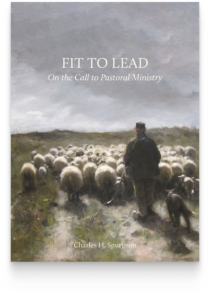 With the rate of pastors retiring, burning out, or concluding their ministries, the need has never been more urgent for aspiring ministry leaders to prepare well for their pastoral calling.
In the eBook Fit to Lead: On the Call to Pastoral Ministry, compiled by The Spurgeon Library at Midwestern Seminary, current and aspiring pastors will gain wisdom from Charles Spurgeon on how to discern and thrive in their call to pastoral ministry. In the short book, Spurgeon—the “Prince of Preachers”—discusses how to identify and encourage those called to ministry, as well as what steps to take in pursuing a call to ministry.
We are delighted to offer this eBook to you for FREE today. Click on this link to get instant access!