D.A. Carson examines the relationship between the gospel and social justice initiatives, discussing how Christians can authentically engage in social action while remaining grounded in the gospel. Carson emphasizes the importance of not confusing the effects of the gospel—such as social reform—with the gospel itself, which is centered on Christ’s redemptive work. He encourages a balanced approach that includes both proclaiming the gospel and engaging in social justice as a response to it.
This subject is huge, as you doubtless know, and my desire today is actually to make only one point, but before I make that one point, I want to offer a few preliminary observations, offer a few perspectives, and then I’m going to make one point and flesh it out in a variety of ways.
First of all, some historical perspective. On the one hand, it is useful to remember those instances in history when the gospel has so been promulgated that huge transformations in society have taken place. In 1740 in London on Easter Sunday there were precisely six people who showed up for Holy Communion in Saint Paul’s Cathedral. That’s merely a measure of how far down any form of Christianity had slunk.
There were 280 crimes on the books that were capital punishments, including stealing a loaf of bread. Slavery was rising in the empire. The Industrial Revolution was in pretty good swing, and kids as young as 4 and 5 were being sent the mines to get coal, sent into dangerous factories at the age of 5 and 6. Debtors’ prisons were such that you could be thrown into jail for debt, and when you were in jail, they didn’t feed you regularly, so unless people came and gave you food, you could actually starve to death in debtors’ prison.
So inevitably, there was quite a lot of social strife and probably the UK wasn’t all that far from a bloody revolution, which is, after all, what took place half a century later in France. But in 1734, God raised up a young Welshman by the name of Howell Harris, who began preaching the gospel in Wales. In 1738, George Whitefield began to preach to coal miners outside the coal stations, especially in the Bristol area. In 1740, John Wesley started preaching.
In a singularly remarkable movement of God, Methodism, in its various phases, particularly Methodism, General Methodism, and so on, continued a fair bit of vibrancy, theological orthodoxy, and social transformation for a period of about 60 years. Now there were ups and downs, of course. Leaders left. Some died, moved on, and so forth; nevertheless, it really was quite remarkable, and out of this came, first of all, for example, the abolition of the slave trade across the Atlantic and eventually the abolition of slavery in the empire.
Also came the first child labor laws, the beginnings of the first trade unions, the beginnings of the first safety laws, the beginnings of the first steps toward compulsory education, and all kinds things. The climax in British history in what is called the 1832 Great Reform Act where there was bevy of changes that were brought about in Westminster Parliament. It’s a nice success story we like to talk about. Now a negative story.
In this country, some form of confessionalism with ups and downs of various flavors, both good and bad, predominated in the 1800s, the nineteenth century, but from about 1880 on, in some denominations a little earlier and some denominations a little later, there comes to be more and more of a bifurcation such that there is a kind of optimism connected with Christian hope and perspective.
Christianity is almost indifferentiable from getting a decent education, being nice to your neighbor, and so on. Eventually, it produced what came to be called the fundamentalist modern split, though don’t forget at the time fundamentalist didn’t have any of the negative overtones that it has in some circles today. It meant people were wanting to hang onto the fundamentals of the faith.
That split developed in a variety of ways such that by the time you got to 1930 or there abouts, probably the same spread of time the Evangelical Awakening occupied in Britain, by the time you got to that point, then at least in the leadership of the mainline churches, not so much in the local churches, but in the leadership of the mainline churches, the gospel was very heavily identified with social transformation. It was hard to find much supernatural Christianity left.
To some extent, almost by way of inverse reaction, then you did get some people so strongly proclaiming the gospel that they tended to downplay the importance of doing good to one’s neighbor. The latter tendency, however, was not nearly as strong as the former; that is, the tendency in the liberal side just to downplay confessional Christianity.
Now let me come to the present tendency to stereotype. Many, today, who are becoming interested in the interrelationship of the gospel to broader doing-mercy-type deeds tend to run to stereotypes like this. The previous generation came down either on the social transformation side or on gospel fidelity side, and we want to put together both. Now I urge you not to adopt that stereotype as your background.
First, though there is this history from 1880 to 1930, there is something of it there. There’s not a lot of it; nevertheless, detailed studies have been done, both in the UK and in the United States, to examine what groups are actually doing the work even in secular relief organizations, like Oxfam or UNICEF or whatever.
Both countries have come out with very strong statistics to demonstrate, in fact, that conservative Christians are doing a vastly disproportionate amount of the work on the ground in both of those organizations. In this country, you can find a lot of those studies at the website of the Acton Institute, and there are corresponding sources that I could tell you about in the UK. In other words, the stereotype doesn’t work very well actually on the ground.
I come from a conservative Christian home that could easily be identified in some sense as fundamentalist. My father was a church-planting pastor. He believed the gospel. We were brought up with the gospel in a cross-cultural situation in French Canada and all the rest. If you told him that he wasn’t concerned about the social needs of people, he would look at you as if he was wondering what planet you were from. I don’t know how many down-and-outers we had in our home. They seemed to be crawling all over the place.
For years and years and years my father was on the board of an orphanage: raising funds there, giving money there, helping out. I remember going up with him to the orphanage to help out some. When he died, he didn’t have much money, but when he died, a very substantial part of his money (before the rest of it was divided equitably amongst his three children), a very substantial part went to charitable things, which included, yes, the local church, some mission organizations, also the American Cancer Society, an orphanage, and so on.
There’s far more integration in these people of another generation than you sometimes realize. Do not get yourself into place where you’re thinking self-righteously about those who have come before. It’s so easy for any generation to start saying, “They did it this way wrong and this way wrong, but we’ve got it right.”
It’s just too easy. Don’t go down that route. Avoid casting what you’re trying to do on the background of a stereotype in which everybody else has got it wrong. It’s not good for you spiritually, and historically, it’s not very fair either.
The second preliminary observation is that there are organizations today that in their statements of faith are recognizing that commitments turn on more than statements of faith, but also on visions of ministry. Let’s take a conservative denomination like the PCA, the Presbyterian Church of America. I’m picking on them just for convenience sake; I could be using others.
Their doctrinal standards are the Westminster Confession, the Westminster Statements, and there is no longer more detailed statement of faith anywhere in the world to my knowledge. Nevertheless, within the PCA, there are churches that temperamentally, stylistically, in terms of heart alignment, are tied up with (let’s say) the Banner of Truth approach to Christian confessionalism and promulgation.
There are others that are tightly allied to the kind of thing Tim Keller is doing in New York City, and there are others that are tightly allied to half a dozen other kinds of things. In other words, there are some who call themselves emerging, and there are some who would call themselves very definitely anti-emerging, and so forth. Even when you have a pretty tight statement of faith like the Westminster Confession, it’s surprising how much diversity you can actually get at the local church level. Those are the realities.
Therefore, one of the reasons why, when we put together The Gospel Coalition, we established not merely a statement of faith, but what we call the foundation documents. We included, in addition to a preamble and a pretty detailed and robust statement of faith, what we call a theological vision for ministry where we try to work out from the statement of faith to what it means in terms of how we conceive ministry to be.
I’ll return to that in a few moments, but you can look at those documents for yourself online. Simply go to thegospelcoalition.org, and then click on “Foundation Documents.” There are there in about 10 or 15 languages, too, so you can pick them up and read them for yourself and you’ll see what I mean by the kind of integration to which I’m going to refer in a few minutes. Now then, that’s all by way of introduction. Let me now make my main point.
The fundamental issue is not only what we’re doing with our time, our priorities, our money, and our imaginations but how we configure the undergirding structure of thought. Now let me explain what I mean by that and then offer something of a preliminary resolution.
When I was first approached to speak to this group, part of the memo that was sent to me said, “Faith Alive is a group that has a desire to engage in discussion about social justice issues and discuss how compassion and justice ministries are part and parcel of the gospel.”
Now if the document had said, “… how compassion and justice ministries and issues are part and parcel of biblical mandates,” I wouldn’t have raised an eyebrow. When you say they’re part and parcel of the gospel, then I want to know what people think the gospel is and how you find out.
Let me go further. McLaren in two or three of his books has argued, for example, that an essential part of the gospel is what Jesus makes out to be the first and second commandment. First commandment: Love God with heart and soul and mind and strength. Second commandment: Love your neighbor as yourself. That is the gospel. Not all of the gospel, but it is a very substantial part of the gospel.
I was interviewing for a particular job. A Christian leader was asked what he understood the gospel to mean, and he said, “Well, there’s a gospel of Jesus Christ, of him crucified, saving us, and so on, and there’s a social gospel …” and he listed two or three others. Even the moniker, the category, of transformation of self and society brings with it a whole nest of related questions that are at the definitional level.
Let me back off and just wander through the definitional issues. What is the gospel and how do we find out about it? Is the gospel simply anything that you think is mandated by Scripture? In which case, loving your neighbor is just always part of the gospel. Is that what the gospel is? How do you find out? There are essentially, if you’re going to be biblical, two ways of finding what the gospel is.
One is to look up every single instance of the word gospel and related words, to gospelize, often to preach good news or something like that, and examine the context and so far as you can you determine what the content is. The second way is to fit that understanding within the broad framework of the Bible’s entire storyline from beginning to end. That’s the discipline of biblical theology. Because, you see, what is an issue at the conceptual level is how you establish the pattern of biblical thought.
If you think that everything is biblical provided you can attach a proof text, well, then, of course Mormons are biblical. Jehovah’s Witnesses are biblical. Those who want to discount any attachment to social justice issues are biblical. Those who want to pour all of their eggs into that basket are biblical. How do you establish what is biblical? My point is that conceptually how we configure the undergirding structure of thought in the Bible is absolutely paramount.
So you can find teachers and preachers, for example, who will choose a text here and a text there and a text somewhere else and say some true things about it and say some absolutely ridiculous things about it, and you can’t tell the difference because they are saying some things about this text which actually flat-out contradict other themes within the same biblical book, let alone within the whole Canon. They don’t have the pattern of how the whole thing fits together.
So the question returns.… How do you establish what the gospel is? What is the gospel? Then, I would say that the very meaning of gospel is news, great news, often good news, but great news that is to be proclaimed. That’s what it is, and however you loathe the details, it’s good news about what God had done, is doing, and especially through Christ. That’s the good news.
Now that means that biblically the force of what the gospel is is going to turn on God’s coming to us in human form in the incarnation, and as Paul says, “As a matter of first importance …” That’s his expression. “… Christ died for sinners, he rose again on the third day according to Scripture.” So it’s all about how God has taken the initiative to reconcile rebels to himself for time and for eternity, and when you take a look at context after context after context, that’s where the gospel focuses.
When you have the gospel of the kingdom, an expression that shows up especially in the Synoptic Gospels, then you likewise have to work through what is meant by kingdom, what is entailed in it in terms of God’s invading reign, what is meant by that, how it comes now and is consummated later, what the structure of its ethics looks like, but it is bound up with God’s saving, transforming reign that is ultimately consummated at the end. It’s good news about what God is actively doing.
That is why historically, in the second place, many, many, many thoughtful theologians across the centuries have been driven to distinguish between the gospel and the effects of the gospel. Now don’t misunderstand me. I’m not saying you only preach the gospel. If you preach the whole counsel of God, then you have to preach not only what the good news is but how it works out in people’s lives.
So there is a place for saying some important things about both the first and second commandment. There is an important place for reminding ourselves of passages like Galatians 6: “Do good to all people, and especially those of the household of God.” Or coming to Jesus’ parable of the good Samaritan where the question it asked, “Who is my neighbor?” and he responds with a story which eventually tells you not who is your neighbor, but to whom are you the neighbor.
It is important to say all of those things. All of those things are bound up fundamentally with fidelity to the whole counsel of God. No argument there. Nevertheless, the pattern of sound teaching, that’s a phrase from Paul in 2 Timothy 1, is, in fact, careful to distinguish between the gospel, the good news about what God has done, with its effects in all kinds of ways.
So if you say, “I’d like to give you my testimony,” and you talk about what a robber you were before you became a Christian and then you trusted Jesus and everything turned over and got a lot better and you started loving people more and on and on and on, have you preached the gospel? Not even close. You’ve talked about the effects of the gospel in your own life, but you haven’t talked about the gospel.
The gospel is about what God has done. It’s about what Jesus has done. You can give your testimony in such a way that you might allude briefly off in the distance somewhere of the gospel and never actually talk about the gospel. Or supposing, then, you want to start something that really helps transform local schools. Is this gospel ministry? Not if you’re going to use gospel in any sense as which it’s used the New Testament. Quite frankly, not.
If on the other hand, you mean part of the effects of the gospel is doing good because we have been transformed and we care for other people who are made in the image of God, and therefore, we ought to be doing this kind of thing, I’m happy. But if you try to say that it’s gospel ministry, what the long-term effect tends to be is to lose what the New Testament says is the gospel. Eventually the gospel gets so dilute that it becomes a kind of Christianized moralism and nothing more.
Now come back to my historical examples with which I began. Let’s come back to the Great Awakening. Did you see the film Amazing Grace? Like it? On several fronts it was brilliant. It was brilliant. Even picking up some one-liners from John Newton, “I know only two things. I am a great sinner and Christ is a great Savior.” He was made out to be a bit of a wimp in his old age; that wasn’t quite true; nevertheless, there were some great lines.
But do you know what was wrong about the film? Wrong, from beginning to end? For anybody who has read the primary documents or read any decent biography of Wilberforce, the whole thing was cast as either Wilberforce was going to enter into vocational ministry and preach or he was going to free the slaves, and even good ol’ Newton said that in his case, he ought to do the latter. So all the rest of his life, then, is pictured as.… Oh, there might be some Christianized stuff that is presupposed in the background, but freeing the slaves, thus, is the gospel for him.
Historically, that is international class rubbish of the very first order. He was a gospel person all his life. He had two chapters of devotions with his family in the morning, about 30 to 45 minutes of devotions was the standard every morning, and he had two more chapters of Bible reading at night. He preached the gospel on the streets and was diligent in evangelism all his life. A member of the local church, he was heavily invested in the fledgling Sunday school movement.
He was a churchman, a gospel person, powerfully, all of his life. That’s what drove him. Moreover, he did not become monofocal even about slavery. And he pushed on slavery all his life; he did. He was also very instrumental in the lead up to the Great Reform Act of 1832, which addressed all kinds of matters in the minds. He wasn’t a monofocal, one kind of person who then gets blessed with a gospel approval at the end.
One of the things that was so stunning about the impact of the Great Awakening on the social face of Britain was that almost all the leaders were powerful, gospel-committed people in the New Testament sense of gospel. They were preaching what God had done in Christ Jesus. They were preaching what Christ had achieved on the cross. They were preaching the power of the resurrection to transform people. They were demanding that people repent and believe.
They were starting, in the case of Wesley, his Methodist societies with the little groups of 12 and local configurations and leadership and discipleship in Bible training and so on. Even while he was writing letters about slavery, Wesley put together his 50 essential books for any fledging preacher that everybody had to read if they were going to be on any of his circuits. And on and on and on. And all of those folks had to do with what the Bible teaches and what the gospel is.
So to have come to any of those people and said, “Is freeing the slaves the gospel?” they would have laughed in your face. Because they made a fairly straightforward, fairly simple, but pretty rigid distinction between the gospel as defined by Scripture, the announcement of what God has done, this good news, this greatness of what God has done in Christ Jesus, and the inevitable transforming effects of the gospel as they work out.
You’ve got to preach both. But you can’t confuse the two, because if you confuse the two, the inevitable result is not the Whitefield-Wesley awakening, it’s 1880 to 1930, which I described a few moments ago, in which you get a dilution and dilution and dilution until you really have no gospel.
Now there are entailments of that, all kinds of entailments. When we worked on the foundational documents for The Gospel Coalition, the statement of faith that I mentioned, and the theological vision of ministry, when we worked on them, I drafted the statement of faith. Tim Keller drafted the theological vision of ministry.
We compared notes and criticized each other, and then we brought in the whole group and for two whole annual sets of meetings, two sets of two days, we had these 50 guys going through them, taking them apart and criticizing them, but out of them came documents that were much stronger, much stronger.
One of the changes that was made consistently in the theological vision of ministry statement was instead of allowing us to say something like, “We are concerned to save people’s souls and also to help reduce suffering in this life,” instead we would say something like.… I should have brought in the document; I’ve got some great examples, but you can read them for yourself. There are scores of examples in the document. “We are concerned to save people for time and eternity and to reduce suffering both in this world and in the world to come.”
Because if you make the bifurcation at that point, so that your reducing suffering only has to do with this life, then somehow you don’t see the danger of the suffering in the next life. What does Jesus say? “Don’t be afraid of him who can destroy your body and afterwards can do nothing. Fear him, rather, who after destroying body cast body and soul into hell. Fear him, I say.”
Now don’t misunderstand me. That does not mean that you, therefore, have the right to go out and just save souls, get people out of hell, but don’t care if they starve to death. Don’t care if there’s social injustice. I’m not saying any of that, but I’m saying equally that it’s not Christian to be very concerned to make sure they get enough food in their tummy and never talk about Jesus and the gospel. Get them fat before you send them to hell.
You have to see what the issues are here. You will not preserve the gospel, you will not, unless you see that the fundamental issue is how men and women are rightly reconciled to God for time and eternity. You will not.
So for those who come from a background where they think being faithful to the gospel has no bearing on social transformation or witness or doing good or whatever, then it’s very helpful to read Tim Keller’s essay, the lead essay, in the first fascicle of 2009 of Themelios, a student theological journal. It’s now entirely digital, and it’s on the website of The Gospel Coalition. That journal had about 200,000 hits in the last six months of 2008. Everything is downloadable there for free. Go and look up volume 33 issue 3.
The lead essay is only 11 pages, and Tim Keller has made as good, strong, and sensible case for Christians being involved in what he calls deeds of mercy, acts of mercy, as anybody I know, but he doesn’t do it by using gospel label to cover, because in the long haul, then, that effect is mere moralism, which never finally saves.
So for someone who comes along as formally orthodox, then whether in their own or in the social structure in which they live, I want to ask some questions. How has your punitive trust in Christ as the one who has borne your sin and has bequeathed the Spirit to you transformed how you love your spouse? What you do with your money? Whether you care for neighbors?
For some people, that’s going to be more active roles in other types of things, too. I told you my father was involved in orphanages and things like that. Or you might be involved in gathering money, going on medical missions, MÈdecins Sans FrontiËres/Doctors Without Borders, and so on. There’s no limit to the possibility.
For example, one of our council members on the coalition is Sandy Wilson. He’s pastor of Second Presbyterian in Memphis. Memphis probably has the worst school system in America. Twenty-five percent of the kids in the high-school system there have been involved with the police (30,000 kids out of 120,000), and a lot of the kids at a strong church like Second Presbyterian don’t go to the public schools. It’s not worth it with lots of Christian schools around.
But Sandy eventually went to the district superintendent and asked, “Is there anything we can do? What can we do to help?” He said, “I’ve got to tell you frankly, not many of our families even use the school system, but is there something we can do to help?” She was an African American woman who was a Christian and who said to him, “Do you love children?”
The first step in the partnership that developed was this church, which is several thousand strong, adopted one of the larger local schools. By adopted, they made sure the buildings were painted, there were enough school supplies, they walked the playgrounds picking up glass. It was cleanup just physically. They put in some muscle power and some money into it.
Then they started throwing a BBQ every time there was a PTA meeting. That immediately quadrupled the number of parents that showed up. Then they got adults involved from the church. By the end of the first year, 318 of them, to do one-on-one tutoring with kids, not as a one-year commitment but as an ongoing commitment.
Within 2 or 3 years the school, which had been registered on the sort of desperate standard and maybe would have to close, was already back within normal statistical ranges. Then the church, knowing that not many churches were big enough to repeat what they had done, started organizing smaller churches in the area to band together so that several churches together would adopt a school.
That’s quietly going on now several years later … this is the miraculous part of it … so far, without the glare of the ACLU on it or something like that. It could be shut down by a legal challenge, I’m sure. It’s not that they’re going in there and preaching the gospel, but they’re all Christians doing it.
But you’ve got to understand, this is not the only stuff that Second Presbyterian does. This is an evangelistic church that’s square on the gospel, is running university missions in local colleges, and seeing conversions regularly. But it is the overflow of [inaudible] especially those of the household of faith, while not losing sight of what the gospel is and what it is not.
So Tim Keller, whose name you know.… Up until now, Redeemer Presbyterian in New York City, have been without a building; they rented one whole floor of a skyscraper for an office space, and then they met in theaters and other halls around Central Park for years, but they realize now that with Tim getting older, transition is coming, and they’re going to have to do something about that, so they’ve gone after their first building. With the square footage costs in a place like New York, that’s not easy to do, but they’ve landed on their first.
You know what building they chose … purposely? Partly under the influence of Sandy down in Memphis? A whopping big old building that has to be rejuvenated right next to the toughest, meanest school in Manhattan. But my reason for telling these stories is not to hold either Tim or Sandy up to some superstar status. They are not. Do you know what they are? They are gospel preachers.
They are wise enough also to understand that such ministries shouldn’t come directly under the leadership of the local church. Don’t forget in the book of Acts when there’s already some social problem within the church of who is getting the fair distribution of food and so on, the apostles were very quick to say, “Listen, we are primarily committed to the ministry of the Word and prayer. But these things have to be addressed, so let’s appoint some others to handle this and this and this.”
If this comes directly under the ministry of the local church, then Tim Keller has to run it, directly or indirectly. If you’ve got Tim Keller doing that, then he won’t be doing what he is doing, namely, proclaiming the gospel and seeing people converted by the thousands in Manhattan. Nevertheless, he displays genial oversight.
It is raising up leaders to take on this and this and this, parallel 501c3s and all kinds of things, with their leaders connected with the church and being taught by the church, but not confusing the proclamation of the gospel that saves and the nature of the church as a new community of the redeemed, of the justified, of the regenerated with nevertheless [inaudible]. In other words, it is really important to understand that the issue is not whether or not we should do good deeds.
For anybody except the most obtuse that’s not an issue. The issue is how you configure the undergirding structure of thought. It’s not just a theoretical matter. It’s whether your undergirding structure of thought for justifying and explaining this and working it all out is square with Scripture in such a way that Holy Scripture is preserved in its integrity, and the gospel itself remains the gospel and does not become something it isn’t.
At the level of our hearts, what this looks like in practice includes things like …
1. What you dream about
What is of central importance to you? What are you passionate about? What are you desperate for? What do you pray over? Now it’s right that we should be praying for some ministry outreach amongst orphans or dealing with some social justice issue regardless of what it is. It’s right. It’s right. But on the other hand, if that’s what you do and never pray for the conversion of a lost person in your own family or who is attending your church or a neighbor, God have mercy on your soul.
2. It also has a bearing on your use of time.
You see, if you become so consumed with a genuine physical need that you don’t have time any more for reading, thinking, praying, or ever talking about Jesus to anyone, but you feel you don’t have to because you’re doing gospel ministry, you’re not. You’ve flipped out of the Great Awakening and into 1880 to 1930. That’s what you’ve done de facto.
3. It will also have a bearing on whom you influence.
I have been teaching enough decades now that I have learned that most students don’t learn what I teach them. They learn only a small part of what I teach them. You know the part that they learn? They learn what I’m excited about. They learn what I keep reiterating because I view it as exciting and central.
So if you get to the place where, yes, you’re orthodox, you do believe the gospel, God bless you. But what you’re talking about all the time, what you’re excited about, what you’re devoting energy and money and priority to all the time, is some social issue, then your students won’t even assume the gospel; they’ll focus all of their attention on that issue.
One of the great strengths of the Evangelical Awakening is, as I’ve said, despite the film, people like Wilberforce and the Countess of Huntingdon and a whole slew of others who really were used of God to transform the social face of Britain, they really were gospel people through and through.
Within that framework, they did do a lot of good, but they were concerned to keep what was central, central, not only for their own sake but for the sake of the standing of the next generation. Two more. Along the lines of what we try to do, then, in the theological vision of ministry document …
4. It is wise and important to address relief of suffering but put it on an entire scale, a relief of suffering both in this life and the life to come.
In fact, when we were thrashing out these documents in the Coalition council, trying to get it right, trying to be faithful to Scripture, we got it all here, and then somebody said at the end, “Okay, we tried to be careful, but how in practice on the street do we preserve a gospel focus in our ministry and our priority and so on, but nevertheless, how do you manage that? How do we keep it?”
Various suggestions were put forth. “Make sure you watch your heart, make sure you’re reading and rereading the Bible itself …” All those things were mentioned. Then one member who is known to be somewhat crustier, simply sat there and said, “Preach hell.” We said, “I beg your pardon?”
He said, “Preach hell, because that will be a pretty definitive test on whether you are really interested in relieving suffering for time of eternity or you’re really just interested in minimizing suffering now; you don’t really believe in hell and, therefore, you don’t really need a Savior to save you.” Then he smirked. He said, “Besides, if you preach hell, those who are into only the social gospel won’t want to have anything to do with you.”
There’s some truth to that, too. There is. If you knew him and his church (I won’t tell you his name), you would know that he is very concerned with all kinds of outreach programs in his own city and so forth. Nevertheless, he is also concerned to think through how it is that you preserve what the apostle himself calls the matter of first importance.
5. When you speak of the transformation of self and society, you have to ask what you mean by that.
How does transformation of self come about in the New Testament? Often the Gospels configure it this way. The gospel is what sort of tips you into Jesus. It tips you into getting saved. It tips you into being justified. It tips you in so that you’re okay; you’ve got your escape ticket out of the lake of burning sulfur. Then the transformation of self after that is basically a matter of learning obedience and discipleship courses and all that kind of thing.
Isn’t that the way a lot of us have inherited this business of transforming self? That is so far removed from the New Testament view of sanctification growth that it’s pathetic, even though it’s pretty common in evangelicalism. In the New Testament, the gospel is not the good news about how you can be justified and then after that comes a whole lot of moralism that actually transforms you.
The gospel in the New Testament is the big category. It’s the big category, not the little category that gets you justified and after that comes all the big category about discipleship. It’s the big category that talks about what God has done, not only to forgive us but to transform us. That’s why the Holy Spirit is given.
That’s why when Paul prays for believers, for example, he prays that the same power that raised Jesus Christ from the dead may be offered up in your inner being by the Holy Spirit to bring you into increased conformity to Christ. The motives he gives for this or that behavior are rarely to do with simple rules.
He doesn’t say, “Oh, don’t fornicate because after all, the law says, ‘Don’t fornicate.’ ” He says, “How on earth can you think of fornicating when you have been covenantally tied to Christ Jesus? He’s yours. You’ve been bought. How can you betray him?” It’s a gospel appeal.
When you understand how the gospel works, the gospel doesn’t come to you and say, “Okay, you’ve been saved; now you mustn’t do this and you mustn’t do that. Never drink, smoke, swear, or chew, and never go out with girls that do. That’s how to be sanctified.” That’s not what the gospel is.
The gospel comes along and says, “This is what God has done. Isn’t it spectacular?” Here there is not only forgiveness but in grace the power of cancelled sin, and in the light of all that he has done, now you’re working to the effects of the gospel. In the light of all that he has done, the only appropriate response is knowing trust, obedience, holy joy that transforms your life and everyone you touch.
The gospel, you see, is the big category, not the little one that just gets you in by the skin of your teeth. That’s the basis, then, for the transformation that generates not only a transformed individual but the transformed community of the church, a community of transformed individuals. That’s a gospel thing. Then when you start talking about the transformation of the broader culture, then you’re along two or three more axes that you need to think about.
In terms of doing good, of helping out in this particular arena or that particular arena and doing some good, whether it’s the school system in Memphis or tackling children down the mines in 1780 Great Britain or any other social problem that you care to address, such that there is some sort of transformation of the culture because Christians and others have rolled up their sleeves and begun to do some important things.
In that sense there certainly can be some transformation of culture that takes place in particular times and circumstances. On the other hand, it is important to remember that must not be set up as an absolute good. How are you going to convince the leaders in the underground church in Saudi Arabia that it’s part of their job to transform culture? If the authorities even know you’re a Christian and you’re a Saudi, you’re beheaded. That’s it. No questions asked. You’re done.
Which is why, by and large, in the New Testament where Paul himself finds himself under the Roman authority, which was after all not a democratic society, but under Nero. Certainly not a constitutional monarch, a dictator, and a cruel and bloody-minded one, too.
In that framework, he almost never talks about transforming society. He talks, rather, about how the church is different from society, and within that framework, doing good and being faithful and show honor to all people. All those kinds of things … yes, yes, yes, and the Bible can still talk about being salt and light in a dark and corrupted world, yes.
But the very fact we can talk about transforming society reflects the fact that we live under democracies of one sort or another where we have more direct access to strings of power. Let’s be quite frank. If the tide of culture goes against us, we might find that the kinds of things that we want to do are against us and we are simply marginalized increasingly.
Then the question becomes not so much how to transform the culture, but what sort of delaying actions we can do, what sort of things we can do, like projects in the local municipality, and this sort of thing. Meanwhile the tide of history turns against us. It could even, in a democracy, turn all the way to persecution. Don’t kid yourself. It could.
Because unless you are a strong and dogmatic postmillennialist, the aim of the Christian is not the transformation of society. You still do good and you try to do as much good as you can, which includes some transformation of the local municipality, but at the end of the day, the Bible is pretty clear that on the last day, [inaudible].
That doesn’t mean that I’m not supposed to be doing what I can, and saying that not only in the sense of preaching the gospel and seeing people converted and taken out to constitute a countercultural community, but also doing good, as in the Great Awakening. But at the same time, the power that actually transforms individuals, transforms men and women and then reaches out through good deeds to touch broader society must not be seen as the kind of ultimate aim unless you are of the postmillennial variety of theologian.
Questions or personal abuse?
Male: [Inaudible]
Don Carson: Yes, and it may be that some are called vocationally to work with [inaudible]. I have no problem with that, but on the other hand, even that person is going to have to be talking to non-Christians. What do they naturally talk about? Do they talk about their faith, how they were converted, what the cross means to them, how Christ came to save people? I’m not denying that there might be some people who particularly got the job of doing something with UNICEF, per se.
I’m not denying that, but the thing to check out at the heart level is does that person now think that because they are doing a job in UNICEF; therefore, they are doing gospel ministry and they have no obligation to share their faith or talk about who Jesus is or what he’s done in their life. Check the heart. That’s why I can’t make it a legalistic thing. “Well, so long as you go three times a month.” That’s just more moralism. It’s a heart issue. Where are your priorities?
Male: Forgive me for my ignorance. How did the stereotype that somehow certain Christians are less concerned with social work come into place and how do we …?
Don: Well, the reason it came into place is because there is at least a little truth to it, and it was truer in the divide that took place between modern so-called fundamentalist so-called between roughly 1880 and 1930. But if you actually take a look at even conservative mission organizations, SIM, and things like that, you tend to look at all the kinds of things that they’re doing.… Well, they have to be planting churches and teaching theology, but they also have people digging wells and so on.
Where does this bifurcation come from? They did that in the 1940s, 1950s, 1960, and 1970s. It’s part of the stereotype, because so often we like to justify where we are by saying, “We’re not like them, and we’re not like that group, and whenever we make those bifurcations, always, we end up in the best place, don’t we?
Henry Kissinger says that in his book White House Years too. Secretary of State goes into power, and he’s supposed to be leading the troops, but all professionals.… He says to them on some issue, “Pago Pago, what do we do about this?” Inevitably the congressionals come back and say, “Well, their [inaudible] forces here. Thus, inevitably, you see he’s forced into a position that is judged to be superior, and we can do that by recasting our own history. “Well, the liberals got it wrong. Conservatives got it wrong. We got it right.” Avoid the attitude like the plaque. It isn’t really all that true and it’s not helpful.
Male: I think what you’re saying is that if you’re a church or an mission organization, there’s no problem with being involved in a social justice ministry where “the gospel” cannot be presented as long as you don’t call that gospel ministry, but you still want us to be involved in those ministries, or else we’d be, I guess, fundamentalists in that regard of separation.
Don: Well, you know, a lot of fundamentalists, actually, are more heavily involved in social issues than you realize, but quite apart from that, I would say that if you have a choice.… Let’s say you’ve got a choice between working with two institutions. One that ties you very, very, very tightly in a counseling situation in a hospital or a school district, never, ever, ever to mention anything about religion and certainly don’t mention the word Jesus. You might mention Islam once or twice, but nothing else.
Or working in the schools doing the same sort of mentoring situation with another sort of organization where you can be yourself. You’re not to proselytize all the time, but you can be yourself. If I had to choose between those two, boy, I know which one I’d want to be with!
But at the same time, even beyond those sorts of choices, then I still want to say, “So if you’re going into the school office, when you check in and you’re talking to a principal or whatever, of course it’s appropriate to talk about …” If you don’t ever talk about your faith to anyone, then how are you being obedient to the Great Commission? It’s there.
Male: Some people say we don’t even want you to do that, that you don’t have the opportunity to do that. I guess that’s kind of a hypothetical.
Don: It is a hypothetical. Usually there are opportunities in any case, or there are parallel organizations you can do the same ministry with or something like that. Even if hypothetical, you really can’t do it that particular matrix, but there are going to be other matrixes in your life where you are doing it. But again, you’re going to test yourself.
Male: Can you talk about how this relates to preaching in regards to how we talked about how preaching hell and then there are those that say, “Well, you only preach Christ and everything, but [inaudible]. Well, no, I can preach on these issues and don’t necessarily have to mention Christ in that way.”
Don: Yeah, you do if you’re a preacher want to preach the whole counsel of God, which means not only.… You can use categories. That means there is a place where I could be preaching law as well as preaching gospel. You ask the Puritans what’s in the Bible, they would have said, law, gospel, and illustrations of both. But thus, they are making a distinction. They’re not saying that everything that is mandated by the Bible is gospel.
Now, I think there are far more sophisticated ways than analyzing what’s in the Bible. I think we have to preach the whole counsel of God in some sense you have to preach the whole Bible, but then you come back to the issue that I was trying to make as my main point. You come back to, then, what is the pattern of sound teaching. What is the nature of the structure of thought in the Bible?
It’s how you integrate this together. So there are some preachers I know who believe the Bible is the Word of God, but they have no idea how it hangs together. So they find a text here and they preach and it sounds basically gospel related, and they have another sermon over here that has something to do with social gospel, and in no sense does it connect together.
It doesn’t hold together. If you ask what their priorities are or how it’s configured or what is the summation of all things or where the glory of God fits in this, they don’t have a blessed clue! They don’t know anything about the patterns. They don’t know how the Bible is put together.
So what I want to say is that even when you’re preaching Isaiah 2 or Amos or the parable of the good Samaritan or Galatians 6, “Doing good to all men such as those who …” and make applications and this sort of thing. Those sorts of sermons based on genuine biblical texts that do make those points still, like every sermon based on any biblical text, need to be integrated into the theme of the book in question, which needs to be integrated into the Canon which inevitably brings you in fashion or another to the centrality of Christ. It just does.
Now I could only begin to unpack that theme in a couple of hours, but when I teach homiletics, I have more than a couple of hours so I spend a lot of time showing that expository preaching is not only explaining what a text says in its bitty locality, but faithful expository preaching is also showing from that bitty text its intercanonical connections to the great tendons that run right through Scripture that bring you to the centrality of Jesus.
That makes for powerful worldview-ish preaching. Then you can make a point of it being text that is rightly configured in the whole counsel of God. But how to do that in a sermon …?
Male: I know there are certain areas or countries in the world where the undiluted proclamation of gospel is not possible, and the only way for a missionary to get into a country where people is to do the soft gospel ministry or like being tentmakers or some work. Do you see that later on when they build a good reputation and the government might allow them to more room to do their ministry?
Don: Yes. It would be a mistake to think that the only legitimate way of making the gospel known is preaching in a kind of public environment. There is a huge centrality in the New Testament in public preaching and teaching; nevertheless, public preaching and teaching in the New Testament is a subset of a bigger category of what might be called the ministry of the Word.
So if you have people going not to, let’s say, the free economic zones of China but working inland where there’s an awful lot more pressure and they start a factory somewhere up near the Mongolian border or something where things are a lot tighter. There is a context in which you, nevertheless, are building relationships, friendships.
You’re in a home and you are a Christian. What does that mean? Who is this Jesus? Then you starting to explain what the Bible is and that, too, is part of gospel proclamation, not in the sense of public display or public voice or lecturing or having a microphone, but it is part of the ministry of the Word.
It is part of the honesty and integrity of sharing your faith with others in order to make central Jesus and all that he has done, all that God has done for us in Christ Jesus. That’s still gospel faithfulness. So within that framework, if you’re also doing good by starting a business in an area where there is an economic down in the country and all of that, that’s great! That’s great! Why not?
So I don’t see any problems with those so long as the Christian who is doing it does not lose the centrality of the richness of the gospel itself, and if there are political holds on how much can be done publically, then all the more creativity is going to go into what can be done privately, but it’s still part of the ministry of the Word.
Free eBook by Rebecca McLaughlin: ‘Jesus Through the Eyes of Women’
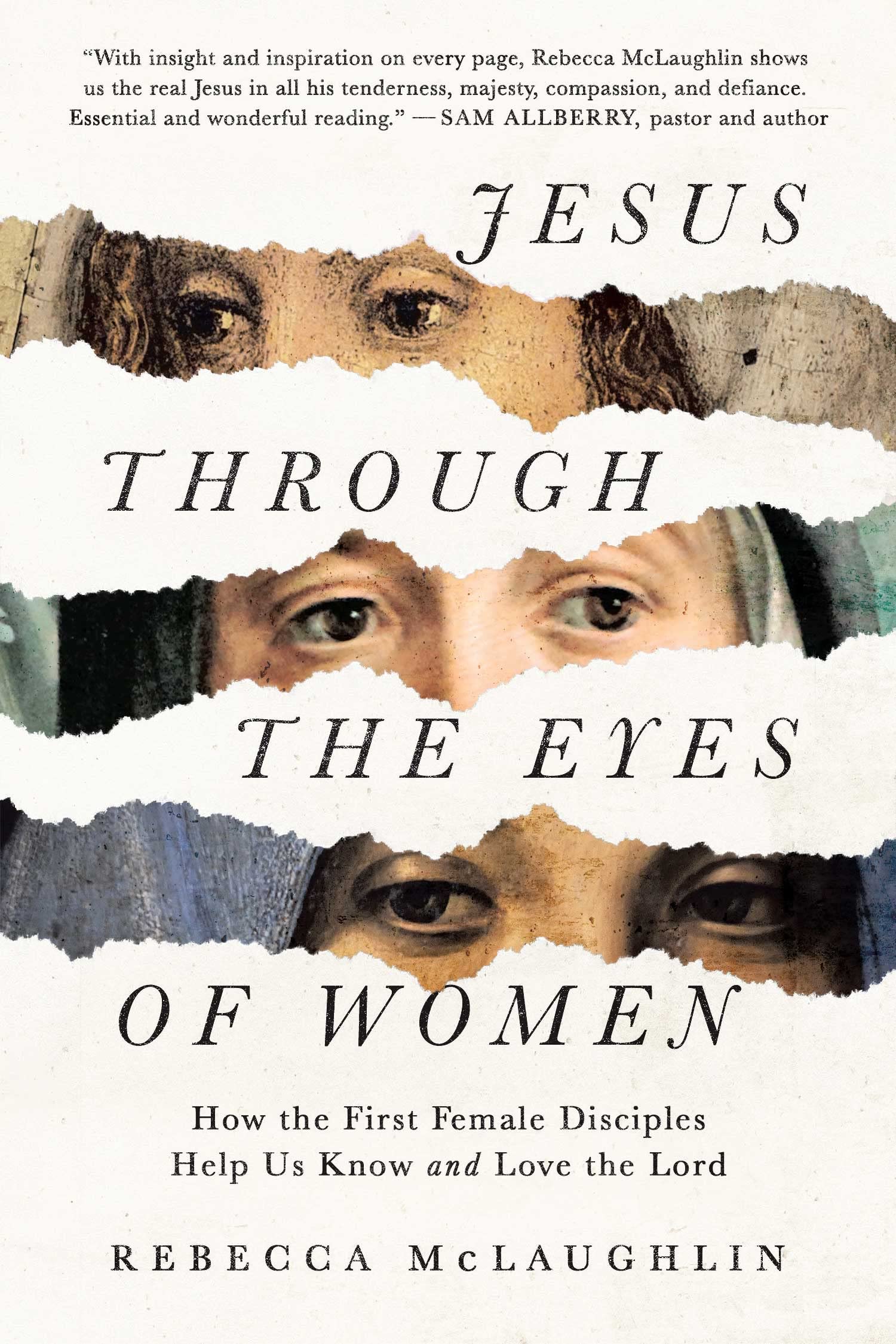 If the women who followed Jesus could tell you what he was like, what would they say?
Jesus’s treatment of women was revolutionary. That’s why they flocked to him. Wherever he went, they sought him out. Women sat at his feet and tugged at his robes. They came to him for healing, for forgiveness, and for answers. So what did women see in this first-century Jewish rabbi and what can we learn as we look through their eyes today?
In Jesus Through the Eyes of Women, Rebecca McLaughlin explores the life-changing accounts of women who met the Lord. By entering the stories of the named and unnamed women in the Gospels, this book gives readers a unique lens to see Jesus as these women did and marvel at how he loved them in return.
We’re delighted to offer this ebook to you for free.