
Listen or read the following transcript as D. A. Carson speaks on the topic of Holy Spirit from Acts from The Gospel Coalition Sermon Library.
One of the striking features of the book of Acts is the number of one-off events recorded in its pages. That is, events that happen only once, occasionally twice, and that’s it. Some, of course, are in the nature of the case, like the ascension itself. Obviously that’s not going to happen two or three times, is it? But I’m talking about things that happen to Christians. When similar things happen in the book of Acts, sometimes, they look very different.
For example, in chapter 1 we find the appointment of Matthias by casting lots, but casting lots is not the method that is used for appointing the first deacons in chapter 6, nor for appointing anyone else in the whole New Testament. It’s pretty difficult to making the casting of lots the fundamental way of choosing an archbishop, for example.
Then the tongues in Acts 2. There, there is a sound like a mighty rushing wind; there are flames of fire. They don’t occur anywhere else. Moreover, in Acts 2, these tongues communicate the great wonders God is doing to people in their own languages, but when tongues recur, for example, in chapters 10 and 11 that we’ll look at in a few minutes, there are no outsiders to communicate to. The same is also so in Acts 19.
So some of the functions of tongues change from passage to passage. Or again, in Acts 8, in the passage that was just read, apparently the apostles, in this case Peter and John, needed to come to Samaria before the believers there could receive the Holy Spirit. Very strange, and yet we don’t find that anywhere else in the book of Acts either. In Acts 9, the conversion of Saul has numerous features in it that are not repeated anywhere else.
Here is an actual manifestation of the resurrected Jesus, not simply a vision, but a manifestation out of time, as if Jesus were coming back and yet, he only comes back, as it were, for Paul and then sort of exposes himself to him, displays himself to him and is gone again. That’s a unique conversion.
In Acts 10, the Holy Spirit falls on Cornelius while Peter is still speaking, before he has even finished his sermon, and that’s a rather unique bestowal of the Spirit in the book of Acts. Now one of the things we must surely learn is God will not be domesticated. He breaks in, and sometimes does surprising things.
Sometimes our structures and expectations are a wee bit too boxy, too confining, too narrow, too rigid so unless God does things in the way we jolly well expect, quite frankly, we’ve got no categories for him whatsoever. On the other hand, there are some immutables in the way God does things, in the way he discloses himself, in the way he bestows his Spirit. The different descriptions are not completely open-ended. When God bestows his Spirit, there are commonalities and there are differences.
So this morning, this Easter Sunday morning, we look at three accounts of the bestowal of the Spirit in the book of Acts. We shall become aware of unique features in each account, features that cannot be held up as normative or repeatable today, but we’ll also become aware of the lessons we must learn from each of these incidences, and we will see how the bestowal of the Spirit is tied immutably and irrevocably to the resurrection of Jesus Christ on that first Easter morning.
1. The bestowal of the Holy Spirit in the conversion of the Samaritans
Acts 8:1b–25. There are three elements in this account that are not typical of most of the accounts in the book of Acts of the bestowal of the Spirit. One of them not very significant and the other two really quite major. The relatively insignificant one is the fact that Philip plays such a leading role.
If you recall, in chapter 6, we are introduced to these people who are appointed to sort out the food distribution problem. One of them is called Stephen, and of course, his end in described in chapter 7. Another one is Philip, and now he picks up the account in chapter 8. So, from these people, who are themselves not apostles, not appointed as elders, nevertheless, from them emerge two who are gifted in evangelism, in teaching the Word of God, in speaking boldly, borne along by the Spirit of God.
It is this Philip now who introduces this remarkable breakthrough in Samaria. That includes chapter 8, verses 4 to 8. Actual miracles. Up until now, the miracles have been pretty well restricted to the apostolic band, but here, now, they’re extending to Philip, one of these proto-deacons, as it were.
But the more important special features in chapter 8 are these: First, the delay in the bestowal of the Spirit and, secondly, when the Spirit is finally bestowed on these Samaritans, the apostles themselves must be present. It must be done at the hands of the apostles Peter and John. There is nothing like that in chapters 1 and 2. Apparently, the Spirit falls on the 120, and then when the Spirit also falls on the 3,000 there is no mention of some peculiar apostolic gift in this regard.
It is a strange passage. Look at verses 14 and following. “When the apostles in Jerusalem heard that Samaria had accepted the Word of God …” What they heard, according to the earlier verses, is that these Samaritans believed Philip, and they believed the good news of the kingdom of God and the name of Jesus and were baptized. That’s normal language in Luke for saying what we mean by saying they became Christians. When the apostles heard these Samaritans had accepted the Word of God, they sent Peter and John to them.
When they arrived, they prayed for them that they might receive the Holy Spirit because the Holy Spirit had not yet come on any of them. They had simply been baptized into the name of the Lord Jesus. Then Peter and John placed their hands on them, and they received the Holy Spirit. A remarkable passage. What is going on here? It cannot mean only the apostles can bestow the Holy Spirit because there are just too many exceptions in this book.
Nor is this a prototype for saying only bishops can bestow the Spirit. Partly because they’re not mentioned here, and partly because, in the New Testament, of course, bishops and elders and pastors are three designations for one group of people. At the same time, what is going on? Is this trying to establish a normative pattern? First of all you believe, and then later, some time later, when somebody lays hands on you, whatever their rank or designated label, then you receive the Holy Spirit.
Well, if that’s what you think, you’re going to have a whale of a hard job interpreting chapter 10, where Peter doesn’t lay hands on anybody. He seems to be the most reluctant apostolic missionary you can imagine, “I’m not sure why I’m here, folks,” he says, “but let me get on with my sermon.” Before he gets very far into it, the Holy Spirit just breaks in and takes over. That is not exactly the sort of pattern you find here, either.
So what is going on? Why is this recorded? What’s the point? It’s not even a question of saying the Samaritans are not really Christians until the Holy Spirit comes. There is some truth to that, but normally the language in Luke/Acts is “believe and be baptized,” and then they are Christians. So to try to say there is something intrinsically unconverted about their status before the Holy Spirit comes is not quite Luke’s point, considering he uses elsewhere, “They believed; they were baptized for conversion.”
I suspect we get at Luke’s point when we recall the four places in this book where Luke mentions the bestowal of the Holy Spirit with accompanying, observable phenomena. First, Acts 2. We have already looked at it. The day of Pentecost. Secondly, this one. Thirdly, Acts 10 and 11, the bestowal of the Spirit on Cornelius and his family and friends. Lastly, Acts 19, which we will look at tomorrow.
Notice in each case, the group is corporate. There is no instance of the outbreak of tongues at the conversion of individual people in the book of Acts, though many, many individuals are said to be converted in the book. It’s always a corporate event. More striking yet, not only is it corporate, but there is an expanding group in each instance. The first instance is the Jews, whether from the Jerusalem area or from around the empire, who are in Jerusalem for the great festivals.
The next group here is the Samaritans. As we’ll see in a few moments, they’re half-breeds. They’re not quite Jews, and they’re not quite Gentiles. We’ll take a look at their history shortly. But certainly, the Jews and the Samaritans didn’t like each other very much. They wouldn’t even eat together. They had quite different views on religion at several points. So this is a major breakout into another group.
By the time you get to Cornelius, then you have someone who is sympathetic to Judaism. He’s a God-fearer, but he’s never been circumcised. He’s not a proselyte. He’s a genuine, honest-to-goodness Gentile, like most of us here, I suspect. Then the group in Acts 19 is different again, but we’ll reserve comment on them until tomorrow.
If you compare this with, let’s say, the Ethiopian eunuch, who shows up at the end of chapter 8, note that he is not part of a group. There’s no mention, in his instance, of a corporate phenomena, speaking in tongues, or anything like that. No. As Philip explains Isaiah 53, who it is who is lead like a sheep to the slaughter, who as a lamb before his shearer is silent.
As he asks Philip, “What is this all about?” and Philip begins with this very passage of Scripture, verse 35, and tells him the good news about Jesus. As the whole thing is explained, eventually, the Ethiopian eunuch stops the chariot and says, “Look. Here’s some water. I want to get baptized. Is there any hindrance?” Philip and the eunuch go down into the water, and Philip baptizes him. When they come up out of the water, the Spirit of the Lord suddenly took Philip away.
There is no mention here of tongues or flames of fire or anything like that. But, you see, in one sense, not only is this not an instance of corporate conversion, this really is not a new group, either. Philip, after all, was in some sense a proselyte within the limitations that he had as a eunuch. He was up to Jerusalem, we’re told, to worship. He was going there because he was a convert himself to Judaism.
So within the constraints of his being a eunuch, he couldn’t be circumcised, then in this sort of situation he was not admitted into some councils the way circumcised people were. He was viewed as uncircumcised in this status, yet he was nevertheless a convert to Judaism. Thus there is a kind of fringe growth, as you move out from the Jews to the Samaritans to this eunuch, but he’s still viewed as a proselyte. He’s a loyal convert in some sense.
But at each new stage, moving out to a new people group, there is this display of the Spirit. That is what is going on in verse 14. Isn’t there an edge you hear in verse 14? “When the apostles in Jerusalem heard that Samaria had accepted the Word of God, they sent Peter and John to them.”
Doesn’t it sound a bit like, “Brothers and sisters, we need to check this one out. I mean, it’s all right for the Jews in Jerusalem to get converted, and it’s fine if the Jews in the Diaspora get converted, I know they speak this funny language, Greek, instead of decent Aramaic, but nevertheless, they are Jews. But the Samaritans …”
They want to check it out. Can you imagine the degree of suspicion that was already there? John 4 reminds us Jews and Samaritans don’t even eat together. They won’t share utensils. The Samaritans were half-breeds because when the Assyrians had come in seven or eight centuries earlier and had taken out the leadership, then they brought in pagans in that first stage of the exile.
The pagans who were then transported into the area intermarried with the Jews who were there, and they developed another whole pattern of religion. Eventually, the Samaritans got to the place where they didn’t believe the whole Old Testament. They based their faith on the Pentateuch, the first five books, but not the whole Hebrew Old Testament.
So when, for example, they read in the five books of Moses that once the people of God get into the Promised Land, there, God says, “I will choose a place for my temple. I will choose a place where I will manifest myself to you,” they recall when the people got into the Promised Land, they came to these two mountains, Mount Gerizim, and Mount Ebal, and the people divided and had a kind of antiphonal singing back and forth, according to the book of Deuteronomy, the blessings of God and the curses of God. Surely this is the place.
Now the Jews who read the whole Old Testament, of course, they remembered the bits about David coming up to Jerusalem, taking over Jerusalem, and eventually moving the ark to Jerusalem, the temple being built under the time of Solomon. But the Samaritans saw that as “later stuff.” Tradition. It’s not part of the Bible. So, for a while, the Samaritans had their own temple built on the mountainside of Gerizim and Ebal.
That’s why the Samaritan woman, in John, chapter 4, approaches Jesus and says, “Well, you know, your fathers say you have to worship in Jerusalem, and our fathers say you have to worship here. What do you say?” Then, to make matters worse, once the Jews had taken over power again from the Greeks, they went in and destroyed the Samaritan temple, which didn’t build sort of ecumenical relations.
As a result, there was bad blood on that score, too. They were both against the Romans, and they were both against each other, and both had deep religious reasons for thinking they were right. There were some shared biblical texts, namely the Pentateuch, but vastly different conceptions of where the locus of things ought to be, and vastly different conceptions of who’s in the right and who’s in the wrong about who’s destroying whom.
So for the Jews now to hear the Spirit of God is breaking out and converting, transforming power of the gospel of Christ amongst the Samaritans? It seems a bit unlikely … not very promising material. Yet, when they go, Peter and John arrive, they hear them expressing their faith in Christ; they understand Philip has taught the gospel. These people have genuinely believed and trusted Christ. In a spirit of solidarity and love for people, Peter and John put their hands on them and pray for them that they, too, will receive the Spirit of God.
They don’t have vast experience of what this looks like in different contexts. They remember Pentecost. We’re told Peter and John prayed for them, and they received the Holy Spirit. Now the text does not explicitly say here they spoke in tongues, but there has to be some sort of manifestation here that attests to Peter and John that they really have received something because it is this that is breaking down the barriers between the two groups. We’ll see that this point is confirmed a little further on, in chapters 10 and 11.
Thirdly, the last strange element here is the matter of Simon the Sorcerer. Verses 18 and following. “When Simon saw that the Spirit was given at the laying on of the apostle’s hands, he thought, ‘Whew! This is really top-quality magic! I’ve been pretty hot stuff in this local area, but this is wonderful. I have to get it.’ ” He’s well enough to do he thinks he can secure it by providing enough money. “Give me also this ability so that everyone on whom I lay my hands may receive the Holy Spirit.”
Peter’s response is, quite literally, “To hell with you and your money.” Now, you can’t translate it that way, just because it’s so cheap an utterance today, but that’s exactly what he says. “May you and your money perish.” Because despite the fact he has been amongst the people who have believed and been baptized, he somehow wants this powerful display so as to be thought powerful.
Just as there are some people who are more interested in being thought holy than in being holy, there are some people who see the power of the Spirit of God, and the transformation of lives, or in this case, an actual strange phenomena, and they want that ability because it will give them a certain kind of status. They will be respected in the community. They will be elevated. They will be promoted, and they’ll do anything to get ahold of it.
“If I can get ahold of this power by paying a lot of money, well, it’s a small price to pay when you think of the return in terms of community prestige.” So also, it has to be said, with deep shame, even with fear, there are some people who try to get into the ministry, serious Christians try to keep them out, but there are some people who try to get into the ministry because they want to be bosses or they want to have a reputation for being great teachers or, God help us, they want to be up front! Those of us who are up front know perfectly well that this can be a seductive place, too.
Instead of wanting the Spirit of God to transform and confirm and empower people with the gospel, somehow the whole gospel package becomes something that will promote them! Talk about idolatry! Peter gets to the heart of this one in a big hurry. “To hell with you and your money!” I have told some people with enormous gifts, “Stay out of the ministry!” because you sense within them this passion for self-promotion.
It doesn’t end here in the New Testament. Remember 3 John? “Diotrephes, who loves to be first.” What a damning indictment. How can anybody want to be first when he stands beside the cross? But this passage also reminds us there is such a thing as spurious conversion. Not every conversion is real. Isn’t that what John himself says, writing in his first epistle? He speaks of those who have gone out, who have abandoned the church.
He says, “They went out from us in order that it might be made clear that they never were of us. If they had been of us, they would have remained with us. But their going shows that they were not of us.” They were still regarded as baptized members in good standing, genuine Christians with the Spirit, along with everybody else, by everybody else, for a long time.
Doesn’t Jesus signal the possibility of spurious conversion in his parable of the soils? Some seed falls on stony ground. What he means by that, in Palestine, is ground with a thin layer of topsoil, under which lies limestone bedrock. Seed falls in that soil, and because it’s so thin it heats up the fastest in the spring.
The early rains come, and the seed germinates, and it seems to be the most promising of the lot! It germinates early, grows nicely, but then the rains stop and the Middle-Eastern sun pelts down, and the roots look for moisture and hit the limestone bedrock. The plant keels over and dies before the second rains come.
Jesus says, “This is like those who hear the word and immediately receive it with joy.” In other words, they seem to be the most promising of the crop, genuine conversions. But later, when persecution or trial comes, then they sort of fall away because in the nature of the case, genuine conversion always works out, with hiccups along the way, undoubtedly, but it always works out with the grace of perseverance.
That’s what Hebrews says. “You have been made partakers of Christ if you hold the beginning of your confidence steadfast to the end.” It is possible to have a remarkable degree of grace, to receive enough from the Lord, enough from the Spirit, enough from the gospel that somehow you’re motivated to turn over a new leaf, change, participate in corporate worship, and yet somehow your heart motives still aren’t really aligned with Christ, there’s no real perseverance, and the right temptations come along and off you go.
I’m not saying that’s the case when every single person falls away. Sometimes, it’s what the Bible elsewhere calls backsliding, and sometimes it’s very difficult to distinguish between backsliding and spurious conversion. Sometimes the Apostle Paul himself doesn’t know which it is. Do you recall the man who’s been sleeping with his stepmother in 1 Corinthians 5? He wants certain discipline to be imposed in the hope his spirit will be saved.
In other words, in the hope it will bring him back to repentance and faith and he will be shown to be saved on the last day. He doesn’t know! That’s one of the reasons why you impose the discipline. In the hope it will bring about repentance. Here Peter has no doubt. If this man persists in this value system, “To hell with you and your money.” Quite literally. So here’s the first account, then, of the bestowal of the Spirit this morning: the bestowal of the Spirit on the Samaritans.
2. The bestowal of the Holy Spirit in the conversion of Saul
We come now to Acts 9, especially verses 1–19. You’re familiar with the account, of course. Saul has been introduced to us already as the one who is genially presiding over the martyrdom of Stephen, holding the coats of the people who actually throw the stones. Now he himself is pursuing Christians with letters from the high priest to get up to the synagogue structures in Damascus so he can find Christians there and haul them off to jail.
In those days, it was amazing how much authority over the local community synagogues had, so that even though there was a civil authority, nevertheless, in the Jewish community itself, the synagogues could impose certain kinds of sanctions, not only excommunication but beatings and so forth. When Paul elsewhere, in 2 Corinthians 12, describes his beatings, he points out some of them were of the sort that came from the synagogue and others were of the sort that came from the Roman rulers.
So in this case, he’s going to use his letters of authority to try to arrest some Christians up in Damascus. By this time, they’re beginning to flee, and he wants to stamp out this pernicious heresy. Then there is this blinding display of light on the Damascus road. Public enough his traveling companions can see it, though they don’t see the resurrected Christ. Public enough they can hear the sounds, even though they can’t discern all the words.
“Saul! Saul! Why are you persecuting me?” Jesus completely identified with his body, the church. “Who are you, Lord?” “I am Jesus whom you are persecuting.” Saul, blinded, is lead by the hand into Antioch. For three days he remains in his blindness until God sends him Ananias, a believer there, one of the believers, no doubt, who would have been targeted had Saul got there with his sight!
“Lord,” Ananias protests when he is commissioned to go to Saul. “I’ve heard many reports about this man …” Verse 13. “… and all the harm he has done to your saints in Jerusalem, and he has come here with authority from the chief priests to arrest all who call on your name! Including me, Lord.” But the Lord said to Ananias, “Go. This man is my chosen instrument to carry my name before the Gentiles and their kings and before the people of Israel. I will show him how much he must suffer for my name.”
The page is drenched with irony. He has come to make the Christians suffer. Now without compulsion, other than the compulsion of the Spirit of God, he will suffer, and thus follow his newfound Master who suffered. So Ananias goes to the house. Remarkably, he doesn’t say, “Now I would like to check out your alleged conversion.”
He begins, “Brother Saul, the Lord Jesus who appeared to you on the road as you were coming here has sent me so you may again and be filled with the Holy Spirit.” Immediately, something like scales fell off Saul’s eyes, and he could see again. He got up and was baptized. Here the Spirit comes upon him, and then baptism follows.
If you ask me, “When exactly was it Saul was converted?” the short answer is, “I don’t have a clue.” In the mind of God? In eternity past. But I think sometimes we are so eager to nail down the precise second we fail to see how often conversion in the New Testament looks more like a process, and the text itself does not tell us at what specific moment it all happened.
No doubt, in the mind of God, there is a moment when the person is regenerate, and a moment before when he’s not, but the text often doesn’t say. What you get repeatedly in the book of Acts in this tying together of faith in Christ and baptism and the filling of the Holy Spirit, with various combinations in which this is worked out. If you want to see a theology that undergirds it, then you have to read more of Paul’s mature thought in Romans and Galatians and elsewhere.
Judging from Paul’s own understanding of his conversion, we can fill in a little bit more. Let me mention two things in this respect. This is filling in, now, from Paul’s own writing on what he understood of Christ. You can read some of his own accounts, not only this summary, but also his own summary recorded by Luke later on in the book, for example, in Acts 26, but then you need to integrate that too, with the kinds of things he says about the gift of the Spirit and the status of Jews before they bow to Christ and so forth.
Then you get a pretty good picture of what’s going on in Paul’s mind, all right. Why is he so venomous against the Christians? It’s not because he’s a secularist. It’s because he’s convinced, deeply convinced, they’re blasphemous. Imagine worshipping an odious, damned criminal. He’s not only fallen afoul, this man Jesus, of the Roman authorities, but he’s hanging on a tree! Read the text.
“ ‘Cursed is anyone who hangs on a tree.’ And you call him the Messiah? You worship him as Lord? What does the Bible say? ‘Cursed is anyone who hangs on a tree.’ ‘Hear, O Israel, the Lord your God, the Lord is one. You shall worship the Lord your God. Him only you will serve.’ And you worship him? What are you trying to introduce? Some kind of binitarianism? Are you some new-fangled bunch of polytheists? Haven’t you learned anything from the exile?”
The Jews fell into captivity because again and again and again they swung toward idolatry, toward polytheism. “And you want to make a god out of Jesus! And what a god he is. He is not even a decent hero! He’s a damned criminal. Literally God damned. That’s what the Bible says. ‘Cursed is everyone who hangs on a tree.’ And you worship him? Do you want to bring the wrath of God down on the head of the covenant people?”
And then the Damascus road. What was Paul to do with that? If Jesus were God damned, how on earth could he be appearing in splendor and glory? Vindicated. He won! He’s resurrected in splendor and glory, at God’s right hand. He’s vindicated by God himself! How can you possibly make sense of that when God himself says, “Cursed is everyone who hangs on a tree”?
So gradually the things he had to have heard from the Christians themselves as he persecuted them, the stories that were already circulating widely about the things Jesus had said and done take on a whole new light. No longer are you dealing with the endless pretensions of someone who’s making ridiculous claims. Some of the claims look different once Jesus is resurrected from the dead. He’s vindicated.
So on the night he was betrayed, knowing he was going to the cross, “This cup is the new covenant in my blood. Drink this, all of you, in remembrance of me. Do this in remembrance of me.” What sort of man is this? Then there was his remarkable audacity in forgiving sins. Do you recall the account in Matthew’s gospel? Jesus is speaking to a packed house. They’re squashed into this establishment, standing room only, and when a quadriplegic is brought in by his friends, they can’t get through the crowd so they go up on the flat roof by the outside steps, a very common structure at the time.
They listen very carefully to where Jesus is speaking, and they start taking off the tiles. Then they drop him down on the heads of the people. If the people won’t give way when a bed is coming through, they’ll give way when a bed is landing on their heads. Then the bed comes down in front of Jesus, and Jesus says, “My son, your sins are forgiven you.”
The authorities say, “Who can forgive sins but God alone?” They’ve just about got it right. Supposing, God forbid, you were brutally assaulted, maybe gang raped. Now you’re lying in a hospital, barely able to speak, bandaged up, your leg in traction. You’re horribly marred and scarred. I come in and say to you, “Be of good cheer. I have found your attackers, and I have forgiven them.”
What would you say to me? Won’t your outrage be outrageous? “Who are you to forgive? You’re not the one who was mugged! You’re not the one who was raped! You’re not the one who was put in this bed! What right have you got to forgive? Only the person who has been offended can forgive the offense!” That’s at the heart of a great deal of Holocaust theology today. Read The Sunflower by Simon Wiesenthal.
Wiesenthal’s entire family was wiped out by the Nazis. Right at the very end of the war, the only one to survive from his family, he’s in a chain gang when the guards pull him out of the line and thrust him into a room. There he sees a young German soldier, maybe 19, dying from his wounds.
The young soldier had asked to speak to a Jew before he died. In the providence of God, Wiesenthal was the one pulled out of the line and shoved in this room. The young soldier, breathing his last, begs for forgiveness, not only for the things the Nazis have done corporately but for things he himself has done to Jews. Wiesenthal, in this very, very moving book, races through his mind how to respond.
He tells himself, “Only the victims can forgive. Only those who are offended against can forgive. Those most offended by the Nazis are dead, and since only those most offended can forgive, and those most offended are dead, there is no forgiveness for the Nazis.” Without saying a word, he walked out of the room.
Wiesenthal just about had it right. Only the most offended party can forgive. But the point is the most offended party in the party is always God. In all of our sins, God is the most offended party. That’s why, ultimately, we must have God’s forgiveness. It’s why, finally, we must have God’s forgiveness or we have nothing.
So for Jesus to see this quadriplegic lowered in front of him, with whom he has had no prior contact so far as the records go, there has been no offense toward Jesus on some human level.… For Jesus to address this man and say, “My son, your sins are forgiven you” is an outrageous thing to say, unless Jesus himself speaks with the voice of God.
Paul was hearing these stories circulating amongst the Christians, of course. The Christians were talking about them all the time, and he was persecuting them. He just thought them ridiculous and outrageous, but now Jesus is vindicated. If he is vindicated by God, then the cursed death he died on that cross could not have been for his own sin. The Christians were right. It was for the sins of others!
That’s the curse he was bearing, and he bore it and exhausted the curse, satisfied his father and is vindicated by God. That’s what the resurrection was about. That’s what the ascension is about. That’s why this manifestation of Christ vindicated in glory is so telling for Paul. He sees his entire reading of the Old Testament is misconstrued. His entire theological structure has to be twisted so now, instead of the law being at the center of everything, these things point forward to the One who bears our sin in his own body on the tree.
There is our forgiveness. There is the manifestation of God himself. This Paul would one day pick up his pen and write, “God was in Christ, reconciling the world to himself. God commended his love toward us in that while we were yet sinners, Christ died for us.” This is the gospel. Paul, receiving the Holy Spirit, has some theology about that, too. Do you remember what he writes to the Romans in chapter 8?
“Therefore there is now no condemnation for those who are in Christ Jesus because through Christ Jesus the law of the Spirit of life set me free from the law of sin and death. For what the law was powerless to do in that it was weakened by the sinful nature, God did, by sending his own son in the likeness of sinful men to be a sin offering. And so he condemned sin in sinful man in order that the righteous requirements of the law might be fully met in us who do not live according to the sinful nature but according to the Spirit.”
He understands conversion is a big package: forgiveness from God, confessing Jesus as Lord, genuine faith, the bestowal of the Spirit, which transforms and renews and regenerates and makes life head off in a new direction entirely. Resurrection Sunday does not end on Sunday. It rushes to Pentecost and down through the centuries of history to us, here in Katoomba.
3. The Holy Spirit in the conversion of Cornelius
Acts 10 and 11. The fact the entire account is repeated in chapter 11 shows how important it is in Luke’s mind. We need to understand why it’s important. The account, you’ll recall, finds Cornelius in Caesarea, a Gentile, a God-fearer, but not a proselyte, not circumcised, and Peter, in Joppa.… Interestingly, the text notes he was staying in the home of Simon the tanner.
Well, that already shows a certain amount of flexibility on Peter’s part. What does a tanner do but play around with dead animals? A decently proper, kosher Pharisee would not be keen on staying in the home of Simon the tanner. So already this man, Peter, has got some flexibility. But the whole account shows while God is working at both ends, preparing Cornelius and preparing Peter, Peter’s got the bigger set of hang-ups here because somehow he still hasn’t quite got by kosher food laws. I’m sure he could’ve told you what Jesus says in Mark, chapter 7.
Mark comments explicitly, “This he said, making all foods clean.” But Jesus was always saying a lot of enigmatic things. In practice, Peter hadn’t got by the food laws. Now this vision with the sheet and unclean things. “Kill, Peter. Rise and eat.” Three times, and the Spirit said, we’re told in 10:19, “Simon, three men are looking for you so get up and go downstairs. Do not hesitate to go with them, for I have sent them.” When Peter shows up in Cornelius’ house, there is something attractive, lovable about the way he does not want to be considered a guru.
Cornelius falls in front of him. Peter says, “Stand up. I’m just another guy, you know.” Talking with him, Peter went in and found a large gathering already there, and he starts off with something less than diplomatic. “You are well aware that it is against our law for a Jew to associate with a Gentile or visit him. I’m here, but it is only because of direct revelation. Otherwise, quite frankly, I wouldn’t have crossed your threshold. But now I’m here. What is it you want?”
Now this is not meant to be a paradigm of how to do cross-cultural evangelism. You have to be careful when you read the book of Acts. So Cornelius tells his story in great detail again. Then Peter begins to speak, and because of this interplay of the call and the voice of the Spirit of God and the vision of the unclean animals, Peter begins to say, “I now realize how true it is that God does not show favoritism but accepts men from every nation who fear him and do what is right.
You know the message. God sent to the people of Israel, telling the gospel, the good news of peace through Jesus Christ who is Lord of all. You know what has happened throughout Judea. These stories were circulating in the synagogue circles, too. Beginning in Galilee after the baptism that John preached, how God anointed Jesus of Nazareth with the Holy Spirit …” That’s been a standard theme through this book. Jesus does what he does anointed by the Holy Spirit.
“… and we’re witnesses of all these things, including his crucifixion and his resurrection. God raised him from the dead, and he was seen on the third day. He was not seen by all the people, but by witness whom God had already chosen—by us who ate and drank with him.” He’s grounding this whole revelation, this resurrection, in history with the witnesses who attest to him. “While Peter was still speaking these words, the Holy Spirit …” There he is again. “… came on all who heard the message.
The circumcised believers who came with Peter were astonished that the gift of the Holy Spirit had been poured out even on the Gentiles.” More cross-cultural sensitivity. “For they heard them speaking in tongues and praising God. Then Peter said, ‘Can anyone keep these people from being baptized with water? They’ve received the Holy Spirit, so I guess we sort of have to do them, too.’ ”
What are we to make of this? There are obvious differences from the Acts 2 account of the breaking out of tongues. In Acts 2, there is communication with outsiders. Now there are no outsiders to be communicated with. No, in Acts 2, part of the function is to show the reversal of Babel, as we have already seen, to show this gospel reaches to men and women across every cultural and linguistic divide.
Part of it is to display the fulfillment of the promises in the Old Testament that God will pour out his prophetic spirit on the last day, to all people, men and women and children, young people, old people. But communication to the outsiders is a big part of it. When you get to Acts 8, assuming you have similar phenomena there, part of the function of this manifestation of the Spirit is to authenticate the Samaritans back to Jerusalem. That’s exactly what you have here, too.
The next chapter makes this abundantly clear. You have first got to have their conversion authenticated to Peter, even, and to those Jews who were with him. Then when Peter gets back to Jerusalem, people say, “Now Peter, we hear that you have been eating with Gentiles. Do you have an explanation?”
So he goes through it all again, very carefully, the whole story repeated, including the references to the Spirit. Verse 15. “ ‘As I began to speak, the Holy Spirit came on us as he had from the beginning, and then I also remembered what John the Baptist had said. John the Baptist predicted that although he was baptizing in water, after him was coming someone who would baptize in the Holy Spirit.
So if God gave them the same gift as he gave me, and God himself had predicted through the words of John the Baptist that Jesus would baptize in the Holy Spirit, well, who was I to think I could oppose God?’ When they heard this, they had no further objections and praised God saying, ‘So then, God has granted even the Gentiles repentance unto life.’ ” Now, we’ll see tomorrow that does not resolve all the issues. There are some of them who think these people ought to get circumcised and follow the law of Moses. We’ll deal with that tomorrow and what the Spirit says in that regard, too.
What you must see here, however, is in the conversion of Cornelius there is this massive move, despite the reticence of the people of God themselves, despite apostolic slowness, to bring the gospel to people like you and me. That’s remarkable. Brothers and sisters in Christ, we are here on this resurrection Sunday, on the Katoomba convention site, not only because Christ died and rose again for our justification but also because, in the mercy of God, he displayed himself in spectacular ways to that first group of Gentiles who were converted as he had in spectacular ways to the first group of Jews at Pentecost.
So it was possible, with tensions still to come, to have one church, Jew and Gentile. Ultimately, as Paul understands as he works all of this out later in his writings, one church, Jew and Gentile, rich and poor, from every race, from every tribe, from every language, men, women, old, young, it doesn’t matter. God is going after sinners from the human race, not just from one tribe.
We are here together as part of this great church, the group of the people of God, gathered before the throne, manifested in all of our local churches. We are gathered here today as one church because of the manifestation of the Spirit of God in Cornelius and his family and friends, before Peter reported back to Jerusalem. So there arises amongst those early believers a deep conviction, “Yes. Yes. In accordance with Scripture, God has shown his mercy to Gentiles, too.”
In other words, these two chapters are designed, not only to preserve the unity of the church but also to help us put our Bibles together so we begin to see how all of the covenantal stipulations that were so important for the Old Testament covenant are to be read in the stream of redemptive history as pointing forward to their culmination in Christ Jesus and all he has secured on our behalf. Luke understands its importance. That’s why he repeats it all, to make sure we absorb it.
At the heart of the importance of this issue is this truth: men and women are saved exclusively by the sacrifice of Christ. This chapter becomes the focal point of the debate in the Jerusalem council in Acts 15, where some begin to say, “Surely the Gentiles have to become Jews first and get circumcised, and then they can accept the Jewish Messiah. First you become a Jew; then you become a Christian. You can’t have the Jewish Messiah until you’re a Jew.”
But part of the whole argument in Act 15 is based again on these two chapters. The Gentiles, Cornelius and his friends, didn’t have to become Jews first. They didn’t have to swear they would observe the Mosaic covenant. They didn’t have to be circumcised. They didn’t have to come under the kosher food laws. The Spirit of God fell on them, too. What does that mean? The exclusive sufficiency of Christ for salvation.
Nothing more, nothing else. Not ever. Not your good works. Not your Anglicanism or your Baptist heritage or anything else. Not your piety. Not your efforts. Not your intelligence. Not your Bible study. Not your Jewishness. Not conversion. Not circumcision. Nothing. The exclusive sufficiency of Jesus Christ.
That is what this underscores in the most powerful way imaginable. God, in his grace, sends his Son. God, in his grace, pours out his Spirit. There is exclusive sufficiency in Christ and all that is secured by him, which is why we sing, God help us, with tears of gratitude:
My hope is built on nothing less
Than Jesus’ blood and righteousness;
I dare not trust the sweetest frame,
But wholly lean on Jesus’ name.
Amen.
Free eBook by Rebecca McLaughlin: ‘Jesus Through the Eyes of Women’
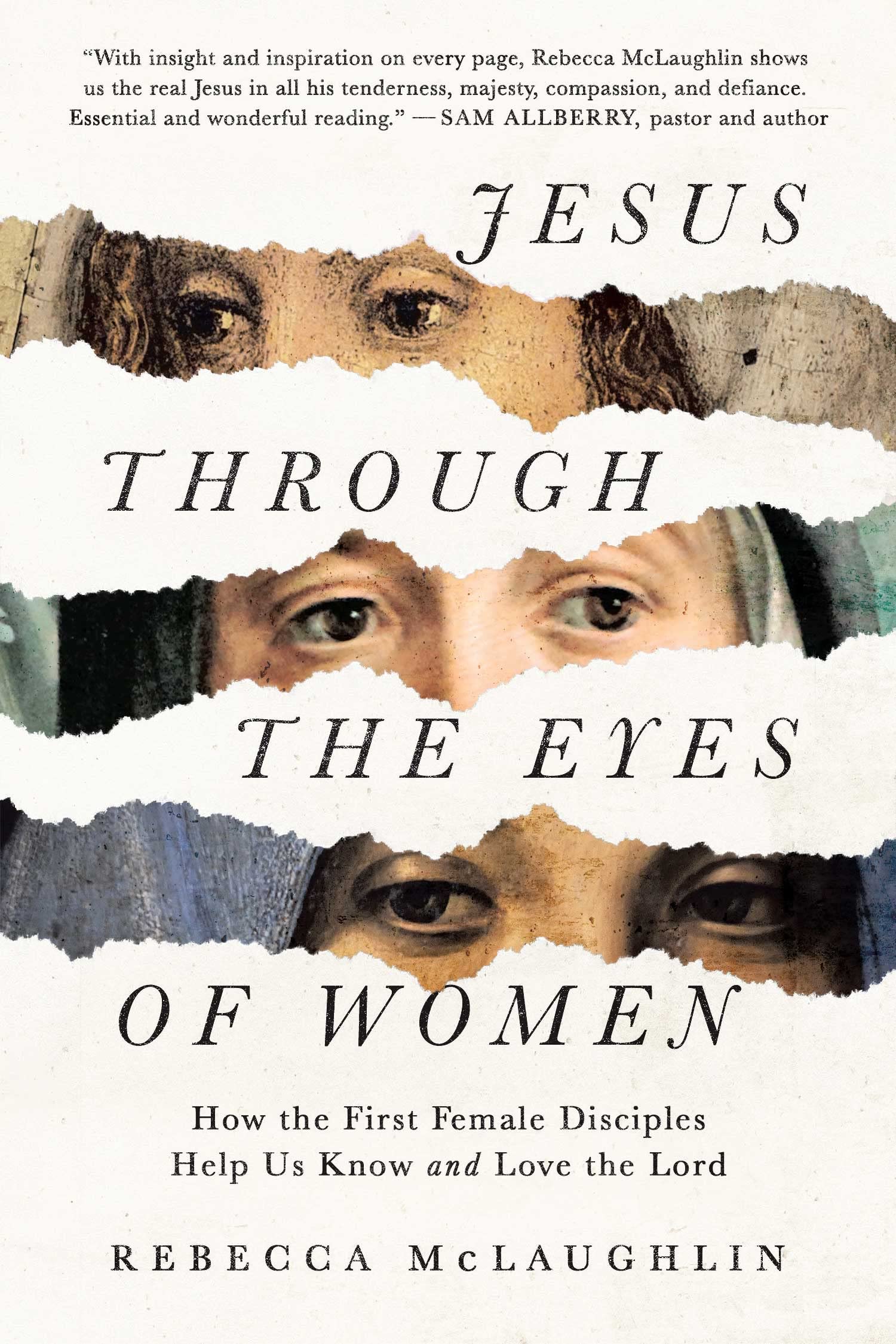 If the women who followed Jesus could tell you what he was like, what would they say?
Jesus’s treatment of women was revolutionary. That’s why they flocked to him. Wherever he went, they sought him out. Women sat at his feet and tugged at his robes. They came to him for healing, for forgiveness, and for answers. So what did women see in this first-century Jewish rabbi and what can we learn as we look through their eyes today?
In Jesus Through the Eyes of Women, Rebecca McLaughlin explores the life-changing accounts of women who met the Lord. By entering the stories of the named and unnamed women in the Gospels, this book gives readers a unique lens to see Jesus as these women did and marvel at how he loved them in return.
We’re delighted to offer this ebook to you for free.