Listen or read the following transcript as D. A. Carson speaks on the topic of hypocrisy from Matthew 6:1-18.
This evening I want to ask the question.… What is the relationship between the Sermon on the Mount recorded in Matthew and the Sermon on the Mount recorded in Luke? There are undoubtedly some theology students here, and you will have had to face this problem in what is called the Synoptic problem. In particular, how do Matthew, Mark, and Luke, the so-called Synoptic Gospels, fit together?
They obviously have parallels. They obviously overlap. They sometimes use each other’s words, and sometimes they diverge and they seem to contradict. How are we to understand these things? In particular, how are we to understand the relationship between the Sermon on the Mount in Matthew and the Sermon on the Mount in Luke? I could give you a long list of differences, but let me draw your attention just to one or two things.
Luke’s account of the Sermon on the Mount is found in Luke, chapter 6, verses 20 to the end, so the first difference is that the thing is very much shorter. It’s not even a full chapter as compared with Matthew’s three full chapters. Luke leaves a great number of things out, including the Lord’s Prayer. Then there are other differences.
Two weeks ago we looked at the Beatitudes closely. Matthew has eight beatitudes and then expands the last one. Luke, if you compare, has only four beatitudes, and then he matches them with four woes. He has, “Blessed are you who are poor, blessed are you who hunger now, blessed are you who weep now, blessed are you when men hate you,” and then jumps to “Woe to you who are rich, woe to you who are well fed,” and so forth.
Then when you look at the Lord’s Prayer itself, in Matthew’s gospel it is considerably longer than in Luke’s gospel. In fact, in Luke’s gospel it’s not found in the Sermon on the Mount at all; it’s found in Luke, chapter 11. We read there, “One day Jesus was praying in a certain place. When he finished, one of his disciples said to him, ‘Lord, teach us to pray, just as John taught his disciples.’ He said to them, ‘When you pray, say …’ ” And he begins.
Instead of beginning “Our Father,” he begins just “Father.” He does not have “who art in heaven” or “in heaven.” He has “Hallowed be your name, your kingdom come,” but he doesn’t have “Your will be done on earth as it is in heaven.” His whole form is shorter. What are we to do with these things? How accurate are all of these reports? Is it possible perhaps that Matthew made half of the Sermon on the Mount up?
These things have honestly to be faced. If we’re going to examine the Sermon on the Mount closely, they have to be faced squarely. Now obviously, there’s not time to examine each problem in detail. Let me first of all just list some guidelines of principles of study in the Synoptic Gospels, and then after I have listed these principles, I will show you how they apply to some of the things I’ve just mentioned and tell you my own view.
1. Jesus was an itinerant preacher.
He was many more things, but he was that. He preached from place to place. For three years, I did itinerant preaching in southwestern Ontario. That means I was out speaking three, four, five, six times a week, but usually in a different place. I just didn’t have time with all that traveling and with the other things I was doing to prepare fresh messages for each place.
I preached the same dozen or so sermons literally scores of times, and I guarantee they never came out once exactly the way they came out some other time. Partly it was because I speak extemporaneously. I don’t sit here reading line after line after line of a detailed manuscript. Partly it’s because I recognized that in some cases I was addressing pastors, in other cases I was addressing young people, in other cases I was addressing Christians, and in some other cases non-Christian students in a secular university.
This naturally meant my approach, my method, my phraseology, would differ. A passage that originally was developed in one context would be developed somewhat differently in another context. If you examine carefully all of Jesus’ sermons, you will see that he does preach the same sermons in more than one place and to different audiences, and he does control them and mold them accordingly.
2. He preached primarily in Aramaic, as far as we know, whereas the New Testament is written in Greek.
That means there are translation problems, two in particular. First, whenever you translate, you don’t get anything verbatim across the barrier. There are differences in language vocabulary, and if you give one piece of prose to two translators, you don’t come out with identical translation. You might have identical meaning, but you won’t have identical form.
Second, some things are non-translatable exactly. For example, if I clear my throat a few times, I might apologize and say, “I’m sorry. I have a frog in my throat.” However, if I were in some parts of Quebec and said that in French.… In point of fact, in Quebec I would have to say, “I have a cat in my throat.” If you think it’s funny for the French Canadians to have cats, you should hear what they think about your frogs. In other words, there are some translation problems that are involved in reporting Jesus’ words. I could give you examples, but I press on.
3. We have condensed reports of what Jesus said, not long verbatim records.
The whole setting of the Sermon on the Mount in Matthew’s gospel, for example, is that he withdraws, and the group of extended disciples (not just the Twelve but extended followers on) moves off to the hills with him, and there he speaks to them.
I can read through the Sermon on the Mount in about 15 minutes. I’m jolly sure Jesus did not withdraw to the hill country of Galilee and then speak for only 15 minutes and call it quits. In other words, this is a condensation of extended discourses, perhaps a day or two days’ teaching. It is a selected condensation, and no more.
This means you can have two people reporting the same sermon and have accurate reports without them being exhaustively accurate. They can be true without being exhaustive. For example, when he gives a beatitude, it does not necessarily mean that then he went on to the next beatitude. It might be that that was a point heading. In other words, our reports are not exhaustive; they are selected, and they are condensed.
4. Some writers in the New Testament outline things chronologically, others topically, and others both.
Matthew, for example, very frequently instead of putting things together chronologically in Jesus’ life puts things together topically. He brings up a subject. It leads on to another subject. It might not have been the next thing that came up in Jesus’ life, but it is the next thing he wants to deal with topically.
There is no reason for not doing that unless you give the impression that it is the next chronological thing. Matthew is quite careful with his introductory formula in introducing the next section of his gospel. Luke mixes his approach. He sometimes has an obvious chronological development and sometimes a topical development.
- There is the problem that arises from these last two points; namely that the evangelists themselves have different interests in reporting.
They are not stressing the same things. Luke has a greater interest in the whole concept of salvation, Matthew in the concept of the kingdom. He stresses both aspects of Jesus’ ministry, which he himself is particularly interested in.
- There is the general literary problem, what is called the Synoptic problem.
It’s obvious when you compare Matthew, Mark, and Luke that they do borrow from each other. One of them, perhaps two of them, saw at least part of the third in writing. There are great debates, and endless ink is spilled on which came first.
The general consensus is that Matthew and Luke had Mark in front of them, but that is highly disputed, and it has been raised again in the last 10 years. All I’m saying is that this is an extremely difficult problem, and the problem of literary dependence has always to be borne in mind when you start talking about how the evangelists perhaps made things up or did not make things up.
5. The differences are usually the type for which we should thank God.
They eliminate the possibility, in many cases, of collusion. In some cases, of course, they’re taking over the story directly, but in some cases the independent value of the witness is very worthwhile. Supposing, for example, we were in a court setting and I asked two witnesses, A and B, to describe a third person, C, whom they both knew.
Witness A gets up. “Yes, I know C,” he says. “He has an aquiline nose, curly brown hair, and blue eyes that dance in the sun,” and he goes on. Witness B gets up and says, “Yes, I know Steve. He has an aquiline nose, curly brown hair, and blue eyes that dance in the sun.” I’d say, “Hey, wait a minute! Where’s the collusion here? The thing reeks of collusion.” Sometimes even the variation is a mark of authentication.
It could be that B will come along and describe C in quite different terms. “Oh, he’s so gifted with music. He plays the most beautiful Beethoven you ever did hear.” A and B are not contradicting each other. They have different questions they’re asking when they’re describing the same person, C. Sometimes the differences are of that nature.
6. When scholars start asking which form of something is the original, usually the question is being begged just a little.
First, there is often no reason why both forms couldn’t be original if the things came from different settings or if they together formed part of an expanded whole or whatever. Second, the disagreements in the scholarly results often show that the criteria used are woefully inadequate.
For example, in the case of the Lord’s Prayer, every serious commentary asks, “Which form of the Lord’s Prayer is original, the Lukan form or the Matthean form?” The majority opinion is Luke’s form. Matthew, we are told, added a wee bit here and there. But there is a significant number of scholars who say, “No, no, no. Matthew’s form is correct. Luke cut a little bit out here and there.”
How on earth are you going to prove that either way? It’s extremely difficult. Usually you go about doing it by establishing a number of criteria, which in your own mind dictate what the evangelist was trying to do. If he was the type who liked expanding things, you see expansions everywhere. If he was the type who rather likes to condense things, you have condensations everywhere. So I’m not convinced that these criteria are the most useful.
Lastly, there is a heavy eyewitness and historiographical element in Synoptic reporting that is inescapable. It’s not a case of writers writing that which has been passed on by oral tradition over centuries. Listen, for example, to the beginning of Luke’s gospel:
Many have undertaken to draw up an account of the things that have been fulfilled among us, just as they were handed down to us by those who from the first were eyewitnesses and servants of the word. Therefore, since I myself have carefully investigated everything from the beginning, it seemed good also to me to write an orderly account for you, most excellent Theophilus, so that you may know the certainty of the things you have been taught.
Do you want to know why I think Luke knew about the virgin birth? I think he had a wee chat with Mary. He spent a lot of time in Palestine, and he went and asked the witnesses. He talked with them and investigated and examined. Now let’s see how some of these things would work out, then, for the problems I mentioned.
In the case of Luke having a shorter account and Matthew a longer one, I suggest they are both very, very short compared to what Jesus originally said. I don’t believe his discourse was climaxed in 15 minutes. Secondly, with respect to the Beatitudes, Matthew’s eight and Luke’s four with his four woes.… Again, I quite readily incorporate the whole lot.
It’s interesting that some scholars, by no means the evangelical ones, see some of the pairs in terms of Aramaic parallels, which were quite common in Jesus’ speech, from what we can detect. For example, Matthew has, “Blessed are they that mourn, for they shall be comforted.” Luke has, “Blessed are they that weep, for they shall laugh.”
It has been suggested quite plausibly that it was an Aramaic couplet originally that went something like, “Blessed are they that mourn, for they shall be comforted. Blessed are they that weep, for they shall laugh.” This sort of coupling arrangement is a very common thing in Jesus’ sayings, as, in fact, the types of sayings you get from rabbis at the time. The Lord’s Prayer is a different order problem, because it does not occur in Luke’s account of the Sermon on the Mount. It occurs in an entirely different setting in Luke 11.
There it just says one day, once upon a time, at a particular time, some disciples came to him and asked him how to pray. That occasion could have been before Jesus’ delivery of the Sermon on the Mount. It could have been private instruction before Jesus spoke publicly on the subject, or it could be a number of half a dozen other possible solutions I won’t list to you but you can find in any of the major conservative commentaries.
All I’m saying by this is not that there are no problems. There are some difficulties that are to be raised and faced squarely, but I do want to say very emphatically that I personally find myself, the more I read the New Testament, judged under the Word rather than able to sit over the Word of God and judge it. I would say this to those of you who are studying theology and have to face these questions squarely: when you come to these questions, don’t suppress them. Don’t pretend they’re not there.
On the other hand, don’t just read the books that are recommended. Trot around to Tyndale House or some other place and ask some of the chaps there for conservative answers or rebuttals or debates in the same area to at least see what the options are. Struggle by all means. Face them fairly. Don’t suppress the doubts. Otherwise they’ll rear their ugly heads later. On the other hand, don’t just face them and then swallow them all. There are answers to be dug out. Face them honestly, and dig them out by all means. That was the introduction. To the text.
Last week we saw the relationship between the Law and the Prophets and the kingdom of God introduced by Jesus. We noticed in particular his authority, how the Law and the Prophets point to him. He fulfills them and then speaks with authority to introduce the new age. He, the King, establishes his king dominion, his reign. His demands for righteousness are searching. They are penetrating. They are utterly without compromise.
So chapter 5 ends, “Be perfect, therefore, as your heavenly Father is perfect.” Indeed, in verse 20, he has said, “I tell you that unless your righteousness surpasses that of the Pharisees and the teachers of the law, you will certainly not enter the kingdom of heaven.” But we humans are a strange lot. We hear high moral injunctions, and we begin to think in terms of how well others would think and speak of us if we were like that. In other words, the greater the demand for holiness, the greater the danger of hypocrisy.
Therefore, Jesus begins the next chapter, “Be careful not to do your acts of righteousness before men to be seen by them. If you do, you will have no reward from your Father in heaven.” In many manuscripts there is a but in there. “Be perfect,” at the end of the chapter, “but be careful.” The King James Version here has “Not do your alms.” In point of fact, the translation in the modern versions is more accurate: “Not do your acts of righteousness.”
“Don’t practice your piety before men to be seen by them,” Jesus is saying. In other words, here again there is a question of whose approval we seek. You will recall that when we studied the Beatitudes two weeks ago we noticed that very word blessed has the idea of God’s approval being poured out, and immediately the question is raised, “Whose approval do I seek?” Here it is now made explicit. “Be careful not just to perform your piety to gain the approval of men, but see to it that your piety gains the approval of your Father in heaven.”
Then Jesus tackles three fundamental acts of Jewish piety.
The first is alms giving in verses 2–4. The second is prayer in verses 5–8 (then verses 9–15 give us his paradigm prayer), and then fasting in verses 16–18. There are common elements in these three fundamental acts of Jewish piety. First there is a description and denunciation of ostentatious piety typical of degenerate Pharisaism. Second, there is an ironic affirmation of the limited results of such piety. They have their reward. Lastly, there is a description of true piety. The same form comes through in each case.
1. Alms (verses 2-4)
“So when you give to the needy, do not announce it with trumpets, as the hypocrites do in the synagogues and on the streets, to be honored by men. I tell you the truth, they have received their reward in full.” It is not the practice of alms giving that is criticized. Even in the Old Testament, giving of alms is regarded as a sacred duty (Deuteronomy 15:11). Indeed, in the previous chapter, verse 42, Jesus himself says, “Give to the one who asks you, and do not turn away from the one who wants to borrow from you.”
Let me digress for a moment. After last week’s talk, someone came to me and said with real anguish, “What do we do about the Cambridge dossers?” That’s no easy problem. Do you give to them every time they come and ask? There was a brother here last year, who has since gone down, who took this verse so seriously that every time somebody tapped him on the shoulder and asked him for something he gave it. The dossers soon found out.
He was plagued almost to the edge of a nervous breakdown, and he himself was starving, quite literally, because he didn’t have enough money. He gave it all away. Only when he didn’t have any more left did he tell them quite honestly, “I’m sorry; I don’t have anything to give you.” Is that what’s in view? Lest I gave that impression to anybody else, I am taking this opportunity to digress.
I worked with alcoholics for a while in Vancouver, and gradually, trying to wrestle with this problem myself, I came to this policy, which satisfies myself. If one of them came to me and asked for money, I never gave it. If it was for food, I took them out to get something to eat. I either took them home or took them to the restaurant, but I stayed with them, and then I paid the tab. Since I’ve been in Cambridge, I don’t know how many have stopped me and asked for money, and in every case that’s what I’ve offered to do, and in no case has anyone taken me up on it.
I’m convinced that we as Christians need to be very concerned about this problem in this city, and I’m glad that there are some Christians who are worried about the problem and are looking toward the possibility of establishing a more permanent residence for them with competent counselors and so forth. I’m convinced further that Christian love does demand that we do what we can to help. I’m not sure it really helps to give your money to provide them with more drink.
That digression aside, alms giving is everywhere regarded as not only a privilege but a duty. Jesus is not talking against that. He speaks rather against the ostentatious giver. The trumpet here might be a metaphorical allusion, somebody tooting his own horn, as it were, but it may also be a reference to blowing trumpets, a time of collecting alms in the temple for special relief.
For example, if there were a special crisis, there could be trumpets blown in the temple that were understood to call the people together to give alms relief. Well, what a glorious opportunity. The trumpet sounds. Out I go and strut down to the temple, and everybody knows what I’m going to do. It could be that sort of allusion that’s in view here.
Such people are hypocrites. The Greek word means literally actors. They are playing at piety. It’s not really piety; it’s playacting. I don’t know who your favorite character is on TV, but, believe it or not, the character who plays him is not like the character he’s playing. Kojak really isn’t Kojak. Sometimes piety really isn’t piety. It’s just playacting.
Jesus said in Matthew 15, “You hypocrites! Isaiah was right when he prophesied about you: ‘These people honor me with their lips, but their hearts are far from me.’ ” Playacting, filling a role. “They have their reward.” People think well of them. “Did you see Rabbi Smith on his way to the temple today? No sooner was the trumpet blown than he went off to give. Rabbi Smith is very concerned about the poor.” But what blessing does he have from God? He has already used it all up.
“But when you give to the needy, do not let your left hand know what your right hand is doing, so that your giving may be in secret.” Here there is giving for the sake of the poor, not for the sake of personal satisfaction. It is secret giving. This secrecy does not suggest that we are not to keep accounts, if we are using this business of not keeping accounts to hide how little we give.
For example, in 1 Corinthians 16, Paul writes to the believers and says, “On the first day of the week, set aside as much as you can according to how the Lord has prospered you. Set aside your gifts according to the way the Lord has prospered you.” So there is some sort of keeping of accounts here. On the other hand, accounts must not be used to sort of say, “Hmm, I gave 20 percent more this year than last year. My sanctification is going up.”
It’s supposed to be secret, reserved, quiet. Nobody should know what you give. It’s between you and the Lord. It’s supposed to be so secret that your left hand shouldn’t know what your right hand is doing. It’s almost as if the Master is searching for some sort of idiom, some sort of phrase that will get across just how quiet and private it ought to be.
“Then your Father, who sees what is done in secret, will reward you.” Again, there is this business of being motivated by the desire to please God. Do I really primarily want the rewards of all of the people who will say what a wonderful giver I am? Is that what I really want or is what I want the blessing that comes from the Lord? It’s a question again of motive. It’s a question again of why I’m doing what I’m doing.
The principle extends not only to alms giving but to all good works. Are the good works we do only done when we’re likely to receive full credit or do we delight to do good works that only the Lord knows about because we want to please him? The answer to that question will determine where I stand in this matter of playacting piety.
2. Prayer (verses 5-15)
“When you pray, do not be like the hypocrites, for they love to pray standing in the synagogues and on the street corners to be seen by men. I tell you the truth, they have received their reward in full.” The hypocrites, the play actors, were playing at giving before. Now they’re playing at praying. Standing in the synagogues. Prayer at synagogue services was led by a member of the congregation who stood in front of the ark of the law for this purpose, and he led the congregation in public prayer.
The reference to streets probably refers to the fact that at times of public fast and perhaps also at the time of the daily afternoon temple sacrifice, prayer could be offered in the streets. If he couldn’t get to the temple, the brother might go just to the street and face the temple and pray. Again, what a splendid opportunity for a little bit of ostentatious piety. “It is my turn to pray at the front of the synagogue this week. It’s time for the temple sacrifice out in the street. Look around. Look up to heaven. I thank you, God, that I am not as other men are.”
Of course, we wouldn’t be quite that gross today, but I wonder sometimes how many of us are similarly motivated when it’s our turn to do the reading at church. Again, it needs to be insisted that Jesus is not speaking against public prayer and public worship any more than he was speaking against alms giving. Rather, it is the ostentation of it he’s speaking against.
He says, “Do not be like these hypocrites, for they love to pray standing in the synagogues to be seen by men.” There is a certain acclaim that comes with any public service, whether it’s being a college CU rep or leading in a service or leading a Bible study. As I know the deceit of my own heart, I’m aware how tempting these things can be, but these people receive the same transient reward, a little bit of a claim, and they sacrifice the blessing that comes from God.
“When you pray, go into you room, close the door and pray to your Father, who is unseen. Then your Father, who sees what is done in secret, will reward you.” I think a very good test is this. Do I pray more and more fervently when I’m alone than when I pray in a fellowship group? If most of your praying is done in public, then I suspect there is a large element of ostentation there. Perhaps the reason we don’t see more results is that we don’t pray more in private. “Your Father, who sees what is done in secret, will reward you.”
Then there is a further warning. “And when you pray, do not keep on babbling like pagans, for they think they will be heard because of their many words.” Here there is a reference to heaping up of phrases. Some pagans thought that if they named all of their various gods they would have a better chance of getting their petitions answered because they hadn’t left anybody out. “Do not say idle things” is the chief thought. Don’t just be mouthing phrases. God is in heaven; you are on earth, so let your words be few.
Again, it’s not a question of not ever praying at length but rather not ever praying redundantly and repetitiously and in a babbling way at length, just praying at length because you’re supposed to pray at length. Again, I fear that evangelicals sometimes think we are heard primarily for the volume of prayer, the amount of it, rather than for anything else.
When I was pastor of a church in Vancouver, I inherited a situation where it was traditional for our weekly prayer meeting for the men and boys to go off and pray in one area of the church and for the women and girls to go off and pray in another area of the church. Well, there are some advantages to that, but there are some disadvantages too. So once, very gently, I suggested that they come together to pray so they could hear each other pray as well.
They had different interests and different concerns and different emphases. One man got up quite shocked. “But this means we would only get half as much praying done.” I suspect the same problem arises in other evangelical circles too. When we think that somehow God will be forced into answering.… If we just repeat the same things often enough, long enough, loudly enough, God will have to do a certain thing.
“Do not be like them, for your Father knows what you need before you ask him.” This is not an incentive to abandon prayer. Rather, the idea is God as Father knows the needs of his family, yet he teaches his children to ask in confidence and trust. In this connection, even the Lord’s Prayer can be a danger. As early as the Didache, a document written at the beginning of the second century, it was prescribed that Christians should repeat the Lord’s Prayer three times a day.
As soon as a thing is prescribed quite like that, it is degenerating again into this repetitious babbling. It’s just done because it’s done because it’s done. It’s that sort of thing Jesus is speaking out against. “This is how you should pray …” Thus begins the Lord’s Prayer. Actually, perhaps better called the “Lord’s Model Prayer.” It is not the prayer the Lord prays so much as the prayer he gives us as a paradigm that we should pray.
The petitions are divided between those concerning God and those concerning men. Concerning God, there are petitions concerning his name, his kingdom, and his will. Concerning men, there are petitions concerning our bread, our sins, our debts, and our temptation. God and his glory, God and his holiness are first, yet the prayer as a whole embraces both God’s glory and our needs.
Moreover, it embraces both our physical needs (our bread) and our spiritual needs (our sins and our temptations). Happily, it is our Father and our sins. Christians are not simply to pray in isolation. They are praying not only for themselves but for the whole church of the living God. This, then, is how we are to pray.
“Our Father.” Jews occasionally addressed God like that, but it was rare. They preferred loftier phrases. Indeed, when you read the prayers of Jews in the intertestamental literature, the literature between the Old Testament and the New Testament, you find some spectacular displays of piling up of phrases. “Great God of the universe, sovereign Lord of Israel, creator of all, sustainer of men,” and on and on. Just chalking them up, sometimes as many as seven, eight, or nine epithets. Jesus says, “Our Father.”
Jesus’ own private address was even simpler. When he addressed the Father it was, “Abba,” a word that is very difficult to translate. “Daddy” is just too flippant. It’s something like, “My father. My dad.” There’s just no good word. It was a very personal form of quiet address, and Christians took that over. In Romans 8, and again in Paul’s epistle to the Galatians, he says, “Because we have been made sons of God, therefore we approach God and say, ‘Abba.’ ”
There is a sense in which God is the father of all men, but the vast majority of biblical uses of the word father have rather to do with the special sonship that comes by being a Christian. I am his son. Paul rejoices in the fact in Romans 8. “He has made us sons by adoption, and if sons then heirs, heirs of God and joint heirs with Jesus Christ.”
We come before the God of the whole universe, the God who made us, the God who stands against us because of our sins, the God who came with us in Immanuel, our Savior, and we approach him and say, “Our Father.” Yet for all this emphasis on “our Father,” which pictures God near us, he is still our Father in heaven.
There is, on the one hand, an emphasis in the New Testament on the joy of personal relationship with God. “Beloved, now are we the sons of God, and it doesn’t even yet appear what we shall be.” On the other hand, there is a putting God back. He is God. He is transcendent. He is in heaven. Let the earth be silent before him.
In North America, there is a tendency toward nifty little choruses that are very memorable and which you can’t quite condemn for heresy but which ought not to be sung at all costs. One in particular I can think of is, “He’s a great big wonderful God.” He sounds like a great big wonderful teddy bear. He is God. He is not only our Father; he’s God in heaven.
“Hallowed be your name.” Name suggests what a person is in Jewish thought. Of God, particularly his nature as he has revealed himself. God reveals himself very often through his name. He is called, for example, El Shaddai, the Almighty One, or he is called Yahweh, or Jehovah as we transliterate it. The I Am or the I Am That I Am or the I Shall Be What I Shall Be.
Then this Yahweh takes on extra words behind that. “I Am That I Am, Our Righteousness.” God’s names emerge from the Old Testament pages with richness that reveals who God is. Now, Jesus says, pray, “Hallowed be your name.” God or Jesus can fall so easily from the lips of men who do not know him, usually as a form of oath, a form of expression that is simply an emphatic indication of disgust or discouragement or anger.
Jesus says, “May your name be hallowed.” To hallow entails reverence and honor. It also suggests that we are to glorify his name by obeying him. The intriguing thing is that for us to pray, “Hallowed be your name” is a prayer that the hallowing of his name will come to pass when what we really mean is that we are the ones who hallow his name. The mind boggles.
What are we doing praying to God that he’ll hallow his name when it’s us who are, in a sense, to hallow his name by ascribing to him reverence and honor and obedience? The same point comes out a little later in the Lord’s Prayer. The idea is that even in the area of our obedience, even in the area of our giving in reverence, in point of fact, when we do give him reverence and when we are obedient to him, it is his gracious working in us that enables us to give him that reverence and obedience.
So we pray to him, “Lord, hallow your name,” and it is part of praying, “Lord, make me holy. Lord, make me ascribe to you all that is yours. Lord, make me reverence you. Work in me so that I honor you. Hallow your own name.” It keeps the focus not at the personal level of what I would like to be like personally but at the longer-range level of why I should be holy: to glorify God. The one little prayer has so much meat in it for meditation, so many implications about how I think of God, it should itself take us to our knees.
“Your kingdom come.” We have seen that the kingdom has to do with God’s reign, his king dominion. It came with the coming of the King, but it is still to come when he comes again. Here there is a prayer for the final establishment of God’s saving reign. There is a sense, as we’ve noted earlier, that God is always reigning. He is always sovereign, but his saving reign, the way he breaks into men’s history and saves men, the positive saving effect of this rule, has broken in with Jesus and in its climactic form will be introduced when Jesus comes again.
Here the believers are told to pray, “Your kingdom come.” At the end of 1 Corinthians, Paul writes, “Maranatha, our Lord come.” Have you ever noticed the way the Bible ends? In the very last chapter of the last book Jesus testifies, “Yes, I am coming soon.” John writes, “Amen, come, Lord Jesus.” The question is immediately raised, “Is that really what I want to pray?”
Or deep down would I prefer to pray, “Lord, I’d like you to come, but not until I get my degree. Lord, I want you to come, but there’s this girl, and I want to marry her first. Lord, I do want you to come, but I’d sure like a crack in the ministry first”? The question is raised again. In one sense, we are to occupy until he comes, but in another sense, all our focus of attention, all of our desires, ought to be for his coming back so that introduces the final stage of righteousness. Or would we rather have a mixture of righteousness and sin?
“Your kingdom come, your will be done on earth as it is in heaven.” The will of God here could either be God’s purpose in history, in which case it is really a statement akin to the prayer about the kingdom … your will in history, your purpose in history begun … or it could be God’s ethical will, which receives maximum emphasis in the gospel of Matthew. “Your will be done so that righteousness prevails.”
We have seen already that in the kingdom the standards and ethics of the kingdom in its final state already prevail and pertain now. However, one brother came to me after the first session when I was trying to explain these things as best I could, and he said to me, “I don’t see what you’re getting at. In the final state, everything will be righteous, everything will be holy, but now there’s such a mixture. You look at chapter 5, and he talks about divorce and murder and hate and lust, and in that we speak of the ethics of the final state pertaining now?”
He has a point. Therefore, there is a sense in which the ethics of the kingdom, the absolute demands of perfection and holiness, although they pertain now, have to be worked out in the context where there is sin and greed and selfishness and hate and bitterness and lust. Christians, therefore, who love righteousness hunger for the time when God’s will will be done on earth as it is in heaven without the caveat, without the exceptions, without the mitigations, just freely, openly, righteously, cleanly, purely.
“Give us today our daily bread.” The word daily is one that occurs very rarely in Greek. In fact, certainly only in the Lord’s Prayer, possibly elsewhere, and nobody is quite sure what it means. It seems to mean literally “day that is coming.” “Give us on the day that is coming our bread.” So if a person prays that at the beginning of the day, he means the day that lies before him today. If he prays it at the end of the day, it means the day that is tomorrow.
It is also possible that it is itself a reference to Jesus coming back. Jesus coming back is sometimes referred to as the day. In which case there could be an allusion here to the idea that, “On that day, give us our bread. Enable us to eat at the messianic banquet on that day.” I think, however, the allusion is simply to daily provision, and that’s all. James writes, “Every good and perfect gift comes down from the Father of lights, with whom is no variableness, neither shadow of turning.”
There is an acknowledgement here that all that we have comes from God. Paul asks, “What have you that you haven’t received?” I’m madly scrambling now trying to finish off my dissertation. I want to submit in about seven weeks, but there are about half a dozen of us at Tyndale House in the same boat. One of us is very seriously delayed due to the fact that his wife has come down with a rare illness and he has spent the last three weeks at home.
As I was just beginning to feel proud of myself for getting as much done as I’ve gotten done this past week, I thought of Roy Williams. My good health I receive from the Lord. If I’ve gotten a lot done this week, what have I but what I’ve received? Your ability to get your marks, your ability to work and earn money, your ability to make friends, your ability to study, your health.… All that you have is from the Lord, from his gracious hand.
In fact, we don’t deserve any of it, for we have long since thrust our rebellious fists in his face. He could quite rightly write us off, but instead we have already seen him described in chapter 5 as the one who sends his sun upon the just and upon the unjust. He sends his rain upon the righteous and the unrighteous. All that we have comes from him. So we go to him and say, “Give us today our daily bread.” Here there is a prayer for our needs. Not our greed; our needs.
“Forgive us our debts, as we also have forgiven our debtors.” Verses 14–15: “For if you forgive men when they sin against you, your heavenly Father will also forgive you. But if you do not forgive men their sins, your Father will not forgive your sins.” The word is debts in Matthew, trespasses in Luke. Both suggest sin, as is indicated by verses 14–15. “If you forgive men when they sin against you.” Probably the Aramaic word Jesus used meant both.
In other words, there is a picture here of sin as a debt, sin as owing something, sin as being in somebody’s due. Does this verse, verse 12, suggest that we forgive first? Does it work like this? I forgive Johnny, and then the Lord forgives me. Is his forgiveness, in that sense, temporally conditional on my forgiving? That is what the NIV sounds like. “Forgive us our debts, as we also have forgiven our debtors.” The Greek need mean no more than, “Forgive us our debts, as we herewith forgive our debtors.” The idea is simply that given to us in Matthew, chapter 18, and I shall read a few verses:
Therefore, the kingdom of heaven is like a king who wanted to settle accounts with his servants. As he began the settlement, a man who owed him ten thousand talents was brought to him. Since he was not able to pay, the master ordered that he and his wife and his children and all that he had be sold to repay the debt. The servant fell on his knees before him. ‘Be patient with me,’ he begged, ‘and I will pay back everything.’ The servant’s master took pity on him, canceled the debt and let him go. But when that servant went out, he found one of his fellow servants who owed him a hundred denarii.” A small pittance. “He grabbed him and began to choke him. ‘Pay back what you owe me!’ he demanded. His fellow servant fell to his knees and begged him, ‘Be patient with me, and I will pay you back.’ But he refused. Instead, he went off and had the man thrown into prison until he could pay the debt. When the other servants saw what had happened, they were greatly distressed and went and told their master everything that had happened. Then the master called the servant in. ‘You wicked servant,’ he said, ‘I canceled all that debt of yours because you begged me to. Shouldn’t you have had mercy on your fellow servant just as I had on you?’ In anger his master turned him over to the jailers until he paid back all he owed. This is how my heavenly Father will treat each of you unless you forgive your brother from your heart.
That’s the idea. It is not a question of temporal sequence. It’s a question, as we saw in the Beatitudes, that we have not really repented ourselves, that we are still holding grudges against other people. There is a sense in which Christians stand in between two poles. On the one hand, we have been forgiven and therefore we ought to forgive, and on the other hand, we are going to need to be forgiven again and therefore we ought to forgive. In either case we ought to forgive.
Therefore, we can read, for example, in Colossians 3, “Forgive as the Lord has forgiven you.” Here we can read, “Forgive other men so that you will be forgiven.” This I find very searching. I like the idea of God forgiving me a great deal. I’m not nearly so good at the idea of forgiving others. Somebody says something that insults me or gets my goat, and I can nurse that grudge for a long time.
“Lead us not into temptation, but deliver us from the evil one.” This is strange phrasing to be asked not to be led into temptation. I think the meaning is simply this. It is a plea not to be overwhelmed by temptation. In other words, there is a recognition here that it is God who keeps us, and we ask him to keep us. I can’t keep myself. I’m not strong enough not to sin, so we ask him that we not be led into temptation. The doxology, the last part of the Sermon on the Mount in the King James Version, is a bit that was added in the second century.
Let me step aside from the text just a moment before I deal with this last small section on fasting. I want to list for you some tips on praying. These are purely practical, and I do so without any feeling at all that I’m a master in the area of prayer and, therefore, have great wisdom to impart. What I prefer to do, rather, is to show you some of the pitfalls and mistakes I’ve made myself, and if these things help you, then well and good.
- Treat prayer at least as a duty.
Much praying is not done because we don’t intend to pray much. If we simply wait until we have the urge, we might wait a long time. Treat prayer at least as a duty.
- Although it is important to avoid legalism, pray regularly as well as spontaneously.
The Old Testament boasts both a Daniel, who prays three times regularly, and a Hezekiah, who faces a problem and goes in and spontaneously takes his letter and spreads it on his bed before the Lord and begins to pray. There is a place for both.
- Mix themes of prayer.
There should be a place for both praise and for petition, for intercession, for affirmation, for meditation, for wonder, for adoration, but also simply for thanking the Lord for what he has done and naming some of the mercies we have received from his hand.
- Pray, stroke, meditate with the Scriptures.
There are many parts of the Bible that are best tackled in this running dialogue sort of way. You read something from the Scriptures and you say:
Lord, I see all the ways that applies to me that I have failed in so miserably. Lord, forgive this sin, and help me to put this principle that I see here in your Word into practice today, especially with that girl Sue whose face I detest. Lord, I’m sorry I feel that way. Your Word says I’m to forgive. Although she said some nasty things to me, Lord, I forgive her now. Help me to hold no grudge and to go out of my way to be kind to her today.” In other words, there is a place for interaction with the Word and with prayer.
- Sincerely abandon all known sin.
“If I regard iniquity in my heart, the Lord will not hear me,” the psalmist says. See also 1 John, chapter 3, verses 21–22. We’re just playacting if we’re coming to the Lord in prayer while we’re still harboring sin in our hearts.
- If it helps, vocalize.
There was a time when I was trying to get a group of Christians together to begin a new church in the west end of Ottawa in a place called Kanata. The Lord provided me with an old jalopy, a beat-up car. I think it was so old the termites held hands to hold it together. On the other hand, it had a good radio in it.
I would go back and forth from where I lived to where I was doing some door-to-door visitation, and so forth, and I’d turn on the radio, and on came the music. I can still tell you what was sung. “If I kiss you will you go away, just like the game my mother used to play.” I have a terrible memory when it comes to exams, but I have a wonderful memory for picking up useless lyrics.
So I would get in the evening to pray, and I would think of the lady who was just at the point of becoming a Christian. I could think of the problems we were having in a school gymnasium. It was absolutely filthy, and the janitor wouldn’t do anything. I’d begin to enumerate these things before the Lord.
“Lord, you know that lady. You know how close she is. Lord, I pray that you will …” “If I kiss you will you go away, just like the game …” Daydreaming. It’s the easiest thing in the world when you pray. Has anybody here not caught himself again and again in the midst of praying just daydreaming? Vocalize until you get over it.
- It might help to develop a quiet prayer partner relationship described by Jesus in Matthew 18:19.
“Again, I tell you that if two of you on earth agree about anything you ask for, it will be done for you by my Father in heaven.” That’s quite a promise. Does it mean that if Phil Payne and I agree that I should have a Cadillac and we get down on our knees together and pray I’ll get a Cadillac?
What’s the point that’s involved here? We get a hint of this sort of thing in 1 John 5:14. “If we ask according to God’s will, he hears us.” Have we not just been praying in the Lord’s Prayer, “Your will be done”? A number of years ago, I developed a friend whom I cherish greatly. I wish I could introduce him to you. He’s one of those people who just radiate the presence of Christ.
He was single at the time, as I, so we had more free time than we otherwise would have had. We agreed to meet together on Monday nights to pray. Well, actually, I see from this perspective that, in point of fact, it was just a senior brother bringing along a young ignorant brother under his arm and trying to help me out, but that’s not the way I saw it at the time.
So we started to pray. We prayed about this, and we prayed about that. It was his turn, and then it was my turn. After two or three hours of this, we both felt dry, but neither of us would admit it. Christians are supposed to pray. We were supposed to go away feeling very spiritual at that point. We did this for two or three Monday nights, and let me tell you, in some respects it was a frustrating experience. I felt in some way as if I was doing my duty, but I also felt as if the heavens were like bronze. I wasn’t getting anywhere.
Then Ken said, “Next week when we come, instead of praying the way we’ve been praying, we’ll list on paper the areas we’re going to tackle. We’ll talk about them and sort them out as much as we can and see if we can fit principles and truths and texts from God’s Word to this situation so that there are things we can actually pray for specifically in this case.”
The next week we got together. The first item concerned a girl whom both of us knew, June Fordham, from a very bad background, who had become a Christian and then just a few months later was told she had terminal cancer. She was lying at death’s door and also at the bottom edge of despair in a Montreal hospital 120 miles away. What were we supposed to pray for June Fordham?
The week before, we had prayed, “Lord, bless June. Lord, if it’s your will, please heal her, but Lord, bless June.” We started listing the possibilities. We could pray that the Lord would heal her. We could pray that he’d take her quickly. We couldn’t agree together that it was the will and mind of the Lord authoritatively to heal her, but we did know from the Scriptures that we could be confident of this very thing: God who begins a good work in us will perform it and complete it till the day of Jesus Christ.
So we said, “Lord, according to all your promises along this line, we claim by the authority of your own Word that you will restore to June the confidence, the faith that is her heritage as your child. She hasn’t rejected you or repudiated you. She just doesn’t understand. Lord, restore to her the joy of her salvation.” That was Monday. There were eight items on our list. We ran out of time after that.
We only prayed for half an hour incidentally. He took the first one. I took the second. He took the third. I took the fourth. Thursday I got a letter from June. It was just so full of the joy of the Lord and confidence and enthusiasm for him and looking forward to going to be with him. She had a fantastic testimony in that hospital during the six weeks before she died. Of the eight things we specifically laid before the Lord that week, five of them were answered just like that.
Let me tell you frankly on the other three. One I never got an answer for. Another one I’m convinced we had asked wrongly. We hadn’t sorted it out right. Another one we prayed about regularly, and then we split up at the end of the summer and moved on to other things. Our batting average wasn’t so good every week, but we did learn gradually to begin to pray specifically. Prayer became hard work. It meant thinking things through, trying to understand what God’s Word had to say to this situation, and then claiming God’s promises for it.
When we were wrong about what we were asking for, and we could see that we were wrong, to go back and say, “Lord, I think perhaps we’re asking for the wrong thing. Above all we want your will to be done. We want to come to an agreement about what your will is and agree to it and claim this promise from your Word. What do you want done? Teach us, Lord.” It meant digging in the Scriptures and digging into these situations.
I tell you these things, but I don’t want to give the impression I’m a great prayer warrior. My prayer life has been up and down like a yoyo. I don’t want to give you the impression I’m speaking down at you. I’ve had such dry spells I wouldn’t want to wish on any of you, but I’m convinced that wrestling in prayer in an intercessory way begins in this sort of fashion, really speaking, “Thy will be done on earth as it is in heaven.” Blessed is the Christian who can sing sincerely:
Sweet hour of prayer, sweet hour of prayer
That calls me from a world of care
And bids me at my Father’s throne
Make all my wants and wishes known.
In seasons of distress and grief
My soul has often found relief
And oft escaped the tempter’s snare
For thy return, sweet hour of prayer.
3. Fasting (verses 16-18)
“When you do fast, do not look somber as the hypocrites do, for they disfigure their faces to show men they are fasting. I tell you the truth, they have received their reward in full.” Again, Jesus is not speaking against the practice of fasting, although in chapter 9, verses 14–17, he does defend the disciples for not fasting because Jesus is with them. It’s a time for joy. But again, he’s not speaking against fasting per se but against its abuse.
There were special fasts at the high feast days in which everybody participated. Everybody fasted then. For example, the Day of Atonement of the Jewish New Year. There were also fasts when the fall rains didn’t come, when the autumn rains failed. There were also individuals who fasted for reasons of moral and religious self-discipline, and again, there was a marvelous opportunity to parade one’s righteousness.
This disfiguring of the face.… The custom then was not to wash one’s face, not to tend one’s hair, and to sprinkle ashes on one’s head. This indicated humiliation. Something originally good, the idea that you are going to be humiliated before the Lord, has thus been prostituted into a sign of humiliation that I can boast about before men. It’s so clever, but we do it all the time. In the circles I was brought up in as a child, I was told that Christians ought to carry their Bibles sometimes to show that they aren’t ashamed of being Christians.
You go to school and carry a novel. You go to school and carry a geography textbook. Why shouldn’t you carry your Bible to school sometimes too as part of witness? Eventually the pendulum swung, and then they carried big Bibles. The trouble is that the human heart is exhaustively deceitful, and virtually anything you do before the Lord can be twisted this way to make a sign, a piece of showmanship. God help us.
“When you fast, put oil on your head and wash your face …” Oil is a sign of joy. The idea is simply go on out and do what’s normal. Spray on your deodorant or use your talc or whatever, but do what’s normal. Don’t do something special. If you usually spray on your deodorant, then spray on your deodorant when you’re fasting too. Don’t do anything different. Don’t show that you’re fasting.
“… so that it will not be obvious to men that you are fasting, but only to your Father, who is unseen; and your Father, who sees what is done in secret, will reward you.” The point is not to change our daily behavior during any voluntary act of piety. The Father alone knows. The general thrust in this chapter is simply to answer the question, “Whom is the Christian trying to please?” Around this question revolves what is authentic piety.
There’s a story of a young minister who, entering his first charge, prepared enthusiastically for his first message. When the great day came, the doors swung open, and in he walked. He got up when the service started. He gradually built up confidence as he went along. Pretty soon he came to the sermon, and he began. “I am the Good Shepherd.”
Then he panicked. He saw there were people out there, and they were all looking at him. He was afraid, and he mumbled, and he stuttered, and he waffled through from point to point and finished 15 minutes early and forgot that he hadn’t even looked at his notes. He flushed and he blushed and he was embarrassed.
Finally, he walked to the bottom of the church, and he stood there shaking hands with people as they walked out. Some of them smiled sympathetically, and some of them looked the other way. Finally, there was one dear little old lady who took his great big red hand in her two little withered ones and said, “My dear pastor, if you had gone in the way you came out, you would have come out the way you went in.”
The question is really whom you’re trying to please. That’s the whole question. For all the negatives that are given in this chapter, there is the converse positive. Real piety, real godliness, real holiness is superlatively clean, superlatively attractive, superlatively wonderful. The real beauty of righteousness must not be tarnished by sham. God help us.
New International Version
Free eBook by Rebecca McLaughlin: ‘Jesus Through the Eyes of Women’
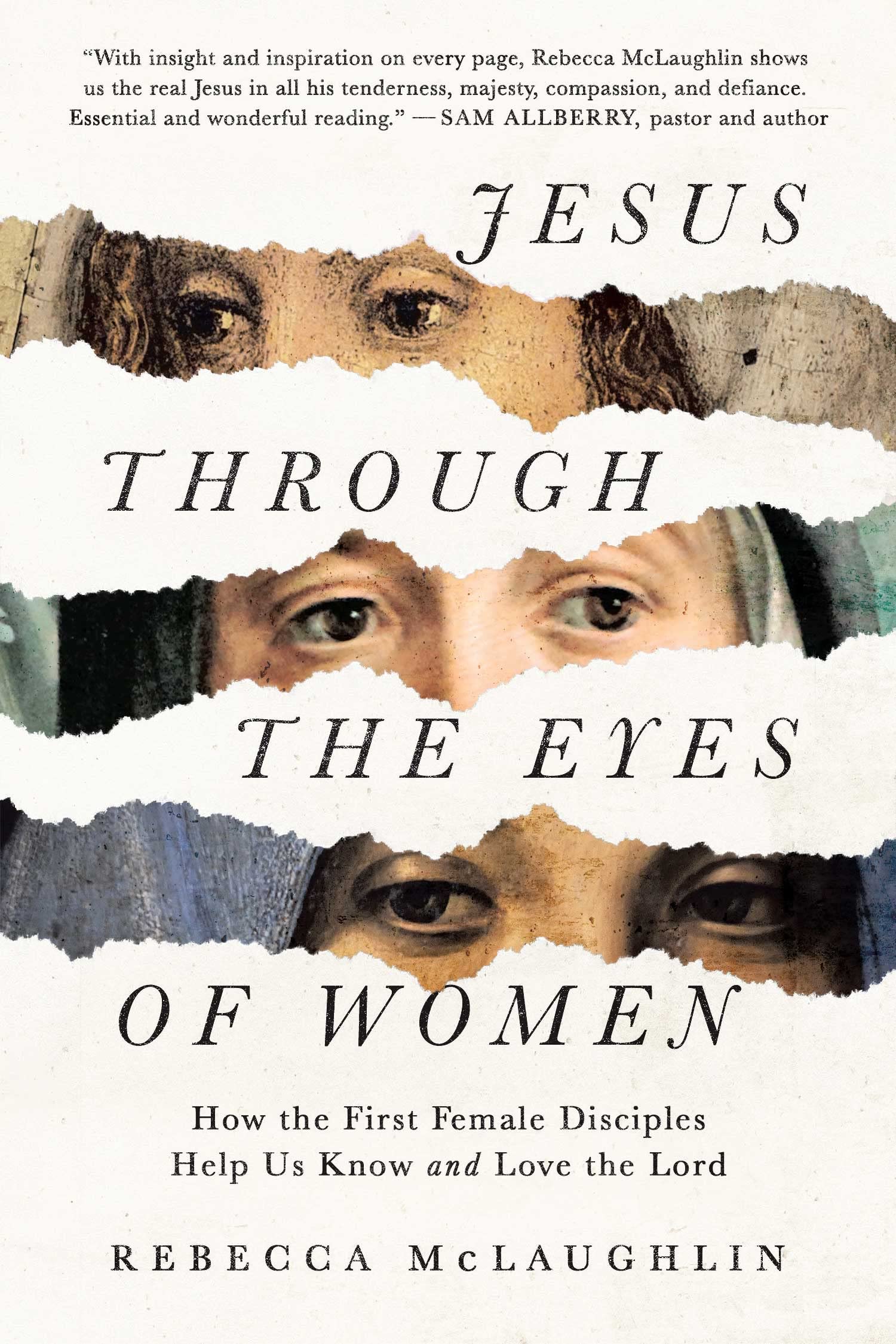 If the women who followed Jesus could tell you what he was like, what would they say?
Jesus’s treatment of women was revolutionary. That’s why they flocked to him. Wherever he went, they sought him out. Women sat at his feet and tugged at his robes. They came to him for healing, for forgiveness, and for answers. So what did women see in this first-century Jewish rabbi and what can we learn as we look through their eyes today?
In Jesus Through the Eyes of Women, Rebecca McLaughlin explores the life-changing accounts of women who met the Lord. By entering the stories of the named and unnamed women in the Gospels, this book gives readers a unique lens to see Jesus as these women did and marvel at how he loved them in return.
We’re delighted to offer this ebook to you for free.