In this Q & A session, John Piper and Don Carson discuss the intersection of pastoral ministry and scholarly work. They explore the historical context and modern expectations of theological scholarship, emphasizing the importance for pastors to engage deeply with academic study while remaining committed to the practical and spiritual needs of their congregations. The dialogue also addresses challenges and strategies for pastors who wish to deepen their theological understanding and apply it effectively in their ministry.
Owen Strachan: Before we start, I just want to say one book that I would commend for those of you who are very interested in what we’ve talked about tonight is Doug Sweeney’s upcoming book from InterVarsity Press, Jonathan Edwards and the Ministry of the Word. Dr. Sweeney sparked a lot of my thought on this topic, which is why I proposed this event, and I would just commend it to you. It’s coming out soon.
The Henry Center booth has flyers for it, and Doug will get your heart fired up either for theological pastoral ministry or scholarly ministry, so look for that book in days to come. Because you both questioned the use of scholar in the event title, I just wanted to say what I was thinking in offering that title, and then have you respond.
In the past, it seems to me that theology was done for the church. There is certainly, and always will be, a place for high-level academic theology, theology among the experts, but it seems to me that in the past men like Augustine, Luther, Calvin, Edwards, Warfield, the Puritans, and many others we could name thought of themselves as theologians of the highest level, but for the church.
So they weren’t writing books just to be smart in the way that you kind of talked about a few minutes ago, Dr. Carson. They were writing to build up and edify the church and draw lost people to the beauty of the Christian faith, and the way that you write about, Dr. Piper. That’s what I was thinking of when I proposed this. You could substitute theologian for scholar, and you could again add that tagline for the church. Is that something that makes sense? Does that help clarify the two callings?
John Piper: No, because there are different levels at which you can do that. I mean, if you take Jonathan Edwards’ Nature of True Virtue, it was written for the sake of the church, but I doubt that any laypeople have gotten much help from it at all. So that’s what I mean by “there are different levels.”
You take his Religious Affections; that’s another level. They’re both powerful books, but one has zero Scripture in it and is talking about consent to being. What in the world is consent to being? He’s just operating at a cutting-edge philosophical response level. I think that it’s okay to do that. There should be people who do that. Not me; I’m going to do Religious Affections level. So the reason that didn’t help me is because if you were to ask me, “Are you one of those?” I just have to make distinctions again.
Owen: Okay.
Don Carson: Yes, I think that there is another factor that’s being left out. At many occasions in the history of the church, the most learned person around, not only in the church but also in the entire society, was the pastor, and until the explosion of knowledge, too, in the latter half of the Enlightenment, they were thinkers who learned so many things on so many fronts.
The pastor was an exegete, but was also studying some biology. They were the most knowledgeable people around, and so one of the reasons why you had so many unconverted people who wanted to be pastors was because this was also a path toward the life of learning.
But eventually the place of learning was not in pastoral ministry. It was in the university or it was in a secular approach to knowledge and this sort of thing, and the pastor becomes someone who’s working with a narrower sphere, and then you have the breakup of the great evangelical institutions, such that you had more and more people getting their theological training in minor Bible institutes and things like that.
The whole life of the mind for a hundred years was less and less well treated in the North American context, with some remarkable exceptions, until you had the founding of the great evangelical institutions and the revitalizing of all of them again, starting with Fuller in 1947 and so forth.
Trinity, for all of its strengths, started as a seminary early in 1961, that’s it, and John was right to say that there was a generation in there that was the transitional generation, that was far more lonely. There were not many of these front-rank thinkers along, they just weren’t there, so in the 1950s the number of front-rank evangelical commentaries around written in English, they’re pathetic. There was just almost nothing there. They were semi-pop things.
John: F.F. Bruce
Don: F.F. Bruce, that was about it, and he’d written a few, and after you said F.F. Bruce, you could say F.F. Bruce. R.V.G. Tasker was doing the little Tyndale bits, but there was just nothing there. So people look back with nostalgia to the great days of F.F. Bruce. “Where is a scholar standing head and shoulders above everybody like F.F. Bruce?” Well, I’ll tell you why he stood head and shoulders above. There was nobody else to stand above.
He was a great scholar in many ways, but there was no competition. Nowadays, there are many who have the capacity of an F.F. Bruce, because of an F.F. Bruce. Do you see? So for all of the fact that there’s all kinds of decline in the West in all kinds of moral and other areas, that’s true; nevertheless in the area of biblical-theological scholarship, I know it’s mixed and it’s compromised and all the rest, but there are great grounds for encouragement, too, huge things for which to be thankful.
Nowadays, there’s a major crisis coming along of a church in some area, and there are going to be some Christians who are going to be addressing it, thinking it through. That’s wonderful, you know? I don’t think it’s those sorts of who’s a pastor, who’s a scholar, and where the drifts are, that have just been turning on one thing like writing for the church, but I think it’s turning on a lot of things, like sociological and our history and so forth.
Owen: Okay, one pushback. Edwards’ A Divine and Supernatural Light, or Heaven is a World of Love, or many other sermons are some of the richest, most theologically astute sermons you could find. It’s some of the most beautiful writing in the English language, I think, and I’m guessing you might agree. There he obviously has a brilliant mind, so I’m not thinking we should all go and try to be like him and write like him.
But he is doing theological work in those sermons in a way that I wonder if many pastors can’t try to do. Not to try to be smart and not get degrees to try to look good, but to push their minds, challenge themselves, and do that kind of theology for the church, and to have academic theologians who write high-level theology, who engage in their own conversations, but who also, in a very Edwardsian way, write for the church as well. Does that make more sense? Is that the kind of thing we could emulate?
John: Well I totally.… Amen, amen. That doesn’t sound like pushback. That sounds like agreement, so I love that. That’s what I would like to call men to do. Do that as much as you can do it and grow in your capacity. So learn your Greek if you can, learn Hebrew if you can, and be as meditative on 2 Corinthians 4:4–6 as you can.
I mean, Edwards was able to do that because he could look at that, and “The god of this age has blinded the minds of unbelievers to keep them from seeing the light of the gospel of the glory of Christ, who is the image of God.” He saw that, and he saw worlds of implication. So that’s what I want.
I want people to see that, so it does take.… I don’t know if the word scholarly is right; I like theological better … a breadth of awareness of what’s been said in other parts of Scripture that are coming to bear on that as you read it. It also takes an unusual, imaginative, penetrating mind to take every one of those words, light, of gospel, of glory, of Christ, who is.… In every one of those words, you’ve got to see through, and the more theological you are, the more vast the worlds are that open with each of those words.
So we want meditative, reflecting, long-staring-at-the-text type thinkers. So thinking is what I’m after if I’m trying to beget theological pastors, to take a text and think deeply about it. It helps if you can go to the Greek and Hebrew. It helps if you know other parts of Scripture, but go deep, penetrate through and think your way through it, put it all back together in a synthetic way, and then do the Divine and Supernatural Light sermon. Yes. The answer is yes.
Don: Yes, but. I mean, there’s a sense in which I agree entirely, but, but, but …
John: Just one sense.
Don: Yeah. The but is, we’re not all Jonathan Edwards, so some people who simply try to emulate him eventually try to build a systematic theology out of each word and then lose what the local text actually says. It’s methodologically flawed. They think they’re doing what Edwards did, but they don’t have his skills, so you want, at the same time, to throw in other things as well and to recognize differences in gifts and grace, even while, yeah, I do want people to be working to their full capacity as theologians and so forth. How come you can say, you know, three minutes’ worth, and I’m restricted to one sentence.
John: I don’t think it was that way with the last comment.
Don: Oh yeah, okay.
Owen: No, I don’t think so. My final question for you, and then we’re going to go to texting Q&A. Let’s focus on pastors for a minute. If a pastor heard your talks, synthesized them, caught a vision for what you’ve been talking about tonight in the way that we were just talking about with Edwards, a kind of Edwardsian, richly theological ministry, how can a young pastor act on this kind of vision, and how can a pastor who is already situated, perhaps middle-aged, who doesn’t have a lot of opportunity to go and get further training or that sort of thing.… How can those two groups (young guy training for the ministry and older pastor) come to embody this vision?
Don: At the risk of being a smart aleck, read a great deal less on the Internet and a great deal more of books. Now don’t misunderstand. I’m not knocking the Internet. You know, The Gospel Coalition, we’ve just pushed a big thing there, and it’s a wonderful tool, but it’s such a scrappy environment.
You know, you’re not learning to think, unless you’re downloading entire books from the Internet and reading them on the screen. I’ve got no objection to that. Believe it or not, I have a Kindle too, and I can read Saint Augustine on my Kindle, but at the same time, there’s a way of just collecting little bits and pieces here and there that don’t train you to think well, and in that connection you have to read and reread the Bible, but it needs to be read within the context of the history of the church, of historical theology, of others.
Believe it or not, some people have studied these texts before you, you know? It’s worth finding out what they have to say as well. You don’t have to keep re-inventing everything. You have to learn to find things for yourself, and your authority really must be the Word. You start and end there, but at the same time, you must become informed by how others before you have wrestled with these things, and they become your teachers, and so on; and that requires sustained thought.
So in the context of pastoral ministry, reserve time in the study, not just for preparing for the next sermon, but for reading beyond that. You just have to block out time for that, and if you’re going to be a technical scholar, then again, you have to reserve time for learning, for reading, for thinking. So much more could be said, and beyond that, also for praying and adoring and all the rest, but you have to reserve time for that, and not just sacrifice everything to the urgent demand of the next email.
John: First, when you go to school don’t choose classes; choose teachers. Find the teachers who do it, model it best, and take as many classes as you can. It doesn’t matter what they teach. I say that about college, and I’d say it about seminary. Don’t take classes; take teachers. Ask around. Find out who is the thinker, the modeler.
Secondly, not only don’t read Internet as much as books; read fewer books, and read them with pencil in hand, and read them very slowly, and underline, and write questions in the margin, and say, “No, it doesn’t agree with page 22,” and then go to page 22 and argue. Get inside and think and argue with a book.
Thirdly, find a group of men … this may be the pastors who are already out there … who would love to do this with you, and get together and read critically some book like that. Read Mortimer Adler’s How to Read a Book. No matter what age you are. If you haven’t read that book, it’s 60 years old as a book, and it will show you how to do reading.
Most people do not know how to read. I would venture to say most people in this room do not know how to read, because reading is an unbelievably non-passive, active affair when you do it, and we’ve been taught, by teachers assigning us 12 books in a class, not to read. We’ve been taught not to read. We think that moving through passages is reading. It’s not reading.
Interact so that you can restate an author’s thought, reconstruct his argument to his satisfaction, and then give reasons, and they’re kinds of reasons you can give. “He was inadequate in the way he described. He was incomplete. He was illogical. He drew wrong inferences.” You need to learn the kinds of ways you can interact. Do the same thing, then, with the Bible.
So there is a way.… What I’m talking about is learning how to think. Think and observe. Think and observe. What you do is observe what’s there and think rightly about it. So the fetal pig and geometry, that’s what it’s about. Wherever you can find somebody to just train you to do that do it. Isaac Watts is mainly known for … what? Hymns, but he wrote a primer on logic. Why would that be? Because you can’t understand the theology you build the hymns on unless you think rightly. So the poet and the logician.
Owen: Thank you. So we have just a few moments for texting questions. I’m going to get them up here and I’ll read them to you two. They’re everywhere. “What are some of the biggest issues you think the church and evangelical scholars will need to deal with in the next 20 years?” Let’s do a lightning round. Let’s do quick answers, if we can.
John: Islam. Christology. Is Jesus the only way? That’s where I’d start.
Don: Continuing challenges in epistemology. That is, how do you know the truth? The place for revelation and understanding, all of that.
John: You’re doing a big two-volume thing on Scripture, because even though he was instrumental a generation ago to write serious things on the authority and the inspiration of the Scripture, it needs to be done again because of how many people, in new ways, challenge the authority of Scripture. Every generation needs its big book on that. Don’s working on that. That will be there for 20 years to come, probably.
Don: We are not yet through the debates about justification and the exact place of substitutionary atonement in the structure of biblical thought. There’s going to be more, and that one comes again every generation as well in one fashion or another. You’ve got to keep redoing that one.
John: Yeah.
Don: Add to that the doctrine of God. That’s partly because of a whole lot of other things, but one of the most neglected doctrines, I think, in the evangelical world is the doctrine of God. We just haven’t spent enough time thinking that through holistically.
John: Clusters of family issues, in relationship to public life and whether you will be allowed, without going to jail, to stand up in your pulpit and say that homosexuality is sin, or to spank your children, or to say that my wife should submit to me.
Don: Yep.
John: This whole cluster of practical family things will become volatile, more than they are now. You see what’s happening in Canada, you see what’s happening in Sweden and other places, and it will be there. I’ve told people, “I will be in jail rather than not preach that it’s right to spank your children. I will go to jail. I will not not preach that in order to stay out of jail.”
I will not even use the phrase so-called “gay marriage” without putting the phrase so-called in front of it. It frustrates me that we have bought the phrase, because there is no such thing as so-called “gay marriage.” It doesn’t exist in the universe. Why evangelicals would start using the term is a sell-out. Stick the phrase so-called in front of it every time you use it, because there is no such thing. That will be called hate speech, and it will be worthy of imprisonment around the corner.
Don: And related to that are the pastoral-theological-personal-definitional issues surrounding what tolerance is, and that is tied to some historical questions. There have been shifts in what tolerance is perceived to be, but it’s also tied to what you think the church’s relationship to culture should be.
There is a nest of issues related to that where it’s going to be important to think very clearly. We’re being painted into a corner and being called intolerant in a very intolerant way, and yet people don’t see just how deeply ironic and tragic and even stupid that is, but nevertheless that’s what’s happening, and this has to be addressed, I’m afraid.
John: There’s one more. I think that the explosion of, I don’t want to just say contemporary worship music and contemporary worship forms, and our church would feel that way to most people, but a very rock-oriented.… Almost everywhere in the world now we have the same songs.
So the issue has become whether or not the ethos generally associated with that on a Sunday morning can sustain the gravitas of the glory of God over the long haul. Whether it can hold it. It is possible. I mean, there are contemporary worship songs that draw out my heart into the bigness of God in a most marvelous way, but there is a kind of low-brow, hip, cool, y’all come, family, chatty way of doing worship today.
The question is if that becomes more and more prevalent, what becomes of the majesty of God in this Book? It’s very difficult to maintain a sense of the bigness and the majesty of God if everything about the service is calculated to be chummy and close and warm and touchy and feely and y’all come.
Something’s got to break there, and I think, I pray, what will happen is that all the best of contemporary worship music and all the best of the weightiness of glory will move and adjust forms so that people your age, you look twenty-something, will feel that sooner rather than later and you won’t overreact against contemporary and say, “You know, I’m going to go liturgical and only hymns and organ and try to do it all old again,”
But rather you’ll say, “We’ve got to find a way, so that from the beginning to the end of this service there’s a weightiness about it, a seriousness, because that corresponds, then, to what the Word will say, and who he is, and what hell really signifies, and how glorious the cross is.” All those realities just don’t fit in talk shows. They don’t.
If you try to do your little talk show down there as you welcome people and, “Please, let’s make this as street-like as possible,” there are realities, and most of them here just don’t fit there. They don’t. They get so dumbed down that the weight of hell and the horror of judgment and the glory of the cross.… People lose their capacity for awe.
Don: May I add a footnote, even though, you know, a sentence …
John: You asking me that? Yes, you may.
Don: Thank you. Thank you.
John: I am 63, after all.
Don: Yeah, that’s right. You’ve got to respect your olders. I mean, what can you say. I agree with that absolutely, 100 percent. I think that practically, in the local church, one of the questions that those who are responsible for sung worship can ask themselves is not just what is orthodox but what is best? There are lots and lots and lots of songs that are individually acceptable, but learn to choose what’s best, not what passes a mere orthodoxy test. That will already change everything.
Then start looking around for certain writers. Two weeks ago I was in England, and I sat down, again, with both Stuart Townend and Keith Getty and his wife. They’re friends. Keith and his wife, believe it or not, spent part of their honeymoon in our home. I mean, how stupid can you get? Nevertheless, they did, and you know what these people do every time some of us get together at some of these things?
They sit down and they ask questions like, “What doctrines are we not hitting adequately in our hymns? What should the tone be?” I mean, there are some people out there that are doing this right. The Stuart Townends and the Keith Gettys of this world are just a cut above almost all the other contemporary hymn writers. Pray for more of those. There are some people making the right moves. I’m encouraged by that.
Owen: All right. Wow. That was quick, indeed. I think that was …
John: May I encourage you to exercise authority over us?
Owen: Yes. Can we do one last question?
John: You may.
Owen: All right. I guess that wasn’t a good exercise of authority. I asked you, but …
Don: He cannot not exercise authority, that’s it.
Owen: Last question, and then we’re going to have Jackson Crum come up and close the night for us. “All things being equal outside of scholarship, does scholarship bring a deeper intimacy and love for God than those who lack scholarship?” That’s a good question to close on. “Does scholarship bring a deeper intimacy and love for God than those who lack scholarship?”
John: “All things being equal” is a very crucial qualifier, and if scholarship means right thinking and right observation, the answer is clearly yes.
Don: Exactly, but if scholarship means something like being an academic without reference to whether or not your subject matter is right, your disciplines are right, your focus is right, your motives are right, the answer is it can be merely deceptive and lead you straight to hell.
Owen: Amen. Let’s applaud our speakers.
Free eBook by Rebecca McLaughlin: ‘Jesus Through the Eyes of Women’
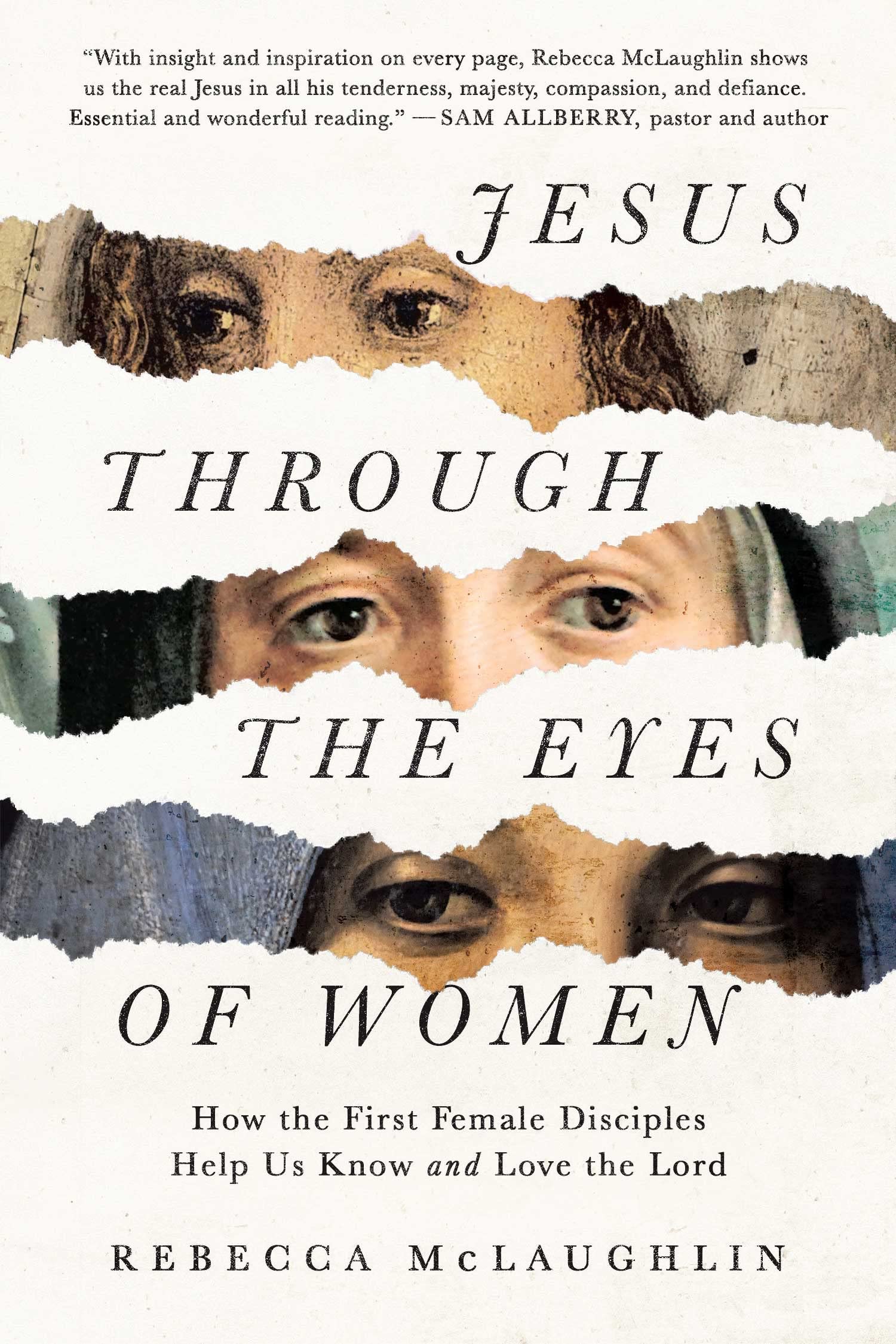 If the women who followed Jesus could tell you what he was like, what would they say?
Jesus’s treatment of women was revolutionary. That’s why they flocked to him. Wherever he went, they sought him out. Women sat at his feet and tugged at his robes. They came to him for healing, for forgiveness, and for answers. So what did women see in this first-century Jewish rabbi and what can we learn as we look through their eyes today?
In Jesus Through the Eyes of Women, Rebecca McLaughlin explores the life-changing accounts of women who met the Lord. By entering the stories of the named and unnamed women in the Gospels, this book gives readers a unique lens to see Jesus as these women did and marvel at how he loved them in return.
We’re delighted to offer this ebook to you for free.