Listen or read the following transcript as D. A. Carson speaks on the topic of atonement from Hebrews 9.
This evening in the last session I would like to read all of Hebrews, chapter 9. I earnestly wish I had two or three hours for this one. There is so much glorious truth, bound up with the atonement, locked into this passage. So at several points I will merely be priming the pump, as it were, for you to go away and do some more digging and reading and thinking on these matters. It is a remarkable chapter. Hear then what Scripture says.
“Now the first covenant had regulations for worship and also an earthly sanctuary. A tabernacle was set up. In its first room were the lampstand, the table and the consecrated bread; this was called the Holy Place. Behind the second curtain was a room called the Most Holy Place, which had the golden altar of incense and the gold-covered ark of the covenant. This ark contained the gold jar of manna, Aaron’s staff that had budded, and the stone tablets of the covenant.
Above the ark were the cherubim of the Glory, overshadowing the atonement cover. But we cannot discuss these things in detail now. When everything had been arranged like this, the priests entered regularly into the outer room to carry on their ministry. But only the high priest entered the inner room, and that only once a year, and never without blood, which he offered for himself and for the sins the people had committed in ignorance.
The Holy Spirit was showing by this that the way into the Most Holy Place had not yet been disclosed as long as the first tabernacle was still standing. This is an illustration for the present time, indicating that the gifts and sacrifices being offered were not able to clear the conscience of the worshiper. They are only a matter of food and drink and various ceremonial washings—external regulations applying until the time of the new order.
When Christ came as high priest of the good things that are already here, he went through the greater and more perfect tabernacle that is not man-made, that is to say, not a part of this creation. He did not enter by means of the blood of goats and calves; but he entered the Most Holy Place once for all by his own blood, having obtained eternal redemption. The blood of goats and bulls and the ashes of a heifer sprinkled on those who are ceremonially unclean sanctify them so that they are outwardly clean.
How much more, then, will the blood of Christ, who through the eternal Spirit offered himself unblemished to God, cleanse our consciences from acts that lead to death, so that we may serve the living God! For this reason Christ is the mediator of a new covenant, that those who are called may receive the promised eternal inheritance—now that he has died as a ransom to set them free from the sins committed under the first covenant.
In the case of a will, it is necessary to prove the death of the one who made it, because a will is in force only when somebody has died; it never takes effect while the one who made it is living. This is why even the first covenant was not put into effect without blood. When Moses had proclaimed every commandment of the law to all the people, he took the blood of calves, together with water, scarlet wool and branches of hyssop, and sprinkled the scroll and all the people. He said, ‘This is the blood of the covenant, which God has commanded you to keep.’
In the same way, he sprinkled with the blood both the tabernacle and everything used in its ceremonies. In fact, the law requires that nearly everything be cleansed with blood, and without the shedding of blood there is no forgiveness. It was necessary, then, for the copies of the heavenly things to be purified with these sacrifices, but the heavenly things themselves with better sacrifices than these.
For Christ did not enter a man-made sanctuary that was only a copy of the true one; he entered heaven itself, now to appear for us in God’s presence. Nor did he enter heaven to offer himself again and again, the way the high priest enters the Most Holy Place every year with blood that is not his own. Then Christ would have had to suffer many times since the creation of the world.
But now he has appeared once for all at the end of the ages to do away with sin by the sacrifice of himself. Just as man is destined to die once, and after that to face judgment, so Christ was sacrificed once to take away the sins of many people; and he will appear a second time, not to bear sin, but to bring salvation to those who are waiting for him.”
This is the Word of the Lord.
Modern Judaism cannot conform to the demands of the old covenant. It cannot do so for two reasons. First, the genealogical records were in every case broken somewhere. That is to say, it is impossible today for anyone to prove that he or she has descended from Judah, let alone from David. In the New Testament, the records were still preserved in the temple, so the New Testament opens with a genealogical record.
But today, although very good records have been kept by Jews now for centuries, all the way down from the Middle Ages, there is in every case some break. You could make some decent guesses. If you come across a Jew by the name of Cohen (if you remember your Hebrew, kohen means priest), there’s a pretty good guess that he’s from the tribe of Levi somewhere back there. On the other hand, you cannot prove it tightly. The genealogical records aren’t there.
Now if you talk to a conservative Jew about that, what he will say is, “Yeah, well, we would have to restore Urim and Thummim to get a reading on it.” The second problem, of course, is the sacrificial system is gone, and you’re going to have to take down the Mosque of Omar to get it going again. Now there are some who advocate that, but it’s a sure recipe for pretty massive conflict in the Middle East.
First-century Judaism had in some ways departed from old covenant religion. That’s true. On the other hand, the biggest departures actually took place after the destruction of the temple. When the temple came down in AD 70, this was not the first time they had faced those sorts of crises. That had happened already in 587 BC. In one sense it happened again. Then, of course, there was further destruction at the Bar Kochba Revolt in 132 to 135, after which it became a capital offense for a Jew to live anywhere in the environs of Jerusalem.
Here in Hebrews, after arguing at length that according to Old Testament Scriptures themselves the old covenant was shown to be obsolete in principle and about to be replaced by that to which it pointed, the writer lays out a wee bit of what that means for our understanding of both the Old Testament cultus and of the New Testament sacrifice of Christ.
Chapter 8 has introduced the notion of the new covenant. In that sense, there is a tie to chapter 7. Chapter 7, and then earlier chapters 3 and 4, as we saw last night, showed that the Old Testament Scriptures themselves announced the principled obsolescence of the Old Testament rest, the Old Testament priesthood, the Old Testament law covenant, in fact. The Scriptures themselves did that.
Then that is confirmed by the prophecy of Jeremiah that is quoted in chapter 8 and quoted again, actually, in chapter 10. The lesson is drawn. By calling this covenant new, he has made the first one obsolete. That is, the action that made the old covenant obsolete in principle took place six centuries before Jesus in the announcement of Jeremiah that a new covenant was to be introduced.
Now I wish I had time to unpack the particular announcement in Jeremiah 31 and following, but I think, because of things I still want to say about the cross work of Christ, I’m going to leave out that material. The notion of the newness announced from the Old Testament ties chapter 8 back to chapter 7. So chapter 8 is one more of those, if you see what I mean.
At the same time, chapter 8 is now tied to chapter 9, because it has introduced the notion of covenant very strongly. So all of chapter 9 and chapter 10 all the way to verse 18 are now showing you some things we need to know about covenant theology, granted that there is a new covenant that has been announced. We may break up this chapter into three parts. First, ministry under the old covenant; second, ministry under the new covenant; and third, further reflections on the new covenant.
1. Ministry under the old covenant
Chapter 9, verses 1–10. What the author says here, in effect, is that under the old covenant there is a need for three things. Now he might have said a lot more about the whole sacrificial structure. He could have said a great deal more. There’s no mention here, for example, of the outer court with its hangings. There’s no mention of the brazen altar and of the laver. The two objects that are portrayed are simply the golden lampstand and the table of shewbread and a couple of other little details that we’ll look at.
So there’s a great deal more that could have been said, and he acknowledges this at the end of verse 5, as we’ll see in a few moments. But what he emphasizes in verses 1–5 is the need for a place, then in verses 6–7 the need for an offering, and then in verses 8–10 the need for an approach. That is what characterized the old covenant temple worship: a place, a sacrifice or an offering, and an approach.
First, the place. “Now the first covenant had regulations for worship and also an earthly sanctuary.” The place. “A tabernacle was set up. In its first room were the lampstand, the table, and the consecrated bread; this was called the Holy Place.” You know the passages as well as I do, I’m sure. Then the Holy of Holies, the Most Holy Place, is introduced in verse 3. “Behind the second curtain was a room called the Most Holy Place, which had the golden altar of incense and the gold-covered ark of the covenant.”
In my view this is a mistranslation. There are many people who take it this way and think that either Hebrews made a mistake, amongst liberal commentators, or that maybe, who knows, in Jesus’ day things were done a little differently and they weren’t following the Old Testament anymore. After all, according to Scripture itself, the golden altar of incense was not in the Most Holy Place. It was in the Holy Place. So why is the author saying that it is in the Most Holy Place?
The word itself here is thymiatērion, but it does not help us, because it is used in the Old Testament both for the altar on which incense is burned, which is the way most people take it, and for the censer. The interpretation “altar of incense,” it seems to me, creates a fundamental difficulty and is not necessary, because it’s placed in the wrong slot. See Exodus 40:3–5.
Moreover, the incense altar was not made of solid gold but rather, like the ark of the covenant, was overlaid with gold, but the particular adjective that is used in Greek here for the golden altar of incense suggests it was made of gold. In this light, it seems to me it is far better to retain the reading here of the Authorized Version, the King James Version. It’s not often that I think the King James Version is right against modern translations, but this is one of them.
It has “the censer.” The censer was used on the Day of Atonement (Leviticus 16:12–13, which you might want to look up at your leisure), and it was made of solid gold. I think that is what is in view, and the reason the author mentions that particular accouterment was precisely because it was used on the Day of Atonement, and that is going to feature highly in what follows.
Then in verse 5, we are told further that on the top of this ark, described at the end of verse 4, with the three elements, the gold jar of manna, Aaron’s staff that budded, the stone tablets of the Law.… Above the ark were the cherubim overshadowing the atonement cover, the hilastērion, the propitiation; that is, the place where blood was shed to turn aside the just wrath of God against the sins of the priest and of the people whom he represents.
This reference to the glory is itself wonderful. “Above the ark were the cherubim of the glory.” Isn’t that lovely? You find a similar expression in Hebrew in Psalm 29. “And all the angels say, ‘The glory.’ ” That is meant to call to mind a whole stream in redemptive history, from the pillar of glory that led the people in the wilderness to the time when they were stationary and the pillar stayed over the entire tabernacle as long as the people were to stay in that place.
Then when they were to move on, the pillar rose and moved off, and then the people packed up the tent, and away they went again until the glory stopped, and so forth. Then when eventually the temple is built, if you recall just before the dedicatory prayer of Solomon, the whole place is so filled with glory and smoke that the priests are not able to perform their function. It is a way of saying that when God manifests himself in even a small display of his spectacular glory, all flesh is chastened and hushed and bowed down.
Then, of course, in Ezekiel’s vision, when he is transported by the Spirit in his vision to Jerusalem, he sees that the glory abandons the temple and goes and sits on the mobile throne chariot, which takes him out of the city and across the Kidron Valley and up on the Mount of Olives, which is a way of saying that judgment is falling, because there is no presence of God to protect Jerusalem or that temple anymore. So four and a half years later, when, in fact, judgment falls at the hands of Nebuchadnezzar, the people are to understand that it’s not just Nebuchadnezzar; this is God’s doing. This is God’s judgment.
Then when the temple is rebuilt, there is actually no mention of the return of the glory. None. But there is a voice heard on the streets of Jerusalem that says, “Destroy this temple, and in three days I will raise it again.” So, first of all, there’s the place. Then in verses 6–7 there’s an offering. “When everything had been arranged like this, the priests entered regularly into the outer room to carry on their ministry. But only the high priest entered the inner room.”
The priests in the outer room had to replace the shewbread and had to trim the wicks and all of that. “But only the high priest entered the inner room, and that only once a year, and never without blood, which he offered for himself and for the sins the people had committed in ignorance.” The blood he brought in was the blood of a bullock for the sins of himself and his family and a male goat for the people (Leviticus 16:3 and following).
“The sins committed in ignorance.” What does that mean? Commentators have a wonderful time with this passage. The Hebrew expression is “sins not committed with a high hand.” Everything turns on what that means. There are some people who argue it really does mean sins committed in ignorance. That is to say, the only sins forgiven under the old covenant were sins committed in ignorance.
That is an impossible interpretation. After all, there are all kinds of accounts of people committing sins, David and many others, who certainly knew what they were doing. I mean, let’s be quite frank. David knew what he was doing when he had Bathsheba. It’s not ignorance in the sense that they were ignorant of the law and then did a no-no, but they didn’t know any better so, as a result, there was forgiveness. That’s not the idea at all.
It’s sins that are genuine sins, rebellion against God, but at least they have this in their favor: they are not sins committed with a high hand. That high hand, I suspect, is at least analogous to the kind of sin envisaged in chapter 6. You see, there is a kind of high hand that looks exactly at what is going on, sees, understands, tastes, participates in, and then damns it all to hell. For that there’s no forgiveness. There wasn’t under the old covenant; there isn’t under the new.
Interestingly enough, there is no passage in Hebrews that says, “Under the old covenant there was forgiveness only for sins of ignorance, but not for the rest; now under the new covenant that’s a little looser, so now there’s forgiveness for sins committed not in ignorance.” That’s not one of the contrasts drawn at all.
There is a sacrifice. Again, the author is selective in what he says. For example, he doesn’t mention that the blood that was to be offered was to be sprinkled once against the front of the mercy seat and seven times upon it, that there was a second goat for Azazel; that is, it was not offered upon the altar but led into the wilderness. It does not enter into the scope of the argument here, so the author doesn’t mention it. He’s quite selective.
No wonder, then, that he says, “We cannot discuss these things in detail now,” which suggests, brothers and sisters in Christ, that had he had more time he could have done so. So it behooves us, on the basis of what he has said, to think through what these other things mean. What that suggests is that we are authorized by the author of Hebrews himself to work out the legitimate biblical typologies even when he himself does not do so.
So while we should avoid the really silly typologies of an earlier generation that had the red rope of Rahab referring to the blood of Christ or something like that, yet, on the other hand, we should not be so suspicious of reading the Old Testament in this profoundly typological way that we become too cynical by half.
That brings us, then, to the approach in verses 8–10. “The Holy Spirit was showing by this that the way into the Most Holy Place …” That is, the way into the very presence of God. “… had not yet been disclosed as long as the first tabernacle was still standing.” That is, people couldn’t get in and see it. There was a death threat for anybody who peeped in or even for the high priest himself if he went in without blood at any time other than Yom Kippur.
The Holy Spirit was showing, therefore, that access to the presence of God was severely limited. It had not yet been opened up. It wasn’t disclosed. As long as the tabernacle was still standing, the tabernacle was not only the means of meeting human beings; it was also the means of emphasizing the distance. The law itself functions like that. It emphasizes what the will of God is and shows us that we can’t get there.
We’re told, “This is an illustration for the present time, indicating that the gifts and sacrifices being offered were not able to clear the conscience of the worshiper.” The author is not saying that those who approached God in good conscience with faith believing under the terms of the old covenant never had their consciences released as they offered the prescribed sacrifices and participated in the corporate worship when the priest went into the Most Holy Place on the Day of Atonement. He’s not saying that.
He’s saying that those people, nevertheless, went away and, conscious of every sin they committed for the next year, knew that last year’s atoning sacrifice didn’t cover them. There would be another sacrifice next year, and if the old priest had popped off by then, there would be a new priest too. And the next year the same. And the next year the same. And the next year the same. And the next year the same. And the next year the same. There was no final dealing with conscience at all.
Moreover, surely the most thoughtful of them must have wondered once in a while how much the red corpuscles of bulls and goats finally really deal with sin anyway. I’m sure all kinds of worshipers didn’t know, didn’t think very deeply. They were just doing what God said, and that was fine. They were responding to the covenantal promises God had made.
But they must have at least asked themselves now and then. That is already suggested by the text itself. “They are only a matter of food and drink and various ceremonial washings—external regulations applying until the time of the new order.” Here, then, is the ministry of the old covenant. Now we turn to …
2. Ministry under the new covenant
What the author does is again take us through a place, an offering, and an approach. A place. Verse 11: “When Christ came as high priest of the good things that are already here, he went through the greater and more perfect tabernacle that is not man-made, that is to say, not a part of this creation.” In fact, that argument returns, as we’ll see in a few moments, in verses 23 and following.
Have you ever noticed when you read through Exodus, just read it through very quickly, you come across variations on this clause something in excess of 30 times? “Moses made a tabernacle according to the pattern that was shown him on the mount,” or “Bezalel and Oholiab were instructed to make all of the accouterments according to the pattern God had shown Moses on the mount.”
Again and again and again. At the end of each section, “According to the pattern God had shown Moses on the mount.” What’s the point of that? Well, there’s a point, of course, in obedience. Similar things are also said, not quite with so much repetitive force but certainly said, in the instructions to Solomon in the building of the temple as well. What’s the point?
The point is this is not simply a matter of, “Make sure you do it my way, and I’m God,” although there is an element of that. It is a way of saying, “The very structure is important; get it right. It’s a copy. It’s a pattern. It’s meant to teach you something. It’s pedagogical. You can’t just sort of call in your finest architects and decide to do it your way. It’s showing you a deeper reality.”
That was why it was so important. You could not be sure of the typological significance of the very structure of the place or the accouterments of the place or how they pointed forward unless you were sure God had given this pattern as reflecting of the deep eternal realities. That’s the point of repeating it again and again and again.
That’s what’s stressed here. “When Christ came as high priest of the good things that are already here, he went through the greater and more perfect tabernacle that is not man-made, that is to say, not a part of this creation.” The point is that the Most Holy Place was so configured that when the high priest went into the Most Holy Place, he understood well that he was there in the very presence of God. The glory was present.
So what is it that Jesus comes into? He comes into the very presence of God in the heavenlies. We’re not to think, then, in crass materialistic terms, as if heaven is sort of structured like a great big temple made of goatskin and things. The point is it’s a way of saying that Jesus comes into the very presence of God himself. That’s the crucial thing. That’s the place.
The offering likewise outstrips the old covenant offerings (verse 10). “He did not enter by means of the blood of goats and calves, but he entered the Most Holy Place …” That is, into the presence of God. “… once for all by his own blood, having obtained eternal redemption.” That brings us then to the approach in verses 13–14. I will deal with all of these verses together.
“The blood of goats and bulls and the ashes of a heifer sprinkled on those who are ceremonially unclean sanctify them so that they are outwardly clean. How much more, then, will the blood of Christ, who through the eternal Spirit offered himself unblemished to God, cleanse our consciences from acts that lead to death, so that we may serve the living God!” This is a passage on which we should spend a great deal of time. Let me instead draw your attention to just a few details.
First, it has been shown now repeatedly that blood in the New Testament when it is not referring to the fluid itself means death violently and sacrificially occurring or life violently and sacrificially ended. So you are not to think that the blood here is something intrinsic mystical. There are people who try to take it this way and actually imagine that Christ somehow, after he died on the cross, scooped up some of the blood that was at the bottom of the cross and offered it before God as a tangible offering in a kind of semi-physical heaven. It’s painful. It really doesn’t understand.
In Paul, for example, everything we are told that the blood accomplishes we are elsewhere told that Christ’s death or the cross accomplishes. So if we’re justified by the blood of Christ, we’re justified by the death of Christ or the cross of Christ. Everything the blood accomplishes, the death accomplishes. What the blood signifies is life, but not just life … life violently and sacrificially ended. It’s a sacrifice. Thus, it is not the composition of the fluid that is the crucial thing; it’s the sacrificial loss of this life, the life of the Son of God. That’s the crucial thing.
Secondly, to us the term redemption does not resonate on the streets of our cities. We don’t use terms like redeem and redemption very much. There might be some places in the country where they have pawn shops. You might redeem something from a pawn shop, but that’s about it. We don’t use redemption very much. We don’t use it in our mortgages anymore. We have other terminology.
In the first century, redemption was a common category. It was used in slave transactions, for example. In the first century, sometimes people became slaves because of overpowering military force but sometimes simply because they didn’t have any Chapter 11 or Chapter 13. They didn’t have bankruptcy laws. If you fell into arrears, what you did was you sold yourself or your family or parts thereof into slavery. That was the honorable thing to do. You didn’t have any choice because there were no bankruptcy laws.
Then if you had a rich cousin 20 miles down the road who heard about your plight and had a little bit of loose cash, he might come and redeem you. In fact, there was a whole legal fiction you went into. He would actually pay the money, plus a little extra, into one of the local temples, and then the temple would pay out the proper money for the price to the person who owned the slave, and thus, in theory, the person who was in slavery was now being released from the slavery to the god. It was a kind of legal fiction.
That kind of legal fiction is picked up, in fact, by Paul himself in a far more meaningful way for us. Likewise, in the Old Testament slaves could be redeemed. Then, of course, every Jewish firstborn male had to be redeemed by the payment of a tax. So the firstborn, who hadn’t been killed at the initial Passover, now was still under the curse, as it were, but was redeemed by the payment of money. He was bought back, released, freed from death or freed from slavery.
So redemption language is everywhere in the first century. There are a lot of other usages as well. As a result, this language would resonate not with simple “God talk” in the first century. It would be everyday talk. It was very powerful. It would resonate right away. It’s really quite wonderful. “He entered the Most Holy Place once for all by his own blood …” Here is a priest who is not only priest, but sacrifice. “… having obtained eternal redemption.”
Then, of course, the blood of goats and bulls at the end of the day can’t achieve more than the ceremonial. But what shall we say of verse 14? “How much more …” This a fortiori argument again. “How much more will the blood of Christ, who through the eternal Spirit offered himself unblemished to God, cleanse our consciences.”
What does this mean? There have been many attempts to explain this expression, “Who through the eternal Spirit offered himself unblemished to God,” but the one that commends itself to me is this. The animals that were offered year by year had no will, no pneuma, no internal being of their own. There was no goat that said, “Here, slaughter me; I’ll bear your sins.” The priest took him by the scruff of the neck and slit his throat.
Passover was a bloody mess. Even Yom Kippur, with only two animals and another one that was released, was not a pretty sight. It wasn’t for the squeamish. On a big Passover, you could slaughter thousands and thousands and thousands of animals, again and again, slitting this throat and this throat and this throat, the whole courtyard sopping red with muddy red blood. And not one animal had volunteered.
In what sense was it a voluntary sacrifice? The only person who was sacrificing something.… Well, the animal was sacrificing its throat, I suppose, but at the end of the day, it was who owned the animal. It was the person offering the sacrifice who was paying for it by offering up the animal. Theirs was a transitory life, those animals, of no potency or virtue. They offered their lives dia aioniou, according to regulation, not according to pneuma aionion, eternal spirit.
But Christ offered himself by his own consenting will. He was acting in perfect submission to his Father, but by so doing he was going to the cross voluntarily. “No one takes my life from me,” he says. “I lay it down of myself.” No bull or goat could have said that. This was the consenting act of his whole person, his whole personality, his pneuma aionion, his God-ness, which from before time acquiesced in the perfect plan of the Father so that he would be in the Father’s own mind the Lamb slain from before the foundation of the earth.
When he writhes in the garden and cries, “Not my will but yours be done,” precisely by saying so he makes the Father’s will his. In other words, I don’t think pneuma aionion here is referring to the Holy Spirit, third person of the Godhead. I don’t think it’s referring to the Spirit of the Father dwelling in Christ quite. Pneuma is a category that is very broad. It has different forces in different contexts. I think it means something like his own eternal being, the consent of his whole being as the God-man, the eternal pneuma.
Thus, Christ’s offering of himself dia pneumatos aionion, through the eternal spirit, is massively, categorically different than the offerings of animals dia aioniou, through the law. Thus it becomes a sacrifice of immeasurable worth. It cleanses our consciences. For Christ does not have to die again and again. We sing lustily:
I have no other argument
I need no other plea
It is enough that Jesus died
And that he died for me.
3. Further reflections on the new covenant
Verses 15 and following. Verse 15 is transitional. It summarizes what has been said so far. “For this reason Christ is the mediator of a new covenant, that those who are called …” Notice for whom this covenant is. “… that those who are called may receive the promised eternal inheritance—now that he has died as a ransom …” There’s that atonement language again. “… to set them free from the sins committed under the first covenant.”
Now although I would love to unpack that at greater length, let me turn instead to the following verses. There are now two primary points that are made till the end of the chapter. First, the need for the death of the covenant ratifier (I’ll explain that), and the need for the real (that is, for the ultimate) to replace the copy, the type.
First, the need for the death of the covenant ratifier (verses 16–22). In most of our English translations, as I’m sure you’re well aware, a clever switch is made here in the meaning of the Greek word diatheke, covenant. It’s now rendered will. Have you noticed? So in verses 16–17 now, the same word, diatheke, becomes in the NIV, which I’m reading, will. “In the case of a will, it is necessary to prove the death of the one who made it, because a will is in force only when somebody has died.”
Well, that’s true for a will, isn’t it? It’s in force only when somebody has died. You have a will, and it’s lurking there behind the scenes, but until somebody falls off the twig, that will does not go to probate and its terms do not come into effect. That’s exactly correct. It’s true that occasionally diatheke later on can have this force, but since what the author is doing here is trying to prove it is necessary that Christ had to die, it’s a bit of a leap to suddenly move from diatheke covenant to diatheke will by a kind of clever exegetical device.
Because the word can mean two things, do we say we have to have a death now because the word means will, and as soon as we establish we have to have a death, then we’ll switch back to covenant? I mean, it becomes a clever exegetical trick rather than a very convincing argument. People have wrestled with that one for years and years and years. That one has gone back and forth across the centuries many, many times.
However, in my view, that problem has been addressed extraordinarily ably by a chap called John Hughes in a very important article published in Novum Testamentum in 1979. It’s not very often that you get an article that really sorts out a very long-standing exegetical conundrum that has been around for centuries. I think he has done it, and it has appeared in several commentaries. The best treatment in commentary proportion is in Lane’s commentary. William Lane’s commentary has this point exactly right.
Now it turns on some crucial rendering of Greek and some knowledge of the Old Testament. To save you pains, I won’t take you through those arguments. I will just give you the conclusion. First, diatheke always means covenant in our literature, without exception. It never means will, and that’s a mistake. The author is not here restricting himself to some clever trick.
Secondly, the first clause of verse 17 should be rendered like this. Not, as in the NIV, “Because a will is in force only when somebody has died,” but quite literally, “For a covenant is made legally secure on the basis of the dead ones.” Now I’ve made that very painful. That’s not good translation. But the “dead ones” refers not to the sacrifice of the covenant person but of the sacrifices themselves.
Let me repeat. “For a covenant is made legally secure on the basis of the dead,” that is, sacrifices. It’s a plural word. It’s not a single word. You see, in the case of a will, the will comes into force when the person in whose name the will is drawn up dies. You don’t have to have 30 people dying in order to have a will come into force. You only need to have the person in whose name the will is drawn up die.
But you have a plural word for dead here, “the dead ones,” which suggests pretty strongly that the “dead ones” here refers, in fact, to the sacrificial animals. Now preserve the word diatheke as covenant, and you’re forced then to render this, “For a covenant is made legally secure on the basis of the dead sacrifices.” That’s true in the Old Testament. We’ll look at that in a few moments.
Verse 16 should read, “In the case of a covenant,” not in the case of a will. Again, I’m going to over-translate. It’s painful. It’s not good English, but you’ll see the point in a moment. “It is necessary for the death of the one who ratifies it to be brought forward.” That’s what the verb literally means. That is, to be brought forward, to be presented. Verse 17: “For a covenant is made legally secure on the basis of the sacrificial victims, since it is never valid while the ratifier lives.”
Now understand the Old Testament grasp of covenant. The persons making the covenant in the Old Testament had to be executed symbolically. That brings us back to Genesis. Turn to Genesis 14 and 15. You’ll recall we looked at Genesis 14 in connection with Melchizedek. Now turn to Genesis 15. I reminded you that there are all kinds of verbal connections between 14 and 15. Now look at Genesis 15.
Here you have ratification again. “Abraham believed the Lord, and God credited it to him as righteousness,” and so on. Then verse 12: “As the sun was setting, Abram fell into a deep sleep, and a thick and dreadful darkness came over him. Then the Lord said to him, ‘Know for certain that your descendants will be strangers in a country not their own, and they will be enslaved and mistreated 400 years. But I will punish the nation they serve as slaves, and afterward they will come out with great possessions.
You, however, will go to your fathers in peace and be buried at a good old age. In the fourth generation your descendants will come back here, for the sin of the Amorites has not yet reached its full measure.’ When the sun had set and darkness had fallen, a smoking firepot with a blazing torch appeared and passed between the pieces. On that day the Lord cut a covenant with Abraham and said, ‘To your descendants I give this land, from the river of Egypt,’ ” and so on.
The cutting of a covenant in that time and place meant you took an animal, or even several animals, and you cut them in half. Both parties of the covenant would then walk between the two parts. They were saying, in effect, “May it be done to me also if I do not keep the terms of this covenant.”
Thus, symbolically, they come under the curse of execution. They are executed by the animals that represent them. They are executed, as it were, symbolically, and taking on themselves the curse if they do not obey this. In that sense, the covenant is not ratified until there has been a kind of symbolic death of the ratifiers. How is that ratifying death done? By the death of the sacrifices.
So in the Old Testament, when you get the various accouterments of the old covenant being cleansed by blood and the covenant being ratified by blood and blood being sprinkled on the people, the point is not just that they’re being cleansed by someone who bears sin; it’s a covenantal ratification. It’s as if God and the people are together saying, “May it be done to us if we do not keep the blood of the covenant.” God always keeps his vows, and the people come under the curse.
In other words, this text is saying (verse 15), “Christ is the mediator of a new covenant, and he seals this covenant in his blood.” Do you not recall that on the night he is betrayed he says with respect to the wine, “This is the covenant in my blood, which is shed for many for the remission of sins”? You see, it’s not only a sign of sacrificial death; it’s a sign of covenantal curse.
“May it be done so to me and to those who join me in the ratification of this covenant if we break the terms of this covenant this day.” Except that he carries the whole death himself. It’s his blood. All along in the terms of the old covenant it’s the blood of animals, and now it’s the blood of one of the ratifying parties: God’s. It’s no longer symbolic. The case of the animals is just symbolic of the death of the covenanters, but in this case, it’s the death of the covenanting party. Not the covenanting party who breaks faith, but the covenanting party who does not break faith.
Now do you see the argument? “In the case of a covenant, it is necessary for the death of the one who ratifies it to be brought forward.” That is, and represented in death. “For a covenant is made legally secure on the basis of the sacrificial victims, since it is never valid while the ratifier lives.” The ratifier must die in the symbolism of the animals, except now the ratifier himself dies.
The old covenant was put into effect with blood, we’re told. Verse 19: “When Moses had proclaimed every commandment of the law to the people, he took the blood of calves, together with water, scarlet wool, and branches of hyssop, and sprinkled the scroll and all the people.” The scroll representing God and then all the people. God and his word and the people. He sprinkles them both.
“May it be done so to me if this is not observed.” But it’s the blood of representative animals that is actually shed. In fact, the law requires nearly everything be cleansed with blood. In fact, without the shedding of blood there is no forgiveness. The need, then, for the death of the covenant ratifier.
Lastly, the need for the real, the ultimate, to replace the copy, the type. That’s the whole burden of verses 23 and following. In many ways this is review, but one could easily spend a lot of time on these verses. “It was necessary, then, for the copies of the heavenly things to be purified with these sacrifices, but the heavenly things themselves with better sacrifices than these. For Christ did not enter a man-made sanctuary …” No, we’ve already seen that. “… that was only a copy of the true one …” We’ve seen that. “… he entered heaven itself, now to appear for us in God’s presence.” The great High Priest.
“Nor did he enter heaven to offer himself again and again, the way the high priest enters the Most Holy Place every year with blood that is not his own.” It’s all laid out very clearly for you here. “Then Christ would have had to suffer many times since the creation of the world. But now he has appeared once for all at the end of the ages to do away with sin by the sacrifice of himself. Just as man is destined to die once …” That is, there is one final sanction for sin. “… and after that to face judgment, so Christ was sacrificed once …”
There is one final remedy for sin, which clears the conscience for all time. “… to take away the sins of many people …” Not all, but many people, his covenant people, those who are earlier called “the called” in verse 15. “… and he will appear a second time, not now to offer his blood again (that’s done), but to close this inaugurated age and bring in culminating, consummating salvation to those who are waiting for him.”
Am I allowed to tell you a story? In my first year at Cambridge University (this was 29 years ago).… I’d been in pastoral ministry for a number of years, and I had planted two or three churches, and now I was off trying to get my PhD. Here I was this guy from Canada, Hicksville, you know, in Cambridge. You look around, and the buildings.… Benet’s Church goes back to pre-Norman times. It’s a thousand years old. King’s College, this spectacular example of perpendicular architecture.
My college was Emma, Emmanuel. Emmanuel College was the great Puritan college. It has the second best Puritan library in the world just in that college. The chapel of that college was designed by Sir Christopher Wren, who also designed St. Paul’s in London. During the time of Cromwell, he replaced the heads of all of the colleges at Oxford and Cambridge by Emmanuel men, because they were the only ones he could trust. It was a great Puritan stronghold.
In fact, if you’re inside the college chapel, down one side in the stained glass window you have figures of Augustine and John Chrysostom and so on. On the other side, you have John Owen and Thomas Goodwin and some great Puritan fathers. This is a Puritan mecca. But the dean of chapel at the time was Don Cupitt. Now for those of you who read modern theology, he’s as close to being an atheist as you can get while still being in Anglican orders, and that’s pretty close.
He was always fair to me. I got on well with him. He put my name in for money when I needed it, and so on. But he was so far left you needed field glasses to see him on some days. Somewhere along the line, he decided he wanted to run a mission. What he meant by mission wasn’t what most of us meant by mission. The college had 460 to 480 people, because it was part of 27 colleges in the university. There are now 30.
The strongest religious group in the college was the CU, the Christian Union, their equivalent of InterVarsity. We had maybe 45 or 50 students. About 1 in 10 in the college was an evangelical Christian. Then there were two or three with SCM and two or three with Baha’i. But he wanted to run a mission, and he was the dean of the chapel. He had a certain amount of clout, and the CU didn’t know quite what to do.
So finally there was a lot of negotiation, and the way it came out, in true English style.… He controlled what would take place in the chapel service on the two Sunday nights. It was going to be a week-long thing. He would control what took place on the two Sunday nights, because in those meetings you would have all of the dons, that is, the academic fellows, processing in, full garb, the whole bit. This was a big deal.
Then the CU would control who would speak at the noon-hour meetings Monday to Friday. He chose for his theme Bonhoeffer’s phrase, “A celebration of death.” Cheerful thought. Then each meeting was “Death and [whatever it was].” So we managed to slip in “Death and the Cross” and a few things like that during the week. We got an Anglican, who was a staunch evangelical (he has long since become a good friend), Jonathan Fletcher, to do all the noonday talks during the week.
Somewhere along the line, the chap who was supposed to come in on the first Sunday canceled, so Jonathan got the first Sunday as well. So now we had the whole thing except the last one. The last one was “A Celebration of Death: Judgment.” The person who was supposed to come in was an American atheist psychiatrist who was supposed to speak on death and judgment.
Three weeks before this was to come off, she found she had a conflict, and she was supposed to be at the Sorbonne. She phoned up Don Cupitt. Don Cupitt threw up his hands in despair and told the CU, and the CU asked me. I was in my first year of the PhD program. It was the first time I had spoken in chapel to the tune of an Anglican evensong. It was going to be an evensong service. I had 20 minutes (that’s it; it was timed), and I had to speak on death and judgment.
My intimidation factor took over. I mean, this was not going to be easy, but it wasn’t the doing of it that was the worst. It was that afterwards we were supposed to go back to some big rooms where everybody sat around and drank sherry or orange juice and fired questions at the preacher. Well, with a theme like death and judgment, there’s really only one text possible, isn’t there? Here it is.
“Just as man is destined to die once, and after that to face judgment, so Christ was sacrificed once to take away the sins of many people; and he will appear a second time, not to bear sin, but to bring salvation to those who are waiting for him.” Well, by this time I was doing a fair bit of speaking in the CUs of the university, so the word began to go around all over the university. “Carson is going to speak on death and judgment with Don Cupitt. Haha!”
So there was this going around all over the university, and they packed the place. They were sitting on the floor. They were swinging from the chandelier. It was absolutely packed with people. I’ve never seen Emmanuel College so full, and I was supposed to speak on death and judgment. So we got through some evensong, and I got through this 20 minutes. I wrote that one out verbatim. I didn’t want to miss anything. I still have it. I looked it up the other day, and I thought, “Did I preach that? It wasn’t very good, was it?”
Somehow I got through it, and then we got back to the place where you were supposed to ask questions. Raymond Hockley, who was the chaplain, said, “I do believe there may be questions arising.” I looked around the room, and the choir is always the most cynical bunch in these chapels. They’re professional musicians, just about, but they really are cynical. If looks could kill, I was already carved up in little pieces on the mat. Then the CUs were there grinning from ear to ear. The tension was so thick in the room you could cut it with a knife.
After Hockley said this.… It felt like about half an hour, but it was probably about 30 seconds. I didn’t know who was going to say what. Then way behind me, parked up way at the back, was a little mathematics don. I’d never met him. He simply said, “I do believe that if we heard more things like that, England would not be in her moral mess.” That’s all he said. For the next 45 minutes, all of the questions were serious, and I spent all my time for the next 45 minutes merely re-explaining the gospel again and again and again and again.
The reason I told you that is not because it was a great sermon (it wasn’t; it was pretty pathetic), but because this was something I could not possibly have controlled. If the first question had been a real zinger, that whole 45 minutes would have taken on a very different hue. The whole thing would have looked very different. The results would have been different. The flavor would have been different. There would have been blood all over the carpet.
It was just in God’s hands, which reminds us again you go back to the central things again and again and again, and leave the outcome to God. There may be times when it’ll cost you, and there may be times when it turns into a glorious triumph of the gospel. Who knows? But when you’re dealing with truths so foundational, so basic to all of understanding of the gospel, you don’t flinch. You don’t fret. You don’t wink. You don’t speak in euphemisms. You just let it out and let God do what he will.
Long have I pondered the pain of the cross:
Wood soaked in blood, washed with tears, drenched in sweat.
Whips, cruel nails, crown of thorns:
At a loss, I can’t explain why this death is a threat.
Cascades of suffering and love shrink my pride;
Silent, I’m hushed by his spear-riven side.
Long have I pondered the shame of the cross:
Jeered by the troops, by authorities scorned.
Mocked by a brigand, society’s dross.
Christ is abandoned, rejected, ignored.
How can I focus on triumphs and things,
Here writhes my Maker, Redeemer, and King.
Long have I pondered the curse of the cross:
Sinless, the Christ bears my guilt and my pain.
Thundering silence, a measureless cost,
God in his heaven lets Christ cry in vain.
Now I can glimpse sin’s bleak horror, and worse:
Christ dies and bears the unbearable curse.
Long have I pondered the Christ of the cross:
Gone is the boasting when I’m next to him.
Loving the rebel, redeeming the lost,
Jesus’ pure goodness exposes my sin.
Self is cut down by this triumph of grace:
Christ’s bloody cross is the hope of our race.
Let us pray.
In all of our efforts, Lord God, to be faithful workers who do not need to be ashamed as we handle the Word of Truth, we beg of you, keep our minds and hearts on the central things. Help us not to be sidetracked by peripheral interests or faddish concerns, but bring us back to the cross again and again and again and again, for without it we are undone. There is no clearing of our consciences. There is no recourse for our guilt.
There is no heaven to be gained; there is only hell to be feared, except for this sacrifice on a little hill outside Jerusalem 2,000 years ago, the climax of all of redemptive history. So bring us back to fasten our adoring gaze here again and again. For your people’s good we pray, and for Jesus’ glory, in whose name we pray, amen.
Free Book by TGC: ‘Before You Lose Your Faith’
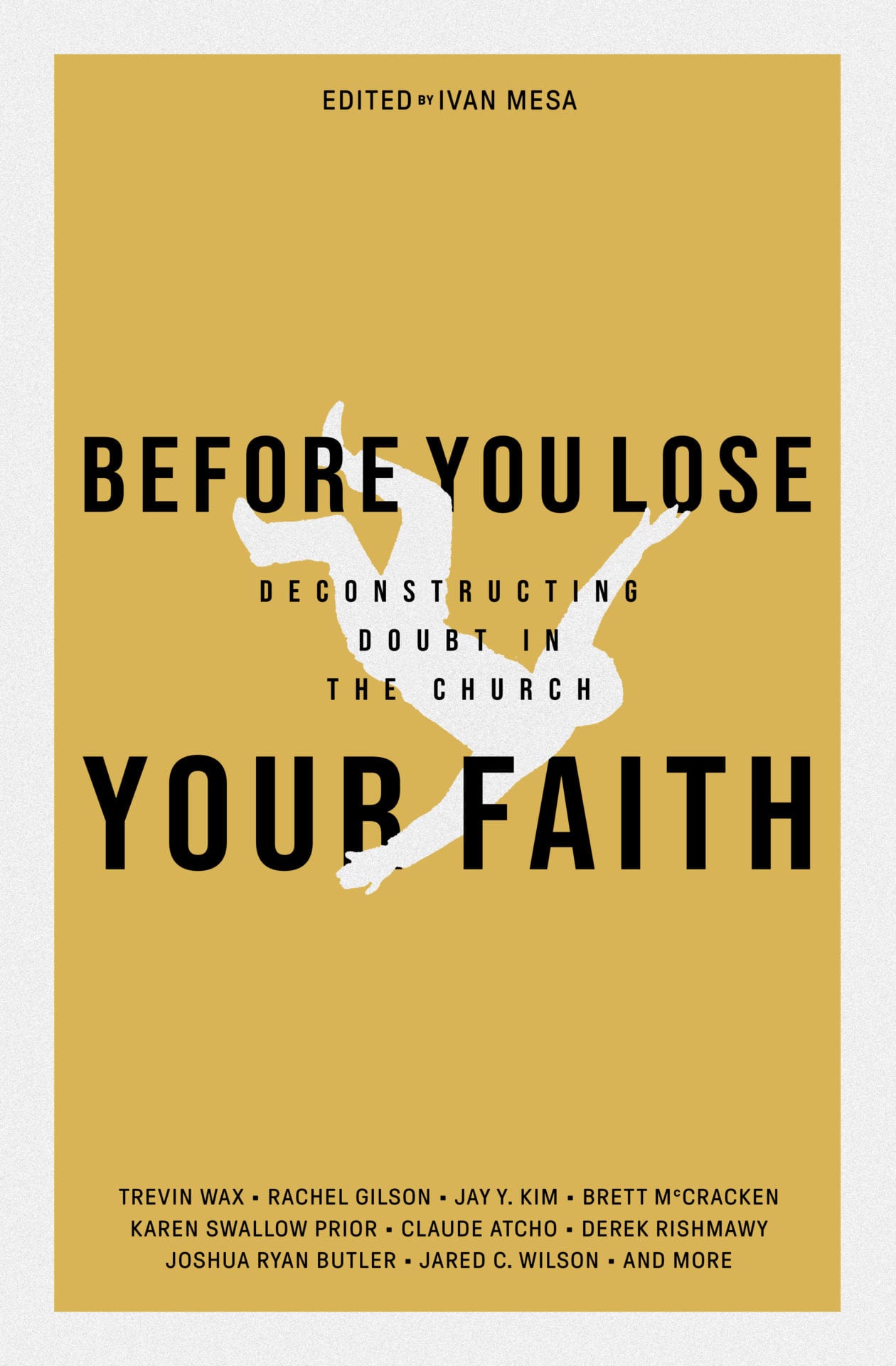 Many young people are walking away from Christianity—for reasons ranging from the church’s stance on sexual morality, to its approach to science and the Bible, to its perceived silence on racial justice.
TGC’s book Before You Lose Your Faith: Deconstructing Doubt in the Church is an infusion of hope, clarity, and wisdom in an age of mounting cynicism toward Christianity.
For anyone entering college or the workplace and looking for a timely reminder of why Christianity is good news in a skeptical age, make sure to get your FREE ebook Before You Lose Your Faith today!