




Young men aren’t doing well. In 2022, among those ages 10 to 24, males accounted for 78 percent of fatal suicide attempts. In 2023, males who graduated from high school were about 8 percent less likely to enroll in college. The labor-force participation rate has dropped around 10 percent for young men ages 20 to 24 in the last 30 years; it has dropped more than 20 percent for the 16–19 age range.
In Notes on Being a Man, Scott Galloway, a popular podcaster and a professor of marketing at NYU, takes this masculinity crisis head-on. He offers an “aspirational vision of masculinity” for those who desire “to be a responsible human flooded with testosterone” (9). As he describes the problem, there’s an entire “generation of young men from all backgrounds who are (a) unbearably lonely, (b) not economically viable, (c) not emotionally viable, and (d) basically adrift” (5).
The book reads like a memoir—Galloway warmly and honestly reflects on his own formative process with gratitude despite heart-wrenching difficulties he was forced to carry even in his early childhood. His candor, shamelessness, and humor make for an engaging, endearing, and easy read. A great deal of wisdom can be gleaned from his vision of masculinity. At the same time, Galloway’s worldview falls far short of the vision of ideal manhood presented in Scripture.
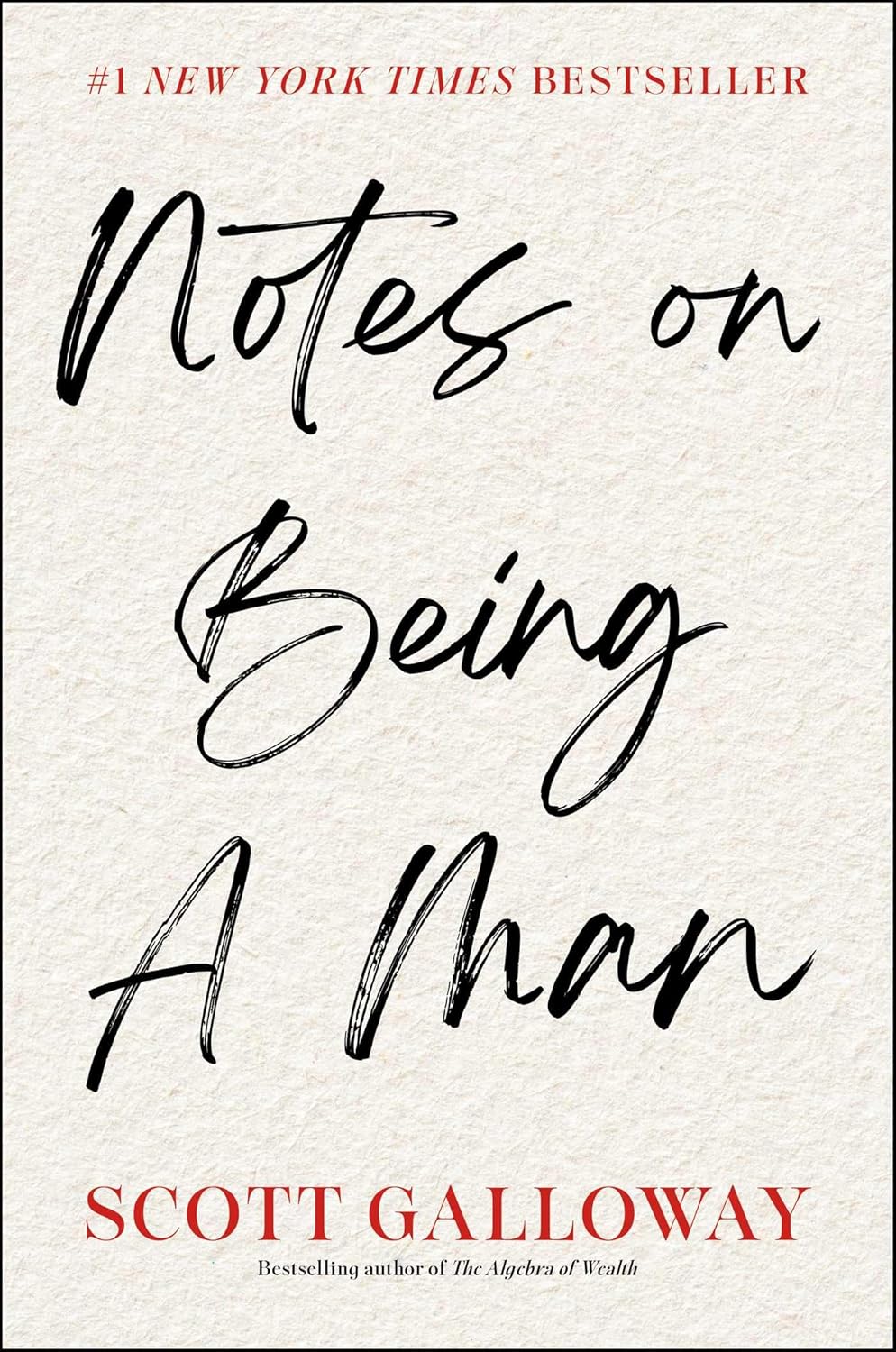
Notes on Being a Man
Scott Galloway
One in seven men reports having no friends, and men account for three of every four deaths of despair in America. Even worse, the lack of attention to these problems has created a vacuum filled by voices espousing misogyny, the demonization of others, and a toxic vision of masculinity. But this is not just a male issue: Women and children can’t flourish if men aren’t doing well. And as we know from spates of violence, there is nothing more dangerous than a lonely, broke young man.
Authentic Wisdom and Generosity
It’s no surprise that guys are attracted to the insight in Notes on Being a Man. In a world of decision paralysis and confused messages about gender, young men are looking for actionable wisdom that helps with their daily issues. Galloway joins figures like Jordan Peterson, Joe Rogan, and Ryan Holiday in his efforts to connect with younger men and empower them to take responsibility for their lives.
Galloway reflects on his life through a lens of gratitude. That allows him to extract proverb-worthy snippets that are shareable, scalable, and practical. His recognition of the problem of dopamine addiction is a great example: “[There are] differences between the feverish, relentless dopa hits [boys] get from TikTok and Instagram versus the slower, incremental results that are more valuable and satisfying from reading, working out, or spending time outside—slow dopa, or ‘Slowpa,’ as I call it” (34).
By pointing out the differences for readers, he’s able to point them toward more fulfilling sources of dopamine.
A main theme in the book is the avoidance of passivity. Galloway quips, “Action absorbs anxiety” (146). That’s good advice for the males of the anxious generation. But it’s more than just a coping mechanism; it’s a recipe for flourishing. He argues, “The ratio of time you spend sweating to watching others sweat is a forward-looking indicator of your success” (72). At its best, this is a secular version of Kevin DeYoung’s Just Do Something.
Galloway has a lot to offer young men looking for tactical help with functioning in the modern economic and romantic environment. And there’s more to his platform than content creation. “I probably get fifteen to twenty people a month asking if I’ll mentor their sons,” he notes. “I say yes, knowing most other men when asked would say no” (234). May the mature men in our churches do likewise.
Murky Moral Pragmatism
Despite his general wisdom and helpfulness, Galloway falls far short of anything resembling Christian ethics. That’s no surprise; he’s an atheist who advocates for an amoral pragmatism throughout the book.
Despite his general wisdom and helpfulness, Galloway falls far short of anything resembling Christian ethics.
For example, although Galloway describes pornography as a “masculinity-killer,” he doesn’t advocate for abstinence (196). Rather, he argues young men should be “purposeful” with their porn use, limiting consumption to 45 minutes per week (192, 128). There’s no real thought in his moral calculus beyond the potential effects on the young man watching porn.
Galloway’s moral relativism seems to rise from his experiences, particularly with his father’s absenteeism and infidelity. He argues, “People believe fidelity is correlated to morality. Maybe. My experience is that it’s inversely correlated to opportunity” (24). When his mother got involved with another man who was already married, it only deepened Galloway’s moral cynicism:
It was a strange realization to have in my forties that when I was a kid, I was in some man’s “other” family. Movies and TV shows are never about the second family and focus instead on the wreckage visited on the first. The knee-jerk response: This is a bad dude. Terry wasn’t. When I heard about his other family, I remember thinking, Life is complicated. (39)
Readers get a front-row seat to his gut-wrenching childhood attempts to make sense of the immorality, deceit, and suffering of adults. It’s quickly evident that without a doctrine of God and sin, all that’s left are coping strategies.
I wish Galloway had better categories for the men who caused so much pain in his early life. They were sinners, not merely complex individuals. Given his moral outlook, it’s no surprise Galloway bailed on his first wife after one botched counseling session. He wanted to live in “Singletown,” where “you can be selfish as hell, do whatever you want whenever you want” (198). Wounds not rightly named can’t be repaired and will inevitably be repeated for generations.
Seek a Better Vision
Galloway is attempting to do something worthwhile. There’s a reason why “manosphere” influencers have become so popular in our culture. Young men must be led, mentored, and offered a compelling vision for masculinity. Androgyny won’t cut it. Though we’re all ontologically equal, Scripture is clear that in some ways, men and women are distinct.
Wounds not rightly named can’t be repaired and will inevitably be repeated for generations.
Yet a godless approach to masculinity—no matter how much it gets right by common grace—can do more harm than good. Trading one counterfeit for another won’t serve the next generation of men well. As the psalmist writes, “How can a young man keep his way pure? By guarding it according to [God’s] word” (Ps. 119:9). Galloway’s advice for young men falls far short.
Nevertheless, this book’s popularity and the cultural conversations about manhood are important signals to Christians. The church needs to be proactive in establishing a robust, biblical vision for manhood. But vision on its own won’t suffice. Churches need to invite young men into a tangible, fraternal community in which they can enjoy one another, be discipled, and grow into God’s authentic design for their manhood. Notes on Being a Man is most useful for helping Christian leaders understand the contours of the cultural conversation on manhood.