
You can read all you want about a place, but until you go there, you won’t be able to understand it in all three dimensions. Pictures can’t do the Grand Canyon justice. Hearing about Yosemite is nothing like being there. Touring the Holy Land affords us a whole new perspective on the places we read about in Scripture.
Several years ago my wife and I visited the Gettysburg battlefield and connected the places to their stories of carnage and valor. My wife wept near a monument dedicated to the soldiers from her home state who died during an arduous, unsuccessful assault. She stood where they once stood and fell by the dozens. Only recently did she learn her great-great-grandfather had fought among them and lost his left arm the next day.
Place matters. We know this in our inmost parts, even if our lifestyles don’t reflect such values. But do we know this biblically? Does God’s Word compel Christians to care about place? That’s the question at the heart of Craig Bartholomew’s book Where Mortals Dwell: A Christian View of Place for Today. He offers readers a tour through the biblical evidence, philosophy, and historical theology to argue that a proper sense of place is central to human flourishing.
Blessing and Curse
Bartholomew—professor of philosophy, religion, and theology at Redeemer University College in Ontario—makes an unfortunate mistake early in the book when he suggests that place contends for the central theme of biblical faith (31). He proves no such thing; nor could anyone else. He does, however, help us recognize the connection between place and redemption. God blessed Adam and Eve by placing them in the garden, displaced them in judgment when they sinned, and promised to replace all who repent and believe in the gospel in the new heavens and new earth. Redemption, then, would be a better candidate as a central theme, with place a primary means by which God expresses his pleasure and displeasure with those who bear his image.
This pattern can be seen most clearly in the Old Testament, which is why Bartholomew’s book is strongest when tracing the place theme here. He suggests the Garden of Eden was not the simple place we make it out to be but an “urban garden,” a potentially complex civilization that might have even included buildings. It was a sanctuary where Adam and Eve enjoyed blessed fellowship with their Creator. But God displaced them when they sinned. The farmer was cursed to struggle with the soil (Gen. 3:17-19). Bartholomew explains how Cain was “condemned to permanent displacement” as a vagrant separated from God and family in return for murdering his brother (33). Yet humans continued to seek sinful autonomy and “make a name for ourselves” by building the tower of Babel, so God displaced them through scattering (Gen. 11:1-9).
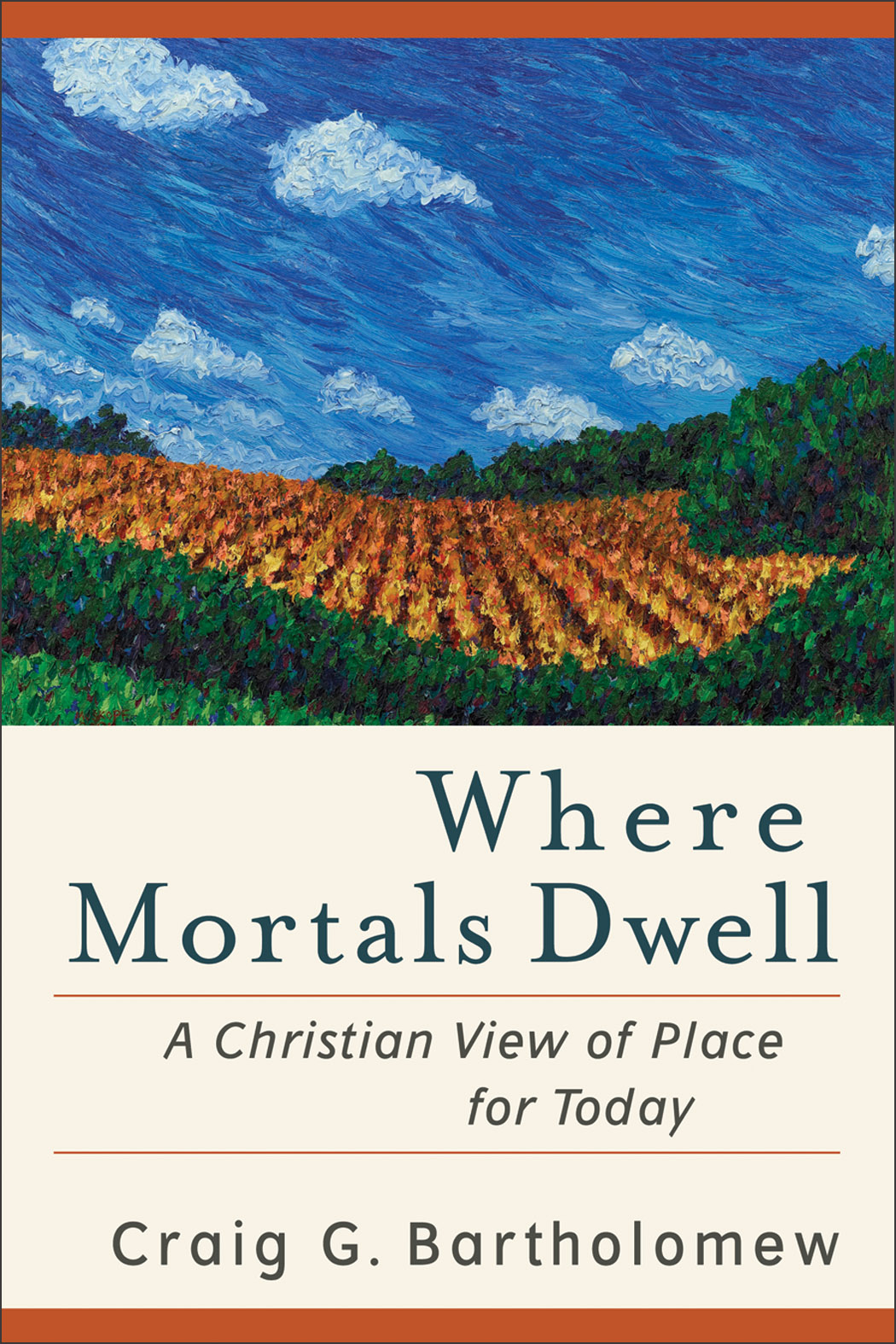
Where Mortals Dwell: A Christian View of Place for Today
Craig G. Bartholomew
Where Mortals Dwell: A Christian View of Place for Today
Craig G. Bartholomew
Place is fundamental to human existence. However, we have lost the very human sense of place in today’s postmodern and globalized world. Craig Bartholomew, a noted Old Testament scholar and the coauthor of two popular texts on the biblical narrative, provides a biblical, theological, and philosophical grounding for place in our rootless culture. He illuminates the importance of place throughout the biblical canon, in the Christian tradition, and in the contours of contemporary thought. Bartholomew encourages readers to recover a sense of place and articulates a hopeful Christian vision of placemaking in today’s world. Anyone interested in place and related environmental themes, including readers of Wendell Berry, will enjoy this compelling book.
The blessing of Israel’s settlement in the Promised Land and subsequent judgment of exile continue this prominent but somehow overlooked biblical theme. Bartholomew faces a stiffer challenge when he arrives at the New Testament. Jesus himself claims to be the temple (John 2:19). No longer will blessing be tied to a particular territory and building where God dwells. In Jesus’ death and resurrection all the nations will be blessed as the apostles take the good news to the ends of the earth (Matt. 28:19). But Bartholomew points out that even in the Old Testament promises of Abraham we see how “particularity (Israel) is always connected with universality (the nations) in God’s purposes of redemption” (45). So in the fullness of time Jesus, the Promised One of Israel, came to a particular place with the purpose of blessing every place. Revelation connects worship of Jesus by “every tribe and language and people and nation” (Rev. 5:9) with the hope of new heavens and a new earth that recall the original place of blessing (Rev. 22:1-5).
From Parochial to Cosmic
Bartholomew’s jaunt through Western philosophical and Christian traditions proves mainly that place is relatively insignificant in abstract thinking. But that’s exactly his point: We’re skeptical of lived experience as an intellectual value. We expect abstraction to give us real knowledge.
“A genuine recovery of place requires a reconfiguration of abstraction in terms of its relationship to everyday experience of the world around us,” Bartholomew writes (183).
Theology, then, might not be the most effective vehicle for compelling Christians to account for place. That makes an ambitious theological work like this one inherently problematic. Bartholomew has done what he can to locate place in the Bible, philosophy, and historical theology, but in the end he borrows from farmer/poet Wendell Berry for application. He touts the virtues of locally grown food, gardening, and birdwatching. He encourages churches to buy land for mixed commercial/community use. These might all be good and godly things, but such suggestions do not evidently flow from Bartholomew’s exegesis and theological development. Again, the Bible seems far more concerned with God’s eternal plan of redemption than with place. Christian theologians throughout history have rightly focused on this primary theme.
However, I still think Bartholomew has touched on something crucially important and sadly neglected in our day. We have forgotten what the biblical writers and Christian theologians assumed. They recognized place is not ultimate, since we must be willing to follow the call of God to go wherever he leads. To be sure, our places can be xenophobic, hostile to God, inhospitable for belief. But places also transmit the wisdom of the ages, teaching us what it means to live in harmony with one another and within the means of God’s good creation. Our places teach us limits, discipline, and patience.
“The best writers on place speak of the need for attentiveness, familiarity, silence, slowness, stability, repetition, particularity, hope, respect, love,” Bartholomew writes. “These are all characteristics and the fruit of Christian spirituality, but rare in our speed-driven, consumerist Western culture” (320).
Extolling the virtues of place necessarily leads us to reassess our places today and wonder whether our lifestyles adorn or inhibit true worship. Does your place help you reflect on God’s provision, beauty, and loving-kindness? Or does it lead to undue attention on your wants and supposed needs?
Bartholomew briefly mentions the Anglican Cathedral of Zanzibar, which was built on a location in Tanzania where slaves were once sold. An altar now stands where slaves were once whipped. Without visiting you can still sense the power of this symbolism. Place matters. You know it when you stand in a place that draws you out of your personal concerns into the cosmic story of God’s redemption.