



Robby Gallaty is a friend of mine and a godly man who loves Jesus and wants others to love Jesus. His passion to help people live out the glorious commission of our Lord is evident in his life and in this book. But friendship aside, I read Growing Up: How to Be a Disciple Who Makes Disciples as a pastor looking for a good resource to challenge me and those I’m discipling. In fact, I read it with a few guys from my church (Tim, Dan, Luis) and spent an early Friday morning talking through things we liked about the book as well as things we felt were lacking.
We all agreed Gallaty’s personal touch and well-illustrated writing make for an easy read. Growing Up is a resource accessible for just about anyone, and each of us read it in a few days. It’s organized in two sections. The first four chapters lay out our Lord’s call to be disciples who make disciples. These chapters highlight Gallaty’s personal transformation through discipleship, his recommendation to be in a discipleship group (a.k.a. “D-Group,” three to five people committed to 12 to 18 months of weekly discipling meetings), and the call to train ourselves for godliness in the context of discipleship relationships.
The remaining six chapters give practical prescriptions that should mark the lives of growing disciples. These chapters follow the acrostic C.L.O.S.E.R., each letter representing a spiritual discipline that helps develop a closer walk with Jesus.
Things We Liked
There are several things my reading group and I appreciated about the book.
This book is for everyone.
Gallaty, pastor of Brainerd Baptist Church in Chattanooga, Tennessee, rightly highlights that everyone who follows Christ should be actively involved in helping others follow Christ. His shepherd’s heart is evident as he addresses struggles people from various backgrounds might face.
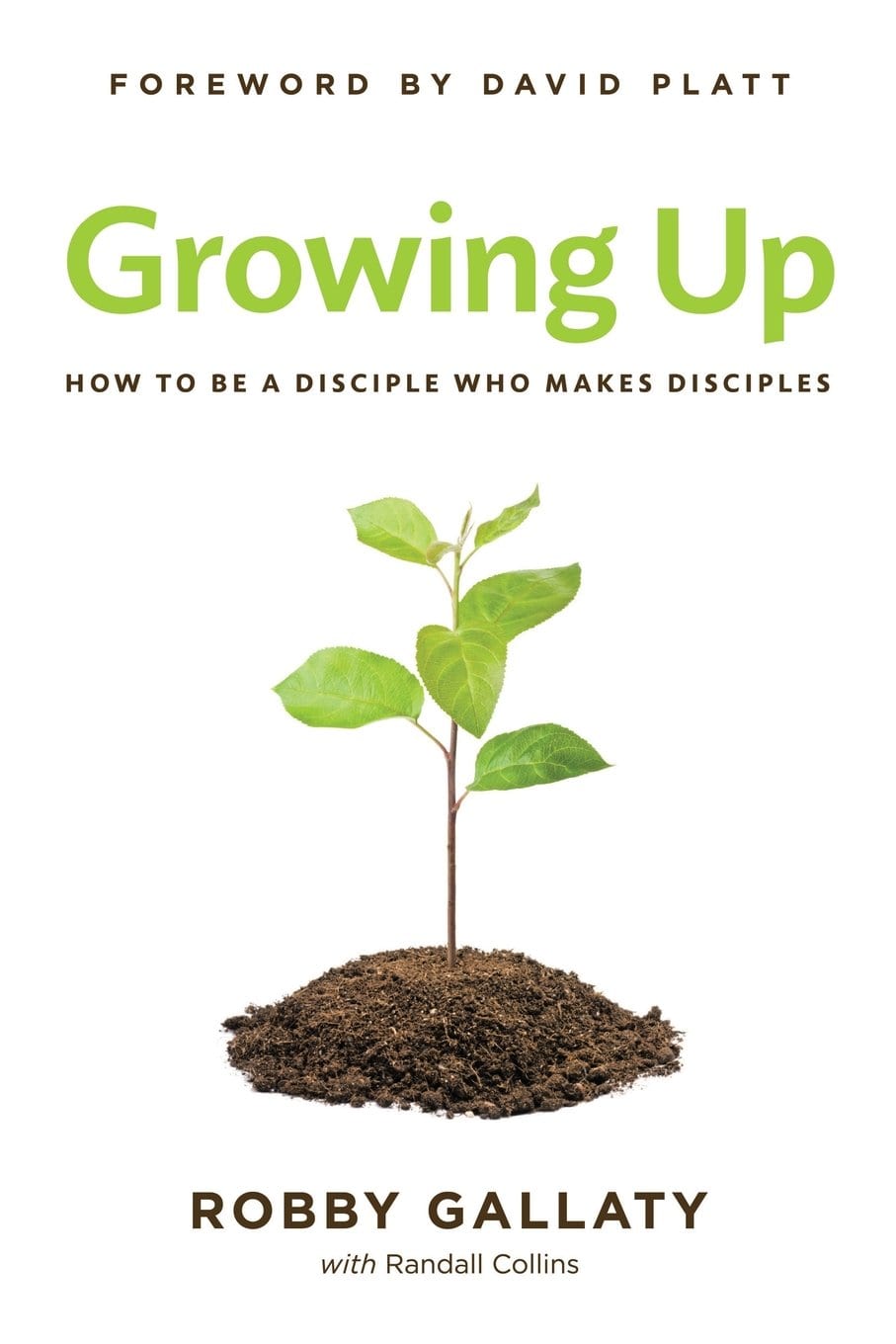
Growing Up: How to Be a Disciple Who Makes Disciples
Robby Gallaty
Whether you’re a seasoned pastor, new believer, stay-at-home mom, or someone who sees no way you can be used by God, this book is written to help you be a more faithful disciple. Gallaty rightly says no one has it all together and that anyone willing can be used by the Lord to carry out the Great Commission.
Don’t you dare just read this book.
This book is not designed to be read and put on the shelf. Gallaty reminded our group of a personal trainer who, with each turn of the page, told us the pages were to be read, engaged with, and implemented. The reader is exhorted to take notes, memorize key verses, and wrestle with thought-provoking questions stationed throughout the book. Tim said Gallaty’s writing was “no intellectual exercise, but more of a kick in the pants.”
We appreciated that the book compelled us to respond with obedience to Jesus. One of the guys already had someone in mind with whom he wanted to go through the book in hopes of helping him become a more faithful disciple of Christ.
Let’s get practical.
It’s common for people to struggle with the “how to” of discipling. Many of us feel overwhelmed with not knowing how to help others grow deeper in their relationship with Jesus. If you wonder How do I do discipleship? this book will leave you with answers.
Gallaty shows himself to be an instructor and prescriber of practical ideas. From cover to cover he gives concrete advice on how to form a discipleship group, ways to keep members accountable, suggestions for Bible reading strategies, challenges to be prayerful, and a slew of resources to use in discipling relationships.
The call to discipleship is needed.
Above all, we felt the call to be active in Great Commission ministry is a bell that needs to be rung again and again. We agree with Gallaty that many churches have sadly become complacent in Christ’s call to be disciple-making disciples.
Each of the guys said chapter seven, “Obey: Follow the Leader,” was the one that affected them most. There Gallaty emphasizes the need to follow Christ and “love him supremely, above everyone and everything else” (106). This book brings the Great Commission to the forefront of importance for the church at large—and there’s no way that emphasis can be bad.
Things Lacking
There were also a few things our group felt that Growing Up lacked.
Can we look up more?
In Gallaty’s attempts to be practical, we were sometimes left with a feeling of us-centeredness. His aim was to be concrete and hands-on, which is great, but this approach would have only been enhanced by helping us marvel at our Master more throughout the book. Discipling is chiefly a pursuit of helping each other delight in and glorify God, but we didn’t feel our affections for Jesus were stirred as much as we desired them to be.
A new set of standards to keep?
One of the drawbacks to Gallaty’s practical approach is that at times he seems to overprescribe what we must do. In the opening pages, for example, he says that for a discipling meeting “to fulfill its purpose and be profitable, each meeting must be focused on the disciple-building activities discussed throughout this book” (xxiii). While the plan in Growing Up is good, we all agreed it was overreaching to suggest it’s the only way to really be faithful to the Great Commission.
We also disagreed with the book’s rejection of one-on-one meetings (48–50), particularly since we felt the case was built on an argument from silence. In our church there are a variety of group sizes, and we’ve found pros and cons in each. As a group of four we found benefit in that size of group, but we thought the book overstated its case when it referred to a group approach as “the Master’s model.”
In light of these examples, I think the book would have benefited from a section stating that our righteousness is rooted fully in Christ’s work. We aren’t accepted by God because of our performance or our adherence to the good suggestions of Growing Up.
Where’s the church?
A conspicuous absence was an emphasis on the discipling that happens in the local church. Though Gallaty loves the local church, Growing Up seems to assume people understand the church’s importance. “D-Groups” can be a wonderful model of discipling, no doubt, but they should be submitted to the discipling of the congregation as a whole. When the church gathers on the Lord’s Day they are being discipled as a community through the prayers, Scripture reading, preaching, and singing. This corporate discipleship fuels and sustains the members as they scatter, including in their D-Groups.
“I really don’t believe much discipling is done through preaching,” Gallaty quotes Avery Willis as saying. “Discipleship is more relational, more one on one” (25). Gallaty goes on to clarify he isn’t minimizing preaching, but I do think he sells the discipleship of Sunday gatherings short. We fully agree “preaching alone will not produce disciples,” but the feel of Growing Up is that discipleship could happen without the church—which would ultimately shortcircuit the good things Gallaty teaches us in the book. For example, he teaches complete confidentiality within D-Groups (41). While we certainly want to create a culture of mutual honor and trust, a confidentiality policy could ultimately undermine Jesus’ instructions in Matthew 18:17 to “tell it to the church” if a member persists in unrepentant sin. The “church” in that text is not a D-Group, but the gathered congregation. Confidentiality in a D-Group, then, must be held in submission to the good of the church as a whole. This shortcoming could have been helped by a chapter or section about building cultures of discipleship in which groups gather to help one another live out what the congregation as a whole is learning.
Bottom Line? Thumbs Up
Books aren’t meant to be read and accepted; they’re meant to be interacted with. We had a lively discussion I trust will bear good fruit in all of our discipling relationships. Each of us gave the “thumbs up” to recommend Growing Up as a resource to people who want to learn more about discipleship and who need practical ideas about helping others grow up into spiritual maturity. Anyone who reads the book might consider the above critiques we hope will be addressed in a future edition or in one of the forthcoming books in this series.
We leave you with the opening line of the book: “The gospel came to you because it was going to someone else.” Go, therefore, and make disciples!
Editors’ note: This review originally appeared at 9Marks.