France’s spiritual landscape looks like the secular, post-Christian desert many American Christians hope to avoid. Secularism has a long history in France, from its Enlightenment philosophes, to the efforts by French revolutionaries to loot and rename Notre Dame, to the recent efforts to ban traditional Muslim outfits. The homeland of Sartre and Foucault seems like an unlikely source for a 500-page apologetics book that sold nearly half a million copies before being translated into English.
That surprising book is God, the Science, and the Evidence: The Dawn of a Revolution. The authors, Michel-Yves Bolloré and Olivier Bonnassies, both have advanced scientific and business training. Their experience and education are equivalent to Silicon Valley executives with Ivy League degrees. This tome is the product of the Roman Catholic devotion of two highly trained computer scientists.
The book defends two complementary theses: (1) Christianity is supported by the sciences and reason in general, and (2) secular materialism requires blind faith. From the vantage point of English-speaking apologetics, not much is new. The authors’ scientific backgrounds allow them to provide novel, evidence-heavy presentations of these arguments; however, a few errors and apologetic choices weaken the book’s overall value.
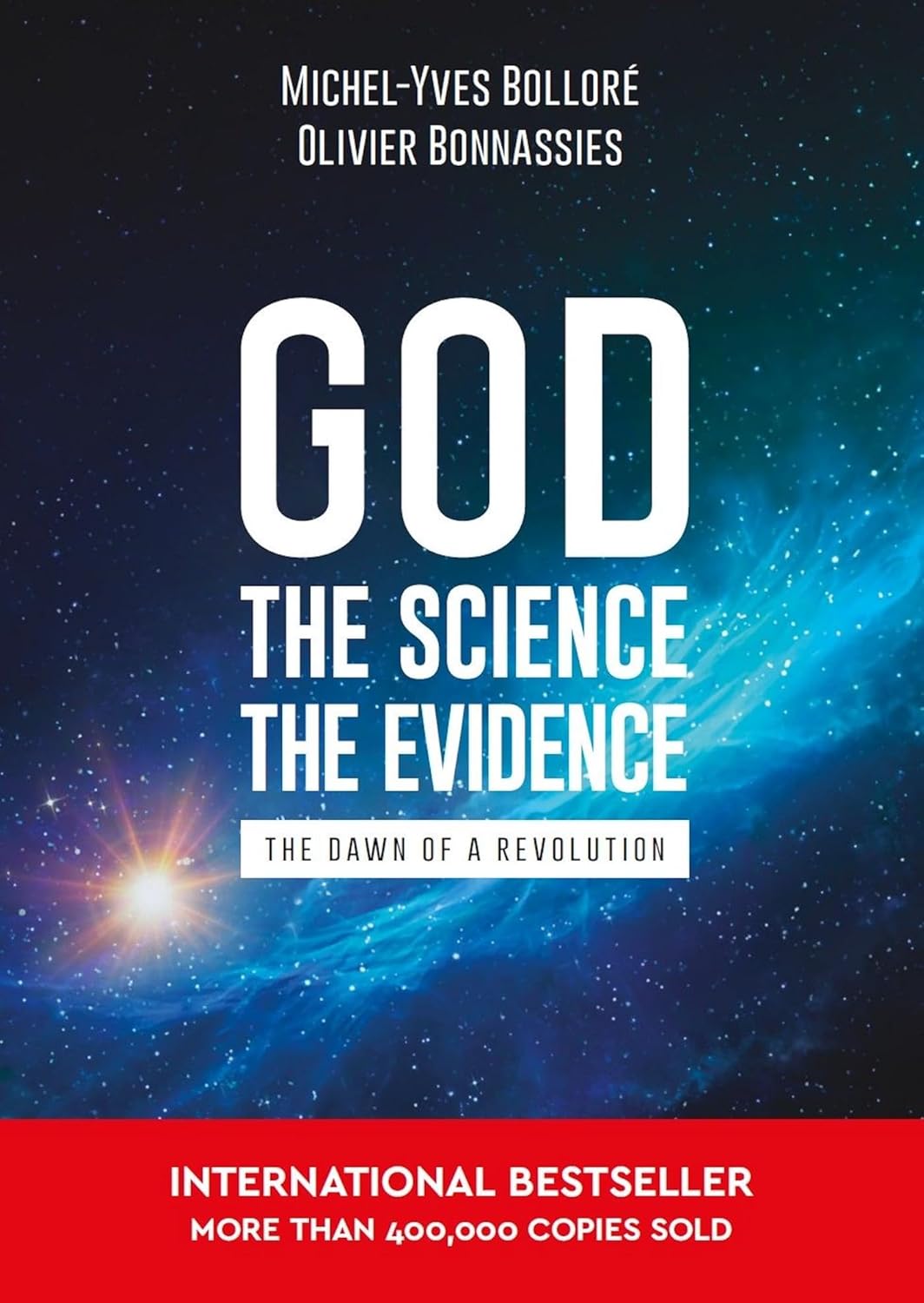
God: The Science and the Evidence
Michel-Yves Bollere and Olivier Bonnassies
God: The Science and the Evidence
Michel-Yves Bollere and Olivier Bonnassies
After four years of research in partnership with more than twenty scientists and esteemed experts, this book explores one of the most significant questions we face: the existence or non-existence of a creator God.
The authors of this highly readable book retrace the fascinating history of these scientific breakthroughs and offer a rigorous overview of the new proof of the existence of God. God, the Science, and the Evidence is an invitation to reflect and debate the place of God in science.
Narrative of Scientific Discovery
Bolloré and Bonnassies employ common apologetic tools, like the Kalam cosmological argument and the argument from fine-tuning. Yet it’s their storytelling that sets the book apart. When the Kalam argument is normally offered, it’s presented in a cold, logical form: Anything that has a beginning has a cause; the universe has a beginning; therefore, it has a cause.
Instead of this concise but colorless presentation, Bolloré and Bonnassies build momentum around the universe’s beginning by tracing the history of discovery. Concerning the importance of the redshift, they write,
Hubble’s observation so strongly confirmed the theory of universal expansion that within just a few years it led to a complete reversal of the scientific consensus. In order to convince himself, Einstein traveled to Mount Wilson in 1931, where he spoke with Edwin Hubble. He emerged defeated and confessed that introducing the cosmological constant into his calculations because of his philosophical preconceptions was “the biggest blunder he had made in his entire life.”
Though the expansion of the universe became the consensus view, the authors note that it didn’t “lead to an immediate consensus as to how it began, even though ‘rewinding’ the history of the Universe is all it takes to show that the Big Bang is a logical necessity” (90).
That logical conclusion leads eventually toward theism’s inevitability. It’s only after stacking up dozens, if not hundreds, of quotes and anecdotes from top scientists that they point to the conclusion that God exists. The sheer volume of examples adds up to an overwhelming force of evidence. Nevertheless, the faith commitments of secular materialism ironically resist scientific evidence both then and now.
Beyond Mere Christianity
Many arguments in the book fit within standard evangelical categories. For example, the authors discuss Scripture’s reliability and C. S. Lewis’s trilemma argument. But some arguments will raise Protestants’ eyebrows.
It’s only after stacking up dozens, if not hundreds, of quotes and anecdotes from top scientists that they point to the conclusion that God exists.
As evidence of modern miracles, they proffer the 1917 appearance of the Virgin Mary in Fátima, Portugal. The authors persuasively argue by directly quoting contemporaneous periodicals and eyewitness reports that some kind of visual display occurred.
Many Protestants will be skeptical about the Mariology implied by the events at Fátima. Nevertheless, Scripture consistently demonstrates that God doesn’t hold a monopoly on supernatural events (e.g., Ex. 7:10–12; Acts 16:16–21). Thankfully, Bolloré and Bonnassies have enough argumentative discipline to allow readers to believe this is demonic.
“As the existence of the devil presumes that of God,” they write, “the question at the heart of the present book would be resolved by the simple acceptance of that possibility” (450n626). They’re correct that anyone who accepts that this event was a genuine product of spiritual intervention—good or evil—has surrendered materialism.
Despite this relatively open-minded argument, it’s striking that in a book that emphasizes both scientific and philosophical arguments, including two chapters on the Bible’s truthfulness, there’s no defense of the miracle of the resurrection. That truth of first importance to the gospel is strangely absent in a volume with an extensive defense of an event focused on a peculiarly Roman Catholic dogma.
Imperfect Arguments
The rigor of the scientific detail in this volume makes it best suited for readers well-versed in science or mathematics. However, that detail also creates a trap for the book because those same readers are more likely to catch the handful of errors.
For example, early in the book, in preparing their argumentative strategy, they write, “Since the two theories [theism vs. atheism] are mutually exclusive, disproving one would validate the other” (53). I sense they’re attempting to use disjunctive syllogism to argue as follows: Either theism or atheism is true; atheism is false; so, theism is true.
It’s striking that in a book that emphasizes both scientific and philosophical arguments, there’s no defense of the miracle of the resurrection.
They’re right that atheism and theism are mutually exclusive. Yet mutual exclusivity isn’t required to use disjunctive syllogism. Furthermore, atheism and theism aren’t the only logical possibilities. These two options fail to canvass the entire logical map.
This narrowing of options is also a major complaint against another French Catholic’s famous wager. This approach can only work if the audience already accepts that the only (serious) options are theism or atheism, but not due to their mutual exclusivity.
Another technical error arises when they say—unfortunately, quoting a mathematician—that Kurt Gödel’s incompleteness theorems apply to any mathematical system. Gödel’s results only apply to systems powerful enough to describe themselves, of which there are exceptions. These slips aren’t fatal, but they could alienate the target audience.
The secular tide in France is ebbing. In August, French newspaper Le Monde (comparable to The New York Times) reported the growth of evangelical Christianity by conversions. The Catholic Church has also seen rising conversions from faithlessness. The Economist reported more than 10,000 adult baptisms on Easter 2025––up 46 percent from the previous year. Despite its flaws, God, the Science, and the Evidence makes many solid arguments that point readers toward a robust theism.