





There is something about social media that convinces everyone they’re an expert on everything . . . and that everyone else is waiting to hear their opinion. The platforms train us in this direction before we’ve even said a word.
“What’s on your mind?”
“What’s happening?”
Then our algorithm-determined feeds deliver the news, controversies, and outrageous statements most likely to provoke a reaction or keep us scrolling.
None of this is news, of course. But in an era when nearly everyone feels the obligation to weigh in on nearly everything—to register concern about the newest scandal, declare allegiance in the latest political tussle, or signal proper outrage over whatever tragedy or injustice now renders us all responsible to have a well-formed opinion—I’m increasingly grateful for artists and authors, singers and songwriters, who know their lane and stay in it.
Pressure to Comment on Everything
Over the past decade, I’ve watched writers, singers, and performers whose artistic work I admire start offering commentary on every cultural flash point. Some of it leans right. Some of it leans left. In almost every case, even when I happen to agree with the substance of their Twitter rant or Instagram post, I wince.
I want to say to a songwriter whose music has sustained me, or an author whose words have steadied my faith: No one is asking for your thoughts on this year’s election cycle. No one expects you to be an expert on geopolitical issues. No one is better off when you try to prove that you belong to the right political tribe. We come to you for beauty. We look to you to lift us out of the churn of the moment, not to mirror back all the anxieties and polarizations that already exhaust us.
I’m not saying artists should disengage from the world’s pain or retreat into a hermetically sealed aesthetic bubble. My plea is for faithfulness to vocation. Beauty shapes us in ways argument rarely does, and art performs a kind of moral and spiritual formation that cannot be replicated by commentary.
Beauty Pulls Us Up
In the foreword to Winfield Bevins’s book How Beauty Will Save the World: Recovering the Power of the Arts for the Christian Life, we find a striking description of beauty’s formative power:
The ideal outcome of an encounter with beauty through art is that one will want to become a beautiful human being, like Christ himself. Art serves in this case as both a model of beauty and a stimulus to beauty. When we encounter true beauty, we encounter it as a kind of epiphany that pulls us in to the object of beauty, pulls us up toward the Source of beauty, pulls us outside of ourselves, and finally pulls us out toward others.
That description stands in sharp contrast to the mechanics of online discourse. Beauty doesn’t demand an immediate reaction. It invites attention, patience, and contemplation. Beauty works under the surface, forming affections more than marshaling arguments, shaping our aspirations more than sharpening our opinions.
Preserving Space for Beauty-Making
Many of today’s artists feel an enormous pressure to “say something” and weigh in online on every passing controversy. Part of that drive comes from the feeling that our culture is unraveling. We sense that things are coming apart, and we assume that by staking out a position we might help hold the fragments together.
Sometimes this impulse arises from genuine lament. Sometimes from fear. Sometimes from the desire to reassure the people whose approval matters most to us that we’re still on the right side.
But the world is already exhausting enough. And that’s why I’m especially thankful for artists, musicians, and writers who resist the pull to turn their social media accounts into a running commentary and instead devote their energies to making something beautiful. To make something of beauty, we must reserve space for deeper reflection, a depth that generates artifacts graced by goodness and truth.
Artists who fulfill this vocation won’t dash off opinions as public signals of belonging because they’re too busy laboring over songs, stories, and works of art that will endure beyond the current cycle of outrage.
Yes, there may be moments when an artist might lend their voice to a cause especially close to their heart, and that still seems fitting. But today there’s no shortage of causes, no scarcity of commentary, and no end to the expectation that public figures must continually signal where they stand.
Social media has collapsed the distance between artists and audiences, and that proximity can be a gift. But when it enables politics to encroach on every sphere of life, something essential is diminished. The mystique of the artist evaporates. The space reserved for beauty narrows. The hope of preserving a realm devoted simply to making something good and true, apart from constant ideological signaling, begins to slip away.
Tending Little Fires
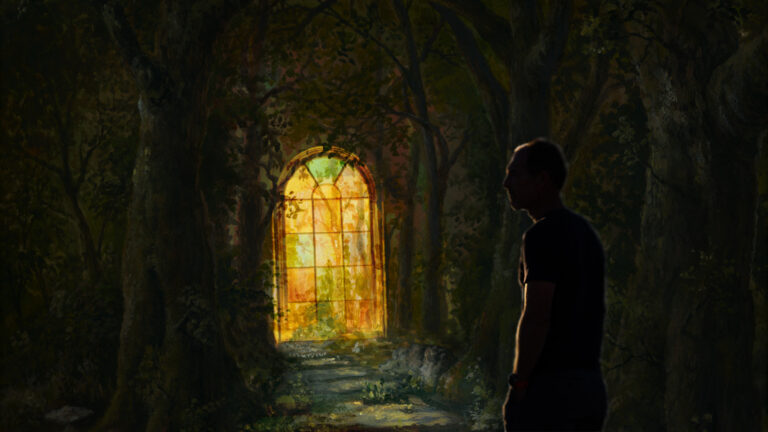
What we need most from the artistic community is precisely what they’re most equipped to offer: creativity, not commentary. Art opens up space and sharpens our vision, reflecting the cracked iconography of humanity while pointing toward wholeness. We need art that acknowledges the groaning of creation yet holds out the hope of restoration secured not by short-term cultural victories but by Christ.
Paul Kingsnorth, near the end of his provocative book Against the Machine, encourages us toward a vision that stands apart from the never-ending torrent of words online. He calls us to build new things out in the margins. To resist exhausting our souls in the heightened battles of every controversy and instead “to prepare the seedbed for what might, one day long after us, become the basis of a new culture.”
One doesn’t have to agree with all of Kingsnorth’s jeremiad against contemporary culture to see the beauty in his admonition to light “particular little fires—fires fueled by eternal things, the great and unchanging truths—and tend their sparks as best we can.”
That is my plea.
We need artists who will tend those small fires. Who offer light rather than heat. Who know their lane. Who can preserve a hearth that diminishes despair, a fire dedicated to warmth and renewal. In an age addicted to commentary, the refusal to utter the hot take may be one of the most countercultural—and most necessary—acts of creative courage an artist can perform.
If you would like my future articles sent to your email, as well as a curated list of books, podcasts, and helpful links I find online, enter your address.