




Now firmly planted in midlife, I find myself in frequent conversations with friends and colleagues five to ten years younger than me who are encountering new challenges around their calling and ambitions.
In the exciting years of early adulthood, your trajectory can feel like it’s up and to the right—a degree, a new job, a promotion, a new opportunity. Life seems ever-expanding in those early years of work, marriage, and child-rearing.
But at the outset of midlife, the arc begins to bend. The possibilities shrink. There’s a simmering uneasiness, an angst at feeling hemmed in by the decisions that have brought you to this point. Limitations show up, closing in on you, causing your early ambitions and aspirations in your career or ministry to bump up against the ceiling of reality.
And now you feel stuck.
Stuck in a job that once suited your skills, with responsibilities you’ve outgrown.
Stuck with fewer opportunities to move up, to make more, to find more fulfillment, to deploy all the gifts and talents you want to offer.
Stuck with the wear and tear of a marriage finishing its second decade or entering its third, with no clear path for maintaining or reestablishing the close connection you had at first.
Stuck with newly felt obligations toward aging parents, wondering how best to honor your father and mother while being a father or mother worthy of honor to your kids who are growing up fast.
People in this season often wish they could escape their current situation and find the new job, or new city, or new church that might bring fresh resolution to present frustration, but they realize every new opportunity might upend life for the whole family.
There’s also a spiritual conundrum here. Where’s the line between God-given ambition and wounded pride? When is discontentment rooted in self-pity and lack of gratitude, and when is discontentment righteous, a sacred cry of the heart to do more for Jesus and his kingdom? How do you cultivate the kind of holy aspiration that resembles the Old Testament character of Caleb (who asked for a mountain!), and how do you simultaneously find contentment in Christ as you submit to the Lord’s wise providence, no matter the circumstance? How does the divine discontent of wanting to be stretched exist alongside the divine contentment of appreciating your lot in life, finding the boundary lines pleasant even when they feel confining?
There are no easy answers. After a few years of this season of restlessness, the spiritual toll can be significant. Weariness sets in because no change is on the horizon. Day-to-day labors become routine, and frustration abounds. It takes energy to muster the passion you once felt for your work, and that effort only adds to the burden and boredom.
Noonday Demon
The peril for anyone in this situation is acedia. Acedia is a weariness of soul—a spirit of apathy—that leads to detachment from life, even when we remain engaged in regular activities. In the Christian tradition, it’s the forerunner to sloth, one of the seven deadly sins.
Acedia may begin with being tired of day-to-day work, but it manifests most acutely when we grow tired in our souls. We’re weary because everything is wearying. As it persists, we turn away from the summons and reality of divine love. We lose our grip on a higher meaning and purpose for our work. We turn inward—too tired to love, to even want to love.
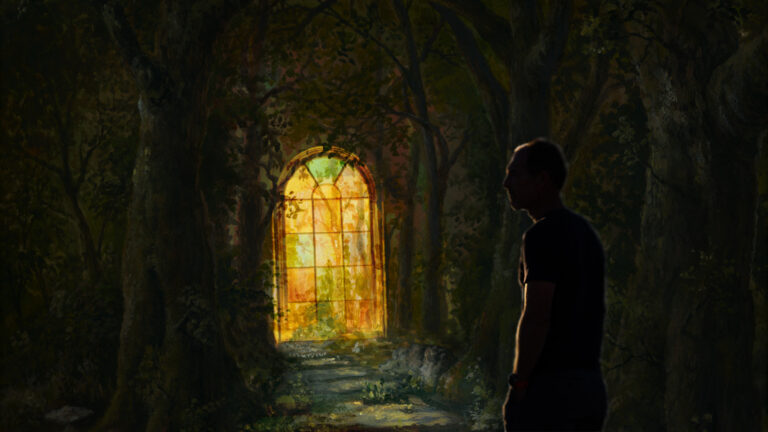
The monastics called this “the noonday demon.” Imagine yourself in a desert monastery, most of your time spent in solitude. Midday is when the sun is highest and brightest, sending temperatures soaring toward suffocation, with shade as the only escape from the heat. All that can be done is the usual routine of working with your hands and praying the Psalms. This withering experience, day after day, led many a monk to reconsider his life choices, to wonder about fruitful avenues now foreclosed, and to worry his gifts and talents were wasted in such a wasteland.
The arc of midlife is perfect for the noonday demon’s tricks. When we reach this life stage, we don’t succumb to a haze of thoughtlessness. On the contrary, our minds go spinning, filled with thoughts—some unwelcome. We daydream about life in a different city. We fantasize about a better church. We keep checking to see if the perfect job (or just a better job, something different) might open up.
The noonday demon would have us smile at fantasy and frown at reality. Because that’s when we become impatient, resentful, and frustrated. Oozing from us is an attitude of discontentment. Bitterness seeps into other areas of life: an impatience toward your spouse, a harshness toward your kids, an envy toward a colleague, a suspicion toward your supervisors. Wounded pride feeds the fear that no one properly appreciates your contributions.
Self-Sabotage and Self-Diminishment
I’ve seen a number of people fall under the sway of the noonday demon, only to sabotage themselves—either by making impulsive decisions that call into question their character and wisdom, or by growing so cynical and resentful they harm their prospects at being hired anywhere else.
For others, it’s not self-sabotage but self-diminishment. The talons of acedia grip the heart, and spiritual anemia robs them of the energy required for love. They put up walls around the heart. They shrug (whatever!) at the people they work with. They lose any passion for loving those entrusted to their care. They no longer care about either learning contentment in every situation or leaning into holy discontent when they sense the Lord is calling them to something more. They settle for a lovelessness that leaves them less themselves.
Avoiding the Noonday Demon
How can we avoid self-sabotage and self-diminishment?
First, remember we’re Christians, not Stoics. We don’t stuff the hurts and disappointments deep down inside, as if they don’t matter. This fallen world groans. So do we. The ache is real. We do ourselves no favors by denying pain or minimizing its effects on our spirit.
Second, be aware of the traps. All around us are opportunities designed to lessen the discomfort of this season. Some people are drawn to the thrill of new adventure, leading to rash decisions and the typical midlife crisis, with unwise or sinful choices that leave lasting repercussions. More than a few respond by hopping from job to job, never reckoning with the reality that thorns and thistles show up everywhere. The grass may seem greener (and sometimes it is!), but there are always weeds you cannot see, and sometimes it’s best to stick with the thorns you know instead of being surprised by a hidden briar patch.
Others seek satisfaction in the anesthetic of the endless scroll, or gravitate toward friends who reinforce the self-pitying spirit rather than challenge it. The path is littered with diversions and distractions that inhibit our ability to grow into Christlikeness during this season.
Third, keep resentment at bay by pressing deeper into your pain, convinced the Lord has something to teach you about himself and yourself in the weariness of noonday.
Andrew Peterson recounts a lengthy period of depression that left him in despair before a concert at a church in North Carolina, unsure he could go on. Seeing the door to a janitor’s closet open, he slipped in to collect himself. As he poured out his sorrows to the Lord and cried for help, someone walked by and slammed the door, leaving him in the dark. The story may be funny now, Peterson says, but in the moment, it felt like the Lord had answered him not by lifting him out of the pit but by pressing him down further in the mud.
Later in life, Peterson was able to reframe that experience through his song “The Rain Keeps Falling”:
My daughter and I put the seeds in the dirt
And every day now we’ve been watching the earth
For a sign that this death will give way to a birth
And the rain keeps falling
Down on the soil where the sorrow is laid
And the secret of life is igniting the grave
And I’m dying to live but I’m learning to wait
And the rain is falling . . .
When we feel like we’re at rock bottom, stuck in a tomb and we can’t move the stone, we may be surprised to feel the Lord’s thumb pressing us further into the mud. But it’s not that he doesn’t care. It’s not that he’s cruel. Only by pressing us deeper into the soil can new life emerge. And the rain that won’t stop—the circumstances that cast a dreary pall over the world—is what waters the seed so it can grow. There is beauty that can only sprout from the soil of deep sorrow.
Finally, start to see waiting as a way of learning to more fully manifest patience, a fruit of the Spirit. Maybe your sphere of influence isn’t as big as you’d hoped, your salary not as high as you expected, your gifts and talents not deployed as effectively as you dreamed. The wait for something new doesn’t have to be frustrating. It can slow you down to take in the opportunities around you. As Jen Wilkin says in her new book on aging, “Shrinking possibilities bring expanding clarity. They enable us to become thoughtful curators instead of thoughtless consumers of the days on our calendars.”
Today’s limitations aren’t walls meant to hem you in; they’re the set and scenery—the backdrop—for you to take the stage and step into your role as a lover of God and a lover of people. Stop squinting as you look up to curse the noonday sun, and start seeing—look around at the sunlight falling on the people God has put in your life to love.
Lessons of Midlife
The noonday demon wins whenever we fight boredom with fantasies or whenever we slide into an unhealthy nostalgia. Acedia removes us from reality, taking us out of the realm of responsibility where we have the most to learn and the most to offer. The noonday demon that haunts the middle years wants you to either panic and overreact (to be impulsive and unwise) or to stop feeling altogether (to answer the dullness in your current circumstances with a dull heart and dulled emotions).
If this season of suffering feels like a hot afternoon with no end in sight, take heart. The sun will move. The world will spin. It could be an unimaginable blessing that brings this season of sorrow to a close. It could also be unspeakable suffering that rocks your world and shakes you out of your slumber. Something will break through the haze of noonday. When that time comes, will you have learned the lessons only the desert can teach you?
If you would like my future articles sent to your email, as well as a curated list of books, podcasts, and helpful links I find online, enter your address.